7 Best Alternatives to Asana for macOS in 2026
By Noahlast updated pricing verified
Compared: Asana alternatives that run on macOS
| Alternative | Best for | Standout | Biggest weakness | Learning curve | Price |
|---|---|---|---|---|---|
| Asanareference | Cross-functional teams of 10-500 people who need shared timelines, dependencies, and status reporting across multiple concurrent projects. | The Work Graph: a connected data model linking goals, portfolios, projects, and tasks that now also assigns work to AI Teammates alongside human assignees. | Asana's task-based model gets expensive and administratively heavy at scale: seat-based pricing jumps from $10.99 to $24.99/user/month just to unlock Goals and Workload, and features like SSO or capacity planning require Enterprise, which is quote-only. | Moderate | Free tier · paid from $10.99/mo |
| monday.com | Mid-size teams that want one configurable platform to run project tracking, CRM, and IT/HR workflows on visual boards instead of stitching together separate point tools. | Highly customizable boards with dozens of column types, automations, and dashboards that adapt to almost any workflow (projects, sales, hiring, IT tickets) without custom development. | Per-seat pricing is billed in blocks (plans are sold for minimum team sizes like 3 seats), and the sticker price jumps once you add real automation or integration volume: Standard caps at 250 automation actions/month while Pro jumps to 25,000, forcing many growing teams to upgrade a full tier just for usage limits rather than features. | Moderate | Free tier · paid from $9/mo |
| Trello | Small teams and individuals who want a simple kanban board to track to-dos without adopting a full project-management framework | Butler automation lets users create no-code rules, buttons, and scheduled commands directly on a board without any add-ons | Trello's card-and-list model gets unwieldy for complex projects with dependencies, multi-step workflows, or heavy reporting needs; teams that outgrow simple kanban often have to bolt on Power-Ups or switch to a tool like Jira or Asana, and the free plan caps workspaces at 10 boards. | Low | Free tier · paid from $5/mo |
| ClickUp | small and mid-sized teams that want tasks, docs, chat, and time tracking on one paid seat instead of buying a tracker, a wiki, a chat app, and a timesheet tool separately | A free plan with genuinely unlimited tasks and unlimited members — including Kanban boards, sprints, docs, calendar view, and in-app video recording — where most competitors cap the free tier by seat count. | ClickUp's all-in-one pitch stacks costs rather than replacing them: a Business seat with the full Everything AI add-on is $12 + $28 = $40/user/month billed yearly, before AI Super Credit overages at $10 per 10,000 credits. The Free Forever plan's 60MB total file storage also collapses the moment a team attaches anything larger than screenshots, and billing is per Workspace with the entire Workspace forced to upgrade together — you cannot put one team on a paid plan. | Steep | Free tier · paid from $7/mo |
| Wrike | cross-functional teams (marketing, product, professional services, IT) that need shared project visibility across departments, not just a single team's task list | Interactive Gantt charts and shareable dashboards are available starting on the $10/user/month Team plan, giving cross-team visibility without requiring the top-tier Business or custom plans that gate this on some competitors. | The two highest tiers, Pinnacle and Apex, require contacting sales with no published pricing, and advanced resource/capacity planning and budgeting tools that larger teams often need are locked behind those custom-priced plans. | Moderate | Free tier · paid from $10/mo |
| Basecamp | small to midsize teams and nonprofits who want flat-rate pricing that doesn't grow with headcount, rather than a per-user tool | Flat, per-account pricing with unlimited users included from the Studio tier up, so adding team members doesn't increase the bill the way per-seat competitors do. | The Free plan is capped at just 1 active project, making it unusable for any real ongoing work, and every paid tier still limits the number of simultaneous active projects rather than only user count, which becomes a real constraint for agencies juggling many client projects at once. | Low | Free tier · paid from $25/mo |
| Smartsheet | enterprise PMOs, IT portfolio teams, and cross-functional operations teams (construction, healthcare, marketing) that need spreadsheet-familiar project tracking with automation, dashboards, and resource management at scale | AI-powered dashboards and resource/capacity planning built on a spreadsheet-like interface, with native integrations into 20+ platforms (Salesforce, Microsoft, Google, AWS, Adobe) and recognition as a Gartner Magic Quadrant Leader for Collaborative Work Management three years running. | There is no permanently free plan — every tier requires a 30-day trial before converting to paid — and Smartsheet's own pricing page does not publish exact per-member dollar amounts for Pro or Business without selecting a country and starting checkout, making upfront cost comparison harder than with competitors like Asana or monday.com. | Moderate | Custom pricing |
| Notion | Teams that want to consolidate scattered docs, wikis, and lightweight project trackers into one linked workspace, and are willing to spend time designing their own database structure. | Custom Agents and Notion Agent, which can complete multi-step tasks using context pulled from Notion pages, connected apps (Slack, GitHub, Google Drive), and the web, billed at $10 per 1,000 Notion credits after a free trial. | Free and Plus plans only give trial access to Notion AI features (chat, meeting notes, research mode); full AI usage requires the Business plan at $20/member/month or separate Notion credits for Custom Agents and Workers, which adds an unpredictable usage-based cost on top of the seat price. | Steep | Free tier · paid from $10/mo |
 Asana
Asana monday.com
 Trello
 ClickUp
 Wrike
Wrike Basecamp
 Smartsheet
 Notion
1.monday.com — best Asana alternative for mid-size teams that want one configurable platform to run project tracking, CRM, and IT/HR workflows on visual boards instead of stitching together separate point tools.
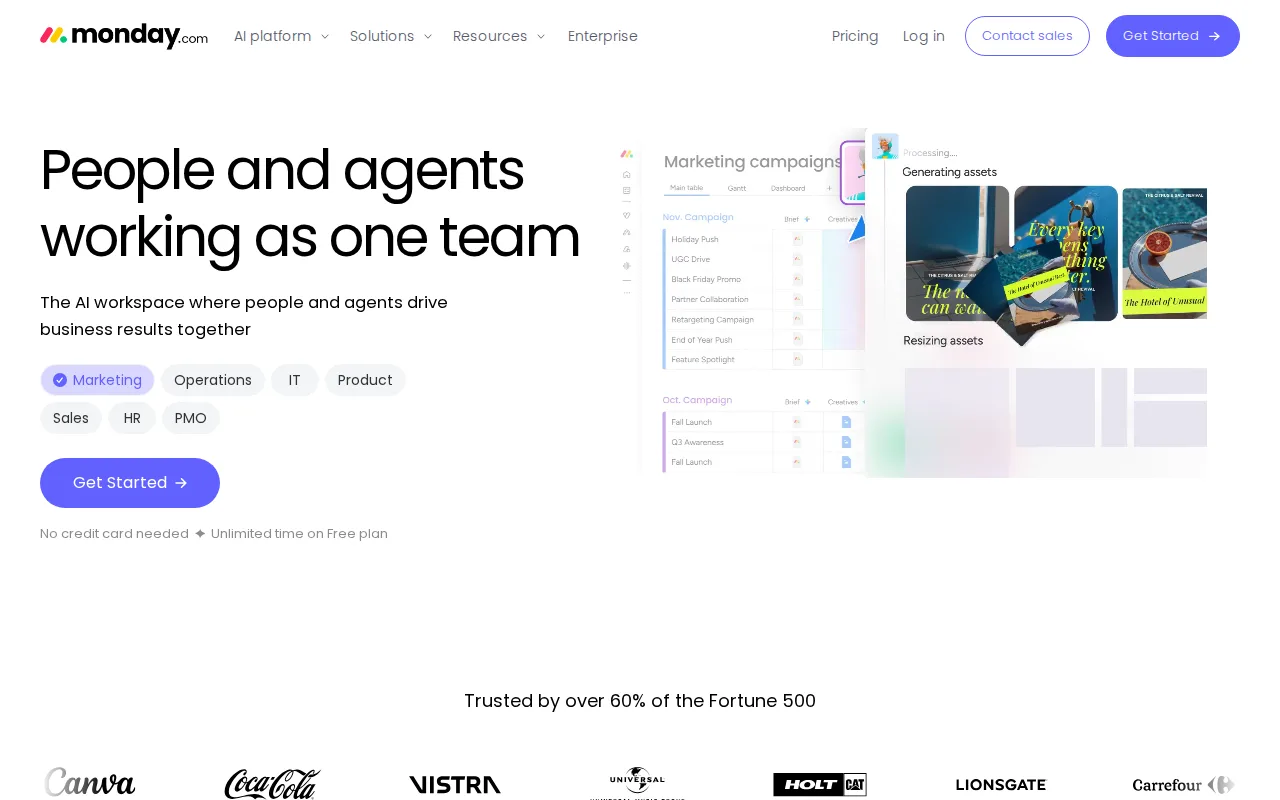
monday.com is the best Asana alternative for mid-size teams that want project tracking, a sales pipeline, and IT or HR workflows on one platform rather than Asana's task-and-project model plus separate tools. monday.com Basic costs $9 per seat/month billed annually against Asana Starter at $10.99 per user/month, and monday.com Pro at $19 per seat undercuts Asana Advanced at $24.99 by $6 a seat, or $120 a month on a 20-person team. Gantt, timeline, and calendar views arrive at Standard ($12/seat), and AI credits are included on every plan including the free one, where Asana's free Personal tier lists no AI Studio allowance at all. The board-and-column system covers projects, sales, hiring, and IT tickets with 200+ templates and no custom development. Asana is still the better choice for teams that live in dependencies and portfolio rollups. Asana's Work Graph links goals, portfolios, projects, and tasks into one connected model, and its free Personal tier gives 2 users unlimited tasks and projects, while monday.com's free plan caps those same 2 seats at 3 boards and 3 docs. monday.com's automation ceilings also force tier jumps unrelated to features: Standard allows 250 automation actions a month and Pro jumps to 25,000.
Compared to Asana: $9 per seat/month against Asana Starter's $10.99, Pro at $19 per seat against Asana Advanced's $24.99, but a free plan limited to 3 boards where Asana's free tier allows unlimited projects
Wins:Basic is $9 per seat/month against Asana Starter at $10.99, and Pro is $19 against Asana Advanced at $24.99 — $120 a month less for 20 seats · One platform runs project management, CRM, and IT/HR workflows on the same boards with 200+ templates, where Asana is task-and-project focused · AI credits are included on every plan including the free tier, while Asana's free Personal plan lists no AI Studio allowance
Loses:Free plan caps 2 seats at 3 boards and 3 docs, where Asana's free Personal tier gives 2 users unlimited tasks and projects · Automation and integration caps force tier upgrades for volume rather than features: 250 actions a month on Standard, 25,000 on Pro · Boards are flatter than Asana's Work Graph, which links goals, portfolios, projects, and tasks into one connected model
Pros
- Free plan and all paid tiers include AI credits and iOS/Android apps out of the box
- Highly flexible board and column system covers project management, CRM, and ops without needing separate software
- 200+ templates speed up setup for common use cases
- Dashboards and Gantt/timeline views are included from the Standard tier up
Cons
- Free tier is capped at just 2 seats and 3 boards, too small for most real teams
- Automation and integration action limits (250/month on Standard) are easy for active teams to hit and require an upgrade to Pro
- Per-seat annual billing math (e.g., $9/seat shown as $90 for 10 seats) makes true monthly cost easy to underestimate at checkout
- Enterprise features like advanced permissions and portfolio management require contacting sales for custom pricing
Pricing: Free tier · paid from $9/mo — $9 per seat/month (Basic, billed annually) vs Asana Starter at $10.99 per user/month; at 20 seats, $180/month vs $219.80/month (verified undefined NaN, NaN)
2.Trello — best Asana alternative for small teams and individuals who want a simple kanban board to track to-dos without adopting a full project-management framework
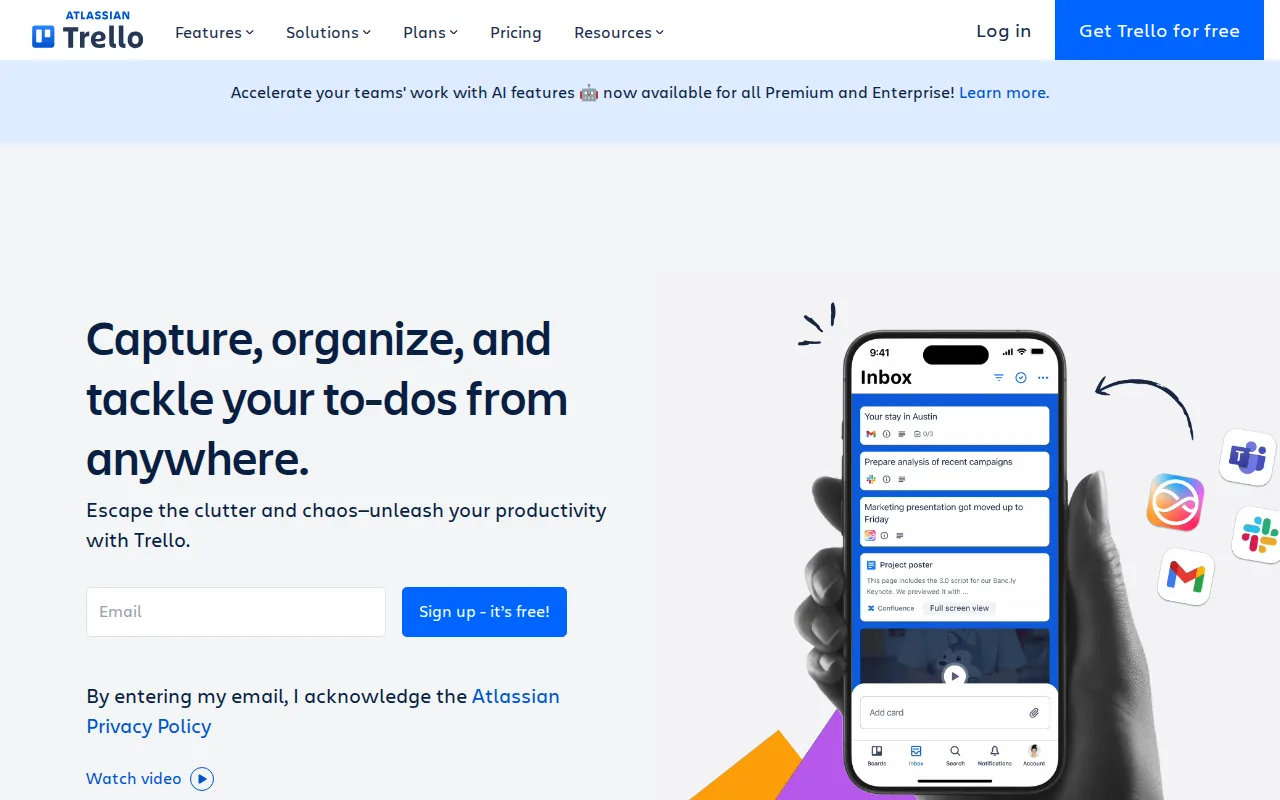
Trello is the best Asana alternative for small teams that want a kanban board and nothing heavier. Trello Standard costs $5 per user/month billed annually ($6 monthly), less than half Asana Starter at $10.99 per user/month, and Trello Premium at $10 still undercuts Asana Starter while adding Calendar, Timeline, Table, Dashboard, and Map views. Trello's free plan is materially larger than Asana's: 10 collaborators per workspace and 10 boards with unlimited cards, against an Asana free Personal tier that stops at 2 users. Butler builds no-code automation rules, buttons, and scheduled commands directly on a board with no add-on, and Trello's learning curve is rated low against Asana's moderate. Asana is still the better choice once projects carry dependencies and reporting. Trello's own listing concedes the limit: the card-and-list structure has no native support for complex dependencies or Gantt-style planning without Power-Ups, and teams that outgrow simple kanban tend to move to Jira or Asana. Asana puts timeline and Gantt views plus reporting dashboards on Starter at $10.99, where Trello holds Timeline and Dashboard for Premium at $10, and Asana's Advanced tier adds portfolios, Goals, Workload, and time tracking that Trello has no equivalent for at any price.
Compared to Asana: $5 per user/month against Asana Starter's $10.99, a free plan with 10 collaborators and 10 boards against Asana's 2-user free tier, but no native dependencies or Gantt planning without Power-Ups
Wins:Standard is $5 per user/month billed annually, less than half Asana Starter's $10.99, and Premium at $10 still undercuts it · Free plan covers 10 collaborators per workspace and 10 boards with unlimited cards, where Asana's free Personal tier stops at 2 users · Butler creates no-code automation rules, buttons, and scheduled commands on a board with no add-on, and the learning curve is rated low against Asana's moderate
Loses:The card-and-list structure has no native support for complex dependencies or Gantt-style planning without Power-Ups · Calendar, Timeline, Table, Dashboard, and Map views require Premium at $10/user/month, while Asana includes timeline and Gantt on Starter at $10.99 · No equivalent to Asana's portfolios, Goals, Workload, or the Work Graph, and the free tier caps file size at 10MB
Pros
- Free plan supports unlimited cards and up to 10 boards per workspace with no time limit
- Simple drag-and-drop kanban interface that most users learn in minutes
- Deep Power-Up and integration ecosystem plus native automation (Butler) without scripting
- Native mobile apps for iOS and Android
Cons
- Free tier limits workspaces to 10 boards and caps file size at 10MB
- Advanced views (Calendar, Timeline, Table, Dashboard, Map) require the Premium plan at $10/user/month
- Card-based structure lacks native support for complex dependencies or Gantt-style planning without add-ons
- Annual billing is required to get the advertised per-seat prices; monthly billing costs 20-25% more per seat
Pricing: Free tier · paid from $5/mo — $5 per user/month (Standard, billed annually; $6 monthly) vs Asana Starter at $10.99 per user/month billed annually (verified undefined NaN, NaN)
3.ClickUp — best Asana alternative for small and mid-sized teams that want tasks, docs, chat, and time tracking on one paid seat instead of buying a tracker, a wiki, a chat app, and a timesheet tool separately
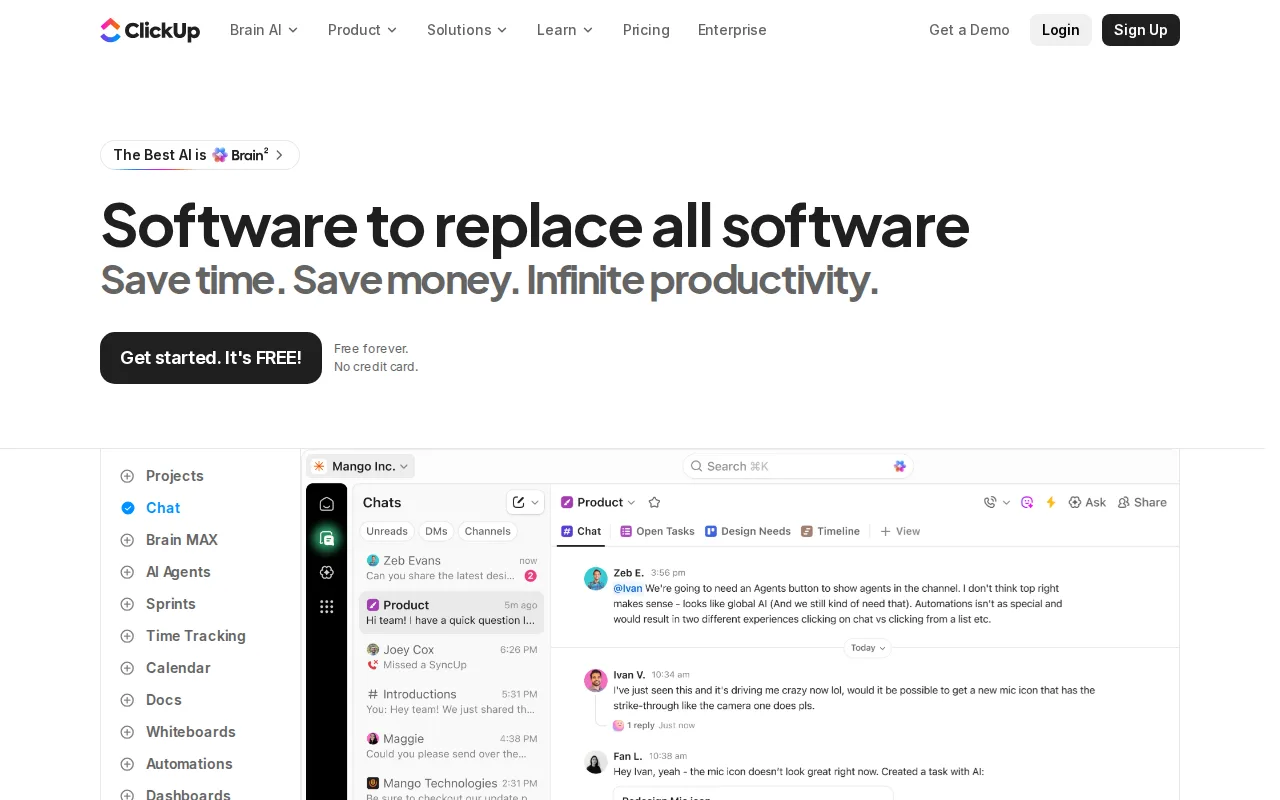
ClickUp is the best Asana alternative for teams that want everyone in the tool without paying for every seat. ClickUp's Free Forever plan carries unlimited tasks and unlimited free plan members on 60MB of storage, against an Asana free Personal tier that stops at 2 users. Paid seats are the cheapest on this page: ClickUp Unlimited is $7 per user/month billed yearly ($10 monthly) and includes unlimited storage, unlimited Gantt charts, unlimited integrations, native time tracking, and resource management, where Asana charges $10.99 per user/month on Starter for timeline and Gantt and holds time tracking and Workload for Advanced at $24.99. ClickUp Business at $12 per user/month billed yearly ($19 monthly) adds unlimited dashboards, 5,000 automation executions a month, portfolio workload management, and Google SSO, still less than half Asana Advanced. Asana is still the better choice for teams that need a connected model of goals and portfolios. Asana's Work Graph links goals, portfolios, projects, and tasks and assigns work to AI Teammates alongside people, while ClickUp organizes work as tasks inside Spaces, Folders, and Lists. ClickUp's Free Forever plan also caps file storage at 60MB, Spaces at 5, and automations at 5 active rules with 100 executions.
Compared to Asana: unlimited free plan members against Asana's 2-user free tier, Unlimited seats at $7 per user/month billed yearly against Asana Starter's $10.99, native time tracking at $7 where Asana holds it for the $24.99 Advanced tier
Wins:Free Forever allows unlimited tasks and unlimited free plan members; Asana's free Personal tier stops at 2 users · Unlimited is $7 per user/month billed yearly ($10 monthly) with unlimited storage, Gantt charts, integrations, and native time tracking, against Asana Starter at $10.99 · Business at $12 per user/month billed yearly ($19 monthly) adds unlimited dashboards, 5,000 automation executions a month, and portfolio workload management, under half Asana Advanced's $24.99
Loses:Work is modeled as tasks in Spaces, Folders, and Lists rather than Asana's Work Graph linking goals, portfolios, projects, and tasks · Free Forever caps file storage at 60MB, Spaces at 5, and automations at 5 active rules with 100 executions, where Asana's free tier has unlimited storage with a 100MB per-file cap · SAML SSO, audit logs, and HIPAA availability require custom-priced Enterprise, and ClickUp has no external review-platform rating on record here
Pros
- Free Forever includes unlimited tasks and unlimited members with Kanban boards, sprints, collaborative docs, calendar view, and in-app video recording.
- Unlimited at $7/user/month billed yearly already covers unlimited storage, Gantt charts, integrations, custom fields, and native time tracking.
- One workspace spans tasks, docs and wikis, chat, whiteboards, dashboards, goals, forms, and time tracking, cutting the number of separate subscriptions a team carries.
- Native apps for Windows, macOS, Linux, iOS, and Android plus a Chrome extension and a public API (10,000 calls/minute on Enterprise).
- ClickUp holds 4.6/5 across 4,630 Capterra reviews, 4.1/5 across 687 Trustpilot reviews, and 4.6/5 across 123 Product Hunt reviews.
Cons
- AI is priced on top of the plan at $9/user/month (Brain AI) or $28/user/month (Everything AI), plus $10 per 10,000 AI Super Credits once the allowance runs out.
- Free Forever caps total file storage at 60MB and Spaces at 5, so the free plan stops working for any team that attaches real files.
- Depth comes with per-plan caps on Spaces, lists, folders, automations, and view types — 40 lists per Space on Free, 200 on Unlimited, 400 on Business — so a workspace needs deliberate setup before it is usable.
- Payment is per Workspace and the whole Workspace must upgrade at once; a single team cannot be moved to a paid plan on its own.
Pricing: Free tier · paid from $7/mo — $7 per user/month billed yearly ($10 monthly) on Unlimited vs Asana Starter at $10.99 per user/month; ClickUp Business at $12 ($19 monthly) vs Asana Advanced at $24.99 (verified undefined NaN, NaN)
4.Wrike — best Asana alternative for cross-functional teams (marketing, product, professional services, IT) that need shared project visibility across departments, not just a single team's task list
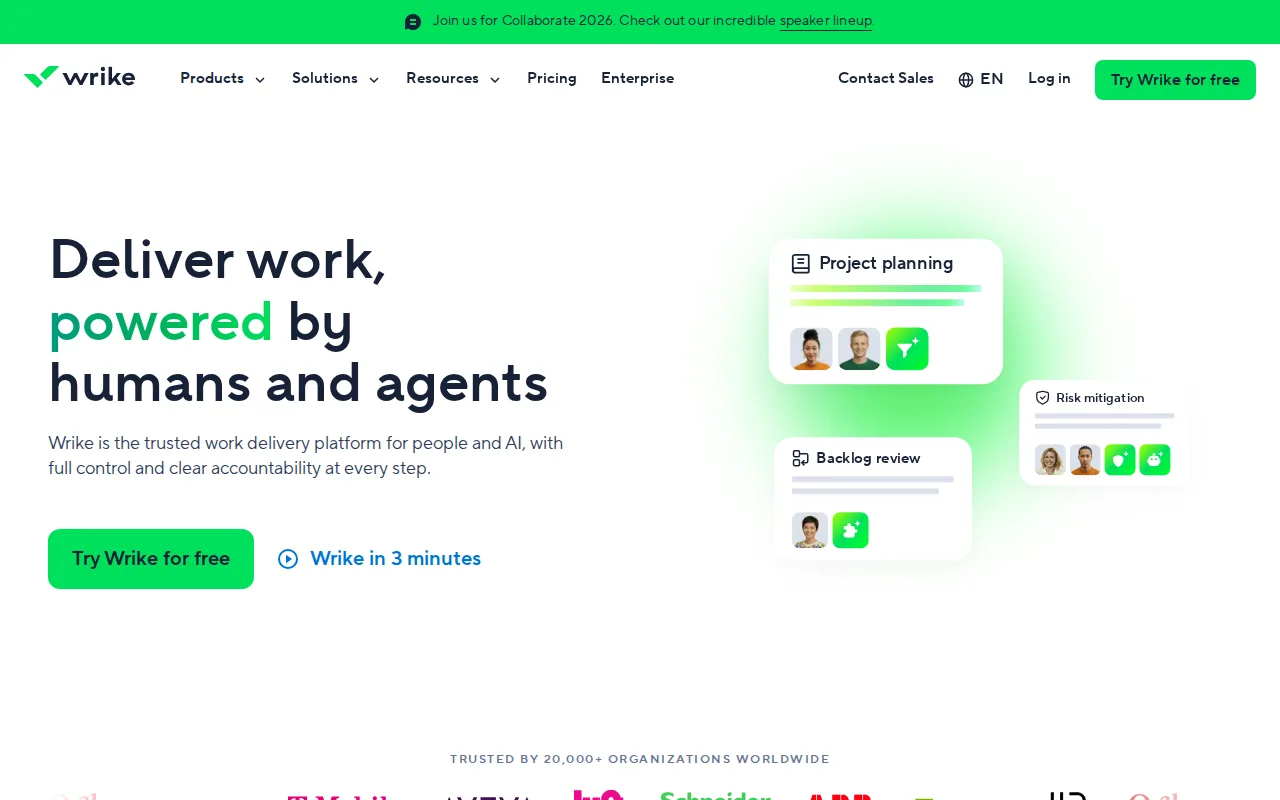
Wrike is the best Asana alternative for organizations that want everyone inside the tool before anyone pays. Wrike's Free plan supports unlimited users with project and task management on web, desktop, and mobile, where Asana's free Personal tier stops at 2 users — the largest free-tier gap on this page. Wrike Team is $10 per user/month billed annually, just under Asana Starter's $10.99, and it includes interactive Gantt charts and shareable dashboards rather than reserving them for a higher tier. Wrike Business at $25 per user/month effectively matches Asana Advanced at $24.99 while adding AI Elite starter actions, workspace templates, and standard integrations. Wrike holds 4.4/5 from 3,036 Capterra reviews and reports use by more than 20,000 organizations; Asana has no external review-platform rating on record. Asana is still the better choice for teams between 15 and 25 people and for anyone who needs published enterprise pricing. Wrike's $10 Team plan is capped at 15 users, so a 16-person team jumps to Business at $25 per user/month, while Asana Starter carries no seat limit at $10.99. Wrike's two highest tiers, Pinnacle and Apex, carry no public price, and advanced resource and capacity planning and budgeting are reserved for them.
Compared to Asana: a free plan with unlimited users against Asana's 2-user free tier, Team at $10 per user/month against Asana Starter's $10.99, but a 15-user cap on that Team plan where Asana Starter has no seat limit
Wins:Free plan supports unlimited users on web, desktop, and mobile; Asana's free Personal tier stops at 2 users · Team at $10 per user/month billed annually includes interactive Gantt charts and shareable dashboards, just under Asana Starter's $10.99 · 4.4/5 from 3,036 Capterra reviews and more than 20,000 organizations reported, where Asana has no external review-platform rating on record
Loses:The $10 Team plan is capped at 15 users, so a 16-person team jumps to Business at $25 per user/month; Asana Starter has no seat limit at $10.99 · Pinnacle and Apex carry no published price, and advanced resource and capacity planning plus budgeting are reserved for those custom-priced tiers · Reviewers report the interface and setup take longer to learn than simpler task managers like Asana or Trello
Pros
- Free plan supports unlimited users, useful for evaluating the tool broadly before paying.
- Interactive Gantt charts and dashboards are available from the entry-level $10/user/month Team plan.
- Serves cross-functional use cases well, with templates and workflows for marketing, product, and IT teams alike.
- AI features are being actively expanded across tiers, from AI Essentials on Team to AI Elite on Business and above.
Cons
- Pinnacle and Apex, the two highest tiers, require a sales conversation with no public pricing.
- Advanced resource and capacity planning, and budgeting/financial tracking, are reserved for the custom-priced Pinnacle tier.
- Team plan is capped at 15 users, forcing a jump to the pricier Business plan for slightly larger teams.
- Interface complexity and setup can take longer to learn than simpler task managers like Asana or Trello, per user reviews.
Pricing: Free tier · paid from $10/mo — $10 per user/month (Team, billed annually, 2-15 users) vs Asana Starter at $10.99 per user/month; Wrike Business at $25 vs Asana Advanced at $24.99 (verified undefined NaN, NaN)
5.Basecamp — best Asana alternative for small to midsize teams and nonprofits who want flat-rate pricing that doesn't grow with headcount, rather than a per-user tool
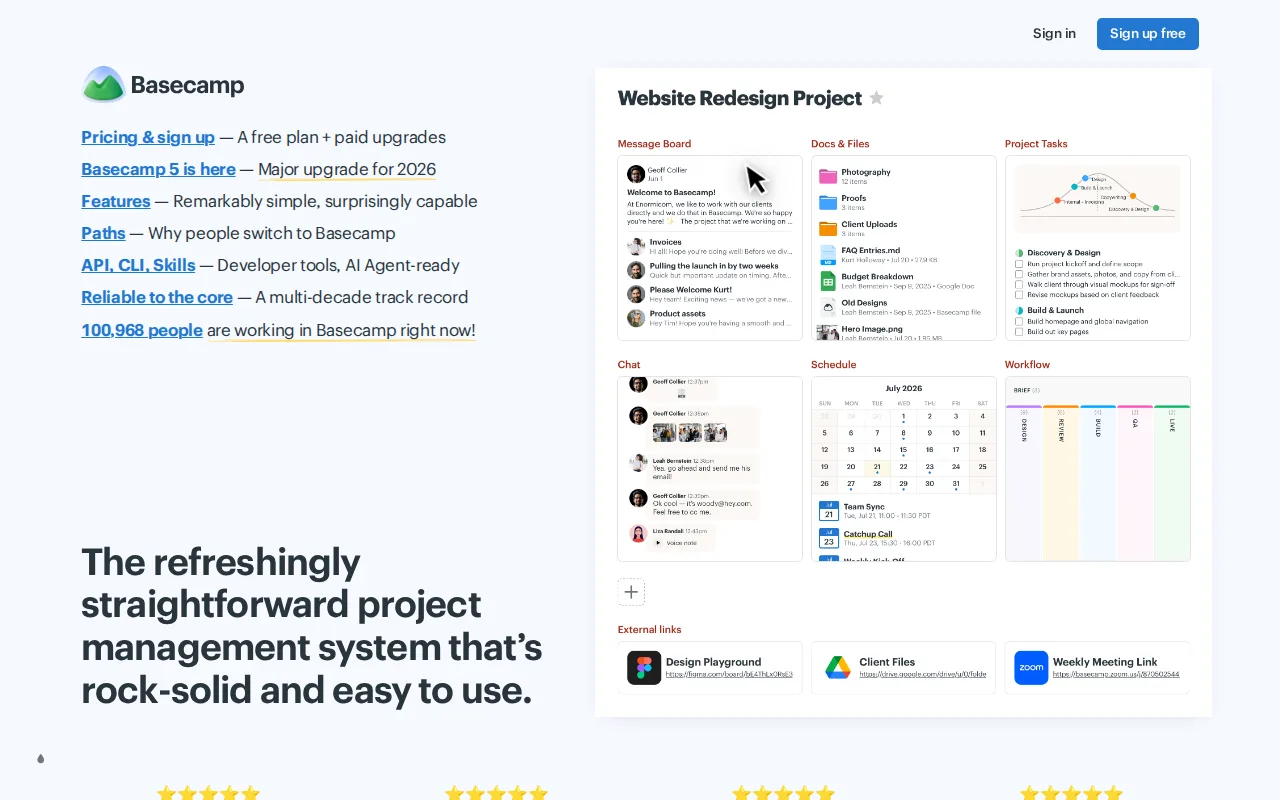
Basecamp is the best Asana alternative for teams that want the bill to stop growing when they hire. Basecamp charges a flat monthly rate rather than per seat: Studio is $59/month with unlimited users, Pro is $100/month with unlimited users, and the Unlimited Edition is $300/month billed annually with unlimited projects, unlimited users, and 1TB of storage. Against Asana Starter at $10.99 per user/month, a 20-person team pays $219.80/month on Asana and $59/month on Basecamp Studio; at 50 people the gap is $549.50 against the same $59. Basecamp bundles message boards, to-do lists, group chat, scheduling, docs, and card tables in one app, its learning curve is rated low against Asana's moderate, and it holds 4.4/5 from 14,437 Capterra reviews, the deepest review base on this page, where Asana has no external rating on record. Asana is still the better choice for teams running many concurrent projects or needing real planning views. Basecamp caps active projects on every tier — 1 on Free, 3 on Freelancer, 10 on Studio, 25 on Pro — while Asana allows unlimited projects even for the 2 users on its free Personal plan, and Basecamp's listed feature set has no Gantt timeline, portfolio, or Workload equivalent.
Compared to Asana: a flat $59/month for unlimited users against Asana Starter's $10.99 per user/month, 4.4/5 from 14,437 Capterra reviews against no external rating, but active-project caps on every tier where Asana allows unlimited projects
Wins:Flat monthly pricing with unlimited users from Studio ($59/month) up, so a 20-person team pays $59 instead of $219.80 on Asana Starter · 4.4/5 from 14,437 Capterra reviews, the deepest external review base on this page; Asana has none on record · Message boards, to-dos, group chat, scheduling, docs, and card tables in one app, with a learning curve rated low against Asana's moderate
Loses:Every tier caps active projects (1 on Free, 3 on Freelancer, 10 on Studio, 25 on Pro), where Asana allows unlimited projects even on its free plan · The listed feature set includes no Gantt timeline, portfolio, or Workload equivalent to Asana's planning views · Capterra reviewers report occasional bugs, slow responses, and crashes, plus notification volume that is hard to tune
Pros
- Flat monthly pricing with unlimited users on Studio and above avoids per-seat cost growth as a team scales.
- Combines message boards, to-dos, chat, scheduling, docs, and card tables in one app instead of requiring separate tools.
- Simple, opinionated interface that reviewers consistently describe as easy to onboard new team members into.
- 37signals reports 99.99% uptime and manages 60+ million projects across its customer base.
Cons
- Free plan is limited to just 1 active project, too restrictive for ongoing real work.
- Active-project caps persist even on paid tiers, so agencies with many concurrent client projects can hit limits before user count becomes an issue.
- Capterra reviewers report occasional bugs, slow responses, and crashes that interrupt workflow.
- Notification volume and customization are frequently cited by reviewers as excessive and hard to tune.
Pricing: Free tier · paid from $25/mo — $59/month flat for unlimited users (Studio) vs Asana Starter at $10.99 per user/month — $59 vs $219.80 a month at 20 users (verified undefined NaN, NaN)
6.Smartsheet — best Asana alternative for enterprise PMOs, IT portfolio teams, and cross-functional operations teams (construction, healthcare, marketing) that need spreadsheet-familiar project tracking with automation, dashboards, and resource management at scale
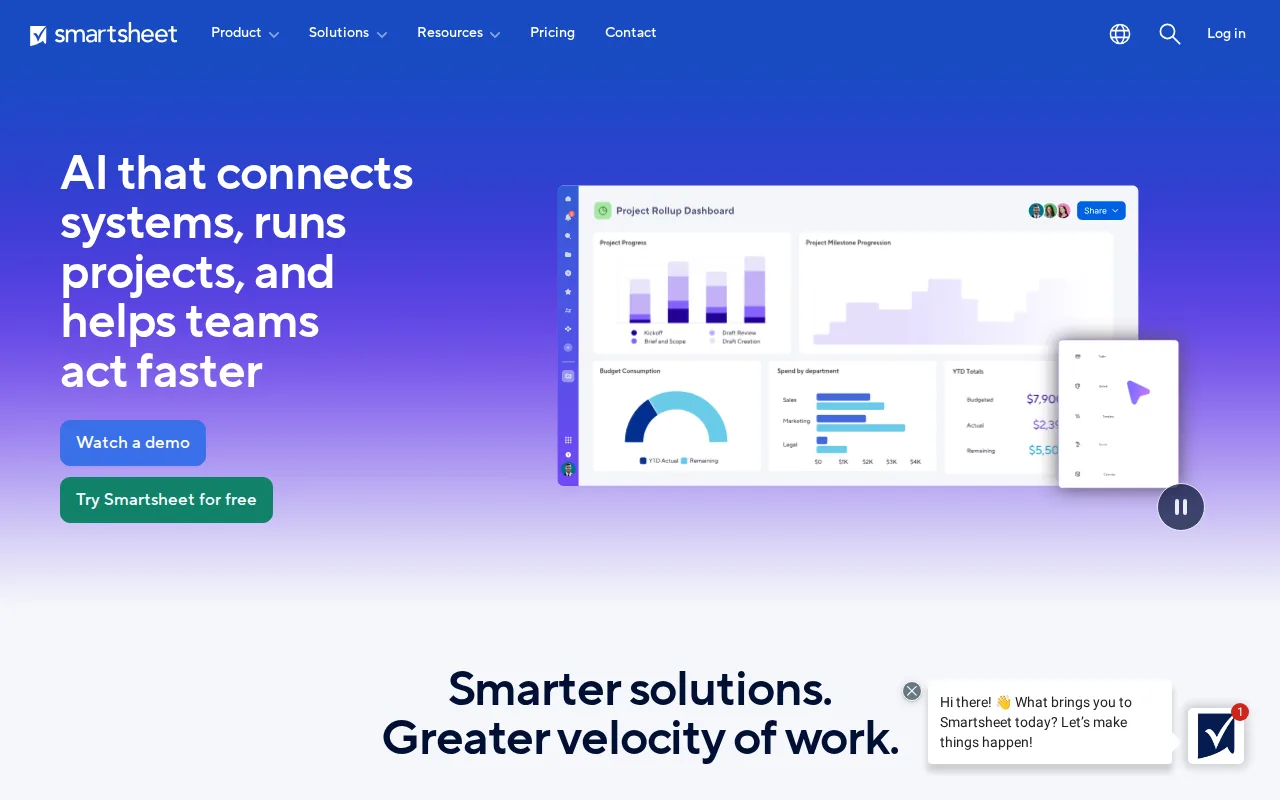
Smartsheet is the best Asana alternative for enterprise PMOs and portfolio teams that need spreadsheet-familiar tracking with resource and capacity planning underneath it. Smartsheet holds 4.5/5 from 3,538 Capterra reviews, the highest score on this page, where Asana has no external review-platform rating on record. It has been named a Leader in Gartner's Magic Quadrant for Collaborative Work Management three years running, reports use by more than 85% of Fortune 500 companies, and connects natively to 20+ platforms including Salesforce, Microsoft, Google, AWS, and Adobe. Its Pro tier includes unlimited free Contributor and viewer seats, so only the people building sheets are billed, which speaks directly to the seat-based pricing Asana's own listing names as its biggest weakness: reaching Goals and Workload means moving every user from $10.99 to $24.99 per month. Asana is still the better choice for small teams and for anyone comparing prices before a sales call. Smartsheet has no permanent free plan at all, only a 30-day trial, while Asana's free Personal tier covers 2 users with unlimited tasks and projects indefinitely. Smartsheet publishes no per-member dollar amount for Pro or Business without selecting a country and starting checkout, and its Business tier requires a minimum of 3 members.
Compared to Asana: 4.5/5 from 3,538 Capterra reviews against no external rating, unlimited free Contributor and viewer seats against Asana's per-user billing, but no permanent free plan where Asana's runs indefinitely
Wins:4.5/5 from 3,538 Capterra reviews, the highest score on this page; Asana has no external rating on record · Pro includes unlimited free Contributor and viewer seats, so only sheet builders are billed, unlike Asana's per-user pricing at $10.99-$24.99 · Resource and capacity planning plus AI-powered dashboards are built into the core product, where Asana holds Workload for Advanced at $24.99 and capacity planning for quote-only Enterprise
Loses:No permanent free plan, only a 30-day trial, while Asana's free Personal tier covers 2 users with unlimited tasks and projects indefinitely · Per-member prices for Pro and Business are not published without selecting a country and starting checkout, where Asana lists $10.99 and $24.99 openly · Built around a spreadsheet-style grid rather than Asana's Work Graph, and the Business tier requires a minimum of 3 members
Pros
- Spreadsheet-familiar interface lowers the learning curve for teams already comfortable with grids and formulas.
- AI-powered dashboards and resource/capacity planning built into the core product.
- Integrates natively with 20+ platforms, including Salesforce, Microsoft, Google, AWS, and Adobe.
- Recognized as a Gartner Magic Quadrant Leader for Collaborative Work Management for three consecutive years.
Cons
- No permanent free plan; only a 30-day trial before billing begins.
- Exact per-member pricing for Pro and Business isn't published without starting checkout.
- Business tier requires a minimum of 3 members, ruling out very small teams from that tier's features.
Pricing: Custom pricing
7.Notion — best Asana alternative for teams that want to consolidate scattered docs, wikis, and lightweight project trackers into one linked workspace, and are willing to spend time designing their own database structure.
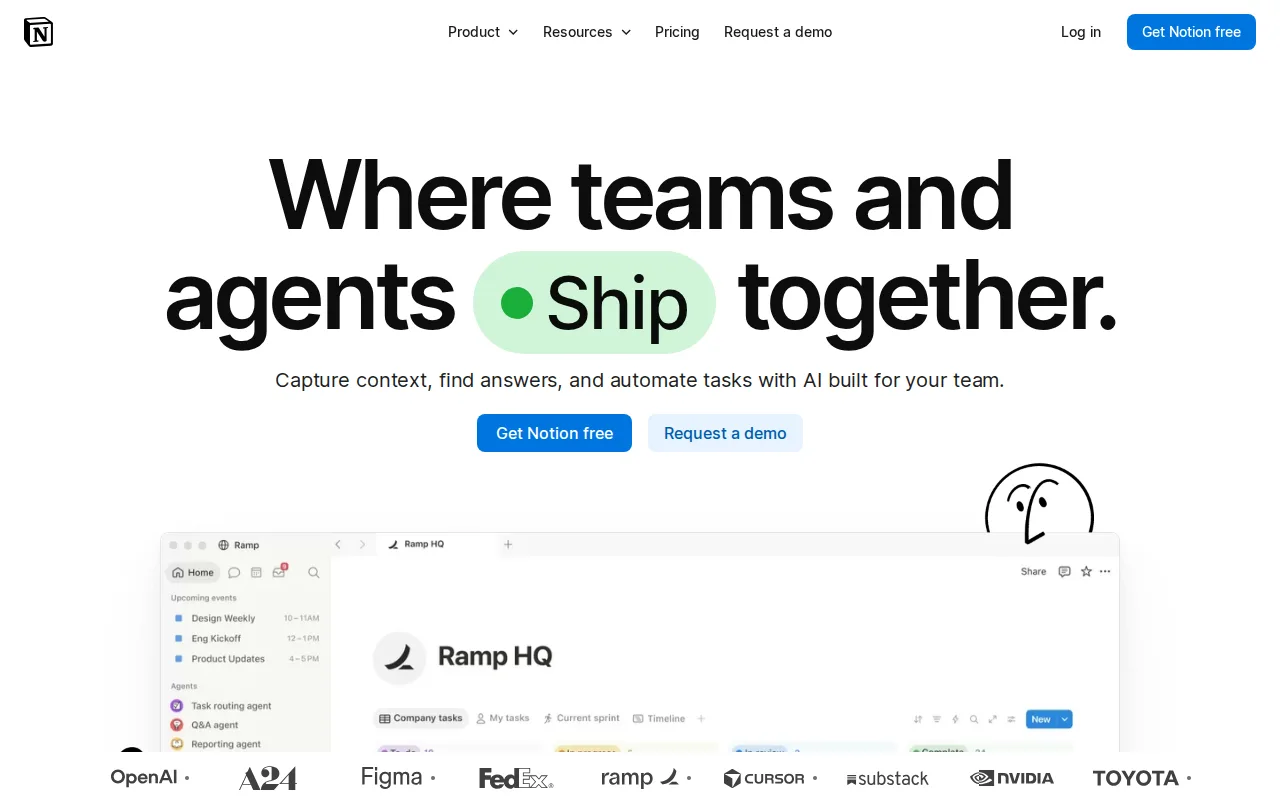
Notion is the best Asana alternative for teams whose project tracker keeps drifting into documents. Notion combines docs, wikis, relational databases, and project tracking in one workspace, so a roadmap, the spec behind it, and the meeting notes about it sit in the same place, where Asana holds tasks and projects and leaves documents elsewhere. Notion Plus is $10 per member/month against Asana Starter at $10.99, and Notion Business at $20 sits under Asana Advanced at $24.99, a $5-per-seat difference worth $100 a month on a 20-person team. Notion also ships a native Linux desktop client, which Asana does not, alongside web, Windows, macOS, iOS, and Android, and offers a public API, webhooks, and a one-way database sync from Asana itself. Asana is still the better choice for structured project management. Asana's Work Graph connects goals, portfolios, projects, and tasks, with timeline and Gantt views included on Starter at $10.99, while Notion asks a team to design its own database structure first and its learning curve is rated steep against Asana's moderate. Notion's meaningful AI — Notion Agent, AI Meeting Notes, Enterprise Search — needs the $20 Business plan, and Custom Agents bill separately at $10 per 1,000 Notion credits.
Compared to Asana: docs, wikis, and databases in the same workspace as the tracker, Plus at $10 per member/month against Asana Starter's $10.99, a native Linux desktop client Asana doesn't ship
Wins:Docs, wikis, and databases share the workspace with the tracker, so a roadmap and its spec are the same page; Asana keeps documents outside the project · Plus is $10 per member/month against Asana Starter's $10.99, and Business $20 against Asana Advanced's $24.99 — $100 a month less for 20 seats · Native Linux desktop client plus a public API, webhooks, and a one-way database sync from Asana itself
Loses:Learning curve is rated steep against Asana's moderate; a team has to design its own database structure before the tracker works · No equivalent to Asana's Work Graph linking goals, portfolios, projects, and tasks, or to the timeline and Gantt views Asana includes on Starter · Meaningful AI (Notion Agent, AI Meeting Notes, Enterprise Search) needs the $20/member/month Business plan, and Custom Agents bill on top at $10 per 1,000 credits
Pros
- Single tool covers docs, wikis, databases, and basic project tracking, reducing tool-switching
- Free plan supports unlimited pages and blocks for solo use, with only multi-member workspaces hitting block limits
- Deep customization through nested pages, linked databases, and templates
- Public API, webhooks, and 1-way database syncs (Jira, GitHub, Asana) for connecting external tools
Cons
- Per-member pricing on paid tiers ($10-$20/month) gets expensive fast for larger teams compared to flat-fee tools
- Offline support is limited to recently viewed or favorited pages on paid plans rather than full offline access
- Flexible block-and-database model has a steep learning curve for teams used to fixed-structure apps
- Meaningful AI features (Notion Agent, Enterprise Search, AI Meeting Notes) require the $20/month Business plan or higher
Pricing: Free tier · paid from $10/mo — $10 per member/month (Plus) vs Asana Starter at $10.99 per user/month billed annually; Notion Business at $20 vs Asana Advanced at $24.99 (verified undefined NaN, NaN)