5 Best Alternatives to Twenty for Web in 2026
By Noahlast updated pricing verified
Compared: Twenty alternatives that run on Web
| Alternative | Best for | Standout | Biggest weakness | Learning curve | Price |
|---|---|---|---|---|---|
| Twentyreference | technical teams who want an open-source, self-hostable CRM they can customize with custom objects instead of configuring a closed platform like Salesforce | Fully open-source (AGPL-3.0) core that can be self-hosted for free, plus a native MCP server so AI assistants like Claude, ChatGPT, and Cursor can query and act on CRM data directly. | Workflow automation is metered via annual credits (50/year on Pro) rather than unlimited, and SSO plus audit logs are locked behind the $19/user/month Organization tier, pricing out smaller teams that need compliance features. | Moderate | Free tier · paid from $9/mo |
| Salesforce | mid-market to enterprise sales teams that need a highly customizable CRM with pipeline management, forecasting, and AI-driven automation, and can dedicate admin resources to configuring it | Deep customization of objects, workflows, and reporting combined with Agentforce AI automation and the largest CRM integration ecosystem (Slack, Tableau, thousands of AppExchange apps). | Pricing climbs steeply across tiers, from $25/user/month at Starter Suite to $550/user/month for the fully AI-enabled Agentforce 1 plan, and Pro Suite and above require annual billing commitments; reviewers consistently describe onboarding and admin training as extensive and time-consuming, and the platform's customization depth often requires a dedicated Salesforce admin to maintain properly. | Steep | From $25/mo |
| HubSpot | small businesses that start on the free CRM and want marketing, sales, and service tools sharing one contact database as they grow, and can absorb the price jump into Professional tiers | A free, seat-unlimited core CRM that every paid Hub (Marketing, Sales, Service) plugs into, so contact and deal data stays unified without separate integrations. | Pricing jumps sharply between tiers — Marketing Hub goes from about $20/seat/month at Starter to an $800+/month Professional bundle plus a mandatory $3,000 onboarding fee — and Trustpilot reviewers report unexpected charges and difficulty canceling subscriptions. | Moderate | Free tier · paid from $7/mo |
| Attio | sales teams of roughly 3-50 people moving off spreadsheets or a legacy CRM who want automatic contact syncing and AI-assisted prospecting built into the base product | Real-time contact syncing with automatic data enrichment included even on the free plan, plus AI agents (via "Ask Attio") that can search and create CRM records from natural-language commands. | The free tier caps out at 3 seats, jumping to $35-44/user/month for Plus makes it notably pricier per seat than legacy CRMs at the low end, and Attio's own Capterra reviews (a small sample of 8) show a wide spread from 2 to 5 stars, with customer service rated lowest at 3.1/5 among reviewed categories. | Moderate | Free tier · paid from $35/mo |
| Pipedrive | small and mid-sized sales teams that want a visual, pipeline-first CRM rather than a generic contact database or a full enterprise suite | A drag-and-drop Kanban pipeline as the CRM's central interface, paired with an AI Sales Assistant that predicts deal outcomes from historical activity. | There is no permanent free tier, only a 14-day trial, and reporting/customization features that competitors bundle lower down are locked behind the Professional tier and above, pushing the realistic per-seat cost for a fully-featured team well past the advertised $14 entry price. | Low | From $14/mo |
| EspoCRM | organizations that want a fully self-hostable, open-source CRM with no per-user licensing fees, or a managed cloud version of the same software | The self-hosted edition is the same full-featured codebase as the paid cloud tiers, with no functionality gated behind a paywall — cloud pricing only buys hosting, storage, and support, not extra features. | Cloud hosting has steep per-user minimums (3 users on Basic, 10 on Ultimate) that make it expensive for very small teams, and self-hosting requires the organization to handle its own server maintenance, updates, and security patching. | Moderate | Free tier · paid from $15/mo |
 Twenty
 Salesforce
 HubSpot
 Attio
Attio Pipedrive
 EspoCRM
1.Salesforce — best Twenty alternative for mid-market to enterprise sales teams that need a highly customizable CRM with pipeline management, forecasting, and AI-driven automation, and can dedicate admin resources to configuring it
Salesforce is the best Twenty alternative for mid-market and enterprise sales teams that need deeper customization, forecasting, and AI-driven automation than Twenty's developer-first platform currently offers. Salesforce holds a 4.4/5 rating from 18,803 Capterra reviews, a far larger review base than any other alternative here, and its Agentforce AI layer can autonomously handle tasks like lead qualification and case routing, going beyond the annual workflow-credit limits (50/year on Twenty's Pro tier) that cap Twenty's automation. Salesforce also integrates natively with Slack, Tableau, and thousands of AppExchange apps, a far larger ecosystem than Twenty's TypeScript Apps framework currently supports. Twenty is still the better choice for technical teams that want a genuinely open-source, self-hostable CRM without per-seat SaaS fees: Salesforce has no free tier at all, starts at $25/user/month for Starter Suite, and climbs to $550/user/month for the fully AI-enabled Agentforce 1 plan, while Twenty's AGPL-3.0 core can be self-hosted for free. Salesforce also requires steep, time-consuming admin training according to reviewers, a much steeper learning curve than Twenty's moderate rating.
Compared to Twenty: no free tier vs Twenty's free self-hosted option, far larger review base (18,803 vs 9 reviews), steeper pricing at scale ($25-$550/user/month vs Twenty's $9-$19/user/month)
Wins:4.4/5 rating from 18,803 Capterra reviews, a vastly larger review base than Twenty's 9 Product Hunt reviews · Agentforce AI can autonomously handle lead qualification and case routing, beyond Twenty's 50 annual workflow-credit limit on Pro · Native Slack and Tableau integration plus thousands of AppExchange apps, a larger ecosystem than Twenty's TypeScript Apps framework
Loses:No free tier at all, starting at $25/user/month, while Twenty's AGPL-3.0 core is free to self-host with no per-seat fees · Pricing climbs to $550/user/month for the top Agentforce 1 plan, far above Twenty's $19/user/month Organization tier · Steep learning curve; reviewers describe admin training as extensive and time-consuming, versus Twenty's moderate rating
Pros
- Highly customizable objects, workflows, and reporting for complex sales processes.
- Deep integration ecosystem, including native Slack and Tableau integration plus thousands of AppExchange apps.
- AI-powered forecasting, deal insights, and Agentforce automation on higher tiers.
- Scales from small-team Starter Suite up through enterprise-grade Unlimited and Agentforce 1 plans.
Cons
- Pricing rises sharply across tiers, reaching $550/user/month for the top AI-enabled plan.
- Pro Suite and above require annual billing, reducing flexibility for growing teams.
- Steep learning curve; reviewers describe admin training as extensive and time-consuming.
- Deep customization often requires a dedicated Salesforce admin to configure and maintain.
Pricing: From $25/mo — $25/user/month Starter Suite up to $550/user/month Agentforce 1 vs Twenty's $9/user/month Pro or free self-hosted (verified undefined NaN, NaN)
2.HubSpot — best Twenty alternative for small businesses that start on the free CRM and want marketing, sales, and service tools sharing one contact database as they grow, and can absorb the price jump into Professional tiers
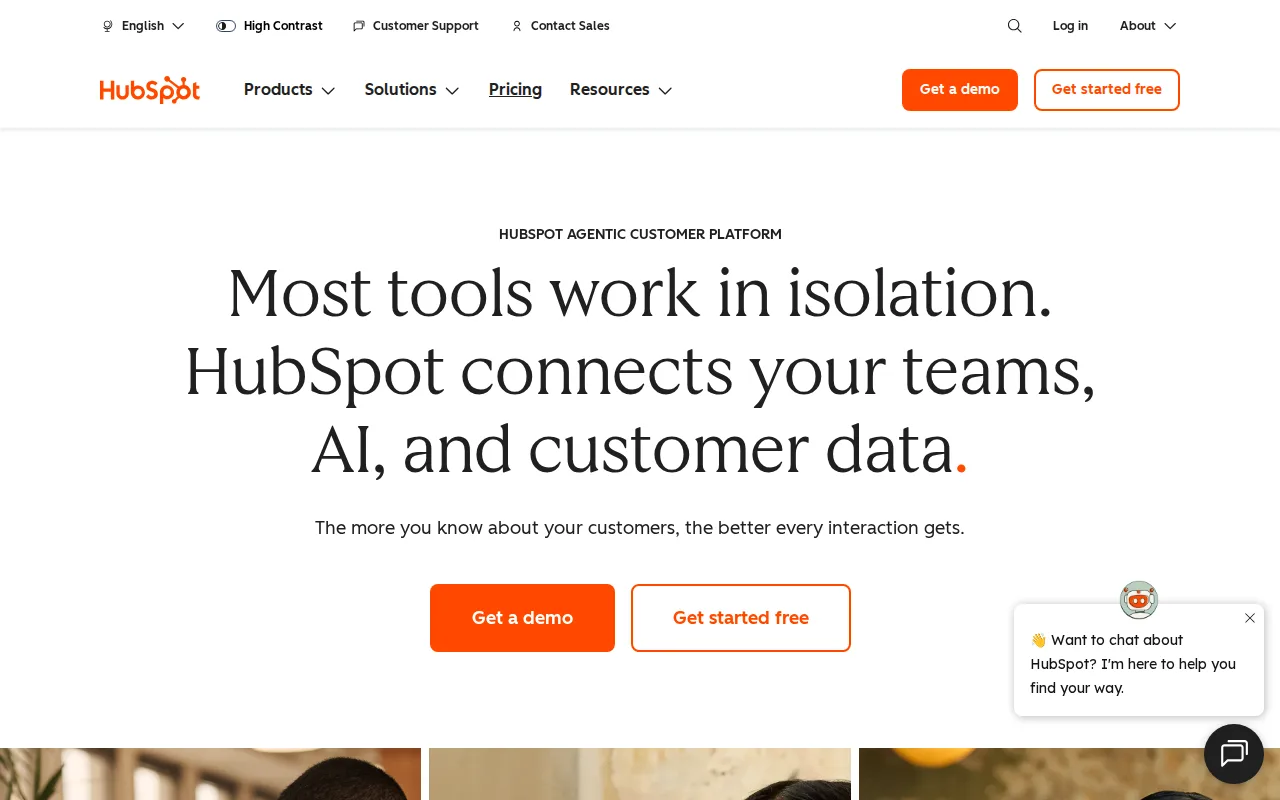
HubSpot is the best Twenty alternative for teams that want a genuinely free CRM with no seat cap, a stronger free offering than Twenty's own free tier, which only exists as a self-hosted option requiring server management. HubSpot's Free CRM has no user-seat limit and includes a core contact database, deal pipeline, and basic email tools, while Twenty's cloud Pro tier starts at $9/user/month with no equivalent no-cost cloud option. HubSpot also holds a 4.5/5 rating from 4,480 Capterra reviews, far more than Twenty's 9 Product Hunt reviews, and its Marketing, Sales, and Service Hubs share one contact record so data stays unified as a team grows. Twenty is still the better choice for technical teams that want unlimited custom objects and fields without hitting a pricing wall: HubSpot's pricing jumps sharply from about $20/seat/month at Marketing Hub Starter to an $800+/month Professional bundle plus a mandatory $3,000 onboarding fee, while Twenty's Pro tier at $9/user/month already includes unlimited custom objects, fields, and views. HubSpot's Trustpilot reviewers also report unexpected charges and difficulty canceling, a stark contrast to its high Capterra score.
Compared to Twenty: seat-unlimited free CRM vs Twenty's self-hosted-only free tier, far larger review base (4,480 vs 9 reviews), steep Professional-tier price jump plus $3,000+ onboarding fees
Wins:Free CRM has no seat cap and requires no self-hosting, unlike Twenty's free tier which only exists as a self-managed deployment · 4.5/5 rating from 4,480 Capterra reviews, far more than Twenty's 9 Product Hunt reviews · Marketing, Sales, and Service Hubs share one contact record, avoiding duplicate data entry as a team scales
Loses:Pricing jumps sharply from about $20/seat/month at Starter to $800+/month at Professional plus a mandatory $3,000 onboarding fee, unlike Twenty's flat $9-$19/user/month tiers · No unlimited custom objects and fields at the entry price the way Twenty's $9/user/month Pro tier includes · Trustpilot reviewers report unexpected charges and difficulty canceling subscriptions
Pros
- Free CRM has no user-seat limit, unlike most competitors' free tiers.
- Marketing, Sales, and Service Hubs share one contact record, avoiding duplicate data entry across departments.
- AI Customer Agent and prospecting agents are built into paid tiers without separate integration work.
- Large ecosystem of native integrations and a certified-partner network for implementation help.
Cons
- Steep price jump from Starter to Professional tier, plus mandatory one-time onboarding fees ($3,000-$7,000) at Professional and Enterprise.
- Trustpilot reviewers report unexpected charges and difficulty canceling, a stark contrast to its high G2/Capterra ratings.
- Running Marketing, Sales, and Service Hubs together multiplies per-seat costs quickly for a growing team.
- Advanced customization and reporting are gated behind Professional/Enterprise tiers, not available on Starter.
Pricing: Free tier · paid from $7/mo — Free CRM, then $7/seat/month Marketing Hub Starter (billed annually) up to $3,600+/month Enterprise vs Twenty's $9-$19/user/month (verified undefined NaN, NaN)
3.Attio — best Twenty alternative for sales teams of roughly 3-50 people moving off spreadsheets or a legacy CRM who want automatic contact syncing and AI-assisted prospecting built into the base product
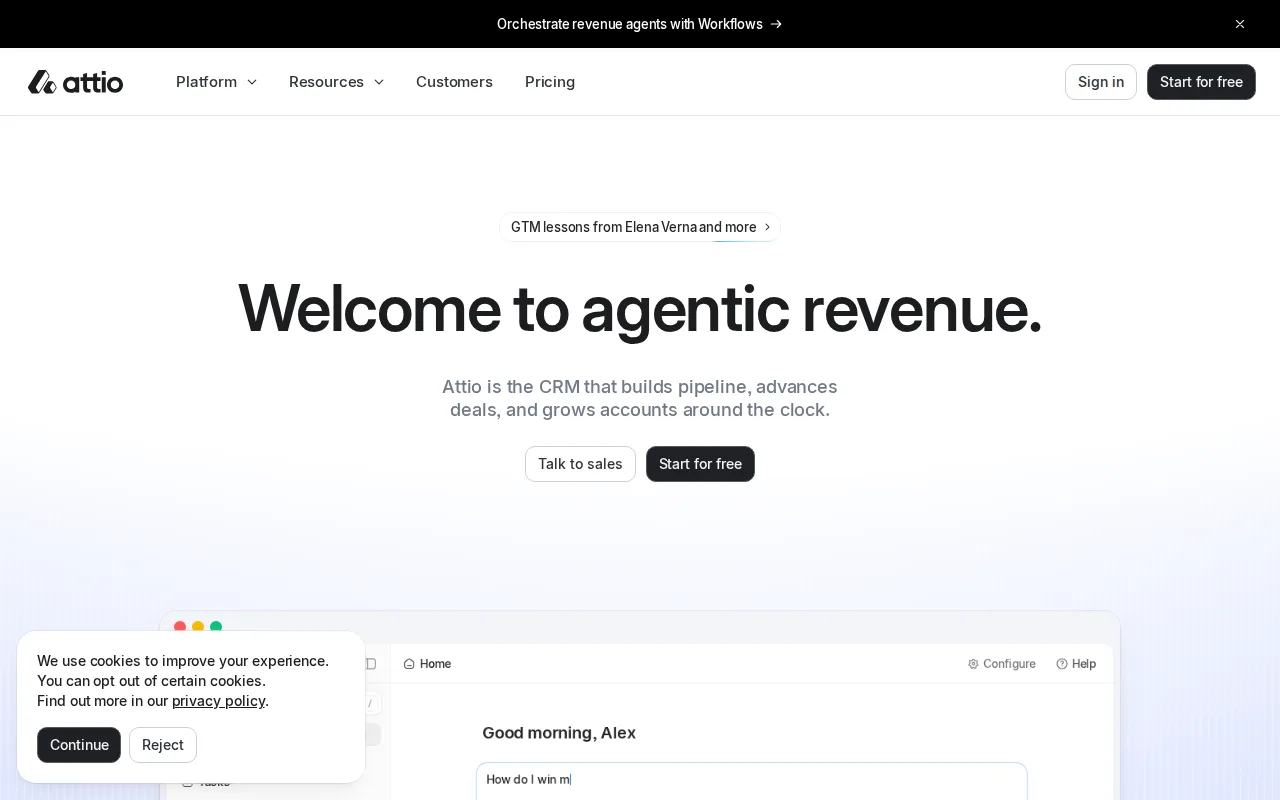
Attio is the best Twenty alternative for sales teams that want AI agents handling prospecting, enrichment, and lead qualification out of the box, a use case both platforms target but that Attio ships more directly through its "Ask Attio" natural-language interface. Attio's Free plan supports up to 3 seats with real-time contact syncing and automatic data enrichment included at no cost, comparable to Twenty's free self-hosted tier but without requiring any server management. Attio also integrates natively with Claude, matching Twenty's own native MCP server for AI-assistant access to CRM data, so both platforms target teams already building AI-forward sales workflows. Twenty is still the better choice for teams that want to avoid Attio's steeper per-seat pricing as they grow: Attio's Plus tier costs $35/user/month billed annually ($44/month billed monthly) once a team exceeds 3 seats, well above Twenty's $9/user/month Pro tier, and Twenty's AGPL-3.0 core can be self-hosted for free with no seat fees at all. Attio's own Capterra reviews are also a small sample of just 8, with customer service rated lowest at 3.1/5 among reviewed categories.
Compared to Twenty: pricier at scale ($35-99/user/month vs $9-19/user/month), both offer native Claude/AI-assistant integration, smaller review sample (8 vs 9 reviews)
Wins:Real-time contact syncing and automatic data enrichment included on the free plan (up to 3 seats), with no self-hosting required unlike Twenty's free tier · "Ask Attio" lets users query or create CRM records in natural language, a more direct AI-interaction model · AI agents can autonomously handle prospecting, lead qualification, and churn-risk detection without manual workflow-building
Loses:Plus tier costs $35-44/user/month once past 3 seats, well above Twenty's $9/user/month Pro tier · No self-hostable option; Attio is cloud-only, while Twenty's AGPL-3.0 core can be self-hosted for free · Capterra review sample is only 8 reviews with customer service rated lowest at 3.1/5, versus Twenty's 4.6/5 from 9 Product Hunt reviews
Pros
- Real-time contact syncing and automatic enrichment included from the free tier, not gated to paid plans.
- AI agents can prospect, qualify leads, and detect account churn risk without manual workflow-building.
- Modern, highly customizable interface that reviewers frequently cite as easier to tailor than legacy CRMs.
- Native integrations with Slack, Notion, Clay, and Claude fit AI-forward sales workflows.
Cons
- Free plan is capped at 3 seats, forcing a jump to paid pricing for any team beyond a very small group.
- Plus and Pro tiers ($35-99/user/month depending on billing) run more expensive per seat than several established CRM competitors.
- Small Capterra review sample (8 reviews) shows inconsistent satisfaction, with customer service the lowest-rated category at 3.1/5.
- Advanced features like call intelligence and sequences require the Pro tier rather than being available at the entry paid price.
Pricing: Free tier · paid from $35/mo — $35/user/month Plus (billed annually, up to 10 seats) vs Twenty's $9/user/month Pro (verified undefined NaN, NaN)
4.Pipedrive — best Twenty alternative for small and mid-sized sales teams that want a visual, pipeline-first CRM rather than a generic contact database or a full enterprise suite
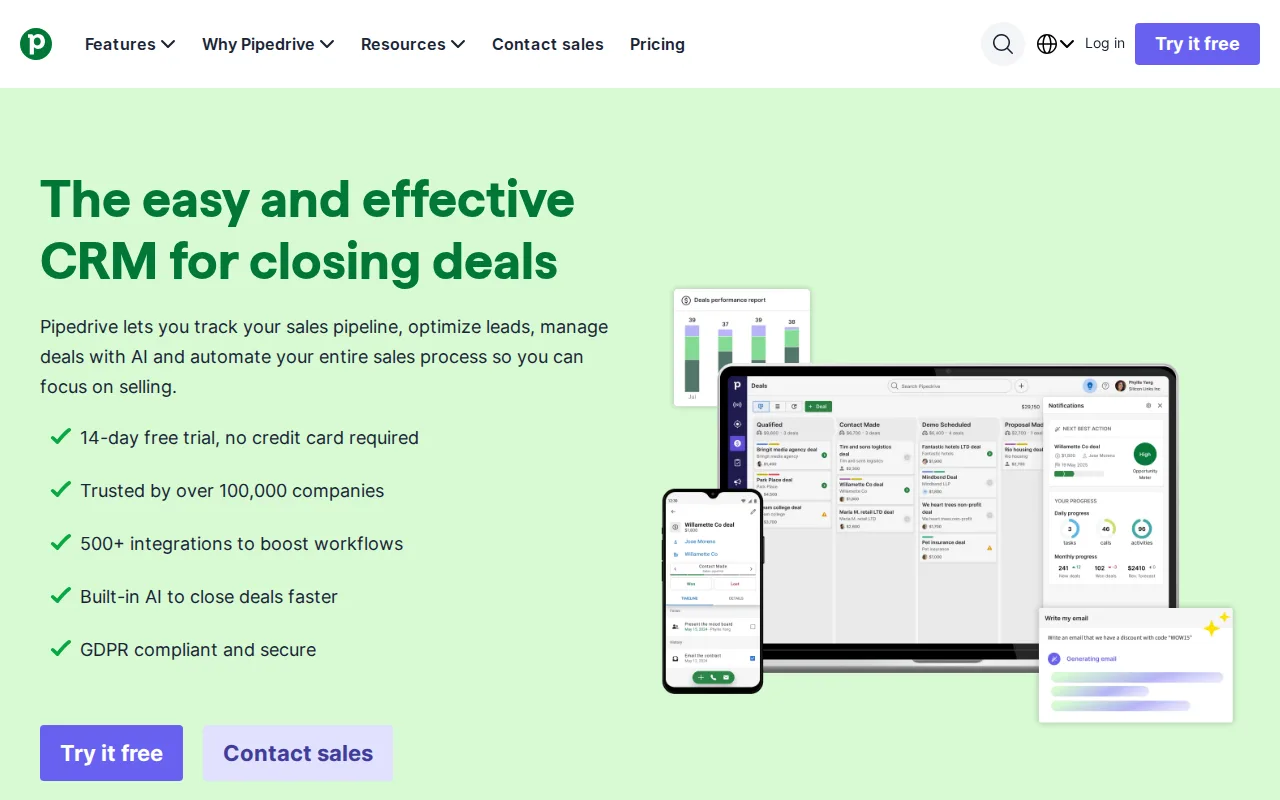
Pipedrive is the best Twenty alternative for sales teams that want a visual, drag-and-drop Kanban pipeline as the CRM's central interface rather than Twenty's more generic customizable-object model. Pipedrive is used by more than 100,000 companies across 179 countries and holds a 4.5/5 rating from 3,058 Capterra reviews, a far larger review base than Twenty's 9 Product Hunt reviews. Pipedrive's Essential tier starts at $14/user/month billed annually, close to Twenty's $9/user/month Pro tier, and its AI Sales Assistant surfaces deal-win predictions from historical pipeline data, a feature Twenty doesn't offer at any tier. Twenty is still the better choice for teams that specifically want a free, self-hostable option: Pipedrive has no permanent free tier at all, only a 14-day trial, while Twenty's AGPL-3.0 core can be self-hosted for free with unlimited custom objects and fields. Pipedrive also locks its AI Sales Assistant, revenue forecasting, and e-signature tracking behind the pricier Professional tier at $64/user/month, well above Twenty's $19/user/month Organization tier that unlocks SSO and audit logs.
Compared to Twenty: no free tier vs Twenty's free self-hosted option, far larger review base (3,058 vs 9 reviews), visual Kanban pipeline vs Twenty's custom-object model
Wins:4.5/5 rating from 3,058 Capterra reviews, a far larger review base than Twenty's 9 Product Hunt reviews · Drag-and-drop Kanban pipeline is faster to learn than Twenty's customizable-object CRM model, matching Pipedrive's low learning-curve rating vs Twenty's moderate · AI Sales Assistant predicts deal outcomes from historical pipeline data, a feature Twenty doesn't offer
Loses:No permanent free tier at all, only a 14-day trial, while Twenty's AGPL-3.0 core is free to self-host indefinitely · AI Sales Assistant, revenue forecasting, and e-signature tracking are locked behind the $64/user/month Professional tier · No native MCP server or AI-assistant integration the way Twenty offers for Claude, ChatGPT, and Cursor
Pros
- Visual, drag-and-drop Kanban pipeline is faster to learn than list-based CRMs.
- AI Sales Assistant surfaces deal-win predictions from historical pipeline data.
- 500+ integrations available through the Pipedrive Marketplace.
- 14-day free trial requires no credit card.
Cons
- No permanent free tier; every plan is a paid subscription after the trial.
- AI Sales Assistant, revenue forecasting, and e-signature tracking are locked behind the Professional tier and above.
- Reporting customization is limited on the entry-level Essential plan.
- Per-seat pricing climbs quickly for teams that need Professional or Power tier features.
Pricing: From $14/mo — $14/user/month Essential (billed annually) vs Twenty's $9/user/month Pro or free self-hosted
5.EspoCRM — best Twenty alternative for organizations that want a fully self-hostable, open-source CRM with no per-user licensing fees, or a managed cloud version of the same software
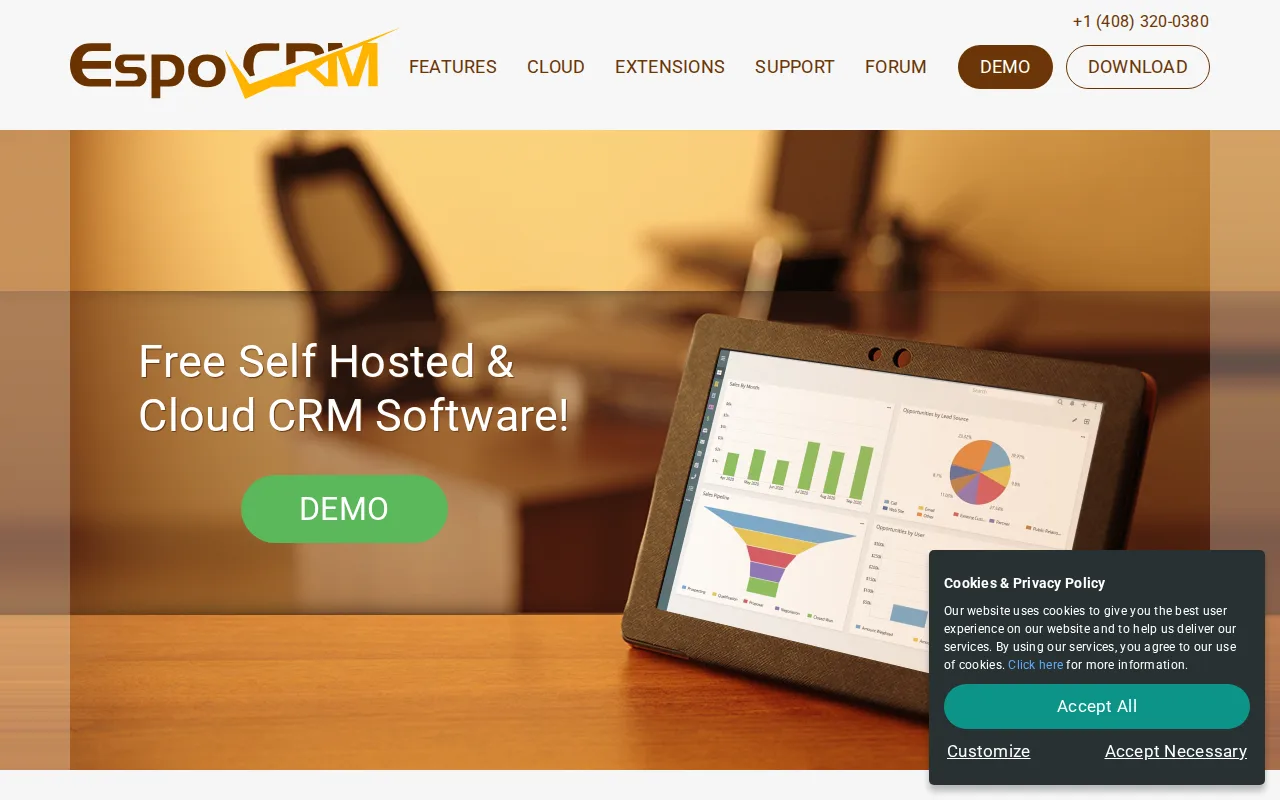
EspoCRM is the best Twenty alternative for organizations that want a fully open-source CRM under the same AGPLv3 license Twenty uses, with no functionality gated behind a paywall. EspoCRM's self-hosted Community edition is free with no per-user fees, matching Twenty's free self-hosted tier, and EspoCRM reports adoption across more than 50,000 companies in 163 countries. Unlike Twenty, which gates SSO and audit logs behind the $19/user/month Organization tier, EspoCRM's cloud tiers only charge for hosting, storage, and support, not extra features, since self-hosted and cloud editions run the same codebase. Twenty is still the better choice for teams that specifically want a native MCP server for AI-assistant access to CRM data: EspoCRM has no equivalent AI-agent integration with Claude, ChatGPT, or Cursor, and its cloud plans carry steep per-user minimums (3 users on Basic, 10 on Ultimate) that raise the effective entry cost above Twenty's per-seat pricing with no user minimum. EspoCRM also carries no external rating on record, so its review reputation can't be directly compared to Twenty's 4.6/5 from 9 Product Hunt reviews.
Compared to Twenty: same AGPLv3 license and free self-hosting, no AI-assistant/MCP integration vs Twenty's native MCP server, cloud plans carry 3-10 user minimums vs Twenty's no minimum
Wins:Self-hosted edition includes the full feature set with no functionality gated behind cloud pricing, unlike Twenty which locks SSO and audit logs behind its $19/user/month Organization tier · Reports adoption across 50,000+ companies in 163 countries, a broader deployment base than Twenty discloses · 2,000+ integrations included on every cloud tier
Loses:No native MCP server or AI-assistant integration with Claude, ChatGPT, or Cursor, a capability Twenty offers directly · Cloud plans carry per-user minimums (3 on Basic, 5 on Enterprise, 10 on Ultimate) that raise entry cost, unlike Twenty's per-seat pricing with no minimum · No external rating on record, making review reputation harder to verify against Twenty's 4.6/5 from 9 reviews
Pros
- Self-hosted edition is free under AGPLv3 with the full feature set and no per-user fees.
- Cloud and self-hosted editions run the same codebase, so no features are gated behind cloud pricing.
- 2,000+ integrations and a REST API are included on every cloud tier.
- Reports adoption across 50,000+ companies in 163 countries, spanning industries from healthcare to manufacturing.
Cons
- Cloud plans have per-user minimums (3 on Basic, 5 on Enterprise, 10 on Ultimate) that raise the effective entry cost.
- Self-hosting requires the organization to manage its own server, updates, and security patching.
- Cloud Ultimate's $69/user/month with a 10-user minimum ($690/month minimum) is a steep jump from Basic's $15/user/month.
- The interface and setup process assume some technical comfort, making it a steeper learning curve than sales-first CRMs like HubSpot.
Pricing: Free tier · paid from $15/mo — Free self-hosted, or $15/user/month Cloud Basic (3-user minimum) vs Twenty's free self-hosted, or $9/user/month Pro with no minimum (verified undefined NaN, NaN)