6 Best Alternatives to Tray.ai in 2026
By Noahlast updated

From our data: 4 of the 6 alternatives listed here (Make, Pipedream, Zapier, n8n) offer a $0 free tier, while Tray.ai itself has none; among confirmed USD paid tiers, Make's Core plan is the cheapest at $12/month, and Boomi's $99/month Base tier is the only other alternative to publish any entry-level dollar figure without requiring a sales quote.
 Make
Make Pipedream
 Zapier
 n8n
n8n Boomi
BoomiHow we picked
- Ranked partly by verified pricing: Make ($12/month Core), Zapier ($19.99/month Professional), and n8n (€20/month Starter) all have recorded pricing-verification dates of 2026-08-21, fresher than Tray.ai's own listing, which publishes no dollar figures anywhere on its pricing page.
- External review-platform ratings anchored ordering: Make (4.8/5, 408 Capterra reviews) and Zapier (4.7/5, 3,069 Capterra reviews) both carry far more review volume than Tray.ai's own 4.9/5 from just 11 Capterra reviews, listed under its former name Tray.io.
- Pricing transparency was weighted heavily given Tray.ai's own biggest cited weakness: Make, Zapier, and n8n's Starter/Pro tiers all publish exact dollar or euro figures, while Workato publishes no pricing tiers at all and Boomi publishes only its $99/month Base tier, leaving higher tiers quote-only like Tray.ai itself.
- Free-tier availability was weighted: four of the six alternatives (Make, Pipedream, Zapier, n8n) ship a $0 tier against Tray.ai's own zero permanently-free plans; Workato and Boomi, the two alternatives closest to Tray.ai's enterprise-governance positioning, also have no confirmed free tier.
Paid placement never alters editorial rank — read the full methodology.
Tray.ai alternatives at a glance
| Alternative | Best for | Standout | Biggest weakness | Learning curve | Price |
|---|---|---|---|---|---|
| Tray.aireference | IT and platform teams at mid-market and enterprise companies who need governed, auditable integrations and AI agent orchestration across 700+ apps, not a quick self-serve Zapier alternative | Merlin Agent Builder and Agent Gateway, which let teams build and govern MCP-based AI agents (conversational or autonomous) on the same runtime and connector library used for traditional integrations. | No published pricing anywhere on the site; every tier, including the entry-level Pro plan, requires a sales conversation and custom quote, which rules Tray.ai out for teams that want to self-serve or compare costs quickly against Zapier, Make, or n8n. | Steep | Custom pricing |
| Make | operations, marketing, and IT teams that need visual, branching automation workflows across 3,000+ apps, beyond what simpler linear automation tools support | A canvas-style visual scenario builder with routers, filters, and branching logic that handles more complex multi-path automations than simpler linear automation tools, plus a natural-language builder (Maia) for describing automations in plain text. | Pricing is metered by operation credits rather than a flat seat price, so complex, high-volume scenarios can consume the monthly allowance quickly; the listed per-tier prices are also annual-billing rates, with monthly billing costing more, and building non-trivial branching scenarios has a real learning curve. | Moderate | Free tier · paid from $12/mo |
| Pipedream | developers who want code-level control (Python, Node.js, Bash, or Go) inside no-code-style workflow automation, and teams building AI agents against thousands of APIs | Any workflow step can run actual Python, Node.js, Bash, or Go code alongside no-code app connectors, and MCP servers expose 10,000+ tools directly to AI agents. | Pipedream's pricing moved to a credit-based model that's hard to estimate in advance — the public pricing page renders entirely client-side with no static content, and per-execution credit costs vary by step complexity, making exact monthly spend difficult to predict before building a workflow. | Moderate | Free |
| Zapier | non-developers and small operations teams who need to connect thousands of different apps through simple trigger-action automations, without engineering resources | The largest pre-built app-integration library in workflow automation, with thousands of supported apps, so most tools a team already uses can be connected without custom API work. | Pricing is metered by task volume, not just seats, so cost rises quickly for high-volume automations, and moving from 750 to 2,000 tasks/month on Professional roughly doubles the monthly bill; unused tasks don't roll over between billing periods. | Low | Free tier · paid from $19.99/mo |
| Workato | enterprise IT and operations teams that need governed, auditable integrations across 1,000+ apps with AI agent orchestration, not self-serve no-code automation for individuals | Enterprise governance controls (role-based access, audit logs, dev/test/prod environments) layered on top of no-code recipe building, letting IT approve reusable integrations that business teams then self-serve within guardrails. | No public pricing whatsoever: every tier, dollar figure, and usage metric is hidden behind a sales conversation, making it impossible to compare cost against competitors like Zapier or Make without engaging Workato's sales team first. | Steep | Pricing not verified |
| n8n | technical teams that want to mix visual workflow building with custom code, either self-hosted for full control or on cloud paying per execution instead of per step | Billing by full workflow execution rather than by individual step or task, so complex multi-node automations don't multiply cost the way per-task pricing does on competitors. | Cloud pricing is listed in euros, not dollars, and jumps sharply from Pro (€50/month) to Business (€667/month), leaving a wide gap for teams that outgrow Pro's execution limits but don't need Business's SSO and compliance features. | Moderate | Free |
| Boomi | mid-size to enterprise IT teams that need to connect many pre-built enterprise applications (SAP, Salesforce, ServiceNow, Workday) through a low-code integration builder rather than custom code | Agentstudio extends the integration platform into AI agent governance with Model Context Protocol (MCP) support, letting IT teams control what data and tools AI agents can access across the same connections used for application integration. | Almost all pricing above the $99/month Base tier is hidden behind a custom sales quote, making it hard for buyers to comparison-shop against MuleSoft or Workato without engaging sales, and usage-based charges on top of the Base tier can make total cost unpredictable. | Steep | From $99/mo |
 Tray.ai
 Workato
1.Make — best Tray.ai alternative for operations, marketing, and IT teams that need visual, branching automation workflows across 3,000+ apps, beyond what simpler linear automation tools support
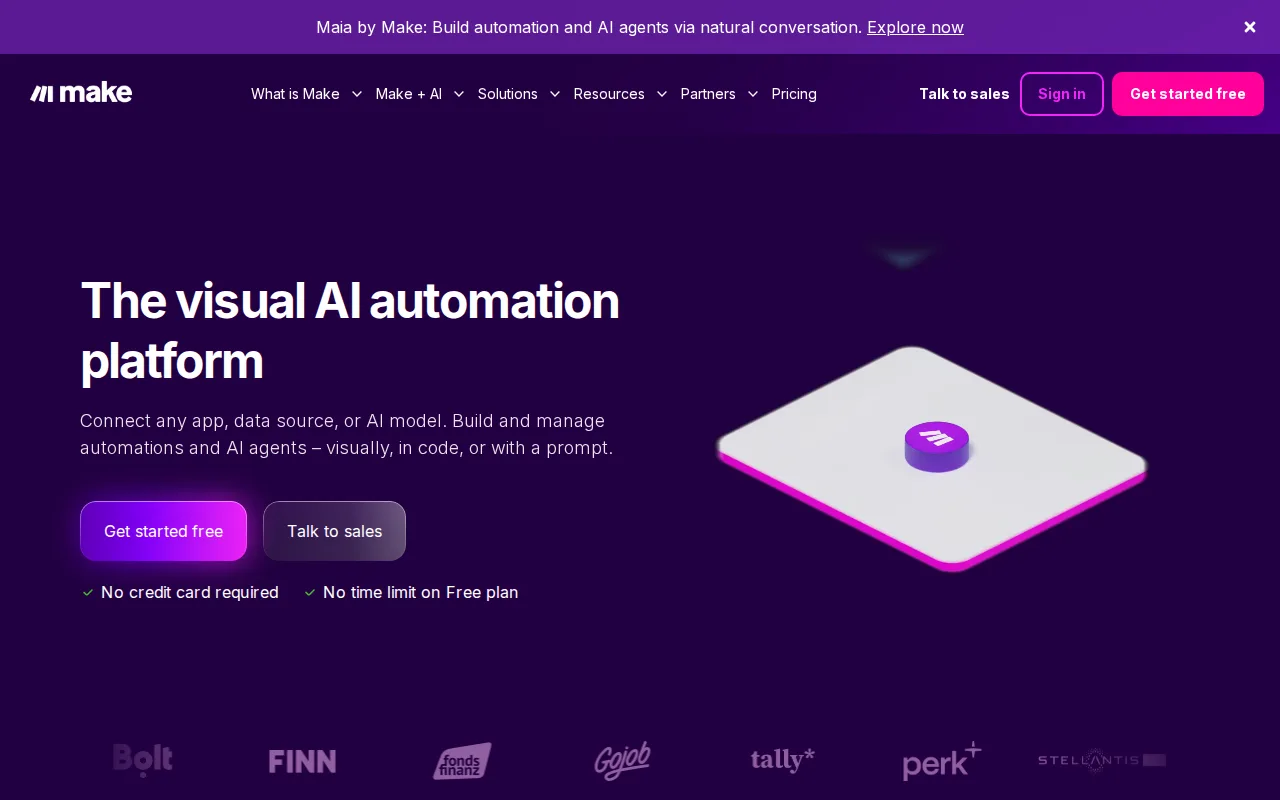
Make is the best Tray.ai alternative for operations, marketing, and IT teams that want a visual, branching workflow builder across 3,000+ apps at published, self-serve pricing instead of Tray.ai's sales-quote-only model. Make's Free plan includes 1,000 operations/month at $0, and Core then starts at $12/month for 10,000 operations billed annually, a concrete published price Tray.ai's own pricing page doesn't offer at any tier, including its entry-level Pro plan. Make reports over 400,000 users in 200+ countries and holds a 4.8/5 rating from 408 Capterra reviews, dramatically more review volume than Tray.ai's own 4.9/5 from just 11 Capterra reviews. Make Grid gives centralized visibility across an organization's automations, and Make also supports SSO and SOC 2 Type II compliance on its Enterprise tier for teams that need governance without Tray.ai's fully custom sales process. Tray.ai is still the better choice for enterprises that specifically need Merlin Agent Builder and Agent Gateway for governing MCP-based AI agents in production, or on-premise connectivity and HIPAA compliance: Make's operation-credit pricing can be consumed quickly by complex, high-volume scenarios, and building non-trivial branching automations has a real learning curve.
Compared to Tray.ai: published self-serve pricing starting at $12/month vs Tray.ai's sales-quote-only tiers, far more review volume (408 Capterra reviews vs 11), Make Grid gives centralized visibility across an organization's automations
Wins:Core plan starts at a published $12/month for 10,000 operations; Tray.ai publishes no dollar figures on any tier, including entry-level Pro · 4.8/5 rating from 408 Capterra reviews, dramatically more review volume than Tray.ai's own 4.9/5 from 11 Capterra reviews · Free plan includes 1,000 operations/month at $0; Tray.ai has no free tier, only a time-limited trial
Loses:No Merlin Agent Builder or Agent Gateway equivalent for governing MCP-based AI agents in production the way Tray.ai offers · No on-premise connectivity or HIPAA compliance tier comparable to Tray.ai's Enterprise plan · Operation-credit pricing means complex or high-volume scenarios can burn through a plan's monthly allowance quickly
Pros
- Visual scenario builder supports branching, routers, and filters for genuinely complex multi-path automations.
- 3,000+ app integrations cover most common business tools out of the box.
- Free tier (1,000 ops/month) is enough to build and test real automations before paying.
- Core plan starts at $12/month, undercutting some competitors for lower-volume users.
Cons
- Operation-credit pricing means complex or high-volume scenarios can burn through a plan's monthly allowance quickly.
- Listed tier prices are annual-billing rates; paying monthly costs more.
- Complex branching scenarios have a real learning curve for non-technical users.
- Free plan's 15-minute minimum interval between scenario runs limits near-real-time automation.
Pricing: Free tier · paid from $12/mo — $12/month Core (10,000 ops) vs Tray.ai's custom-quoted Pro tier (no published price) (verified undefined NaN, NaN)
2.Pipedream — best Tray.ai alternative for developers who want code-level control (Python, Node.js, Bash, or Go) inside no-code-style workflow automation, and teams building AI agents against thousands of APIs
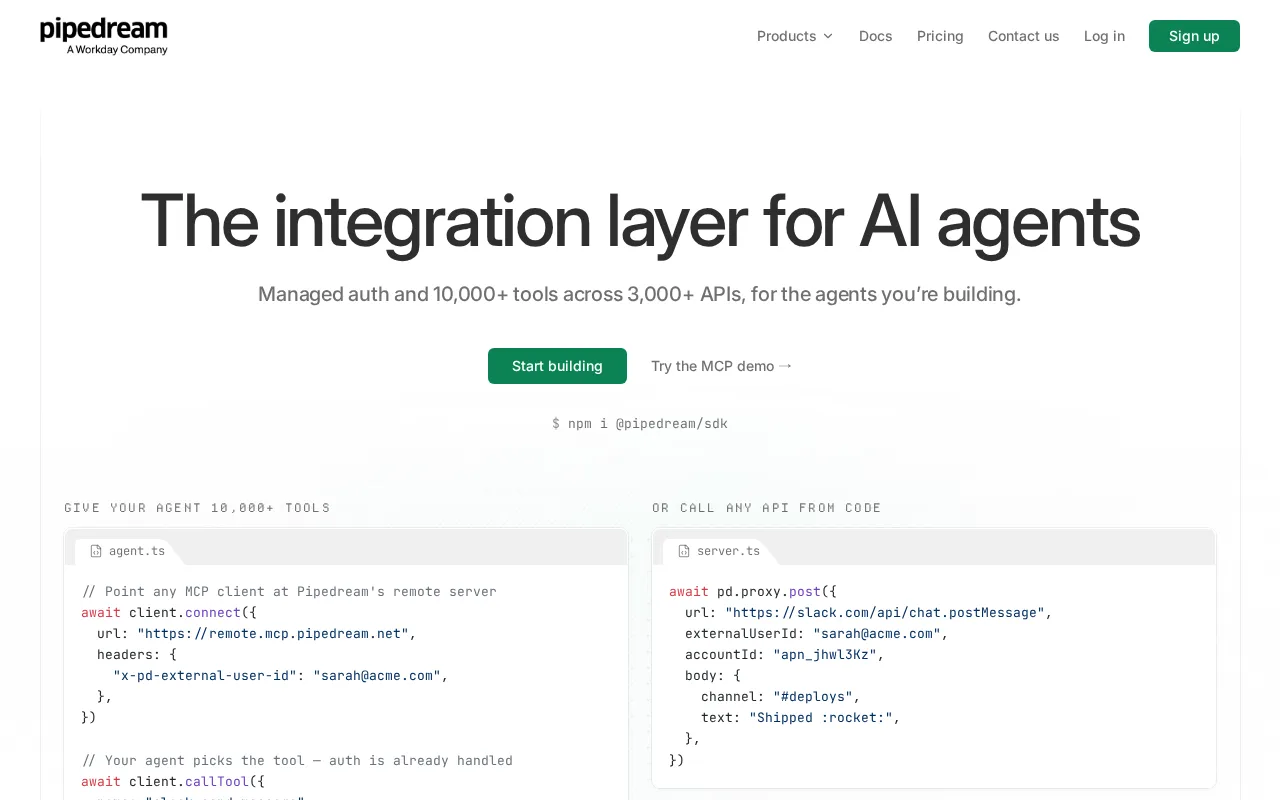
Pipedream is the best Tray.ai alternative for developers who want to drop actual Python, Node.js, Bash, or Go code into any workflow step, a level of code-level control Tray.ai's low-code recipe builder doesn't expose the same way. Pipedream's Free plan includes a daily execution credit limit at $0, giving developers a starting point Tray.ai doesn't offer since every Tray.ai tier requires a sales conversation before access. Pipedream also runs MCP servers exposing 10,000+ tools to AI agents, comparable in spirit to Tray.ai's own Agent Gateway for governing MCP-based agents, and its core workflow engine is open source on GitHub, a transparency Tray.ai's closed-source platform doesn't offer. Pipedream holds a 5.0-star rating from 6 Capterra reviews, thinner in volume but a full match to Tray.ai's own 4.9/5 score from 11 Capterra reviews. Tray.ai is still the better choice for enterprise IT teams that need RBAC, audit trails, and HIPAA/SSO support on a governed runtime with 700+ pre-built connectors: Pipedream's pricing moved to a credit-based model that's hard to estimate in advance, since its public pricing page renders entirely client-side with no static content.
Compared to Tray.ai: free tier with daily execution credits vs Tray.ai's sales-quote-only access at every tier, MCP servers exposing 10,000+ tools to AI agents, open-source core workflow engine on GitHub
Wins:Free plan includes a daily execution credit limit at $0; Tray.ai requires a sales conversation before any tier is accessible · MCP servers expose 10,000+ tools to AI agents, comparable in spirit to Tray.ai's own Agent Gateway · Core workflow engine is open source on GitHub, a transparency Tray.ai's closed-source platform doesn't offer
Loses:No RBAC, audit trails, or HIPAA/SSO support comparable to Tray.ai's Enterprise governance tier · No 700+ pre-built connector library matching Tray.ai's scale for mainstream enterprise systems · Credit-based paid pricing is hard to estimate before building, since the pricing page isn't published as static, comparable numbers
Pros
- Mixes no-code app connectors with real code (Python, Node.js, Bash, Go) in the same workflow step.
- 1,000+ pre-built integrations and managed authentication across connected services.
- MCP servers expose 10,000+ tools for AI agent workflows out of the box.
- Core workflow engine is open source, and the platform is SOC 2 Type II, HIPAA, and GDPR compliant.
Cons
- Credit-based paid pricing is hard to estimate before building, since the pricing page isn't published as static, comparable numbers.
- Free plan's daily execution credit cap limits it to light usage or evaluation, not production workloads.
- Writing custom code steps assumes at least basic programming ability, a steeper ask than pure no-code tools for non-technical users.
Pricing: Free
3.Zapier — best Tray.ai alternative for non-developers and small operations teams who need to connect thousands of different apps through simple trigger-action automations, without engineering resources
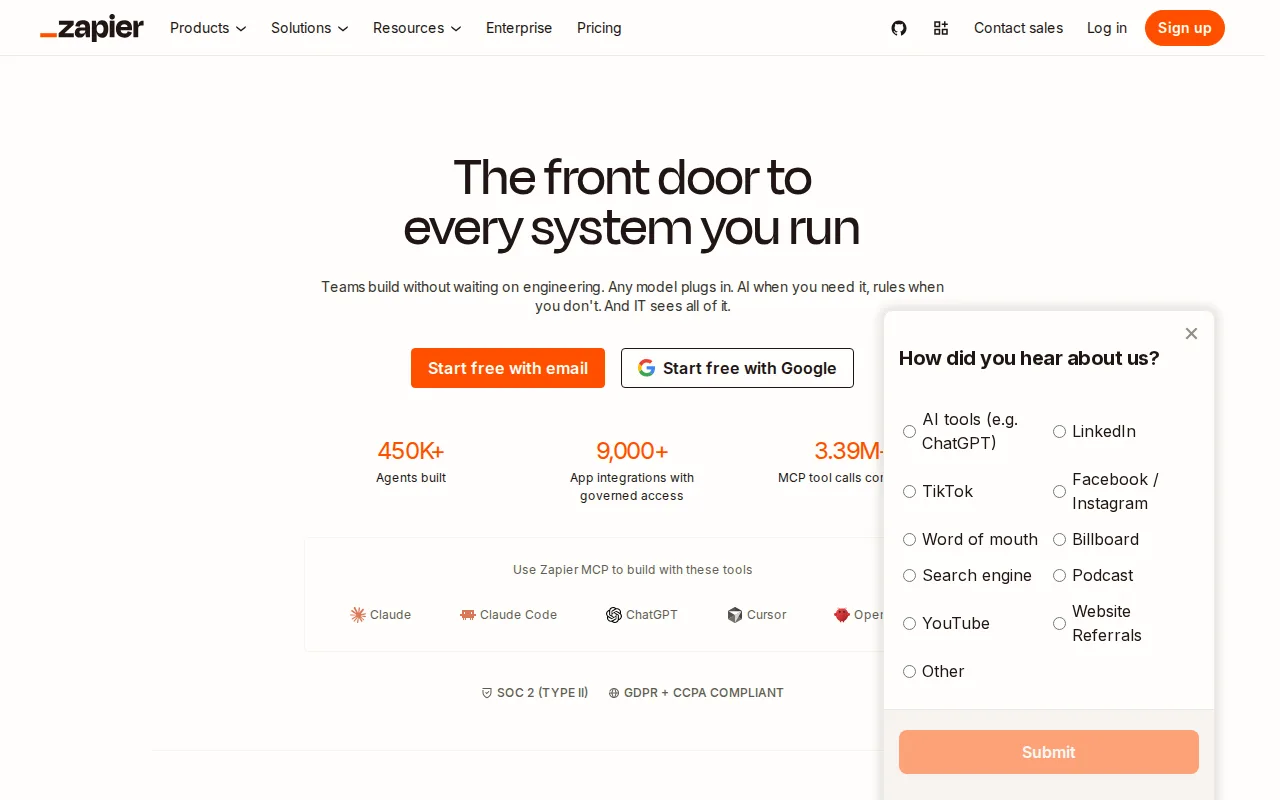
Zapier is the best Tray.ai alternative for non-developers and small operations teams that need to connect thousands of apps through simple trigger-action automations without engineering resources or a sales call. Zapier's Free plan covers 100 tasks/month at $0, and Professional then starts around $19.99/month billed annually for 750 tasks/month, a published, self-serve price point Tray.ai's own pricing page doesn't offer at any tier. Zapier's pre-built app-integration library is the broadest in workflow automation, covering thousands of connectors most teams already use, and it holds a 4.7/5 rating from 3,069 Capterra reviews, roughly 279 times the review volume of Tray.ai's own 4.9/5 from 11 Capterra reviews. AI-assisted Zap building and AI fields also reduce manual setup for common workflows. Tray.ai is still the better choice for IT-governed enterprise deployments that need role-based access control, audit trails, HIPAA compliance, and Merlin Agent Builder for MCP-based AI agent governance: Zapier's task-based pricing means cost scales directly with automation volume, and Team/Enterprise features like SSO require a meaningful jump in monthly cost over Professional.
Compared to Tray.ai: published self-serve pricing from $19.99/month vs Tray.ai's sales-quote-only tiers, broadest pre-built app-integration library in workflow automation, far more review volume (3,069 Capterra reviews vs 11)
Wins:Professional plan starts at a published $19.99/month for 750 tasks; Tray.ai publishes no dollar figures on any tier · Broadest pre-built app-integration library in workflow automation, covering thousands of connectors · 4.7/5 rating from 3,069 Capterra reviews, roughly 279 times the review volume of Tray.ai's own 11 Capterra reviews
Loses:No role-based access control, audit trails, or HIPAA compliance tier comparable to Tray.ai's Enterprise governance features · No Merlin Agent Builder or Agent Gateway equivalent for governing MCP-based AI agents in production · Task-based pricing means cost scales directly with automation volume, and high-frequency workflows can get expensive fast
Pros
- Free plan supports real two-step automations, not just a trial, at 100 tasks/month.
- Broadest app-integration library among no-code automation tools, covering thousands of connectors.
- AI-assisted Zap building and AI fields reduce the manual setup needed for common workflows.
- Multi-step Zaps with filters, paths, and webhooks cover moderately complex logic without custom code.
Cons
- Task-based pricing means cost scales directly with automation volume, and high-frequency workflows can get expensive fast.
- Unused monthly tasks don't roll over, unlike some competitors' credit systems.
- Team and Enterprise features like SSO and shared workflows require a meaningful jump in monthly cost over Professional.
- Complex multi-branch logic can be harder to debug in Zapier's linear Zap editor than in visual-flow competitors like Make.
Pricing: Free tier · paid from $19.99/mo — $19.99/month Professional (750 tasks) vs Tray.ai's custom-quoted Pro tier (no published price) (verified undefined NaN, NaN)
4.Workato — best Tray.ai alternative for enterprise IT and operations teams that need governed, auditable integrations across 1,000+ apps with AI agent orchestration, not self-serve no-code automation for individuals
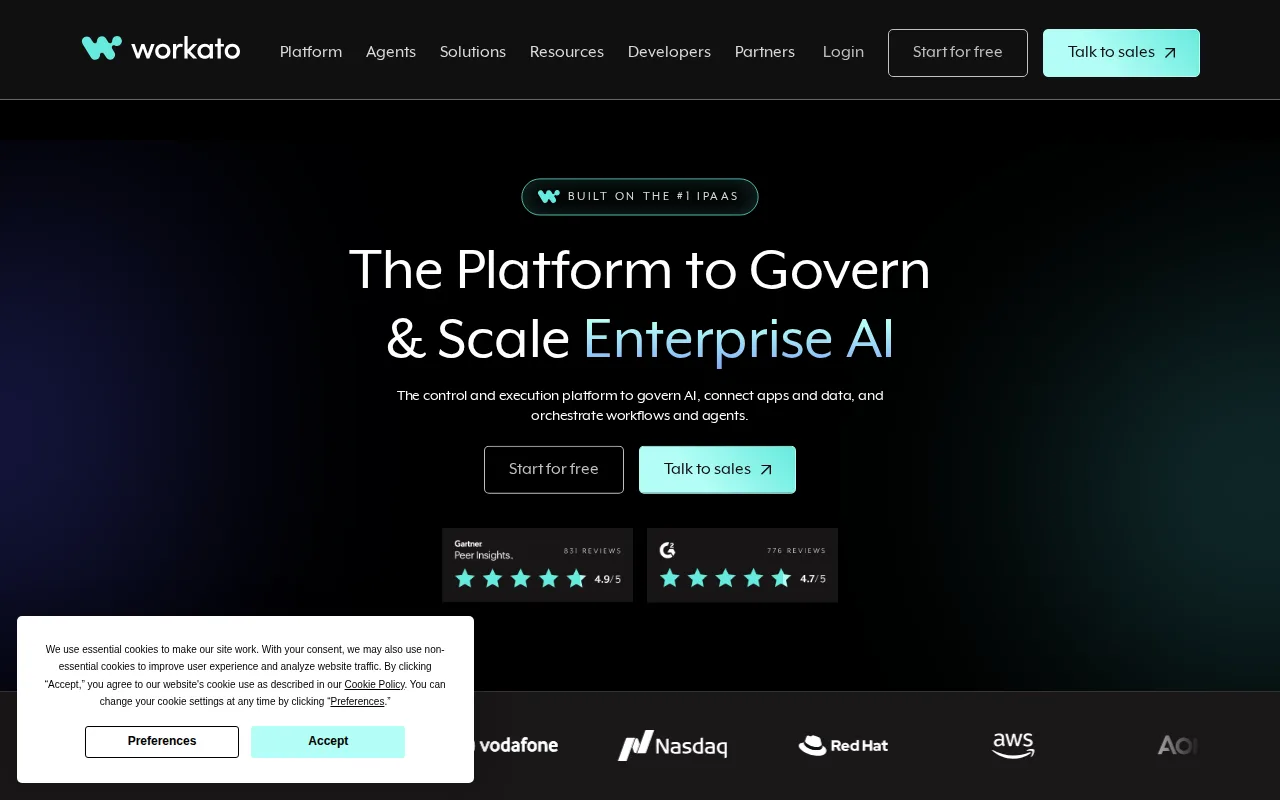
Workato is the best Tray.ai alternative for enterprise IT and operations teams that need governed, auditable integrations across 1,000+ connectors with AI agent orchestration layered on the same infrastructure, closely matching Tray.ai's own enterprise-governance positioning. Both platforms share the same quote-only pricing model: Workato's public pricing page, like Tray.ai's, contains no tier names or dollar amounts and routes every visitor to a demo request or sales conversation. Workato's customer base skews toward Fortune 500 and large mid-market companies, with roughly half of the Fortune 500 cited as customers, a scale signal comparable to Tray.ai's own enterprise focus. Workato holds a 4.6/5 rating from 85 Capterra reviews, more review volume than Tray.ai's own 4.9/5 from 11 Capterra reviews. Tray.ai is still the better choice for buyers who specifically want Merlin Agent Builder's named MCP-governance tooling: neither Workato nor Tray.ai publish a confirmed free tier, and Workato's enterprise focus and governance layer add complexity that is overkill for small teams or simple automations, the same complexity tradeoff Tray.ai's own listing acknowledges about itself.
Compared to Tray.ai: 1,000+ pre-built connectors vs Tray.ai's 700+, roughly half of the Fortune 500 cited as customers, more review volume (85 Capterra reviews vs 11)
Wins:1,000+ pre-built connectors covering major enterprise systems (Salesforce, NetSuite, Workday, ServiceNow), more than Tray.ai's 700+ connector count · Roughly half of the Fortune 500 cited as customers, a scale signal comparable to Tray.ai's own enterprise focus · 85 Capterra reviews (4.6/5), more review volume than Tray.ai's own 11 Capterra reviews
Loses:No published pricing whatsoever, the same quote-only limitation as Tray.ai itself, so neither platform lets buyers self-serve a price comparison · No confirmed free tier, unlike Zapier, Make, or n8n, matching the same gap in Tray.ai's own listing · Steeper learning curve reflecting its IT-department target audience, a complexity tradeoff Tray.ai's own listing also acknowledges for itself
Pros
- Enterprise-grade governance (RBAC, audit logs, environment management) that consumer automation tools typically lack.
- 1,000+ pre-built connectors covering major enterprise systems like Salesforce, NetSuite, Workday, and ServiceNow.
- AI agent orchestration built on the same connector and recipe infrastructure as traditional integrations.
- Trusted by roughly half of the Fortune 500, indicating proven scale for large, complex integration needs.
Cons
- No public, self-serve pricing; every plan requires a sales conversation to get a number.
- Enterprise focus and governance layer add complexity that is overkill for small teams or simple automations.
- No confirmed free tier, unlike Zapier, Make, or n8n, which all offer a usable free plan.
- Steeper learning curve than no-code-first competitors, reflecting its IT-department target audience.
Pricing: Pricing not verified
5.n8n — best Tray.ai alternative for technical teams that want to mix visual workflow building with custom code, either self-hosted for full control or on cloud paying per execution instead of per step
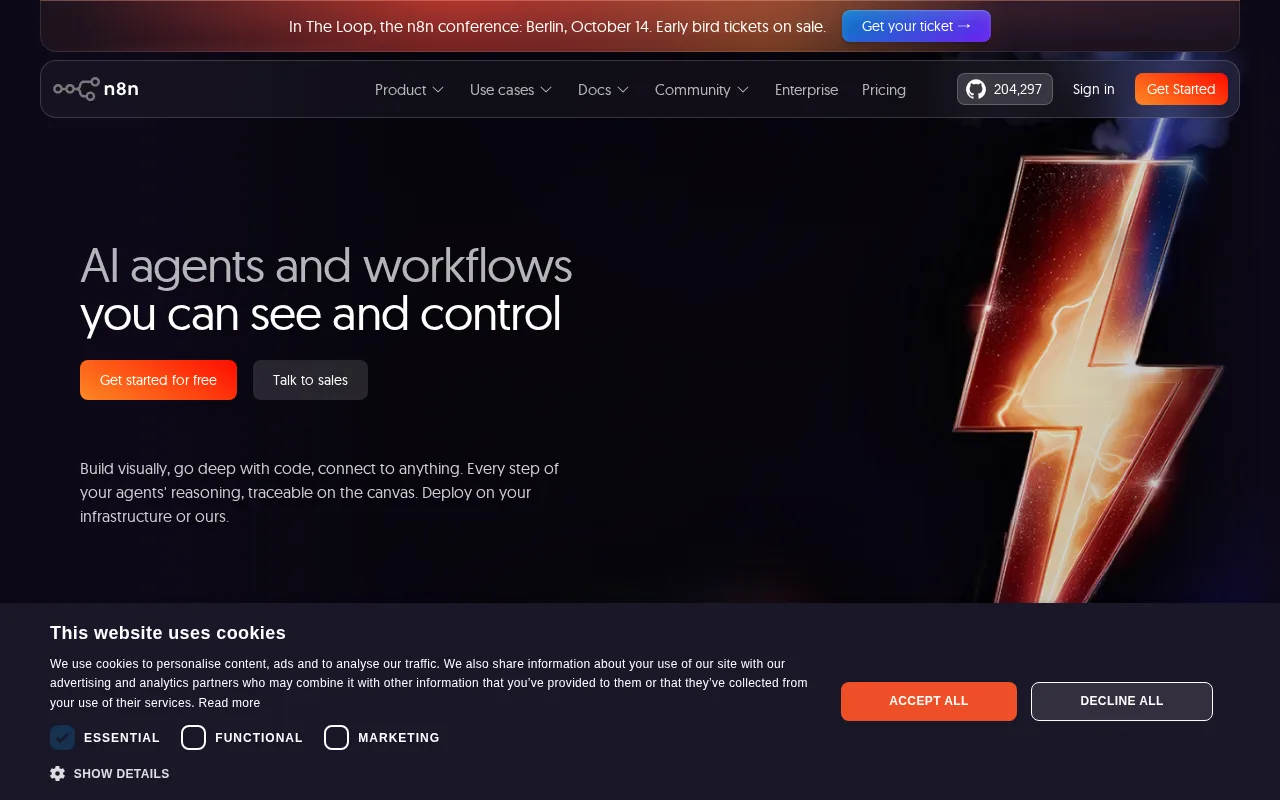
n8n is the best Tray.ai alternative for technical teams that want to self-host a full-featured automation engine for free, rather than committing to Tray.ai's sales-quote-only, cloud-only model. n8n's Self-hosted Community edition costs $0 via Docker under the Sustainable Use License, with the same core automation engine as its paid cloud tiers, something Tray.ai doesn't offer at any price since every tier, including entry-level Pro, requires a sales conversation. n8n's cloud Starter tier costs €20/month for 2,500 workflow executions, and every node can be extended or replaced with custom JavaScript or Python code, giving technical teams a flexibility Tray.ai's more IT-governed recipe builder doesn't emphasize. n8n holds a 4.6/5 rating from 48 Capterra reviews, more than 4 times the review volume of Tray.ai's own 4.9/5 from 11 Capterra reviews. Tray.ai is still the better choice for enterprises that need RBAC, audit trails, HIPAA compliance, and Merlin Agent Builder for governing MCP-based AI agents at scale: n8n's Sustainable Use License is not OSI-approved open source, and its cloud pricing jumps sharply from Pro (€50/month) to Business (€667/month) with nothing in between.
Compared to Tray.ai: free, fully-featured self-hosted Community edition vs Tray.ai's sales-quote-only access at every tier, every node can be extended with custom JavaScript or Python code, more review volume (48 Capterra reviews vs 11)
Wins:Free, fully-featured self-hosted Community edition via Docker; Tray.ai has no free tier and requires a sales conversation for every plan · Every node can be extended or replaced with custom JavaScript or Python code, more flexibility than Tray.ai's more IT-governed recipe builder emphasizes · 4.6/5 rating from 48 Capterra reviews, more than 4 times the review volume of Tray.ai's own 11 Capterra reviews
Loses:No RBAC, audit trails, or HIPAA compliance tier comparable to Tray.ai's Enterprise governance features · No Merlin Agent Builder or Agent Gateway equivalent for governing MCP-based AI agents in production · Sustainable Use License is not OSI-approved open source, and cloud pricing jumps sharply from Pro (€50/month) to Business (€667/month) with nothing in between
Pros
- Bills per full workflow execution, not per step, which can be cheaper than per-task pricing for complex automations.
- Free, fully-featured self-hosted Community edition via Docker with the complete automation engine.
- Every node can be extended or replaced with custom JavaScript or Python code.
- 500+ pre-built app integrations plus native support for building multi-agent AI workflows with human-in-the-loop steps.
Cons
- Large price jump between Pro (€50/month) and Business (€667/month) cloud tiers, with nothing in between.
- Sustainable Use License is not OSI-approved open source; enterprise features require a separate commercial license even for self-hosted use.
- Self-hosting requires managing your own Docker infrastructure, updates, and scaling, unlike a fully managed cloud automation tool.
- Visual canvas can get cluttered on large workflows with many branches and custom code nodes.
Pricing: Free — €20/month Starter (or $0 self-hosted) vs Tray.ai's custom-quoted Pro tier (no published price) (verified undefined NaN, NaN)
6.Boomi — best Tray.ai alternative for mid-size to enterprise IT teams that need to connect many pre-built enterprise applications (SAP, Salesforce, ServiceNow, Workday) through a low-code integration builder rather than custom code
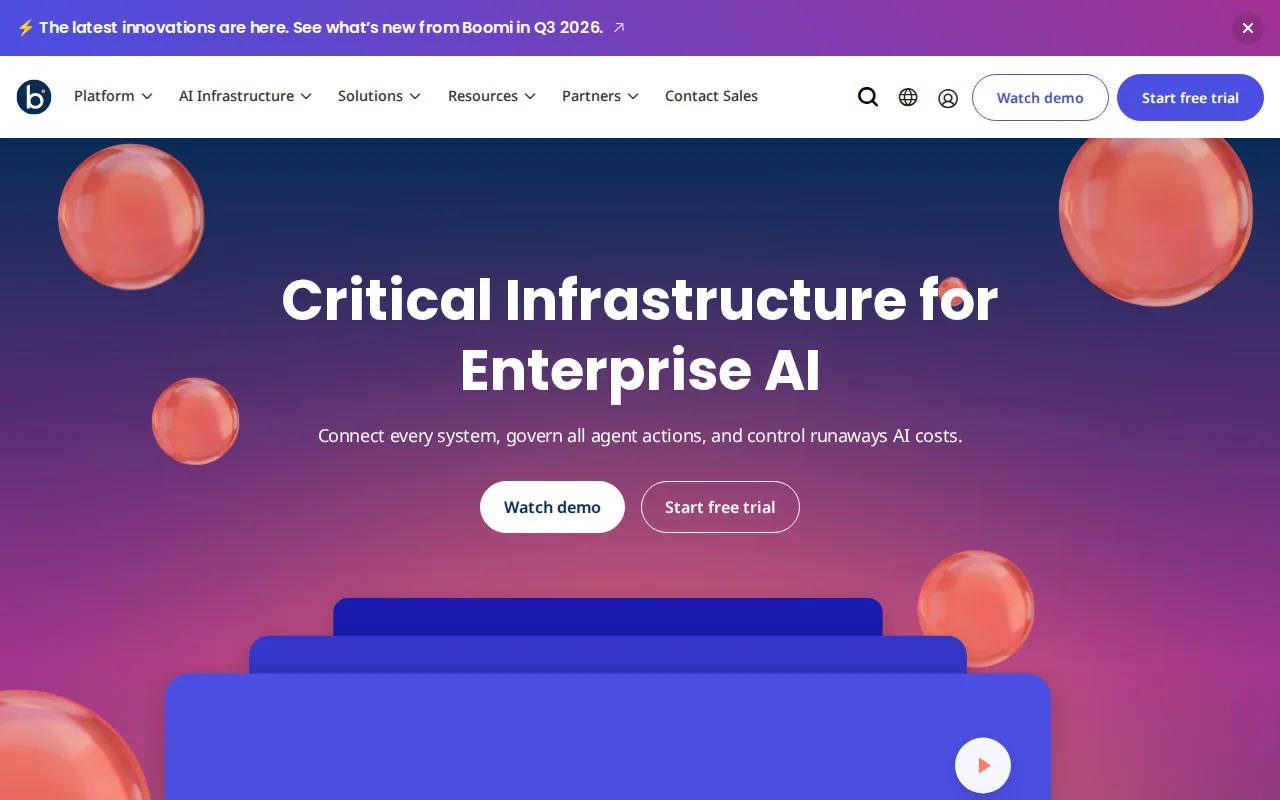
Boomi is the best Tray.ai alternative for enterprise IT teams that want to connect 1,000+ pre-built enterprise application connectors (SAP, Salesforce, ServiceNow, Workday) starting from a published price, rather than Tray.ai's fully quote-only model. Boomi's Data Integration Base tier costs $99/month pay-as-you-go with no long-term contract required, a concrete published starting price Tray.ai doesn't offer at any tier, including its entry-level Pro plan. Boomi has been named a Leader in Gartner's Magic Quadrant for iPaaS for 12 consecutive years, and its newer Agentstudio product extends the platform into AI agent governance with Model Context Protocol (MCP) support, closely comparable to Tray.ai's own Merlin Agent Builder and Agent Gateway. Boomi's 30-day free trial covers core integration features, data mapping, and basic API management. Tray.ai is still the better choice for buyers who want any independent review evidence to compare: Boomi has no external ratings recorded in its own listing, versus Tray.ai's 4.9/5 from 11 Capterra reviews, and almost all Boomi pricing above the $99/month Base tier is hidden behind a custom sales quote, just as steep a wall as Tray.ai's own fully quote-only pricing.
Compared to Tray.ai: published $99/month Base tier vs Tray.ai's fully quote-only pricing at every tier, named a Gartner Magic Quadrant Leader for iPaaS for 12 consecutive years, Agentstudio adds MCP-based AI agent governance comparable to Tray.ai's Agent Gateway
Wins:Data Integration Base tier costs a published $99/month pay-as-you-go with no long-term contract; Tray.ai publishes no dollar figures on any tier · Named a Leader in Gartner's Magic Quadrant for iPaaS for 12 consecutive years · Agentstudio adds AI agent governance with Model Context Protocol (MCP) support, closely comparable to Tray.ai's own Merlin Agent Builder and Agent Gateway
Loses:No external ratings recorded in its own listing, versus Tray.ai's 4.9/5 from 11 Capterra reviews · Pricing above the $99/month Base tier is entirely custom-quoted, just as steep a wall as Tray.ai's own fully quote-only pricing · 30-day trial covers only core features, not the full API Management or Data Hub product lines
Pros
- Low-code builder connects over 1,000 pre-built enterprise application connectors including SAP, Salesforce, and Workday.
- Named a Leader in Gartner's Magic Quadrant for iPaaS for 12 consecutive years.
- Agentstudio adds AI agent governance with MCP support on the same platform used for integration.
- Base tier starts at a published $99/month with no long-term contract, unlike many enterprise iPaaS competitors.
Cons
- Pricing above the Base tier is entirely custom-quoted, with no published numbers for Professional, Enterprise, or higher tiers.
- Usage-based charges on top of the Base subscription make total monthly cost hard to predict in advance.
- Steep learning curve for teams new to enterprise iPaaS concepts like Atoms, connectors, and process orchestration.
- 30-day trial covers only core features, not the full API Management or Data Hub product lines.
Pricing: From $99/mo — $99/month Data Integration Base vs Tray.ai's custom-quoted Pro tier (no published price)
Which one is right for you?
- You want visual, branching automation with published self-serve pricing instead of a sales callMake
- You're a developer who wants to drop real code into workflow stepsPipedream
- You want the broadest pre-built app-integration library without engineering resourcesZapier
- You need enterprise governance and 1,000+ connectors but still want some independent reviews to checkWorkato
- You want to self-host a free, code-extensible automation enginen8n
- You want a published entry-level price on an enterprise iPaaS with Gartner Leader recognitionBoomi
- You need MCP-based AI agent governance comparable to Tray.ai's Agent Gateway but at a published starting priceBoomi
Frequently asked questions
Is there a free alternative to Tray.ai?
- Yes — Make, Pipedream, Zapier, and n8n all offer a $0 free tier (n8n's is a fully-featured self-hosted Community edition), unlike Tray.ai, which has no free tier at any level, only a time-limited trial.
What is the closest alternative to Tray.ai?
- Workato is the closest match on positioning: it shares Tray.ai's enterprise governance focus, 1,000+ connector library, and the same quote-only pricing model with no published dollar figures.
Can Zapier replace Tray.ai?
- Yes for teams that don't need IT-governed integrations, since Zapier's broad connector library and published pricing (from $19.99/month) beat Tray.ai's sales-only model, but enterprises needing RBAC, audit trails, and HIPAA compliance should stay with Tray.ai.
Which Tray.ai alternative also builds and governs AI agents?
- Boomi's Agentstudio and Pipedream's MCP servers both extend into AI agent governance, and Boomi's Agentstudio specifically adds Model Context Protocol support comparable to Tray.ai's own Merlin Agent Builder and Agent Gateway.
Which Tray.ai alternative is free and self-hostable?
- n8n, whose Self-hosted Community edition runs the same core automation engine as its paid cloud tiers for free via Docker under the Sustainable Use License.
Why is it hard to compare Tray.ai's price against competitors?
- Tray.ai's biggest cited weakness is that it publishes no dollar figures anywhere on its site, so every tier, including entry-level Pro, requires a sales conversation and custom quote before a buyer can compare costs.