Zapier — A no-code automation platform connecting thousands of apps through 'Zap' workflows, free for 100 tasks/month or from about $20/month billed annually for more volume.

By Noahlast updated pricing verified
Zapier screenshots & video
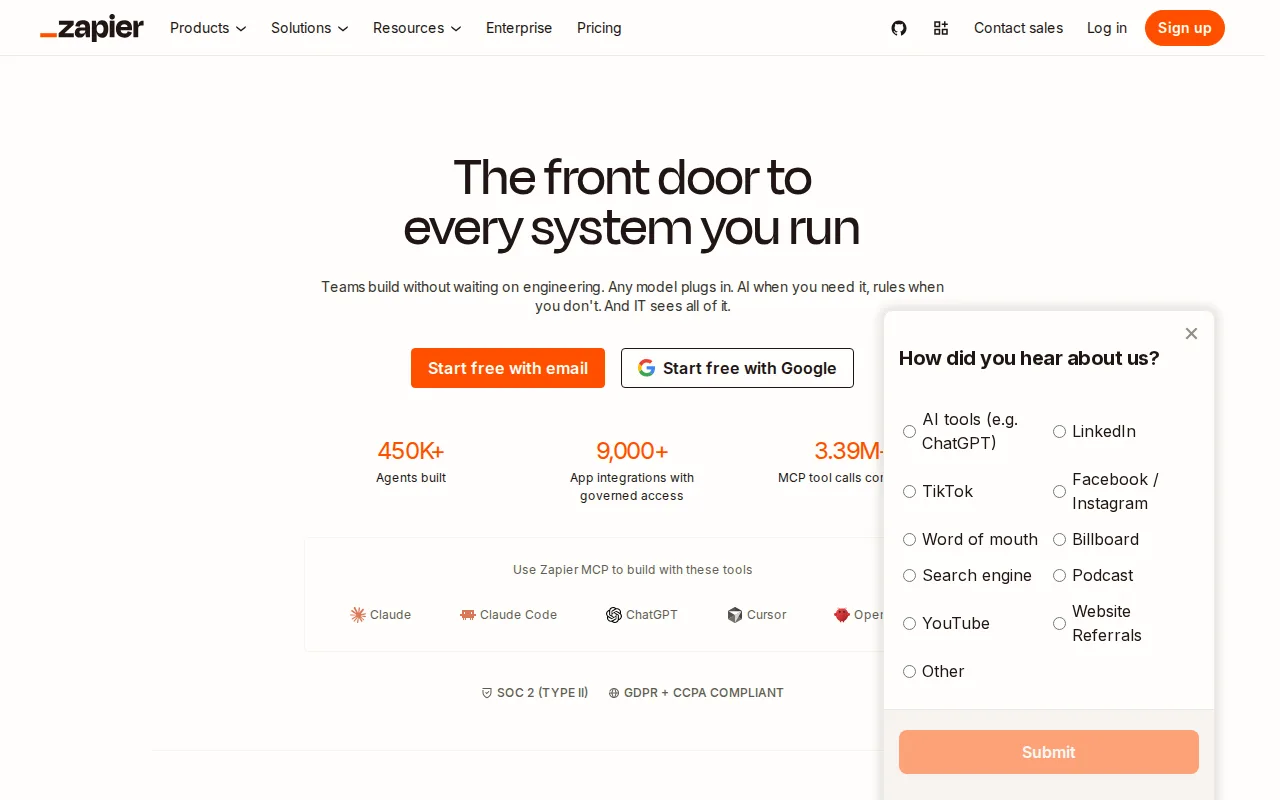
Zapier in 20 seconds
Best for: non-developers who need to connect many different apps through simple automations without engineering resources
Pricing: Free for 100 tasks/month; Professional starts at $19.99/month billed annually for 750 tasks/month, scaling with task volume.
- Zapier's Free plan includes 100 tasks/month with two-step Zaps only.
- Professional starts at $19.99/month billed annually for 750 tasks/month and scales up to $2,199/month for 1 million tasks/month.
- Team plans start at $69/month billed annually for 2,000 tasks/month and add SSO and shared workflows.
- Pricing is metered by 'tasks' (each action a Zap performs), not just by user seats.
- Zapier holds a 4.7/5 rating from 3,069 reviews on Capterra.
Limitations: Cost scales directly with task volume, which can get expensive for high-frequency automations.; Unused monthly tasks don't roll over between billing periods.; SSO and shared team workflows require the Team tier, a meaningful cost jump over Professional.; Linear Zap editor can be harder to debug for complex branching logic than visual-flow competitors.
Top alternatives: Make, n8n, Microsoft Power Automate, Workato — full list
What is Zapier?
Zapier is a workflow automation platform: users build 'Zaps,' automations triggered by an event in one app (a new email, a form submission, a calendar event) that perform actions in one or more other connected apps, without writing code. Pricing is metered by 'tasks,' each action a Zap performs counts as one task, so cost scales with automation volume rather than just user seats, and unused monthly tasks don't roll over. Beyond basic two-step Zaps available on the Free plan, paid tiers unlock multi-step workflows, filters and conditional paths, webhooks, and AI-assisted Zap building. Zapier also sells separate add-on products, Zapier Agents and Zapier Chatbots, billed on their own usage-based pricing rather than the core task allowance.
Zapier is a no-code automation platform that connects apps through trigger-and-action workflows called Zaps, letting non-developers automate tasks like syncing leads from a form into a CRM or posting Slack alerts from new spreadsheet rows. The Free plan covers 100 tasks/month with two-step Zaps; Professional starts around $19.99/month billed annually at 750 tasks/month and scales with task volume up to $2,199/month for 1 million tasks, while Team adds shared workflows and SSO starting near $69/month billed annually at 2,000 tasks. Zapier differentiates on its breadth of app integrations (thousands of pre-built connectors) and AI-assisted workflow building, and competes with Make and n8n on price-per-task and with Microsoft Power Automate for teams standardized on Microsoft 365.
Standout feature: The largest pre-built app-integration library in workflow automation, with thousands of supported apps, so most tools a team already uses can be connected without custom API work.
Biggest weakness: Pricing is metered by task volume, not just seats, so cost rises quickly for high-volume automations, and moving from 750 to 2,000 tasks/month on Professional roughly doubles the monthly bill; unused tasks don't roll over between billing periods.
Pros
- Free plan supports real two-step automations, not just a trial, at 100 tasks/month.
- Broadest app-integration library among no-code automation tools, covering thousands of connectors.
- AI-assisted Zap building and AI fields reduce the manual setup needed for common workflows.
- Multi-step Zaps with filters, paths, and webhooks cover moderately complex logic without custom code.
Cons
- Task-based pricing means cost scales directly with automation volume, and high-frequency workflows can get expensive fast.
- Unused monthly tasks don't roll over, unlike some competitors' credit systems.
- Team and Enterprise features like SSO and shared workflows require a meaningful jump in monthly cost over Professional.
- Complex multi-branch logic can be harder to debug in Zapier's linear Zap editor than in visual-flow competitors like Make.
Zapier pricing
Free tier · paid from $19.99/mo · verified from the vendor's pricing page
| Plan | Price | Notes |
|---|---|---|
| Free | Free | 100 tasks/month, two-step Zaps only, unlimited Zaps, basic AI access. |
| Professional | $19.99/mo | Billed annually for 750 tasks/month ($29.99/month billed monthly); multi-step Zaps, unlimited premium apps, webhooks, AI fields, filters and paths; price rises with task volume up to $2,199/month for 1M tasks/month. |
| Team | $69/mo | Billed annually for 2,000 tasks/month ($103.50/month billed monthly); everything in Professional plus 25 users, shared Zap workflows, SAML SSO, priority support. |
| Enterprise | Custom | Custom pricing, unlimited users; advanced admin controls, SCIM provisioning, custom data retention, observability. |
What reviewers say
Scores belong to their platforms; we display them with attribution and never fold them into our own ratings.