Workato — Enterprise iPaaS for integration, workflow automation, and AI agent orchestration across 1,000+ connectors, with quote-only pricing.

By Noahlast updated
Workato screenshots & video
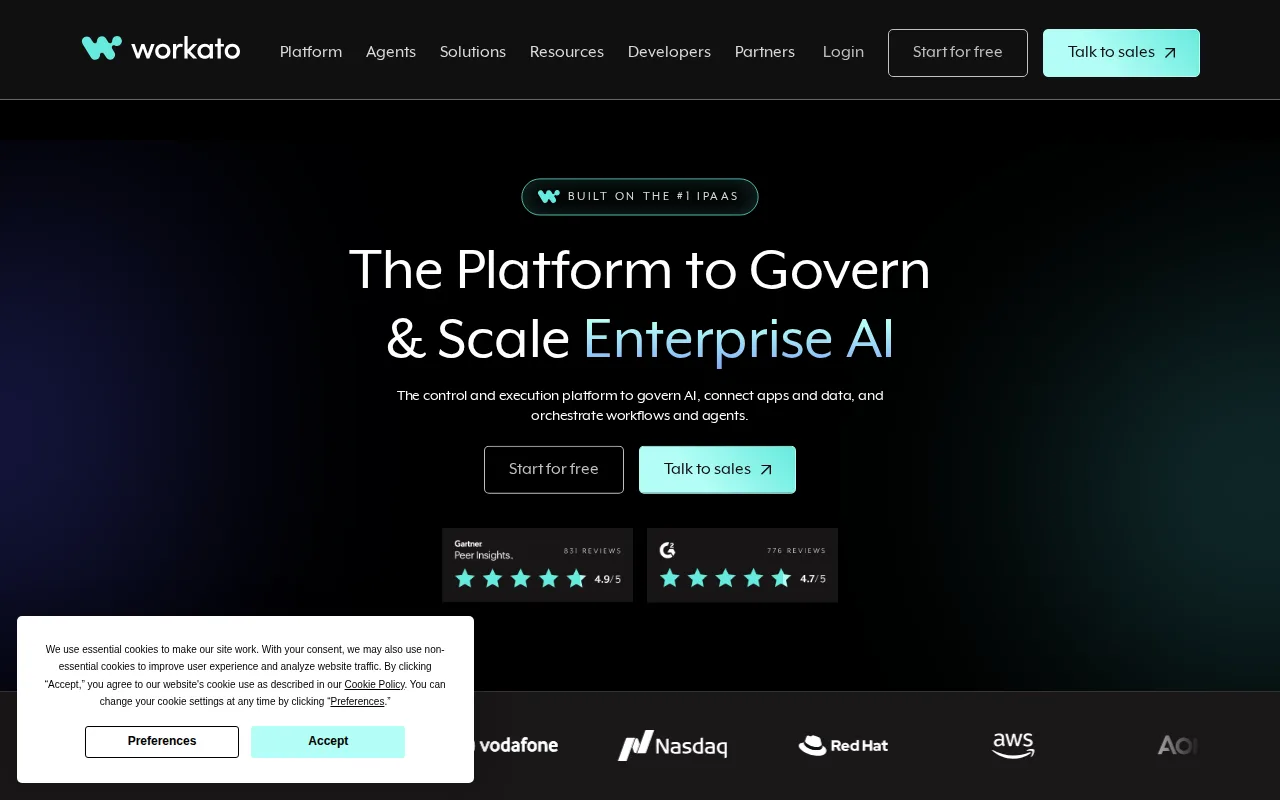
Workato in 20 seconds
Best for: enterprise IT and operations teams needing governed, auditable integrations across many apps
Pricing: No public pricing; quote-based, sales-driven, no confirmed free tier.
- Workato is an enterprise iPaaS with 1,000+ pre-built connectors.
- Roughly half of the Fortune 500 are cited as Workato customers.
- Workato publishes no self-serve pricing; the pricing page routes every visitor to a demo or sales conversation.
- Workato holds a 4.6/5 rating from 85 reviews on Capterra.
- Workato includes AI agent orchestration built on its existing connector and recipe infrastructure.
Limitations: No public, self-serve pricing is available anywhere on the site.; No confirmed free tier, unlike Zapier, Make, or n8n.; Enterprise governance focus makes it overkill for small teams or simple automations.
Top alternatives: Zapier, Make, Tray.io, Boomi, MuleSoft — full list
What is Workato?
Workato is an integration and workflow automation platform (iPaaS) built for enterprise IT and operations teams rather than individual users or small businesses. It connects 1,000+ applications through pre-built connectors and lets teams build "recipes" — trigger-and-action workflows — that move data and orchestrate processes across departments. What separates Workato from consumer-facing automation tools like Zapier is its enterprise governance layer: role-based access controls, audit logs, environment management (dev/test/prod), and the ability to package integrations as reusable, IT-approved building blocks that business users can self-serve from within guardrails. Workato has also added AI agent orchestration, letting teams build, deploy, and monitor AI agents that call the same connectors and recipes used for traditional integrations. Workato's customer base skews toward Fortune 500 and large mid-market companies, and half of the Fortune 500 are cited as customers. Pricing is entirely quote-based: the public pricing page contains no tier names, dollar amounts, or per-task rates, and every path leads to a sales conversation or demo request, consistent with how competing enterprise iPaaS platforms like Boomi and MuleSoft price.
Workato is an enterprise integration platform as a service (iPaaS) used by large organizations, including roughly half of the Fortune 500, to connect applications like Salesforce, NetSuite, Workday, and ServiceNow and orchestrate multi-step workflows across IT, finance, HR, sales, and support. It positions itself as a governance-focused alternative to point-to-point automation tools, adding capabilities to build and monitor AI agents alongside traditional integration recipes. Workato does not publish self-serve pricing: the pricing page shows no tier names or dollar figures and routes every visitor to a demo request or sales conversation, typical of enterprise iPaaS vendors that price by usage volume and negotiated contract. There is no confirmed free tier.
Standout feature: Enterprise governance controls (role-based access, audit logs, dev/test/prod environments) layered on top of no-code recipe building, letting IT approve reusable integrations that business teams then self-serve within guardrails.
Biggest weakness: No public pricing whatsoever: every tier, dollar figure, and usage metric is hidden behind a sales conversation, making it impossible to compare cost against competitors like Zapier or Make without engaging Workato's sales team first.
Pros
- Enterprise-grade governance (RBAC, audit logs, environment management) that consumer automation tools typically lack.
- 1,000+ pre-built connectors covering major enterprise systems like Salesforce, NetSuite, Workday, and ServiceNow.
- AI agent orchestration built on the same connector and recipe infrastructure as traditional integrations.
- Trusted by roughly half of the Fortune 500, indicating proven scale for large, complex integration needs.
Cons
- No public, self-serve pricing; every plan requires a sales conversation to get a number.
- Enterprise focus and governance layer add complexity that is overkill for small teams or simple automations.
- No confirmed free tier, unlike Zapier, Make, or n8n, which all offer a usable free plan.
- Steeper learning curve than no-code-first competitors, reflecting its IT-department target audience.
Workato pricing
Pricing not verified
What reviewers say
Scores belong to their platforms; we display them with attribution and never fold them into our own ratings.