6 Best Alternatives to Qualtrics in 2026
By Noahlast updated

From our data: All six Qualtrics alternatives publish prices and offer a free plan or free self-hosted edition, where Qualtrics publishes no price and has no free tier; the smallest listed paid plan on each costs between $7/month (one Google Workspace Business Starter seat) and $90/month (SurveyMonkey Team Advantage's 3-seat minimum), or $84 to $1,080 a year, against the roughly $6,500/year that third-party buyer data cites for the smallest Qualtrics deployments.
 SurveyMonkey
 LimeSurvey
 Jotform
 Formbricks
 Google Forms
How we picked
- Qualtrics publishes no prices, so its figures here come from the third-party buyer data in its listing: about $6,500/year for small deployments, around $650,000/year for average enterprise contracts, and $5,000-$20,000 for implementation. Every alternative publishes prices and was compared against that low end.
- Pricing was verified on-site on 14 September 2026 for SurveyMonkey, LimeSurvey, Typeform, Jotform, and Formbricks. The Google Forms Workspace prices and all Qualtrics figures carry no verification date.
- Review scores were read alongside sample sizes: Google Forms (4.7/5 from 11,534 Capterra reviews), SurveyMonkey (4.6/5 from 10,494), Jotform (4.7/5 from 2,919), and Typeform (4.7/5 from 974) have large samples, LimeSurvey has 4.4/5 from 50, and the Formbricks 5.0/5 rests on 2 Capterra and 23 Product Hunt reviews. Qualtrics's listing cites G2 averages around 4.3-4.4/5 split across several product pages, with no single score on record.
- None of the six covers Qualtrics's full CX, EX, and research platform, so each was matched to the part it replaces: SurveyMonkey for general survey programs, LimeSurvey for research methods, Typeform and Jotform for forms, Formbricks for in-product CX feedback, and Google Forms for free internal surveys.
- Free access and hosting control were checked against Qualtrics, which has no free tier: all six alternatives have a free plan, and LimeSurvey and Formbricks are the two that can be self-hosted at no cost.
Paid placement never alters editorial rank — read the full methodology.
Qualtrics alternatives at a glance
| Alternative | Best for | Learning curve | Price |
|---|---|---|---|
| Qualtricsreference | large enterprises running unified CX, EX, and market-research programs across many channels who have budget for a six-figure annual contract and dedicated admin resources | Steep | Custom pricing |
| SurveyMonkey | HR, customer-experience, and market-research teams that need to run surveys at volume and want response-based pricing rather than a flat per-seat fee | Low | Free tier · paid from $30/mo |
| LimeSurvey | academic researchers, market researchers, and public-sector or healthcare organizations that need advanced survey logic and GDPR-compliant data residency, whether self-hosted for free or on managed cloud | Moderate | Free tier · paid from $36/mo |
| Typeform | marketing and product teams that want higher form-completion rates through a conversational, one-question-at-a-time design and are willing to pay per response volume rather than per user | Low | Free tier · paid from $28/mo |
| Jotform | small businesses and individuals building surveys, applications, or payment-collecting forms who need more submission volume than Google Forms offers without Typeform's higher price | Low | Free tier · paid from $34/mo |
| Formbricks | product and CX teams that need GDPR-compliant, self-hostable in-product surveys with precise attribute-based targeting | Moderate | Free tier · paid from $74/mo |
| Google Forms | individuals and small teams who need a free, fast survey or intake form that dumps responses straight into a Google Sheet, without complex branching or payment collection | Low | Free tier · paid from $7/mo |
 Qualtrics
 Typeform
1SurveyMonkey — best Qualtrics alternative for HR, customer-experience, and market-research teams that need to run surveys at volume and want response-based pricing rather than a flat per-seat fee
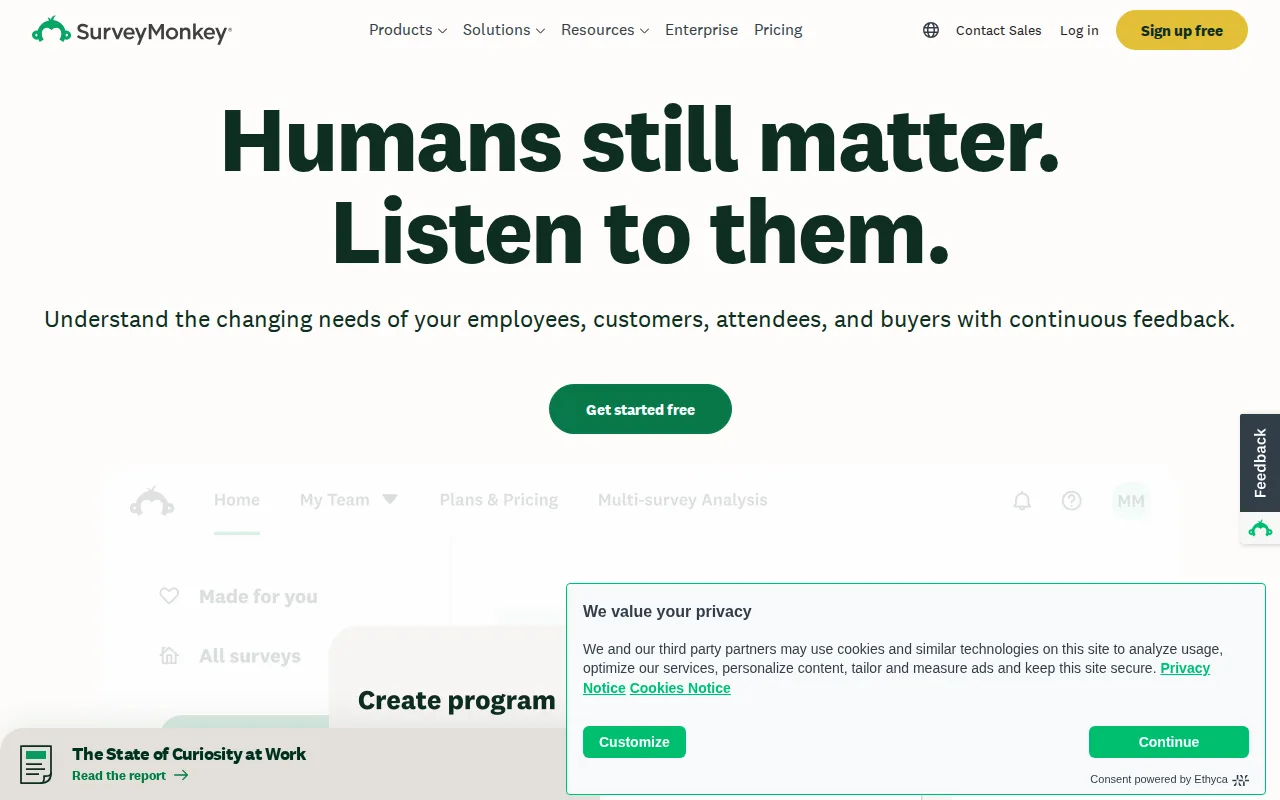
SurveyMonkey is the best Qualtrics alternative for HR, customer-experience, and market-research teams that run surveys at volume and want a price they can see before a sales call. SurveyMonkey publishes its plans: Team Advantage is $30/user/month billed annually with a 3-user minimum and 50,000 responses a year, and Team Premier is $92/user/month with 100,000 responses, white-label branding, advanced logic, multilingual surveys, and phone support. A 3-seat Team Advantage account costs $1,080/year, about a sixth of the roughly $6,500/year that third-party buyer data cites for the smallest Qualtrics deployments, before Qualtrics's $5,000-$20,000 implementation fees. SurveyMonkey adds a large library of validated templates, AI-assisted summaries of open-text answers, native iOS and Android apps for offline collection, a free plan, and 4.6/5 from 10,494 Capterra reviews. Its learning curve is rated low against Qualtrics's steep one. Qualtrics is still the better choice for enterprises that feed contact-center calls, store visits, and digital touchpoints into one analytics layer, or that rely on Experience Agents to trigger interventions automatically. SurveyMonkey's 3-user minimum penalizes a single power user, the jump from $30 to $92 per user is steep for one Premier feature, and responses beyond the annual cap cost $0.15 each.
Compared to Qualtrics: published plans from $30/user/month where Qualtrics quotes every deal, a 3-seat Team Advantage account at $1,080/year vs roughly $6,500/year for small Qualtrics deployments, no unified CX, EX, and research platform or Experience Agents in its listing
Wins:Published plans from $30/user/month billed annually, where Qualtrics prices every product line through a custom quote · A 3-seat Team Advantage account costs $1,080/year, about a sixth of the roughly $6,500/year cited for small Qualtrics deployments, with no implementation fee listed · 4.6/5 from 10,494 Capterra reviews, a free plan, native iOS and Android apps for offline collection, and a learning curve rated low against Qualtrics's steep one
Loses:No unified CX, EX, and market-research platform, Experience Agents, or synthetic-audience testing in its listing · Team plans require at least 3 users, and white-label branding and advanced logic need Team Premier at $92/user/month, a steep jump from $30 · Responses beyond the 50,000 or 100,000 annual cap bill at $0.15 each
Pros
- Free tier lets individuals test the product before committing to a paid seat.
- Large library of pre-validated survey templates and question types speeds up survey creation.
- AI-assisted survey summarization surfaces themes in open-text responses automatically.
- Native iOS and Android apps support offline survey collection at events and in the field.
Cons
- Team plans require a 3-user minimum, expensive for a single power user who wants Team-tier features.
- Jump from Team Advantage ($30/user/month) to Team Premier ($92/user/month) is steep for teams that need just one Premier-only feature like white labeling.
- Response overages beyond the annual cap bill at $0.15 per additional response, which can add up quickly for high-volume campaigns.
- Free plan question and response limits are restrictive enough that most real use cases require upgrading.
Pricing: Free tier · paid from $30/mo — $1,080/year for SurveyMonkey Team Advantage at its 3-user minimum ($30/user/month) vs roughly $6,500/year for the smallest Qualtrics deployments in third-party buyer data (verified September 14, 2026)
2LimeSurvey — best Qualtrics alternative for academic researchers, market researchers, and public-sector or healthcare organizations that need advanced survey logic and GDPR-compliant data residency, whether self-hosted for free or on managed cloud
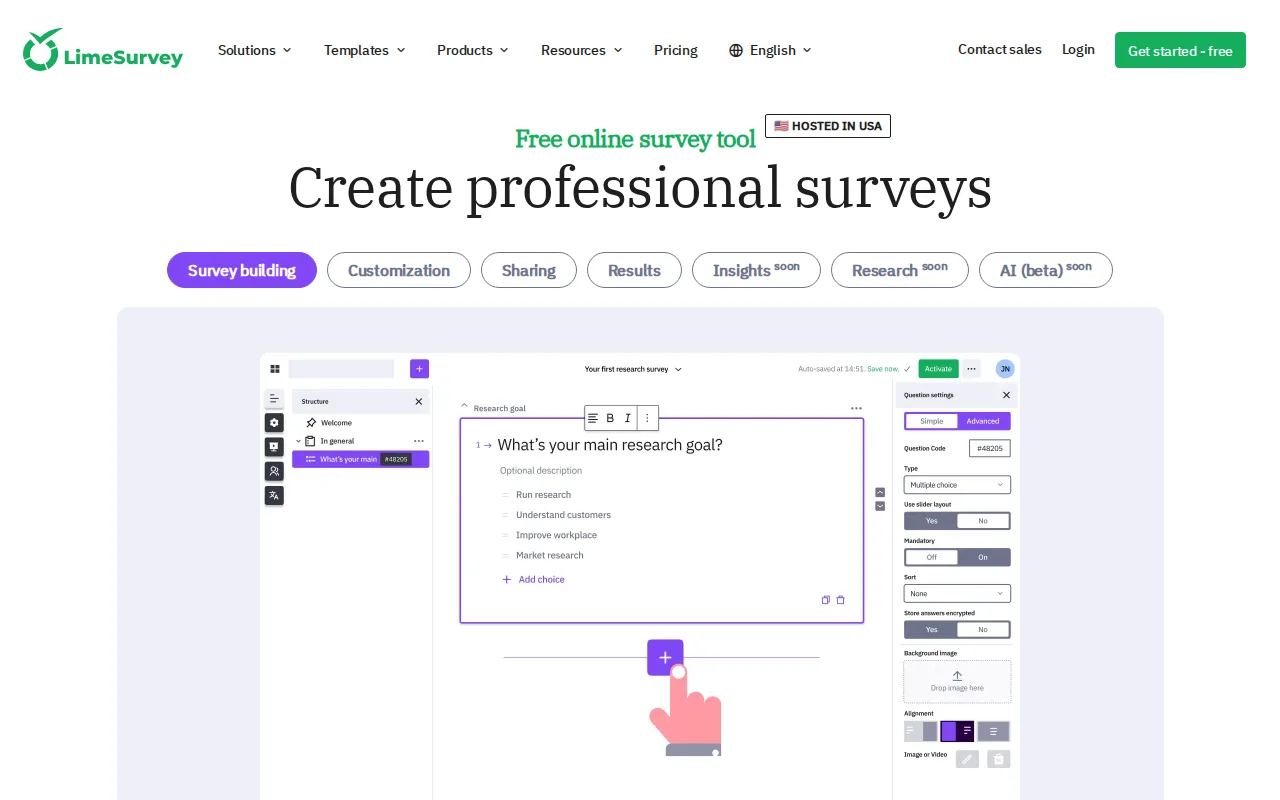
LimeSurvey is the best Qualtrics alternative for academic researchers, market researchers, and public-sector or healthcare teams that need research-grade methods and control over where data lives. LimeSurvey is open source under the GPL, and the self-hosted Community Edition is free with unlimited surveys and responses. It ships 800+ templates and 30+ question types, including conjoint analysis, MaxDiff, and heatmaps, plus GDPR tooling, WCAG 2.2 accessibility support, and 80+ languages for editors and respondents. Teams that do not want to run a server can use managed cloud in 7 regions, including the EU, US, UK, Canada, and Australia: Cloud Basic is $39/month, Expert is $432/year, and Business is $831/year, with 30-50% off for teachers, students, and charities. Even Cloud Business costs far less than the roughly $6,500/year cited for small Qualtrics deployments. Qualtrics is still the better choice for organizations that want AI text and sentiment analytics, Experience Agents, and CX and EX programs in one managed platform. Self-hosting LimeSurvey means maintaining your own server, updates, and security patches, Cloud Basic is capped at 1 admin user and 1,000 responses a month, SSO and SAML sit in a quote-only Corporate tier, and its 4.4/5 rating comes from just 50 Capterra reviews.
Compared to Qualtrics: open source under the GPL with a free, unlimited self-hosted edition, conjoint analysis, MaxDiff, and heatmaps across 30+ question types, Cloud Business at $831/year vs roughly $6,500/year for small Qualtrics deployments
Wins:Self-hosted Community Edition is free under the GPL with unlimited surveys and responses, where Qualtrics has no free tier · Research-grade question types, including conjoint analysis, MaxDiff, and heatmaps, with 800+ templates and 80+ languages · Managed cloud in 7 regions from $39/month, with Cloud Business at $831/year, a fraction of the roughly $6,500/year cited for small Qualtrics deployments
Loses:No AI text and sentiment analytics, Experience Agents, or CX and EX program tooling in its listing · Self-hosting means maintaining your own server, updates, and security patches, and Cloud Basic is capped at 1 admin user and 1,000 responses a month · SSO, LDAP, and SAML require the quote-only Corporate tier, and the 4.4/5 rating rests on 50 Capterra reviews
Pros
- Fully open source (GPL) and free to self-host, with no feature gating between free and Cloud tiers.
- 800+ templates and 30+ question types, including advanced methods like conjoint analysis and MaxDiff.
- GDPR compliance tooling and choice of 7 hosting regions for data residency requirements.
- 80+ language support for both survey creation and respondent-facing forms.
Cons
- Self-hosting requires managing your own server, updates, and security patches.
- Cloud Basic's entry tier is capped at 1 admin user and 1,000 responses/month, a tight limit for active research teams.
- Interface and survey-logic builder have a steeper learning curve than simpler form tools like Google Forms or Typeform.
- Corporate tier pricing (SSO, LDAP, SAML) is not published and requires a custom quote.
Pricing: Free tier · paid from $36/mo — $0 self-hosted or $831/year for LimeSurvey Cloud Business vs roughly $6,500/year for small Qualtrics deployments in third-party buyer data (verified September 14, 2026)
3Typeform — best Qualtrics alternative for marketing and product teams that want higher form-completion rates through a conversational, one-question-at-a-time design and are willing to pay per response volume rather than per user
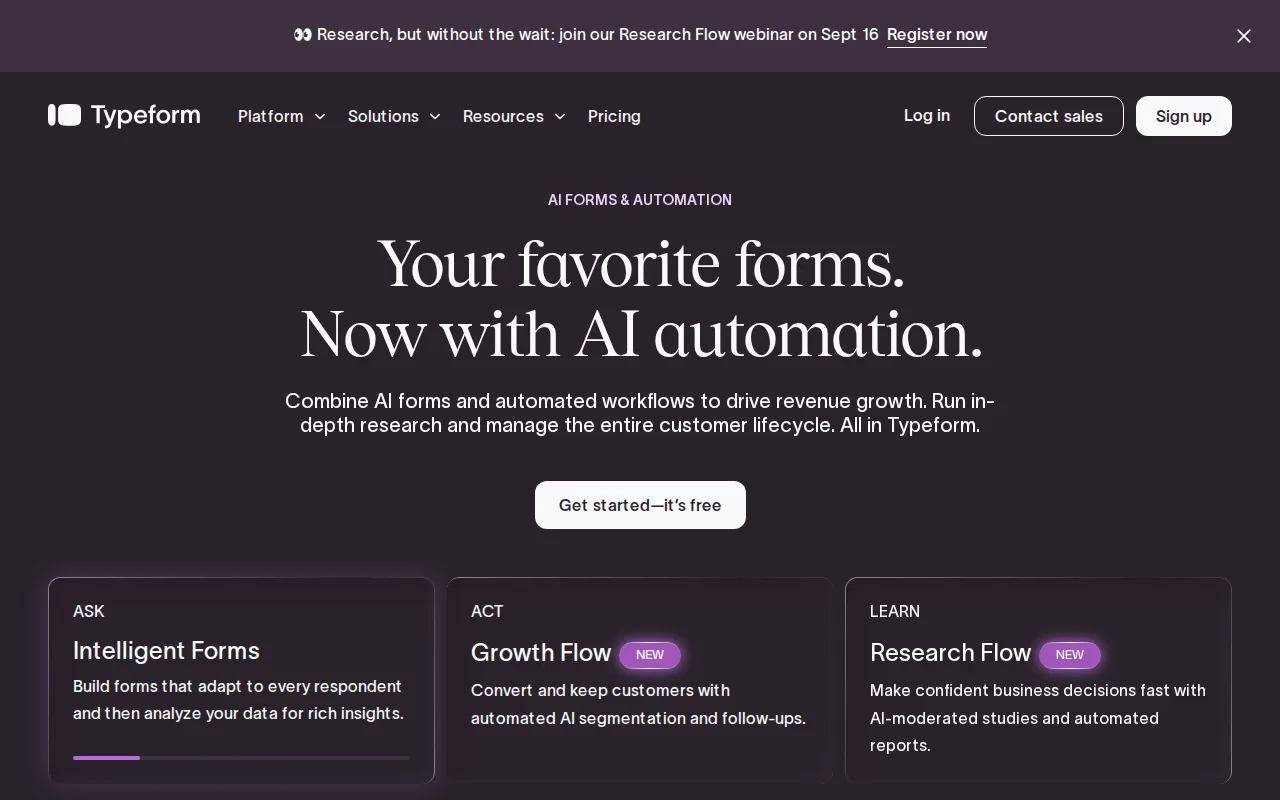
Typeform is the best Qualtrics alternative for marketing and product teams whose surveys live or die on completion rates. Typeform shows one question per screen instead of a scrolling form, a format its own data says increases completion rates for lead-generation and feedback forms. Its visual editor supports conditional logic, branching, and webhooks, paid plans add AI-powered form creation, and native integrations push responses to Salesforce, HubSpot, and Google Sheets. Prices are published and billed annually: Basic is $28/month for 100 responses a month, Plus is $56/month for 1,000 responses and 3 users with branding removed, and Business is $91/month for 10,000 responses, 5 users, and drop-off analytics. A year of Business costs $1,092, against the roughly $6,500/year cited for small Qualtrics deployments. Typeform holds 4.7/5 from 974 Capterra reviews, and its learning curve is rated low against Qualtrics's steep one. Qualtrics is still the better choice for research programs that need analytics depth rather than a polished respondent experience. Typeform's free plan was cut to 10 responses a month in February 2026, response caps force upgrades even for one-person teams, branding removal starts at Plus, and there is no native mobile app. Its listing also includes no text analytics, Experience Agents, or employee-experience tooling.
Compared to Qualtrics: one question per screen, a format Typeform's own data ties to higher completion rates, Business at $91/month billed annually ($1,092/year) vs roughly $6,500/year for small Qualtrics deployments, a free plan cut to 10 responses a month and no text analytics in its listing
Wins:One-question-per-screen format that Typeform's own data says raises completion rates on lead-generation and feedback forms · Published plans from $28/month billed annually, with Business at $91/month ($1,092/year) for 10,000 responses a month, where Qualtrics quotes every deal · 4.7/5 from 974 Capterra reviews, native Salesforce, HubSpot, and Google Sheets integrations, and a learning curve rated low against Qualtrics's steep one
Loses:Free plan was cut from 100 to 10 responses a month in February 2026, and response caps force upgrades regardless of team size · No native mobile app, and branding removal requires Plus at $56/month billed annually · No text and sentiment analytics, Experience Agents, or employee-experience tooling in its listing
Pros
- One-question-at-a-time format is widely cited as improving form completion rates versus traditional scrolling forms.
- AI-powered form creation on paid plans speeds up building forms from a prompt or existing document.
- Native integrations with Salesforce, HubSpot, and Google Sheets avoid manual data export.
- Annual billing cuts the effective monthly price by roughly 30% versus month-to-month across every tier.
Cons
- Free plan responses were cut from 100/month to 10/month in a February 2026 change, making it impractical for anything beyond testing.
- Pricing scales on response volume, not just users, so a single popular form can force an upgrade regardless of team size.
- No native mobile app; form building and management are web-only, unlike SurveyMonkey's dedicated iOS/Android apps.
- Branding removal requires the Plus tier ($56/month annually), unlike some competitors that include it at the entry paid tier.
Pricing: Free tier · paid from $28/mo — $91/month for Typeform Business billed annually ($1,092/year, 10,000 responses/month) vs roughly $6,500/year for small Qualtrics deployments in third-party buyer data (verified September 14, 2026)
4Jotform — best Qualtrics alternative for small businesses and individuals building surveys, applications, or payment-collecting forms who need more submission volume than Google Forms offers without Typeform's higher price
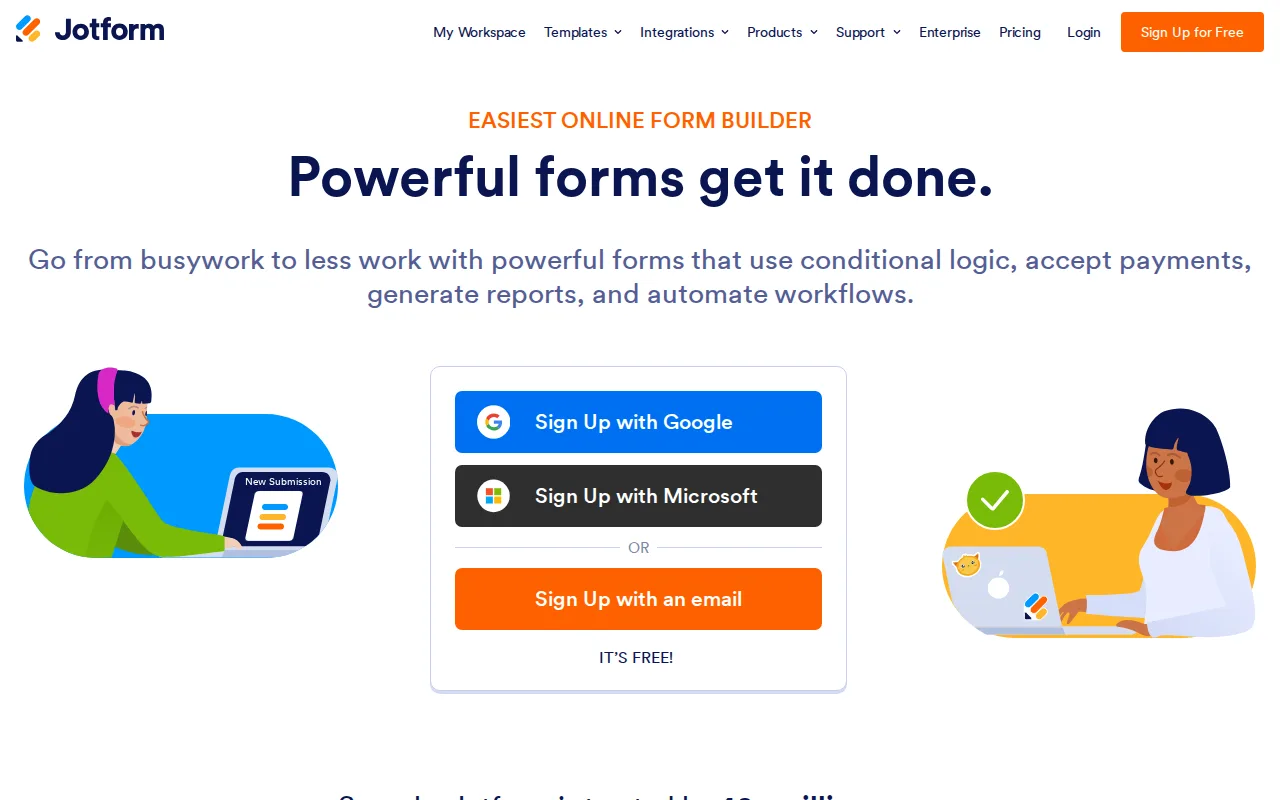
Jotform is the best Qualtrics alternative for small businesses, clinics, and nonprofits whose surveys double as applications, registrations, or order forms. Jotform's drag-and-drop editor adds conditional logic, file uploads, e-signatures, and built-in payment collection through Stripe, PayPal, and others, and its Gold plan includes HIPAA-friendly form handling for healthcare intake. The free Starter plan covers 5 active forms and 100 submissions a month, and paid plans are published: Bronze is $34/month billed annually ($408/year) for 1,000 submissions, Silver $39/month ($468/year) for 2,500, and Gold $99/month ($1,188/year) for 10,000 submissions. Nonprofits and schools get 50% off those tiers. Gold costs less than a fifth of the roughly $6,500/year cited for small Qualtrics deployments. Jotform holds 4.7/5 from 2,919 Capterra reviews, runs on web, iOS, and Android, and has a learning curve rated low against Qualtrics's steep one. Qualtrics is still the better choice for analyzing feedback rather than collecting it. Jotform's listing includes no text or sentiment analytics or Experience Agents, and its submission caps apply account-wide, so one busy form can block every other form until the next cycle. Branding stays on until Bronze, and Enterprise pricing for unlimited use requires a sales conversation.
Compared to Qualtrics: built-in Stripe and PayPal payments, e-signatures, and HIPAA-friendly handling on Gold, Gold at $1,188/year vs roughly $6,500/year for small Qualtrics deployments, account-wide submission caps and no text analytics in its listing
Wins:Payment collection through Stripe, PayPal, and others, plus e-signatures and file uploads, built into the form builder · Gold at $99/month billed annually ($1,188/year) adds HIPAA-friendly form handling, under a fifth of the roughly $6,500/year cited for small Qualtrics deployments · Free Starter plan, 50% off paid tiers for nonprofits and schools, and 4.7/5 from 2,919 Capterra reviews
Loses:Monthly submission caps apply account-wide, so one high-traffic form can block every other form · No text or sentiment analytics, Experience Agents, or CX and EX program tooling in its listing · Jotform branding stays on forms until Bronze, and unlimited Enterprise use is quote-only
Pros
- Free Starter plan is a real, ongoing free tier, not a time-limited trial.
- Payment collection (Stripe, PayPal, and others) is built into the form builder rather than requiring a separate integration.
- Gold tier's HIPAA-friendly capability supports healthcare intake forms without a separate compliance product.
- Nonprofits and educational institutions get 50% off paid tiers.
Cons
- Monthly submission limits apply account-wide, so one high-traffic form can block submissions on all other forms.
- Jotform branding stays on forms until upgrading to a paid Bronze tier or higher.
- Jumping from Starter's 100 monthly submissions to meaningful volume (1,000+ on Bronze) requires a $34-39/month commitment.
- Enterprise pricing is not published and requires a sales conversation for unlimited usage.
Pricing: Free tier · paid from $34/mo — $99/month for Jotform Gold billed annually ($1,188/year) vs roughly $6,500/year for small Qualtrics deployments in third-party buyer data (verified September 14, 2026)
5Formbricks — best Qualtrics alternative for product and CX teams that need GDPR-compliant, self-hostable in-product surveys with precise attribute-based targeting
Formbricks is the best Qualtrics alternative for product and CX teams that want in-app feedback without sending customer data to a third party. Formbricks is open source, and its self-hosted community edition is free with unlimited responses, while the managed cloud runs in Frankfurt for EU data residency. It collects feedback through link surveys, in-product surveys, and email, with conditional logic and hidden fields. The free Hobby cloud plan includes 250 responses a month and full API access. Pro at $74/month adds 2,000 responses, unlimited seats, white-labeling, segment targeting, webhooks, iOS and Android SDKs, and AI translations, and Scale at $325/month adds quota management, workflows, AI response labeling, and access roles. A year of Pro on monthly billing costs $888, against the roughly $6,500/year cited for small Qualtrics deployments. Qualtrics is still the better choice for programs beyond in-product feedback, such as employee experience priced by headcount, contact-center analytics, and market research. Formbricks caps Pro at 2,000 responses a month before metered overage, holds quotas and workflows for the $325 Scale tier, and has smaller integration and template libraries than established survey tools. Its 5.0/5 score rests on 2 Capterra and 23 Product Hunt reviews.
Compared to Qualtrics: an open-source, self-hostable community edition with unlimited responses, in-product surveys with segment targeting and mobile SDKs from $74/month, 2,000 responses a month on Pro before metered overage
Wins:Self-hosted community edition is free and unlimited, and the managed cloud runs in Frankfurt for EU data residency · In-product surveys with attribute- and segment-based targeting and iOS and Android SDKs on Pro at $74/month, or $888 a year on monthly billing · Free Hobby cloud plan with 250 responses a month and full API access, where Qualtrics has no free tier
Loses:Pro caps responses at 2,000 a month before metered overage, and quota management and workflows require Scale at $325/month · Smaller integration and template library than established survey tools · No employee-experience, contact-center, or market-research tooling in its listing, and the 5.0/5 score rests on 2 Capterra and 23 Product Hunt reviews
Pros
- Open source codebase with a genuinely free, unlimited self-hosted community edition.
- Attribute- and segment-based targeting fires surveys only for the right user cohort, not just page-based triggers.
- iOS and Android SDKs bring native in-app survey support beyond web widgets.
- GDPR-compliant hosting in Frankfurt for teams that need EU data residency without self-hosting.
Cons
- Cloud response limits are tight for the price: 2,000 responses/month on the $74/month Pro tier, with metered overage beyond that.
- Self-hosting requires running and maintaining your own infrastructure to get the full free experience.
- Smaller third-party integration and template library than established survey tools like Typeform or SurveyMonkey.
- Advanced features like quota management and workflows are locked behind the $325/month Scale tier.
Pricing: Free tier · paid from $74/mo — $74/month for Formbricks Pro ($888/year billed monthly, 2,000 responses/month) vs roughly $6,500/year for small Qualtrics deployments in third-party buyer data (verified September 14, 2026)
6Google Forms — best Qualtrics alternative for individuals and small teams who need a free, fast survey or intake form that dumps responses straight into a Google Sheet, without complex branching or payment collection
Google Forms is the best Qualtrics alternative for individuals and teams running quick internal surveys, sign-ups, or quizzes where cost matters more than analytics. Google Forms is free with any Google account, with unlimited forms and responses limited only by the 15GB of storage the account shares across Gmail, Drive, and Photos. Responses flow live into a linked Google Sheet, forms support conditional branching and an auto-graded quiz mode, and several people can edit a form at once, as in Docs and Sheets. Organizations get admin controls and branding removal through Google Workspace from $7/user/month billed annually, so a 10-person team pays $840/year, against the roughly $6,500/year cited for small Qualtrics deployments. Google Forms holds 4.7/5 from 11,534 Capterra reviews, the largest sample on this page, and its learning curve is rated low against Qualtrics's steep one. Qualtrics is still the better choice for any program where the analysis is the product. The Google Forms listing includes no text or sentiment analytics, there is no native payment collection, theming is minimal with no custom domains, and multi-page logic is far more limited than in dedicated tools. Its Workspace prices also carry no verification date here.
Compared to Qualtrics: free unlimited forms and responses with any Google account, responses that land live in a Google Sheet, minimal theming, no native payments, and no text analytics in its listing
Wins:Free with any Google account, with unlimited forms and responses limited only by 15GB of shared storage, where Qualtrics has no free tier · Responses sync live into Google Sheets, with conditional branching, an auto-graded quiz mode, and real-time co-editing built in · 4.7/5 from 11,534 Capterra reviews and a learning curve rated low against Qualtrics's steep one
Loses:Minimal design customization, with no custom domains and Google branding on personal accounts · No native payment collection and far more limited multi-page logic than dedicated survey tools · No text or sentiment analytics, Experience Agents, or research tooling in its listing, and Workspace prices carry no verification date
Pros
- Free for unlimited forms and responses on any Google account.
- Responses sync live into Google Sheets for immediate analysis.
- Conditional logic (skip/branch questions) and an auto-graded quiz mode are built in at no cost.
- Real-time collaborative editing, matching Google Docs and Sheets.
Cons
- Minimal design customization — no custom domains, limited theming, and Google branding stays on personal accounts.
- No native payment collection; requires a third-party add-on through the Google Workspace Marketplace.
- Advanced multi-page logic and white-labeling require paid competitors like Typeform or Jotform.
Pricing: Free tier · paid from $7/mo — $0 for personal use, or $7/user/month for Google Workspace Business Starter billed annually ($840/year for 10 users), vs roughly $6,500/year for small Qualtrics deployments in third-party buyer data
Which one is right for you?
- You run employee and customer surveys at volume and want AI summaries of open-text answersSurveyMonkey
- You collect survey responses offline at events or in the fieldSurveyMonkey
- You need conjoint analysis or MaxDiff and want the data hosted in a region you choose, or on your own serverLimeSurvey
- You want marketing or feedback forms that people finish, shown one question at a timeTypeform
- Your forms collect healthcare intake data or paymentsJotform
- You want surveys inside your product that fire only for a specific user segmentFormbricks
- You need a quick internal survey with responses landing in a spreadsheet, at no costGoogle Forms
Frequently asked questions
Is there a free alternative to Qualtrics?
- Yes — all six alternatives here have a free option, and Google Forms is the most generous, with unlimited forms and responses limited only by a Google account's 15GB of storage. LimeSurvey and Formbricks can also be self-hosted free with unlimited responses, while the free plans of SurveyMonkey, Typeform (10 responses a month), and Jotform (100 submissions a month) are tight. Qualtrics has no free tier.
What is the closest alternative to Qualtrics?
- SurveyMonkey is the closest: it serves the same HR, customer-feedback, and market-research teams, adds AI analysis of open-text responses, and sells an Enterprise plan with SSO and custom data centers. Unlike Qualtrics, SurveyMonkey publishes prices, from $30/user/month on Team Advantage with a 3-user minimum, but its listing does not include Qualtrics's unified CX, EX, and research platform or Experience Agents.
Can SurveyMonkey replace Qualtrics?
- Yes for survey programs built on standard questionnaires, templates, and AI-summarized results, at published prices from $30/user/month. SurveyMonkey is not a like-for-like replacement for enterprises that feed contact-center calls, store visits, and digital touchpoints into one analytics layer, or that rely on Qualtrics's Experience Agents and synthetic-audience testing.
How much cheaper are Qualtrics alternatives?
- Usually by thousands of dollars a year: third-party buyer data puts small Qualtrics deployments around $6,500/year plus $5,000-$20,000 for implementation, while SurveyMonkey's 3-seat Team Advantage minimum costs $1,080/year and Jotform Gold $1,188/year. Qualtrics publishes no prices, so its figures come from buyer reports rather than a rate card.
Which Qualtrics alternative is best for academic research?
- LimeSurvey, which is open source under the GPL and includes research-grade methods such as conjoint analysis, MaxDiff, and heatmaps, along with 80+ languages and WCAG 2.2 accessibility support. LimeSurvey can be self-hosted free or run on managed cloud in 7 regions from $39/month, with 30-50% discounts for teachers, students, and charities.
Which Qualtrics alternative can keep survey data on my own servers?
- LimeSurvey and Formbricks are both open source and can be self-hosted free with unlimited responses. Formbricks also offers managed EU hosting in Frankfurt and LimeSurvey managed cloud in 7 regions, while Qualtrics, SurveyMonkey, Typeform, Jotform, and Google Forms list no self-hosted option.
Does any Qualtrics alternative run surveys inside a product?
- Formbricks is built for it, with in-product surveys and, on the $74/month Pro plan, attribute- and segment-based targeting plus iOS and Android SDKs for native apps. Its free Hobby cloud plan covers 250 responses a month, and the self-hosted community edition is free with unlimited responses.