6 Best Alternatives to Obsidian for Android in 2026
By Noahlast updated pricing verified
Compared: Obsidian alternatives that run on Android
| Alternative | Best for | Standout | Biggest weakness | Learning curve | Price |
|---|---|---|---|---|---|
| Obsidianreference | individuals building a long-lived personal knowledge base who want their notes to stay plain markdown files they can read, back up, and move without the app | Every note is a plain markdown file in a normal folder on the device, so the vault opens offline and instantly, syncs with whatever tool you already use, and remains readable if Obsidian ever disappears. | Obsidian is built around one person's local vault, so the things a team takes for granted cost extra or do not exist: real-time collaboration only arrives through paid shared vaults on Obsidian Sync, and there is no web version at all, which means a vault is unreachable from any machine where you cannot install the app. Getting the same notes onto a phone and a laptop also means $4-$8/user/month for Sync or assembling your own iCloud, Dropbox, or Git setup, since the free app ships no sync of its own. | Moderate | Free tier · paid from $4/mo |
| Notion | Teams that want to consolidate scattered docs, wikis, and lightweight project trackers into one linked workspace, and are willing to spend time designing their own database structure. | Custom Agents and Notion Agent, which can complete multi-step tasks using context pulled from Notion pages, connected apps (Slack, GitHub, Google Drive), and the web, billed at $10 per 1,000 Notion credits after a free trial. | Free and Plus plans only give trial access to Notion AI features (chat, meeting notes, research mode); full AI usage requires the Business plan at $20/member/month or separate Notion credits for Custom Agents and Workers, which adds an unpredictable usage-based cost on top of the seat price. | Steep | Free tier · paid from $10/mo |
| Anytype | privacy-conscious individuals and small teams who want a Notion-style flexible workspace that works fully offline and doesn't require trusting a third party with unencrypted data | Local-first, end-to-end encrypted storage with optional peer-to-peer sync, so the app is fully functional offline and data isn't dependent on a company's cloud servers by default. | The client is released under a source-available license, not a standard OSI-approved open-source license, so it doesn't carry the same community-audit and fork guarantees as fully open-source competitors like Logseq; the product is also younger and less mature than Notion or Obsidian, with a smaller plugin and integration ecosystem. | Moderate | Free |
| Standard Notes | privacy-focused professionals and journalists who want a fully open-source, end-to-end encrypted notes app they can self-host instead of trusting a vendor's servers | Fully open-source (AGPL-3.0) client and server code that can be self-hosted, combined with end-to-end encryption that keeps even Standard Notes/Proton from reading note content. | The free tier's editor is intentionally minimal (plain text-focused), so richer formatting, extended note history, and file attachments require a paid plan whose current price is not transparently listed on the marketing site without navigating to a signup flow, and the plain-text-first design means it lacks the richer block-based editing found in competitors like Notion. | Low | Free |
| Joplin | People who want an offline-first, end-to-end encrypted Markdown note app with a free self-hosted sync option and no vendor lock-in. | End-to-end encryption is available on every sync method, including the free options (Dropbox, OneDrive, WebDAV, Nextcloud), not just the paid Joplin Cloud tier. | Joplin's editor and web clipper feel less polished than Notion or Evernote, and Joplin Cloud has no free plan of its own, so ongoing hosted sync costs money even though the app itself is free. | Moderate | Free tier · paid from $3.23/mo |
| Evernote | Individuals who want to capture and search notes, scanned documents, and web clips across phone, desktop, and browser in one synced place | Web Clipper plus advanced search (Boolean, geographic, and filtered queries) across notes, scanned documents, and attachments | The free tier limits users to 50 notes total and syncing to only 1 device, which is restrictive enough that most people who rely on Evernote daily end up needing a paid plan within weeks | Moderate | Free tier · paid from $14.99/mo |
| Microsoft OneNote | Windows and Microsoft 365 users who want a free, flexible page-based notebook for lecture notes, meeting notes, and research without a separate subscription | A free-form, page-based canvas (not a linear document) where typed text, handwriting, images, and audio can be placed anywhere on the page, combined with being fully free and bundled at no extra cost for Windows/Microsoft 365 users. | OneNote's free-form canvas makes notes harder to search and structure at scale compared to hierarchical or database-style tools like Notion, and its feature development has visibly slowed in recent years as Microsoft has focused more investment on Loop and Copilot-integrated tools. | Low | Free |
 Obsidian
 Notion
 Anytype
 Standard Notes
 Joplin
 Evernote
 Microsoft OneNote
1.Notion — best Obsidian alternative for teams that want to consolidate scattered docs, wikis, and lightweight project trackers into one linked workspace, and are willing to spend time designing their own database structure.
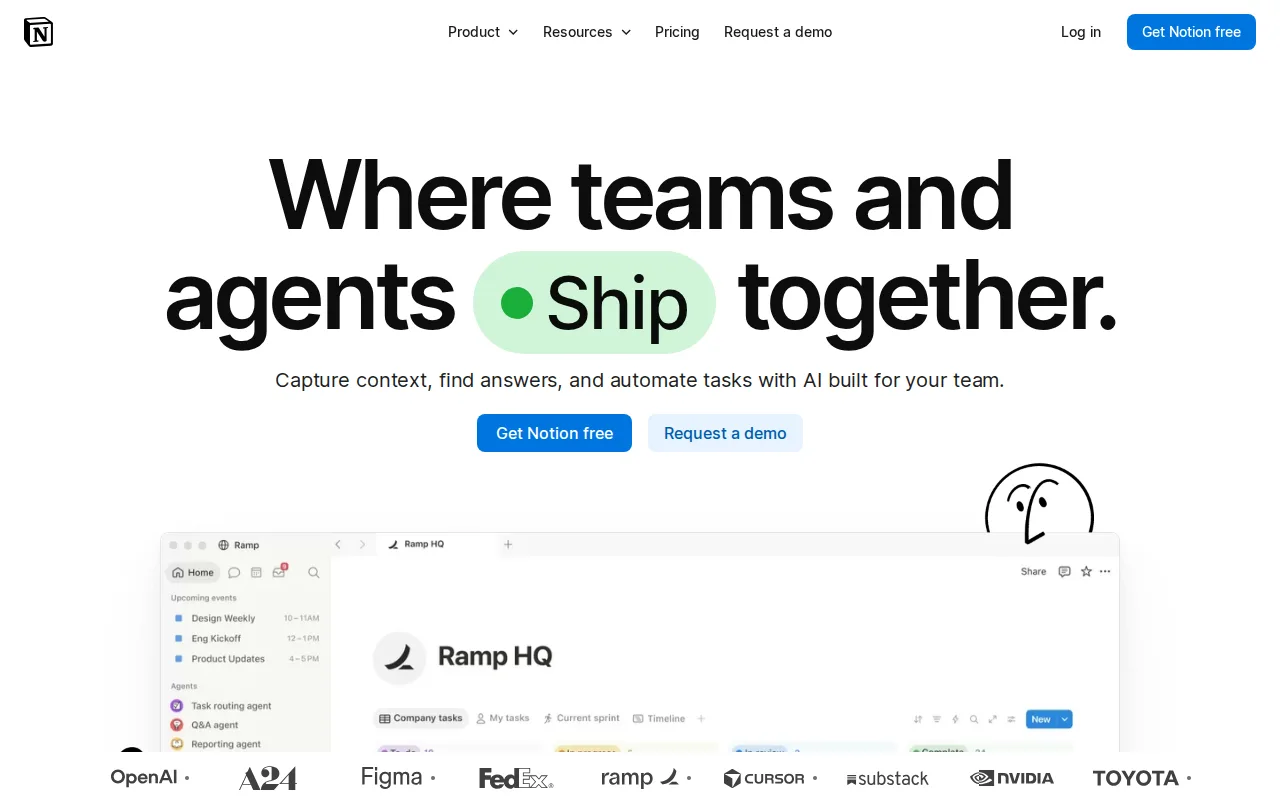
The hosted all-in-one workspace Obsidian is most often compared against: Notion keeps pages in its own cloud database, Obsidian keeps markdown files on your disk.
Pros
- Single tool covers docs, wikis, databases, and basic project tracking, reducing tool-switching
- Free plan supports unlimited pages and blocks for solo use, with only multi-member workspaces hitting block limits
- Deep customization through nested pages, linked databases, and templates
- Public API, webhooks, and 1-way database syncs (Jira, GitHub, Asana) for connecting external tools
Cons
- Per-member pricing on paid tiers ($10-$20/month) gets expensive fast for larger teams compared to flat-fee tools
- Offline support is limited to recently viewed or favorited pages on paid plans rather than full offline access
- Flexible block-and-database model has a steep learning curve for teams used to fixed-structure apps
- Meaningful AI features (Notion Agent, Enterprise Search, AI Meeting Notes) require the $20/month Business plan or higher
Pricing: Free tier · paid from $10/mo (verified undefined NaN, NaN)
2.Anytype — best Obsidian alternative for privacy-conscious individuals and small teams who want a Notion-style flexible workspace that works fully offline and doesn't require trusting a third party with unencrypted data
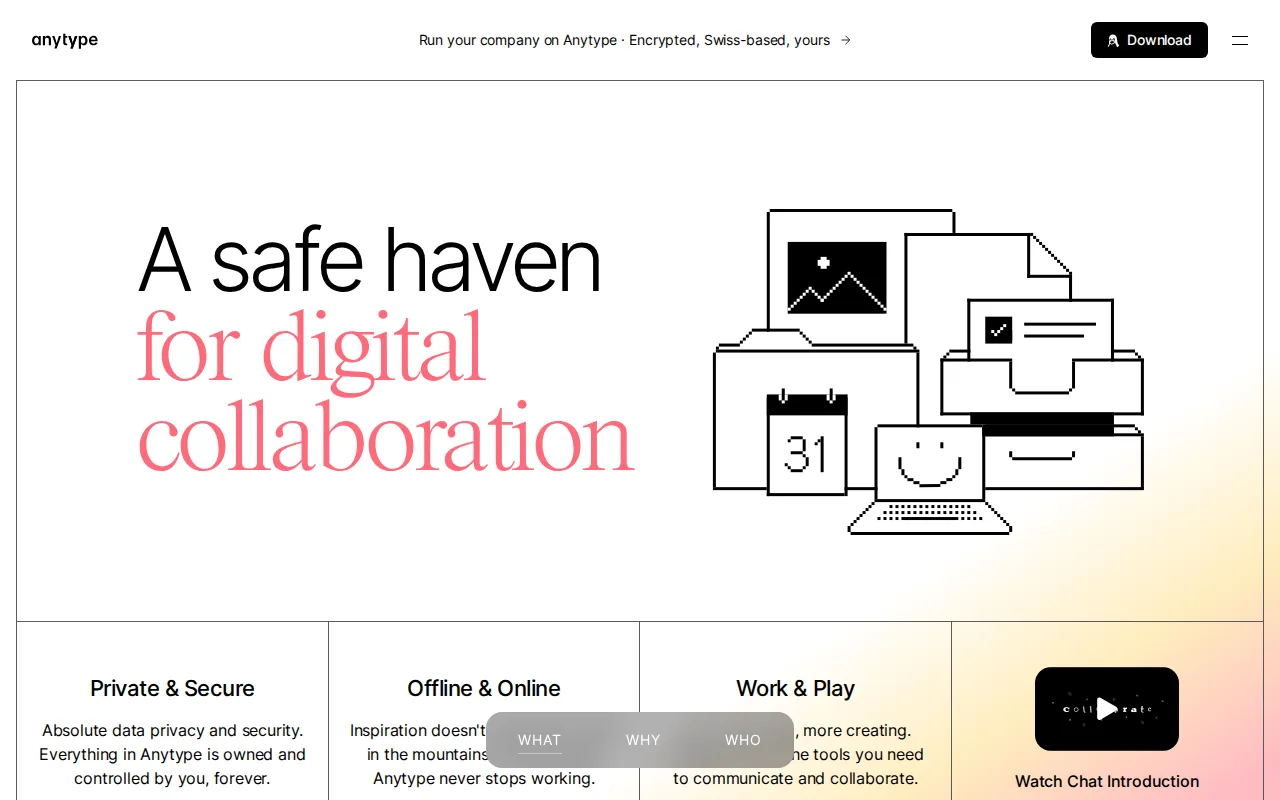
Local-first, end-to-end-encrypted knowledge base with linked objects and multi-device sync included, competing directly with Obsidian's privacy and data-ownership pitch.
Pros
- Local-first architecture means the app works fully offline with data stored on-device.
- End-to-end, zero-knowledge encryption for any data that does sync.
- Free desktop and mobile apps with no feature paywall on core offline functionality.
- Composable block system (databases, kanban, calendar) offers Notion-like flexibility.
Cons
- Uses a source-available license rather than a standard OSI-approved open-source license.
- Smaller plugin and third-party integration ecosystem than Notion or Obsidian.
- Paid Any-Sync Network membership pricing is not clearly published, making cost planning harder.
- Younger, less battle-tested product than long-established note-taking competitors.
Pricing: Free
3.Standard Notes — best Obsidian alternative for privacy-focused professionals and journalists who want a fully open-source, end-to-end encrypted notes app they can self-host instead of trusting a vendor's servers
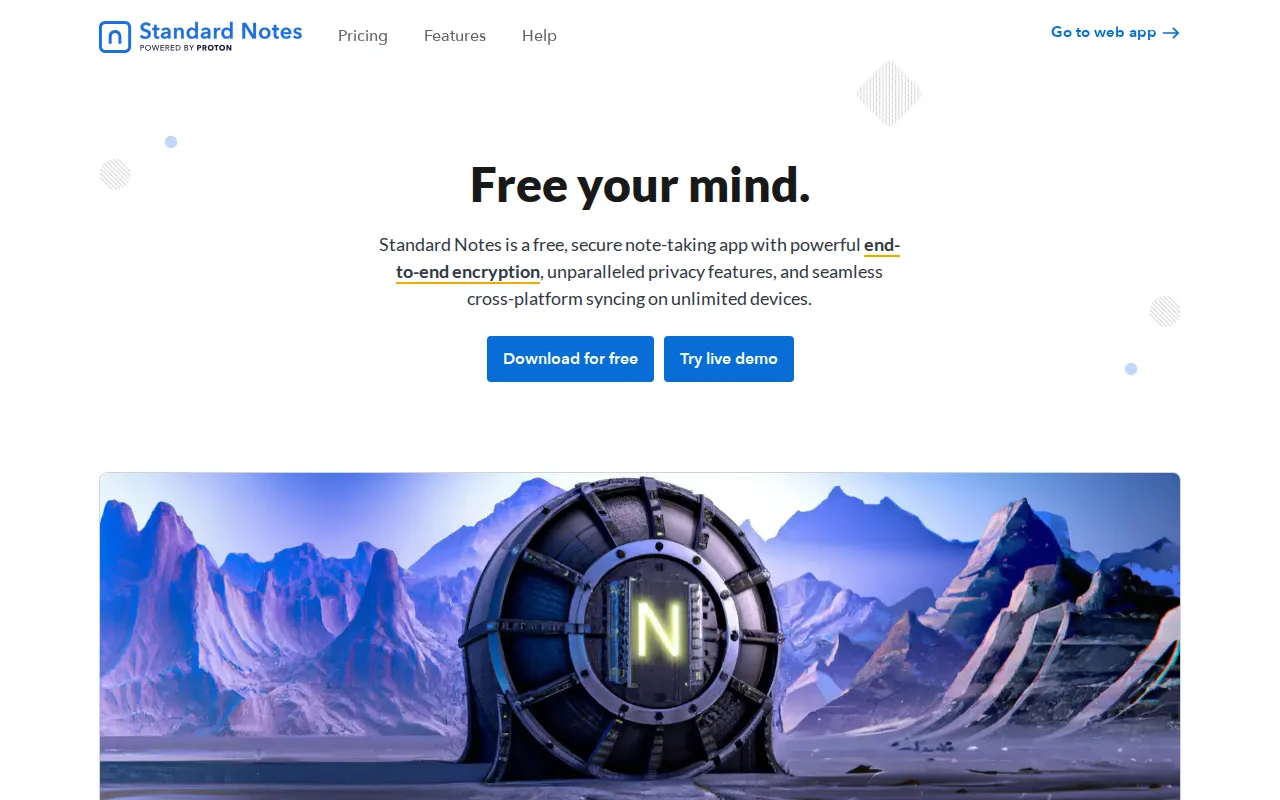
Open-source, end-to-end-encrypted notes app that bundles cross-device sync, cross-shopped by users who do not want to pay separately for Obsidian Sync.
Pros
- Fully open-source and self-hostable (AGPL-3.0), letting privacy-conscious users run their own server.
- End-to-end encryption means Standard Notes cannot read note content, even after the Proton acquisition.
- Native apps across web, Windows, macOS, Linux, iOS, and Android from one shared codebase.
- Backed by Proton's infrastructure and funding since the April 2024 acquisition.
Cons
- Free tier's default editor is intentionally plain and minimal compared to rich-text or block-based note apps.
- Paid tier's exact current pricing is not clearly published on the marketing site without starting a signup flow.
- Smaller user base and review footprint than mainstream note apps, meaning fewer third-party integrations.
- Self-hosting the server requires technical setup that most users will skip in favor of the hosted service.
Pricing: Free
4.Joplin — best Obsidian alternative for people who want an offline-first, end-to-end encrypted Markdown note app with a free self-hosted sync option and no vendor lock-in.
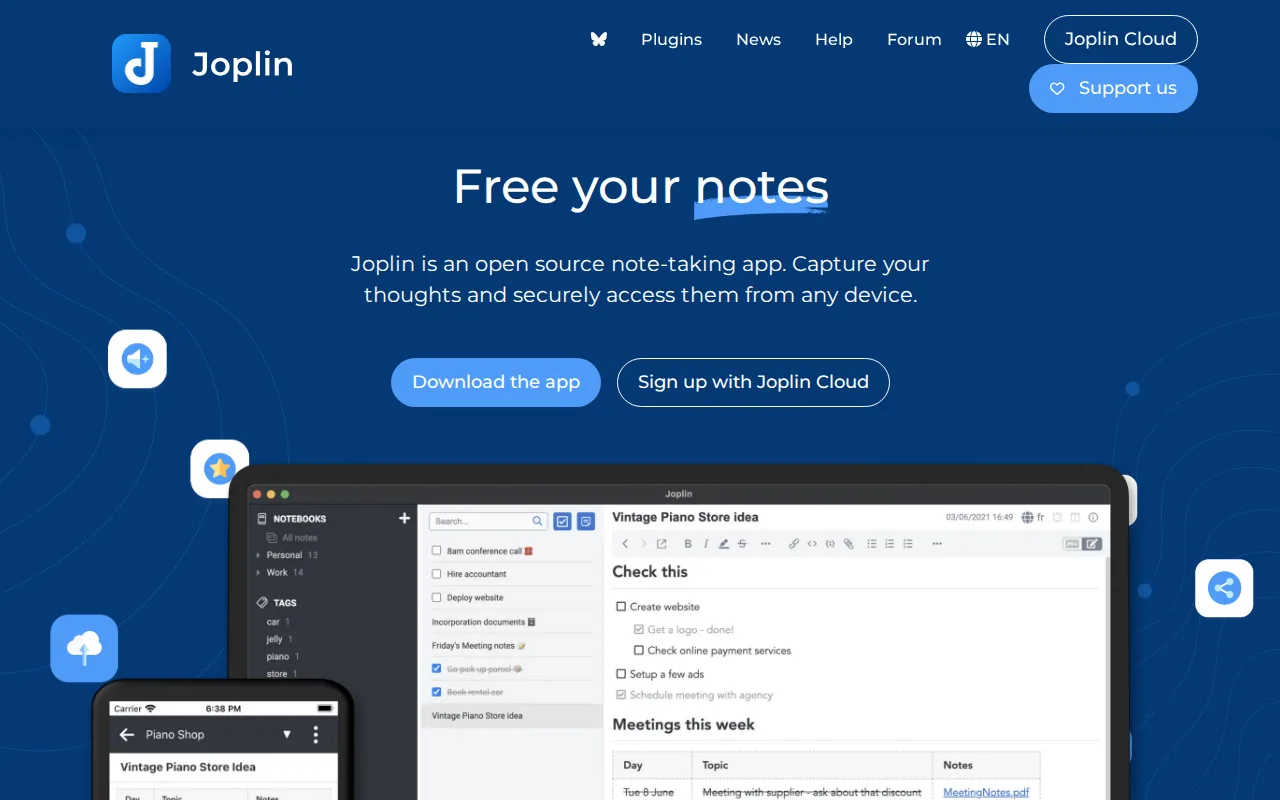
Open-source markdown note app with free sync through your own Dropbox, OneDrive, or WebDAV, the usual free substitute for Obsidian Sync.
Pros
- Fully open-source core app under a permissive license, with source code on GitHub
- Notes stored as local Markdown files with attachments, avoiding proprietary lock-in
- End-to-end encryption supported on all sync backends, including free ones like Dropbox and WebDAV
- Extensible via a plugin API, custom themes, and both Markdown and Rich Text editors
- Available on Windows, macOS, Linux, Android, iOS, and as a terminal app
Cons
- No free tier for the official Joplin Cloud sync service; cheapest paid plan is 2.99 EUR/month billed monthly
- Basic Joplin Cloud plan caps attachments at 10 MB and storage at 2 GB, well below Pro's 30 GB
- Notebook sharing and email-to-note require the Pro tier or higher, not included in Basic
- UI and mobile clipper are less refined than commercial alternatives like Notion or Evernote
Pricing: Free tier · paid from $3.23/mo (verified undefined NaN, NaN)
5.Evernote — best Obsidian alternative for individuals who want to capture and search notes, scanned documents, and web clips across phone, desktop, and browser in one synced place
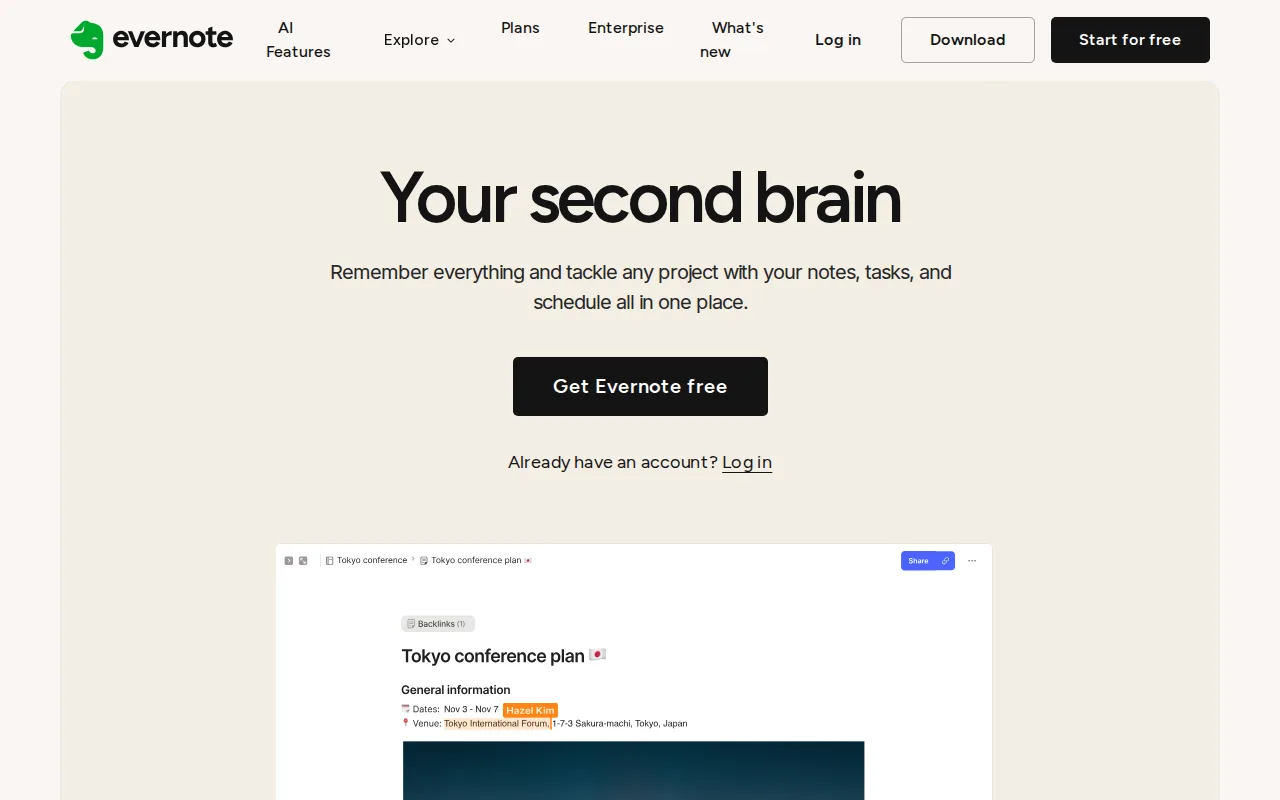
The long-standing hosted note incumbent people migrate away from; Evernote's notes live in its cloud, Obsidian's in a local folder you control.
Pros
- Strong OCR and document scanning for turning paper and PDFs into searchable notes
- Mature apps on Windows, Mac, iOS, Android, and web with reliable sync
- Web Clipper captures full articles, screenshots, and PDFs directly into notebooks
- AI features for meeting transcription, rewriting, and semantic search built into paid plans
Cons
- Free plan is capped at 50 notes and 1 device, far tighter than competitors like Google Keep or Notion's free tiers
- Notebook limits even on the paid Starter plan (20 notebooks) can feel restrictive for heavy users
- Pricing has risen substantially over the years, which has pushed some long-time users toward cheaper alternatives
- No fully offline-first, end-to-end encrypted note body by default outside of the in-note encryption feature on Mac and Windows
Pricing: Free tier · paid from $14.99/mo
6.Microsoft OneNote — best Obsidian alternative for windows and Microsoft 365 users who want a free, flexible page-based notebook for lecture notes, meeting notes, and research without a separate subscription
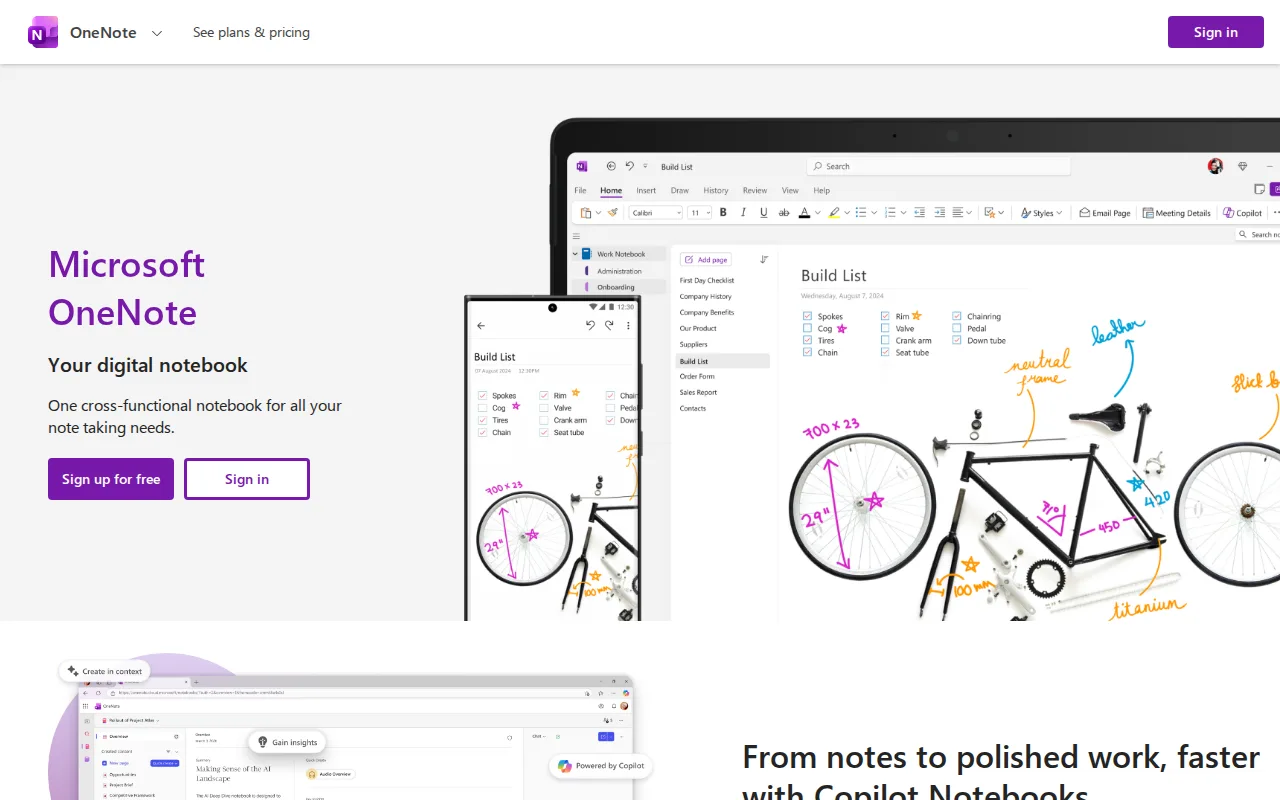
Free, widely deployed note app synced through OneDrive, the default many Obsidian buyers are replacing when they want plain files and linking.
Pros
- Completely free to use with a Microsoft account, with no OneNote-specific paid tier.
- Free-form, page-based canvas supports mixing typed text, handwriting, images, and audio anywhere on the page.
- Syncs across web, Windows, macOS, iOS, and Android via OneDrive.
- Bundled at no extra cost for the large existing base of Windows and Microsoft 365 users.
Cons
- Free-form canvas structure makes large notebooks harder to search and organize than database- or block-based tools like Notion.
- Feature development has slowed compared to competitors, with Microsoft investing more recently in Loop and Copilot.
- Deeper storage and integration require a paid Microsoft 365 subscription rather than a OneNote-specific upgrade.
- Collaboration features are less robust than purpose-built collaborative workspace tools like Notion.
Pricing: Free