5 Best Alternatives to Evernote in 2026
By Noahlast updated
From our data: All 5 alternatives listed here have a free tier, and 2 of them (Microsoft OneNote and Apple Notes) have no paid plan for the note app at all; of the three that do charge — Bear Pro at $2.99/month, Obsidian Sync at $4/user/month billed annually, and Notion Plus at $10/member/month — the median is $4/month, roughly a quarter of Evernote's own $14.99/month Starter plan.
 Notion
 Microsoft OneNote
 Obsidian
 Bear
Bear Apple Notes
How we picked
- Every price was set against Evernote's own $14.99/month Starter and $17.99/month Advanced tiers: Notion Plus is $10/member/month, Obsidian Sync is $4/user/month billed annually, Bear Pro is $2.99/month or $29.99/year, and Microsoft OneNote and Apple Notes charge nothing for the app itself.
- Free tiers were judged against the specific limits that drive Evernote users away: 50 notes, 1 notebook, 1 device sync, 1GB monthly upload, and 20 tags. Tools whose free plan removes the note cap and the one-device restriction ranked above tools that only discount the paid tier.
- Device coverage was compared against Evernote's web, Windows, macOS, iOS, and Android apps: Notion matches all five and adds Linux, OneNote matches all five, Obsidian ships Windows, macOS, Linux, iOS, and Android apps but no web app, Bear is macOS and iOS only, and Apple Notes is macOS and iOS with a limited iCloud.com web view.
- Evernote's two standout capabilities — the Web Clipper and OCR search across scans and PDFs — were used as the feature test: Obsidian ships a Web Clipper extension for Chrome, Safari, Firefox, Edge, Brave, Arc, Orion, and Vivaldi, Bear Pro adds OCR search inside images and PDFs, and Apple Notes has Live Text search across scanned and handwritten pages.
- External review evidence is thin across this category and was used only where a listing records it: Bear holds 4.6/5 from 34 Product Hunt reviews, and Evernote, Notion, OneNote, and Apple Notes carry no external rating on record, so the ranking leans on published pricing and feature limits instead.
Paid placement never alters editorial rank — read the full methodology.
Evernote alternatives at a glance
| Alternative | Best for | Standout | Biggest weakness | Learning curve | Price |
|---|---|---|---|---|---|
| Evernotereference | Individuals who want to capture and search notes, scanned documents, and web clips across phone, desktop, and browser in one synced place | Web Clipper plus advanced search (Boolean, geographic, and filtered queries) across notes, scanned documents, and attachments | The free tier limits users to 50 notes total and syncing to only 1 device, which is restrictive enough that most people who rely on Evernote daily end up needing a paid plan within weeks | Moderate | Free tier · paid from $14.99/mo |
| Notion | Teams that want to consolidate scattered docs, wikis, and lightweight project trackers into one linked workspace, and are willing to spend time designing their own database structure. | Custom Agents and Notion Agent, which can complete multi-step tasks using context pulled from Notion pages, connected apps (Slack, GitHub, Google Drive), and the web, billed at $10 per 1,000 Notion credits after a free trial. | Free and Plus plans only give trial access to Notion AI features (chat, meeting notes, research mode); full AI usage requires the Business plan at $20/member/month or separate Notion credits for Custom Agents and Workers, which adds an unpredictable usage-based cost on top of the seat price. | Steep | Free tier · paid from $10/mo |
| Microsoft OneNote | Windows and Microsoft 365 users who want a free, flexible page-based notebook for lecture notes, meeting notes, and research without a separate subscription | A free-form, page-based canvas (not a linear document) where typed text, handwriting, images, and audio can be placed anywhere on the page, combined with being fully free and bundled at no extra cost for Windows/Microsoft 365 users. | OneNote's free-form canvas makes notes harder to search and structure at scale compared to hierarchical or database-style tools like Notion, and its feature development has visibly slowed in recent years as Microsoft has focused more investment on Loop and Copilot-integrated tools. | Low | Free |
| Bear | writers and students on Mac, iPhone, and iPad who want a fast markdown editor with tag-based organization instead of folders | Nested hashtag organization (#work/projects/2026) replaces folders entirely, and a single search bar filters by tag, title, or body text at once. | No Windows, Linux, Android, or web app — Bear only works if every device you use is an Apple device, so switching platforms means losing access to your notes app entirely. | Low | Free tier · paid from $2.99/mo |
| Obsidian | individuals building a long-lived personal knowledge base who want their notes to stay plain markdown files they can read, back up, and move without the app | Every note is a plain markdown file in a normal folder on the device, so the vault opens offline and instantly, syncs with whatever tool you already use, and remains readable if Obsidian ever disappears. | Obsidian is built around one person's local vault, so the things a team takes for granted cost extra or do not exist: real-time collaboration only arrives through paid shared vaults on Obsidian Sync, and there is no web version at all, which means a vault is unreachable from any machine where you cannot install the app. Getting the same notes onto a phone and a laptop also means $4-$8/user/month for Sync or assembling your own iCloud, Dropbox, or Git setup, since the free app ships no sync of its own. | Moderate | Free tier · paid from $4/mo |
| Apple Notes | Apple users who want a free, preinstalled note app that syncs automatically across iPhone, iPad, and Mac without setting up a third-party account. | Deep OS integration: Quick Note from Control Center or Safari, Live Text search inside scanned or handwritten pages, and document scanning with automatic perspective correction, all built in without installing anything extra. | There is no native Windows or Android app. Cross-platform users are limited to the stripped-down iCloud.com web notes interface, and syncing photos or scanned documents quickly eats into the free 5GB iCloud storage shared across Mail, Photos, and backups, pushing users toward a paid iCloud+ plan. | Low | Free tier · paid from $0.99/mo |
 Evernote
1.Notion — best Evernote alternative for teams that want to consolidate scattered docs, wikis, and lightweight project trackers into one linked workspace, and are willing to spend time designing their own database structure.

Notion is the best Evernote alternative for people whose notes have outgrown notebooks and want wikis, databases, and light project tracking in the same place. Notion Plus costs $10/member/month billed monthly and less billed yearly, about $5 below Evernote's $14.99/month Starter plan, and it removes the limits that define Evernote's tiers: unlimited blocks, unlimited file uploads, custom forms and sites, and 30-day page history, where Evernote Starter still caps you at 1,000 notes, 20 notebooks, and 3-device sync. Notion's free plan gives a solo user unlimited pages and blocks with 7-day page history, against Evernote's free ceiling of 50 notes, 1 notebook, and 1 device. Notion runs on web, Windows, macOS, Linux, iOS, and Android, adding a Linux desktop app Evernote does not offer, and exposes a public API, webhooks, and one-way database syncs with Jira, GitHub, and Asana. Evernote remains the better choice for straightforward capture. Notion's learning curve is rated steep against Evernote's moderate, its offline support covers only recently viewed or favorited pages on paid plans where Evernote users rely on local copies, and it has no equivalent to Evernote's OCR search across scanned documents. Notion's AI also sits behind the $20/member/month Business plan plus $10 per 1,000 credits for Custom Agents.
Compared to Evernote: $10/member/month against Evernote's $14.99 Starter plan with no note or notebook caps, a Linux desktop app Evernote does not ship, and a steeper learning curve rated steep against Evernote's moderate
Wins:Plus is $10/member/month with unlimited blocks, unlimited file uploads, and 30-day page history, against Evernote Starter's $14.99/month with 1,000 notes, 20 notebooks, and 3-device sync · The free plan gives a solo user unlimited pages and blocks, where Evernote's free plan stops at 50 notes, 1 notebook, and 1 device sync · Runs on web, Windows, macOS, Linux, iOS, and Android, adding the Linux desktop client Evernote lacks · Public API, webhooks, and one-way database syncs with Jira, GitHub, and Asana turn notes into a system other tools can read
Loses:Learning curve rated steep against Evernote's moderate, because the block-and-database model expects you to design your own structure · Offline access covers only recently viewed or favorited pages on paid plans, weaker than relying on a synced local notebook · No equivalent to Evernote's OCR search across scanned documents and PDFs, one of Evernote's strongest features · Real AI (Notion Agent, AI Meeting Notes, Enterprise Search) needs the $20/member/month Business plan plus $10 per 1,000 credits for Custom Agents, and per-member pricing adds up fast on bigger teams
Pros
- Single tool covers docs, wikis, databases, and basic project tracking, reducing tool-switching
- Free plan supports unlimited pages and blocks for solo use, with only multi-member workspaces hitting block limits
- Deep customization through nested pages, linked databases, and templates
- Public API, webhooks, and 1-way database syncs (Jira, GitHub, Asana) for connecting external tools
Cons
- Per-member pricing on paid tiers ($10-$20/month) gets expensive fast for larger teams compared to flat-fee tools
- Offline support is limited to recently viewed or favorited pages on paid plans rather than full offline access
- Flexible block-and-database model has a steep learning curve for teams used to fixed-structure apps
- Meaningful AI features (Notion Agent, Enterprise Search, AI Meeting Notes) require the $20/month Business plan or higher
Pricing: Free tier · paid from $10/mo — $10/member/month for Notion Plus (billed monthly, cheaper yearly) vs Evernote's $14.99/month Starter — about $5 less per person per month with no note cap (verified undefined NaN, NaN)
2.Microsoft OneNote — best Evernote alternative for windows and Microsoft 365 users who want a free, flexible page-based notebook for lecture notes, meeting notes, and research without a separate subscription
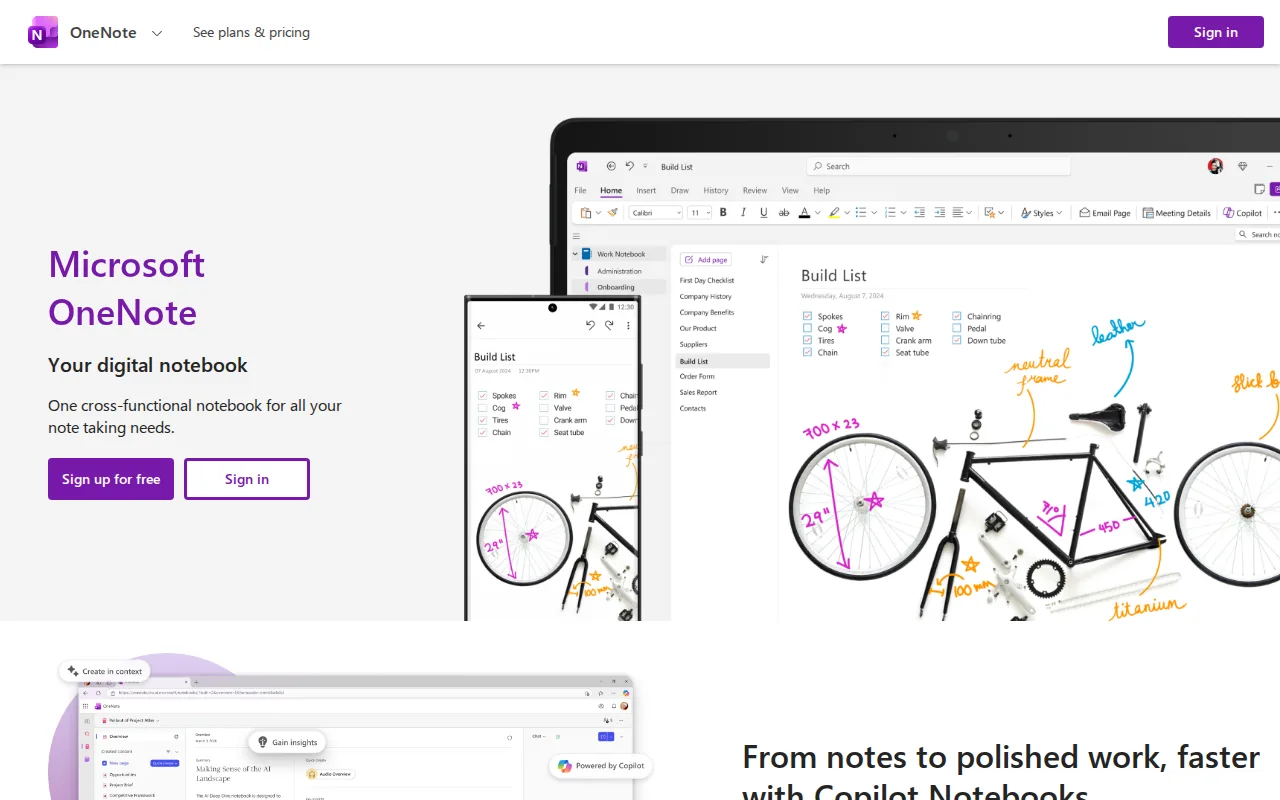
Microsoft OneNote is the best Evernote alternative for anyone who wants the note cap gone without paying anything. OneNote is fully free with a Microsoft account and has no OneNote-specific paid tier or feature paywall, so the 50-note, 1-notebook, 1-device limits on Evernote's free plan simply do not exist, and the $14.99/month Starter plan you would need to escape them (about $180 a year) is not required. OneNote covers the same five platforms as Evernote — web, Windows, macOS, iOS, and Android — and syncs through OneDrive's free 5GB allowance. Its page model is looser than Evernote's: typed text, handwriting, images, and audio go anywhere on a free-form canvas rather than into a linear document, and the learning curve is rated low against Evernote's moderate. It also comes bundled at no extra cost for the large existing base of Windows and Microsoft 365 users. Evernote is still the better tool for finding things later. OneNote's free-form canvas makes large notebooks harder to search and organize than Evernote's Boolean, geographic, and filtered queries, OneNote's feature development has visibly slowed as Microsoft has shifted investment to Loop and Copilot, and collaboration is thinner than in purpose-built workspace tools. More storage means buying a Microsoft 365 subscription rather than upgrading OneNote itself.
Compared to Evernote: completely free with no note cap or paid tier, against Evernote's 50-note free plan and $14.99/month Starter, the same five platforms Evernote covers, and a free-form canvas that is harder to search at scale than Evernote's Boolean and filtered queries
Wins:Free with a Microsoft account and no OneNote-specific paid tier, where Evernote caps free users at 50 notes, 1 notebook, and 1 device sync · Saves the $14.99/month Evernote Starter plan, roughly $180 a year, for the same everyday note capture · Free-form page canvas mixes typed text, handwriting, images, and audio anywhere on the page, rather than a linear note · Learning curve rated low against Evernote's moderate, and it comes bundled at no extra cost for Windows and Microsoft 365 users
Loses:The free-form canvas makes big notebooks harder to search and structure than Evernote's Boolean, geographic, and filtered search · Feature development has visibly slowed as Microsoft directs investment to Loop and Copilot instead · Expanded storage and deeper Outlook and Teams integration require a paid Microsoft 365 subscription, not a OneNote upgrade · Collaboration is less capable than purpose-built collaborative workspaces, and there is no OneNote equivalent to Evernote's Enterprise admin controls
Pros
- Completely free to use with a Microsoft account, with no OneNote-specific paid tier.
- Free-form, page-based canvas supports mixing typed text, handwriting, images, and audio anywhere on the page.
- Syncs across web, Windows, macOS, iOS, and Android via OneDrive.
- Bundled at no extra cost for the large existing base of Windows and Microsoft 365 users.
Cons
- Free-form canvas structure makes large notebooks harder to search and organize than database- or block-based tools like Notion.
- Feature development has slowed compared to competitors, with Microsoft investing more recently in Loop and Copilot.
- Deeper storage and integration require a paid Microsoft 365 subscription rather than a OneNote-specific upgrade.
- Collaboration features are less robust than purpose-built collaborative workspace tools like Notion.
Pricing: Free — $0 for the full OneNote app on every platform, limited in practice by OneDrive's free 5GB, vs Evernote's $14.99/month Starter plan (about $180 a year)
3.Bear — best Evernote alternative for writers and students on Mac, iPhone, and iPad who want a fast markdown editor with tag-based organization instead of folders
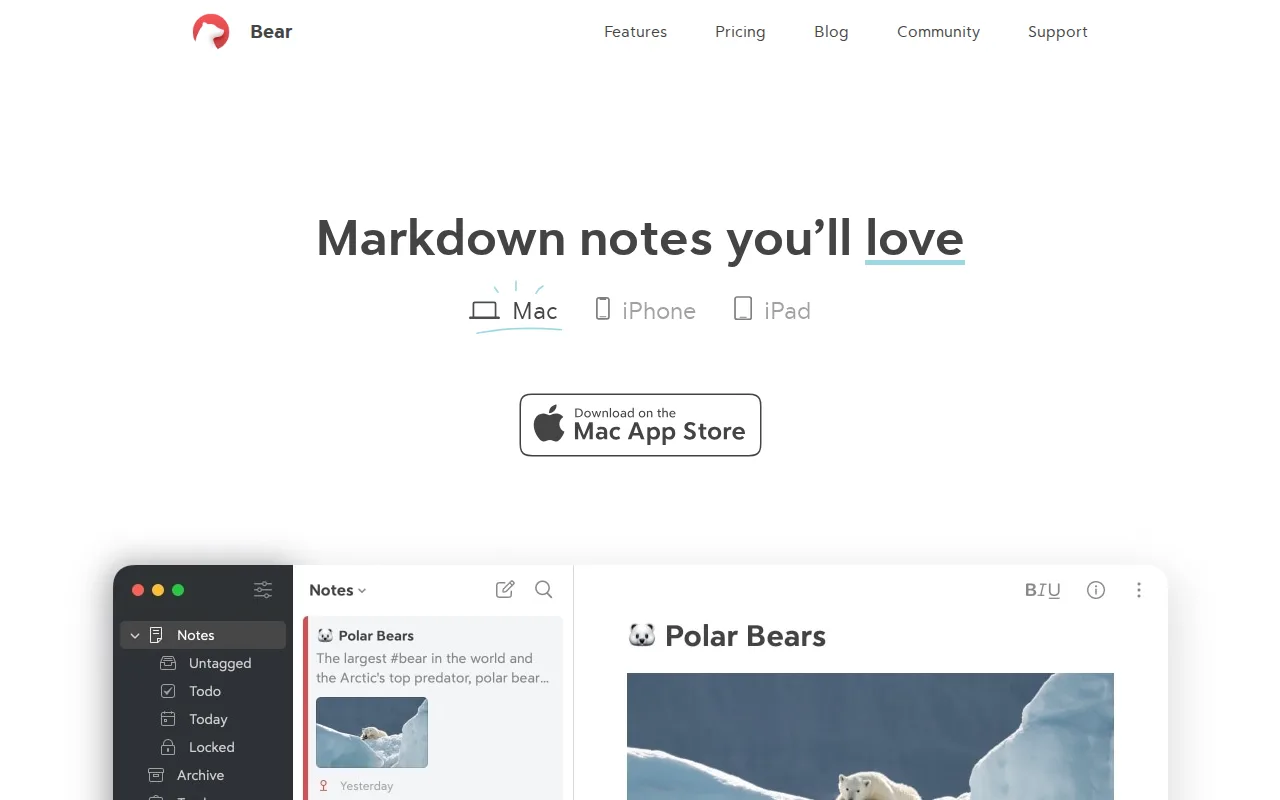
Bear is the best Evernote alternative for writers and students living entirely on Apple hardware who want the editor to disappear. Bear Pro costs $2.99/month or $29.99/year, against Evernote's $14.99/month Starter plan at $179.88 a year, so the same person saves about $150 a year and gets iCloud sync across every Apple device, 28+ themes, OCR search inside scanned images and PDFs, and export to DOCX, PDF, RTF, HTML, TextBundle, and ePub. That OCR search matters specifically because scanned-document search is one of the reasons people stay on Evernote. Instead of Evernote's notebooks, Bear organizes with nested hashtags such as #work/projects/2026, and one search bar filters by tag, title, and body text at once. It is made by the independent studio Shiny Frog in Bologna, Italy, holds 4.6/5 from 34 Product Hunt reviews, and its learning curve is rated low against Evernote's moderate. Evernote is the better choice for anyone with a mixed-device life or a team. Bear has no Windows, Linux, Android, or web client at all, where Evernote runs on all five of web, Windows, macOS, iOS, and Android, so switching platforms means losing the app entirely. Bear's free tier is local-only with no iCloud sync, and it has no built-in collaboration or team plan.
Compared to Evernote: $29.99/year for Bear Pro against Evernote Starter's $179.88/year, OCR search inside images and PDFs plus export to six formats, and Apple-only availability with no Windows, Linux, Android, or web client
Wins:Bear Pro is $2.99/month or $29.99/year against Evernote Starter's $179.88/year, roughly $150 less per year · OCR search inside scanned images and PDFs, matching the scanned-document search Evernote users depend on · Exports to DOCX, PDF, RTF, HTML, TextBundle, and ePub, a wider set of formats than most note apps offer · Nested hashtags replace folders entirely and double as instant search filters, and the learning curve is rated low against Evernote's moderate
Loses:macOS and iOS only, with no Windows, Linux, Android, or web client; Evernote covers web, Windows, macOS, iOS, and Android · The free tier is local-only with no iCloud sync, so any multi-device use requires the Pro subscription · No built-in collaboration or note sharing for teams, and no equivalent to Evernote's Enterprise plan with admin controls · iCloud sync, OCR search, and most themes are all behind Pro, so the free tier is a single-device notebook
Pros
- Distraction-free markdown editor with live preview and Apple Pencil sketch support.
- Nested hashtag system replaces rigid folders and doubles as instant search filtering.
- Exports to DOCX, PDF, RTF, HTML, TextBundle, and ePub, more formats than most note apps offer.
- Low subscription price ($2.99/month) compared to bundled productivity suites.
Cons
- No Windows, Linux, Android, or web client — Apple-only.
- iCloud sync, OCR search, and most themes are locked behind the Pro subscription; the free tier is local-only.
- No built-in collaboration or note-sharing features for teams.
Pricing: Free tier · paid from $2.99/mo — $2.99/month or $29.99/year for Bear Pro vs Evernote's $14.99/month Starter ($179.88/year), about $150 less per year (verified undefined NaN, NaN)
4.Obsidian — best Evernote alternative for individuals building a long-lived personal knowledge base who want their notes to stay plain markdown files they can read, back up, and move without the app
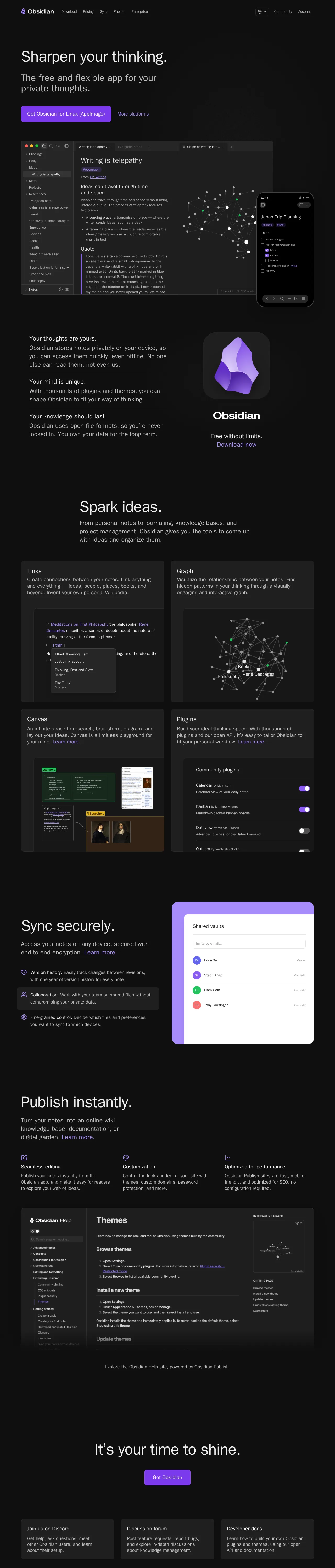
Obsidian is the best Evernote alternative for people who want their notes to outlive the app. Obsidian is free without limits and needs no sign-up at all, so Evernote's free ceiling of 50 notes, 1 notebook, 1 device sync, 1GB monthly upload, and 20 tags has no counterpart here. Notes are stored locally on the device in open file formats, work offline, and per obsidian.md are unreadable by the company, which collects no telemetry. Sync is an optional add-on at $4/user/month billed annually ($5 month-to-month), which adds AES-256 end-to-end encryption, version history, and collaboration on shared vaults; at $48 a year that is roughly a quarter of Evernote Starter's $179.88. Publish is $8/site/month billed annually, a commercial license is $50/user/year but explicitly not required, and students, faculty, and nonprofit employees get 40% off Sync and Publish. Obsidian ships apps for Windows, macOS, Linux, iOS, and Android plus a Web Clipper extension for Chrome, Safari, Firefox, Edge, Brave, Arc, Orion, and Vivaldi, covering the clipping workflow Evernote is known for, along with backlinks, a graph view, Canvas, and thousands of community plugins and themes. Evernote is still better for people who want it all handled: Obsidian has no web app, and its pricing and download pages list no built-in meeting transcription or AI rewriting of the kind Evernote bundles into its paid plans.
Compared to Evernote: free without limits and without a sign-up where Evernote's free plan stops at 50 notes on 1 device, notes stored locally in open file formats that work offline, and optional Sync at $4/user/month billed annually against Evernote Starter's $14.99/month
Wins:The app is free without limits and requires no sign-up, against Evernote's free caps of 50 notes, 1 notebook, 1 device sync, 1GB monthly upload, and 20 tags · Notes live locally in open file formats, readable offline and portable out of the app, where Evernote keeps notes in its own hosted service · Optional Sync costs $4/user/month billed annually ($48/year) with AES-256 end-to-end encryption, version history, and shared-vault collaboration, against Evernote Starter's $179.88/year · Ships Windows, macOS, Linux, iOS, and Android apps plus a Web Clipper for Chrome, Safari, Firefox, Edge, Brave, Arc, Orion, and Vivaldi, and adds backlinks, a graph view, Canvas, and thousands of community plugins
Loses:No web app, so a locked-down work machine cannot reach your notes through a browser the way evernote.com can · Sync, backup, and sharing are your responsibility unless you buy the paid Sync add-on; nothing is hosted by default · Obsidian's own pricing and download pages list no built-in meeting transcription or AI rewriting, features Evernote includes in its paid plans · No external review rating on record in this directory, so there is no user-score evidence to weigh against Evernote's track record
Pros
- The app is free without limits and needs no account; notes are stored locally as plain markdown files in open formats, so there is no lock-in.
- 7,647 community plugins and 755 themes let the editor be reshaped for research, writing, task management, or visualization.
- Works fully offline on Windows, macOS, Linux, iOS, and Android, with no server round-trip to open a note.
- Obsidian states notes stay on the device and are inaccessible to the company, its apps collect no telemetry, and Obsidian Sync is AES-256 end-to-end encrypted.
- Paid products are optional services rather than a feature wall: Sync from $4/user/month, Publish from $8/site/month, and a commercial license the FAQ says is not required.
Cons
- There is no web version, so a vault is only reachable from a device where Obsidian is installed.
- Cross-device sync is a paid add-on from $4/user/month, or a do-it-yourself setup on iCloud, Dropbox, or Git.
- Real-time collaboration needs paid shared vaults on Obsidian Sync; there is no free multi-user editing.
- Obsidian's own apps are not open source — obsidian.md publishes open file formats plus public release and plugin repositories, but not the application source.
Pricing: Free tier · paid from $4/mo — Free with no limits and no sign-up; optional Sync is $4/user/month billed annually ($48/year) against Evernote Starter's $14.99/month ($179.88/year) (verified undefined NaN, NaN)
5.Apple Notes — best Evernote alternative for apple users who want a free, preinstalled note app that syncs automatically across iPhone, iPad, and Mac without setting up a third-party account.
Apple Notes is the best Evernote alternative for Apple users who want to stop paying for note-taking today. Apple Notes ships preinstalled on every iPhone, iPad, and Mac, costs nothing, and needs no signup beyond an existing Apple Account, so it removes Evernote's free-plan limits of 50 notes, 1 notebook, and 1 device sync without the $14.99/month Starter upgrade. It also keeps the parts of Evernote people actually use daily: document scanning with automatic perspective correction, Live Text search inside scanned and handwritten pages, Apple Pencil handwriting, Quick Note from Control Center or Safari, individual notes locked behind a password or Face ID, and real-time collaboration with other Apple Account holders over iCloud. Storage is the only cost, and only once attachments push past the free 5GB shared across all Apple services, at which point iCloud+ starts at $0.99/month. Evernote is the better choice for anyone not fully inside Apple's ecosystem. Apple Notes has no native Windows or Android app, leaving cross-platform users with a stripped-down iCloud.com web view, where Evernote ships real apps on web, Windows, macOS, iOS, and Android. It also has no public API or plugin ecosystem, weaker backlinking and database features than dedicated knowledge tools, and no equivalent to Evernote's Boolean, geographic, and filtered search or its Enterprise admin controls.
Compared to Evernote: free and preinstalled on every iPhone, iPad, and Mac against Evernote's $14.99/month Starter plan, built-in document scanning with Live Text search across scans and handwriting, and no native Windows or Android app where Evernote ships both
Wins:Free and already installed on every iPhone, iPad, and Mac, with no signup beyond an existing Apple Account and no note or device caps · Document scanning with automatic perspective correction and Live Text search inside scanned and handwritten pages, close cover for Evernote's OCR workflow · Individual notes lock behind a password, Face ID, or Touch ID, and real-time collaboration works with any other Apple Account holder · Quick Note from Control Center or Safari captures straight into Notes without opening the app, and the learning curve is rated low against Evernote's moderate
Loses:No native Windows or Android app; cross-platform users get only the stripped-down iCloud.com web view, while Evernote ships real apps on all five platforms · No public API or plugin ecosystem, so notes cannot be wired into other tools the way Evernote's integrations allow · Weak backlinking and database features, and no equivalent to Evernote's Boolean, geographic, and filtered search queries · The free 5GB of iCloud is shared with Photos, Mail, and device backups, so scans and images fill it quickly and push you to iCloud+ from $0.99/month
Pros
- Free and already installed on every iPhone, iPad, and Mac, no signup beyond an existing Apple Account
- Notes can be locked individually with a password or Face ID/Touch ID
- Built-in document scanning, Apple Pencil handwriting recognition, and Live Text search across scanned and handwritten content
- Real-time collaboration and sharing with other Apple Account holders via iCloud
Cons
- No native Windows or Android client, only a limited iCloud.com web view
- No public API or plugin ecosystem, unlike Notion or Obsidian
- Weak backlinking and database features compared to dedicated PKM tools
- Free iCloud storage (5GB total, shared with Photos and backups) fills up fast once notes include images or scans
Pricing: Free tier · paid from $0.99/mo — $0 for the app itself, with iCloud+ from $0.99/month only once attachments exceed the shared free 5GB, against Evernote's $14.99/month Starter plan
Which one is right for you?
- You want your notes to double as a team wiki and project tracker rather than just a notebookNotion
- You want a free app with no note cap that already works on the Windows machines your company issuesMicrosoft OneNote
- You want your notes as plain files on your own disk that will still open in ten yearsObsidian
- You write long-form in markdown on a Mac and an iPhone and want the editor out of the wayBear
- You just want a notes app that is already on your iPhone, with nothing to install and no account to createApple Notes
- You rely on notes offline on planes and trains and cannot lose access when the connection dropsObsidian
- You need OCR search inside scanned receipts and PDFs on Apple devices for under $30 a yearBear
- Your team of five needs shared docs with granular permissions and SSO, not just personal notesNotion
Frequently asked questions
Is there a free alternative to Evernote?
- Yes, three of them: Microsoft OneNote and Apple Notes are free with no paid tier for the app at all, and Obsidian is free without limits and without a sign-up. All three remove Evernote's free-plan caps of 50 notes, 1 notebook, and 1 device sync; OneNote is limited in practice by OneDrive's free 5GB and Apple Notes by the 5GB iCloud allowance shared with Photos and backups.
What is the closest alternative to Evernote?
- Microsoft OneNote is the closest match: the same notebook-section-page model, the same five platforms (web, Windows, macOS, iOS, and Android), and the same mixed capture of typed text, handwriting, images, and audio. The differences are price and search, since OneNote has no paid tier or note cap while Evernote charges $14.99/month for Starter, and Evernote's Boolean, geographic, and filtered queries beat OneNote's free-form canvas at scale.
Can Notion replace Evernote?
- Yes for most people, since Notion Plus at $10/member/month costs about $5 less than Evernote's $14.99 Starter plan and removes the 1,000-note and 20-notebook caps. Two gaps matter: Notion's offline access reaches only recently viewed or favorited pages on paid plans, and it has no equivalent to Evernote's OCR search across scanned documents. Notion's learning curve is also rated steep where Evernote's is moderate.
Which Evernote alternative is cheapest?
- Microsoft OneNote, Apple Notes, and Obsidian all cost nothing for the app itself. Of the paid options, Bear Pro is the cheapest at $2.99/month or $29.99/year and Obsidian Sync is $4/user/month billed annually ($48/year), both far below Evernote's $14.99/month Starter plan at $179.88 a year.
Which Evernote alternative works fully offline?
- Obsidian, because it stores notes locally on the device in open file formats and is built to work offline; Bear's free tier is local-only as well. Evernote's own listing records no fully offline-first, end-to-end encrypted note body by default outside its in-note encryption on Mac and Windows, and Notion's offline support covers only recently viewed or favorited pages.
Which alternatives keep Evernote's Web Clipper and scanned-document search?
- Obsidian ships a Web Clipper extension for Chrome, Safari, Firefox, Edge, Brave, Arc, Orion, and Vivaldi, covering the clipping half. For the scanning half, Bear Pro adds OCR search inside images and PDFs and Apple Notes has built-in document scanning with Live Text search across scanned and handwritten pages.
Do any of these run on Windows and Android?
- Three do: Notion (web, Windows, macOS, Linux, iOS, Android), Microsoft OneNote (web, Windows, macOS, iOS, Android), and Obsidian (Windows, macOS, Linux, iOS, Android, with no web app). Bear is macOS and iOS only, and Apple Notes is Apple-only with a limited iCloud.com web view for everyone else.
Why are people leaving Evernote?
- The free plan is capped at 50 notes, 1 notebook, and 1 device sync, tight enough that daily users hit the wall within weeks. Paid entry then starts at $14.99/month for Starter, which still limits you to 1,000 notes and 20 notebooks, and Evernote's own listing notes that pricing has risen substantially over the years, pushing long-time users toward cheaper tools.