Bear — A markdown notes app for macOS, iPhone, and iPad that replaces folders with nested hashtags, priced at $2.99/month for Pro.

By Noahlast updated pricing verified
Bear screenshots & video
Bear in 20 seconds
Best for: writers and students on Mac, iPhone, and iPad who want a fast markdown editor with tag-based organization instead of folders
Pricing: Free for local-only notes; Bear Pro is $2.99/month (or $29.99/year) for iCloud sync, OCR search, and full theme/export options.
- Bear Pro costs $2.99/month or $29.99/year and adds iCloud sync, 28+ themes, and OCR search.
- Bear runs only on macOS, iPhone, and iPad; there is no Windows, Linux, Android, or web version.
- Bear organizes notes with nested hashtags instead of folders.
- Bear's free tier works offline with 3 themes and no iCloud sync.
- Bear is made by Shiny Frog, an independent studio based in Bologna, Italy.
Limitations: No Windows, Linux, Android, or web client.; No built-in collaboration or note sharing for teams.; iCloud sync and OCR search require the paid Pro subscription.
Top alternatives: Notion, Obsidian, Apple Notes, Craft, Evernote — full list
What is Bear?
Bear is a markdown note-taking app built for Apple devices only: macOS, iPhone, and iPad. It's made by Shiny Frog, an independent studio based in Bologna, Italy.
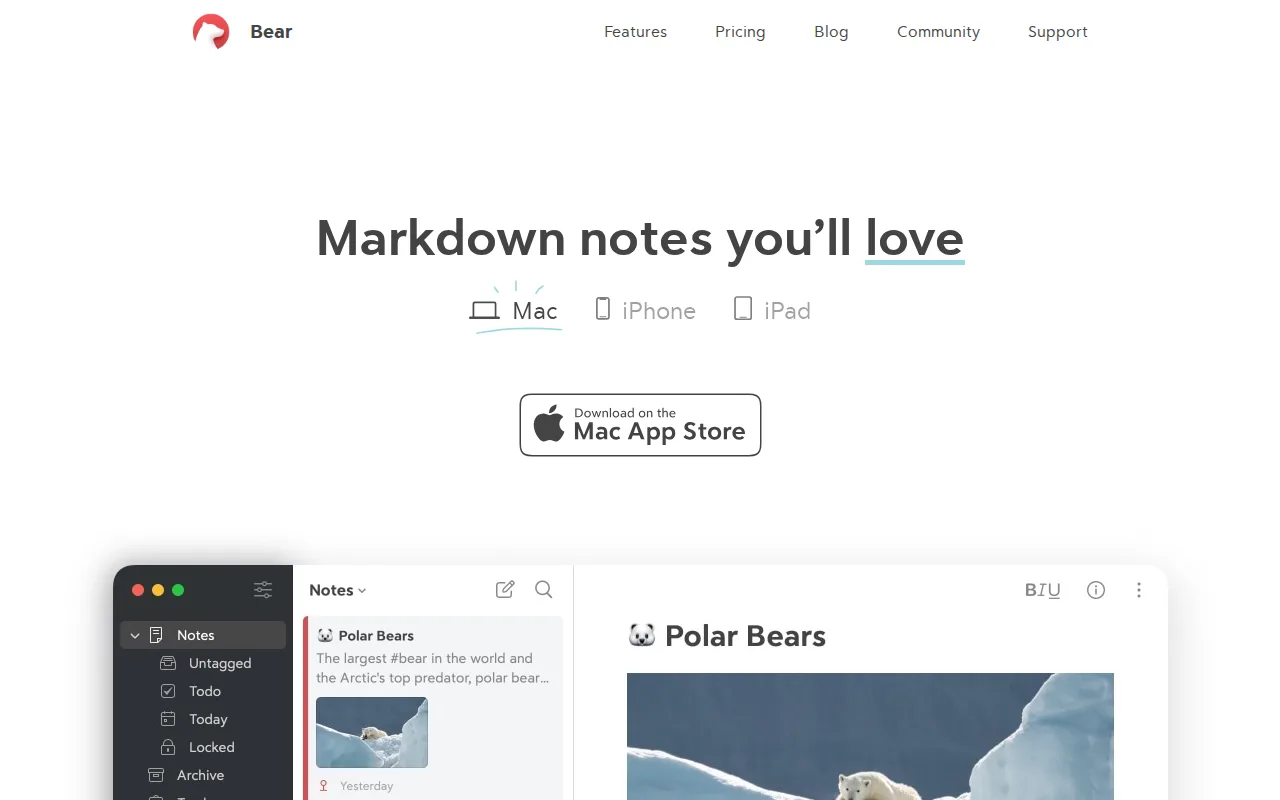
Notes are written in plain markdown and rendered live, with support for images, tables, to-do lists, and Apple Pencil sketches. Instead of folders, Bear organizes notes with nested hashtags (#work/projects/2026), and a single search bar filters across tags, titles, and body text.
The free tier works entirely offline with three themes and basic export. Bear Pro ($2.99/month or $29.99/year) adds iCloud sync across every device, 28+ themes, OCR search inside scanned images and PDFs, and export to DOCX, PDF, RTF, HTML, TextBundle, and ePub. There is no web app, and no Windows, Linux, or Android client — Bear is a bet on staying inside Apple's ecosystem in exchange for a simpler, faster editor.
Bear is a markdown note-taking app built only for Apple devices, made by the independent studio Shiny Frog for writers, students, and anyone who wants a single fast app for notes, journaling, and drafts. The free tier works offline with three themes and basic export; Bear Pro at $2.99/month or $29.99/year adds iCloud sync across devices, 28+ themes, OCR search inside images and PDFs, and export to DOCX, PDF, RTF, and ePub. Notes are organized with nested hashtags instead of folders, and a single search box filters by tag, title, or body text at once. Bear has no Windows, Linux, Android, or web version, which rules it out for anyone outside Apple's ecosystem or working on a mixed-platform team.
Standout feature: Nested hashtag organization (#work/projects/2026) replaces folders entirely, and a single search bar filters by tag, title, or body text at once.
Biggest weakness: No Windows, Linux, Android, or web app — Bear only works if every device you use is an Apple device, so switching platforms means losing access to your notes app entirely.
Pros
- Distraction-free markdown editor with live preview and Apple Pencil sketch support.
- Nested hashtag system replaces rigid folders and doubles as instant search filtering.
- Exports to DOCX, PDF, RTF, HTML, TextBundle, and ePub, more formats than most note apps offer.
- Low subscription price ($2.99/month) compared to bundled productivity suites.
Cons
- No Windows, Linux, Android, or web client — Apple-only.
- iCloud sync, OCR search, and most themes are locked behind the Pro subscription; the free tier is local-only.
- No built-in collaboration or note-sharing features for teams.
Bear pricing
Free tier · paid from $2.99/mo · verified from the vendor's pricing page
| Plan | Price | Notes |
|---|---|---|
| Free | Free | Local notes only, document scanning, basic export, 3 themes; no iCloud sync across devices. |
| Bear Pro | $2.99/mo | Also available at $29.99/year. Adds iCloud sync, 28+ themes, OCR search inside images/PDFs, and advanced export (DOCX, PDF, ePub, HTML, TextBundle). |
What reviewers say
Scores belong to their platforms; we display them with attribution and never fold them into our own ratings.