5 Best Alternatives to Microsoft OneNote in 2026
By Noahlast updated
From our data: All 5 alternatives listed here have a free tier like Microsoft OneNote's, but only Obsidian and Apple Notes are free without note, device, or sync limits, and among the four that charge for app features or cross-device sync ($2.99/month Bear Pro, $4/user/month Obsidian Sync billed annually, $10/member/month Notion Plus, and $14.99/month Evernote Starter) the median is $7/month.
 Evernote
 Notion
 Obsidian
 Apple Notes
How we picked
- Retrieval at scale was the ranking axis, because that is Microsoft OneNote's stated weakness: its free-form canvas gets harder to search and structure as notebooks grow, so alternatives were judged on what replaces it, whether that is Evernote's OCR and Boolean search, Notion's databases, Obsidian's links and backlinks, or Bear's nested hashtags.
- Free tiers were compared against Microsoft OneNote's own, which is the full app on five platforms with a 5GB OneDrive allowance and no feature paywall: Obsidian is free without note or device limits, Apple Notes is free on Apple hardware, Notion's free plan is unlimited for solo use, Bear's free tier is local-only, and Evernote's caps at 50 notes and 1 device.
- Pricing verification dates were used where they exist: Notion and Bear carry independently verified on-site pricing, Evernote's and Apple Notes' listed tiers have no verification timestamp on record, and Obsidian's figures were read directly from its own pricing page.
- External review evidence is thin in this category and is reported as found: Bear holds 4.6/5 from 34 Product Hunt reviews, while Evernote, Notion, Obsidian, Apple Notes, and Microsoft OneNote itself all have no external rating on record.
- Platform coverage was measured against Microsoft OneNote's five (web, Windows, macOS, iOS, Android): Notion covers six by adding Linux, Obsidian covers five by trading the web for Linux, Evernote matches all five, and Bear and Apple Notes are Apple-only.
Paid placement never alters editorial rank — read the full methodology.
Microsoft OneNote alternatives at a glance
| Alternative | Best for | Standout | Biggest weakness | Learning curve | Price |
|---|---|---|---|---|---|
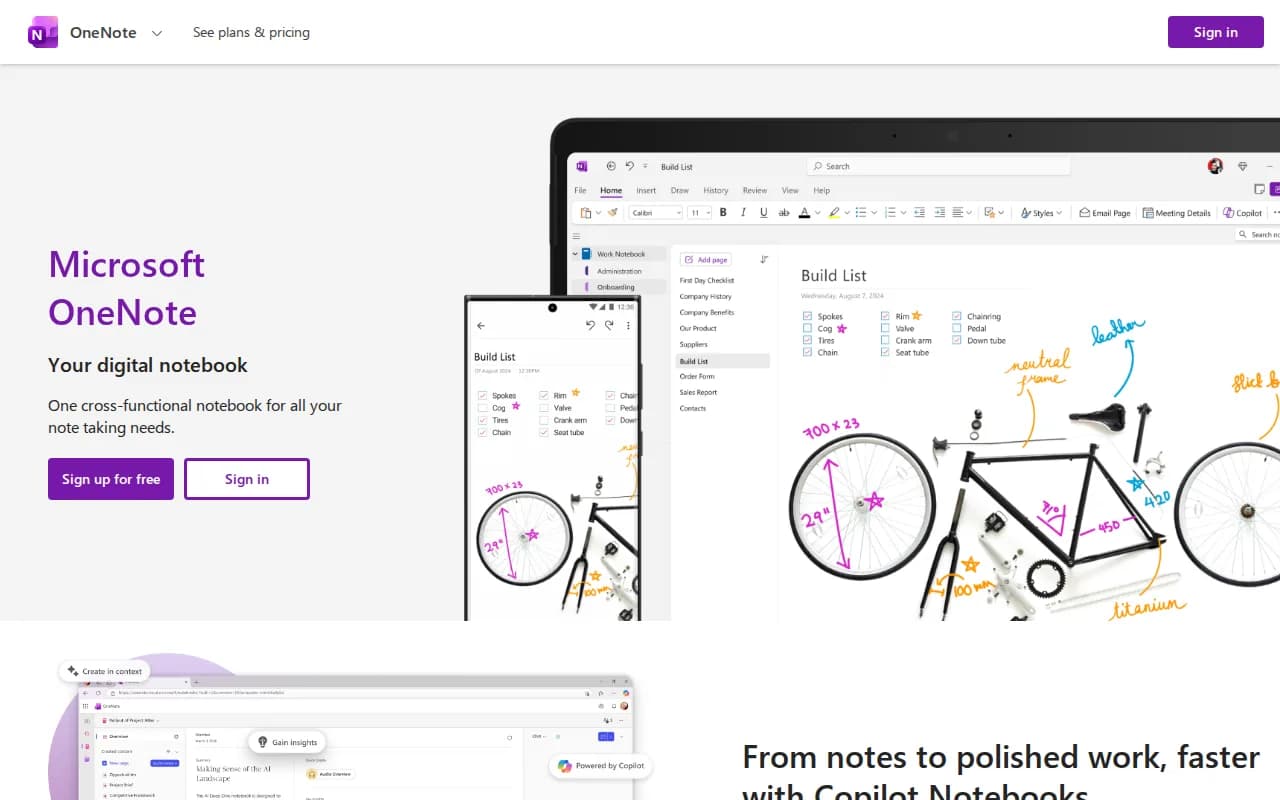
| Microsoft OneNotereference | Windows and Microsoft 365 users who want a free, flexible page-based notebook for lecture notes, meeting notes, and research without a separate subscription | A free-form, page-based canvas (not a linear document) where typed text, handwriting, images, and audio can be placed anywhere on the page, combined with being fully free and bundled at no extra cost for Windows/Microsoft 365 users. | OneNote's free-form canvas makes notes harder to search and structure at scale compared to hierarchical or database-style tools like Notion, and its feature development has visibly slowed in recent years as Microsoft has focused more investment on Loop and Copilot-integrated tools. | Low | Free |
| Evernote | Individuals who want to capture and search notes, scanned documents, and web clips across phone, desktop, and browser in one synced place | Web Clipper plus advanced search (Boolean, geographic, and filtered queries) across notes, scanned documents, and attachments | The free tier limits users to 50 notes total and syncing to only 1 device, which is restrictive enough that most people who rely on Evernote daily end up needing a paid plan within weeks | Moderate | Free tier · paid from $14.99/mo |
| Notion | Teams that want to consolidate scattered docs, wikis, and lightweight project trackers into one linked workspace, and are willing to spend time designing their own database structure. | Custom Agents and Notion Agent, which can complete multi-step tasks using context pulled from Notion pages, connected apps (Slack, GitHub, Google Drive), and the web, billed at $10 per 1,000 Notion credits after a free trial. | Free and Plus plans only give trial access to Notion AI features (chat, meeting notes, research mode); full AI usage requires the Business plan at $20/member/month or separate Notion credits for Custom Agents and Workers, which adds an unpredictable usage-based cost on top of the seat price. | Steep | Free tier · paid from $10/mo |
| Obsidian | individuals building a long-lived personal knowledge base who want their notes to stay plain markdown files they can read, back up, and move without the app | Every note is a plain markdown file in a normal folder on the device, so the vault opens offline and instantly, syncs with whatever tool you already use, and remains readable if Obsidian ever disappears. | Obsidian is built around one person's local vault, so the things a team takes for granted cost extra or do not exist: real-time collaboration only arrives through paid shared vaults on Obsidian Sync, and there is no web version at all, which means a vault is unreachable from any machine where you cannot install the app. Getting the same notes onto a phone and a laptop also means $4-$8/user/month for Sync or assembling your own iCloud, Dropbox, or Git setup, since the free app ships no sync of its own. | Moderate | Free tier · paid from $4/mo |
| Bear | writers and students on Mac, iPhone, and iPad who want a fast markdown editor with tag-based organization instead of folders | Nested hashtag organization (#work/projects/2026) replaces folders entirely, and a single search bar filters by tag, title, or body text at once. | No Windows, Linux, Android, or web app — Bear only works if every device you use is an Apple device, so switching platforms means losing access to your notes app entirely. | Low | Free tier · paid from $2.99/mo |
| Apple Notes | Apple users who want a free, preinstalled note app that syncs automatically across iPhone, iPad, and Mac without setting up a third-party account. | Deep OS integration: Quick Note from Control Center or Safari, Live Text search inside scanned or handwritten pages, and document scanning with automatic perspective correction, all built in without installing anything extra. | There is no native Windows or Android app. Cross-platform users are limited to the stripped-down iCloud.com web notes interface, and syncing photos or scanned documents quickly eats into the free 5GB iCloud storage shared across Mail, Photos, and backups, pushing users toward a paid iCloud+ plan. | Low | Free tier · paid from $0.99/mo |
 Microsoft OneNote
 Bear
Bear1.Evernote — best Microsoft OneNote alternative for individuals who want to capture and search notes, scanned documents, and web clips across phone, desktop, and browser in one synced place
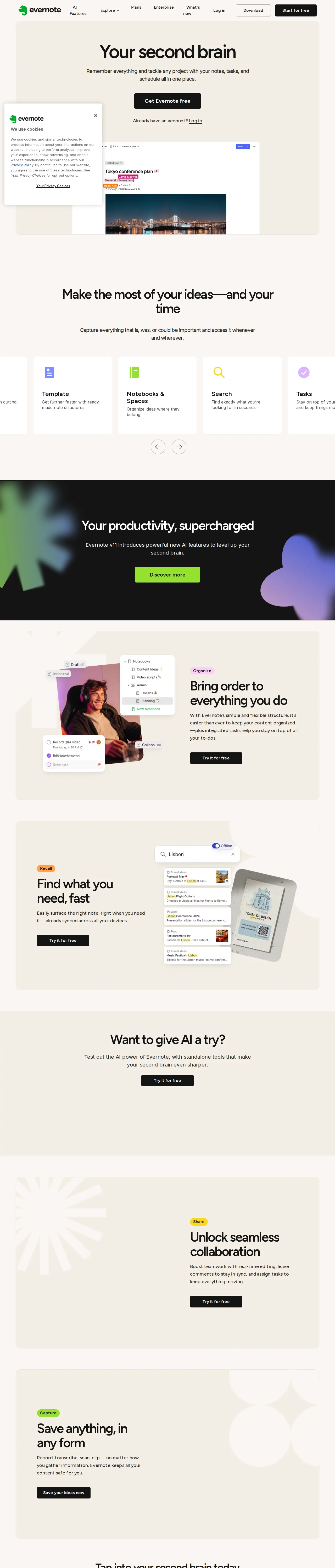
Evernote is the best Microsoft OneNote alternative for people whose notes are mostly captured rather than typed. Evernote's OCR turns scanned paper and PDFs into searchable text, its Web Clipper pulls full articles, screenshots, and PDFs straight into notebooks, and its search handles Boolean, geographic, and filtered queries across notes and attachments. That directly targets Microsoft OneNote's weak point, since OneNote's free-form canvas gets harder to search and organize as notebooks grow. Evernote runs on the same five platforms as Microsoft OneNote (web, Windows, macOS, iOS, Android) and adds AI meeting transcription, semantic search, and rewriting on paid plans, where Microsoft OneNote has no OneNote-specific paid tier or AI add-on at all. Microsoft OneNote is the better choice on price, and it is not close. Microsoft OneNote is free with a Microsoft account, with no note cap and no device cap, using OneDrive's 5GB free allowance. Evernote's free plan stops at 50 notes, 1 notebook, 1 device sync, 1GB of monthly upload, and 20 tags, which most daily users hit within weeks, and the first paid tier, Starter, is $14.99/month ($179.88/year) and still caps notebooks at 20. Advanced is $17.99/month for unlimited notes and devices. Evernote also has no external review rating on record, and its price increases over the years are a recurring complaint from long-time users.
Compared to Microsoft OneNote: OCR search across scanned documents and PDFs plus Boolean and geographic queries, a free plan capped at 50 notes and 1 device where Microsoft OneNote has no such cap, and $14.99/month for the first paid tier against Microsoft OneNote's $0
Wins:OCR turns scanned paper and PDFs into searchable text, and search supports Boolean, geographic, and filtered queries across notes and attachments · Web Clipper captures full articles, screenshots, and PDFs directly into notebooks · AI meeting transcription, semantic search, and rewriting are built into paid plans, where Microsoft OneNote has no OneNote-specific paid tier or AI add-on
Loses:The free plan stops at 50 notes, 1 notebook, 1 device sync, 1GB monthly upload, and 20 tags, where Microsoft OneNote is free across web, Windows, macOS, iOS, and Android with no note or device cap · Starter costs $14.99/month ($179.88/year) and still caps notebooks at 20; unlimited notes and devices require Advanced at $17.99/month · No external review rating on record, and repeated price increases over the years are a recurring complaint from long-time users
Pros
- Strong OCR and document scanning for turning paper and PDFs into searchable notes
- Mature apps on Windows, Mac, iOS, Android, and web with reliable sync
- Web Clipper captures full articles, screenshots, and PDFs directly into notebooks
- AI features for meeting transcription, rewriting, and semantic search built into paid plans
Cons
- Free plan is capped at 50 notes and 1 device, far tighter than competitors like Google Keep or Notion's free tiers
- Notebook limits even on the paid Starter plan (20 notebooks) can feel restrictive for heavy users
- Pricing has risen substantially over the years, which has pushed some long-time users toward cheaper alternatives
- No fully offline-first, end-to-end encrypted note body by default outside of the in-note encryption feature on Mac and Windows
Pricing: Free tier · paid from $14.99/mo — $14.99/month ($179.88/year) for Starter after a 50-note free tier, vs Microsoft OneNote's $0 with a Microsoft account
2.Notion — best Microsoft OneNote alternative for teams that want to consolidate scattered docs, wikis, and lightweight project trackers into one linked workspace, and are willing to spend time designing their own database structure.
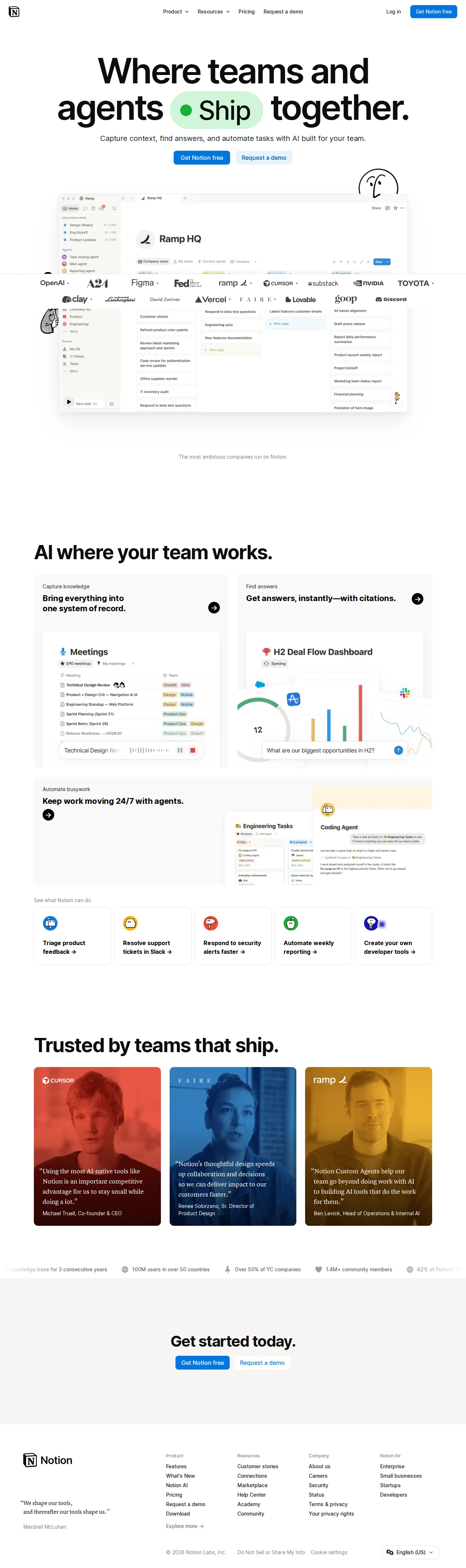
Notion is the best Microsoft OneNote alternative for people whose notebooks have outgrown free-form pages. Where Microsoft OneNote places text, ink, images, and audio anywhere on a canvas, Notion builds pages out of blocks and relational databases with linked views, filters, and templates, which is the structure OneNote's canvas does not impose and the reason large OneNote notebooks get hard to search. Notion's free plan gives a solo user unlimited pages and blocks, and it runs on six platforms including a native Linux desktop app, one more than Microsoft OneNote's five. Paid plans are $10/member/month for Plus and $20/member/month for Business, which adds Notion Agent, AI Meeting Notes, Enterprise Search, SAML SSO, and 90-day page history, plus a public API, webhooks, and one-way database syncs with Jira, GitHub, and Asana. Microsoft OneNote stays the better choice for handwriting, for simplicity, and for cost. Microsoft OneNote is free with a Microsoft account with no paid tier at all, where Notion's meaningful AI features need the $20/member/month Business plan plus usage-based credits at $10 per 1,000. Notion's learning curve is steep against OneNote's low one, its offline support covers only recently viewed or favorited pages on paid plans where OneNote syncs local notebooks through OneDrive, and its free plan caps file uploads at 5MB with 7-day page history.
Compared to Microsoft OneNote: relational databases with linked views and templates instead of a free-form canvas, a native Linux desktop app Microsoft OneNote does not offer, and $10 to $20 per member per month for paid plans against Microsoft OneNote's $0
Wins:Blocks and relational databases with linked views, filters, and templates give the structure Microsoft OneNote's free-form canvas leaves to the user · Runs on six platforms including a native Linux desktop app, where Microsoft OneNote covers web, Windows, macOS, iOS, and Android only · Public API, webhooks, and one-way database syncs with Jira, GitHub, and Asana, plus Notion Agent and AI Meeting Notes on the Business plan
Loses:Steep learning curve against Microsoft OneNote's low one, since the block-and-database model has to be designed before it pays off · Per-member pricing of $10 (Plus) to $20 (Business) per month, plus AI credits at $10 per 1,000, where Microsoft OneNote is free with no paid tier at all · Offline support reaches only recently viewed or favorited pages on paid plans, and the free plan caps file uploads at 5MB with 7-day page history
Pros
- Single tool covers docs, wikis, databases, and basic project tracking, reducing tool-switching
- Free plan supports unlimited pages and blocks for solo use, with only multi-member workspaces hitting block limits
- Deep customization through nested pages, linked databases, and templates
- Public API, webhooks, and 1-way database syncs (Jira, GitHub, Asana) for connecting external tools
Cons
- Per-member pricing on paid tiers ($10-$20/month) gets expensive fast for larger teams compared to flat-fee tools
- Offline support is limited to recently viewed or favorited pages on paid plans rather than full offline access
- Flexible block-and-database model has a steep learning curve for teams used to fixed-structure apps
- Meaningful AI features (Notion Agent, Enterprise Search, AI Meeting Notes) require the $20/month Business plan or higher
Pricing: Free tier · paid from $10/mo — Free for solo use, then $10/member/month (Plus) or $20/member/month (Business), vs Microsoft OneNote's $0 with a Microsoft account (verified undefined NaN, NaN)
3.Obsidian — best Microsoft OneNote alternative for individuals building a long-lived personal knowledge base who want their notes to stay plain markdown files they can read, back up, and move without the app
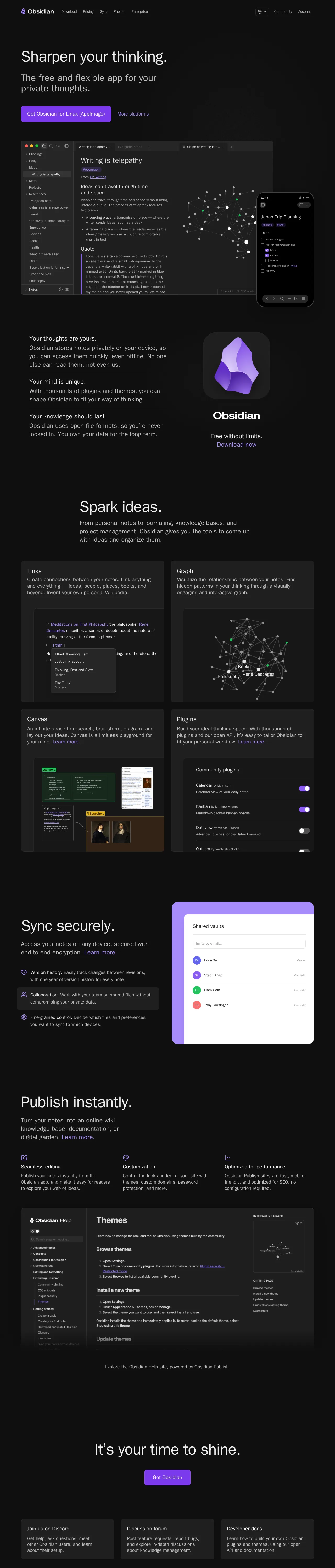
Obsidian is the best Microsoft OneNote alternative for people who want their notes to stay on their own disk in open file formats. Obsidian is free without limits and needs no sign-up at all, where Microsoft OneNote requires a Microsoft account and stores notebooks in OneDrive. Obsidian keeps notes locally on the device, uses open file formats so nothing is locked in, and collects no telemetry, and thousands of community plugins and themes plus links, backlinks, and a graph view supply the structure Microsoft OneNote's free-form canvas leaves out. It runs on Windows, macOS, Linux, iOS, and Android, which covers the Linux gap Microsoft OneNote does not. Microsoft OneNote is still the better choice for anyone who wants sync and web access included. Obsidian's cross-device sync is a paid add-on, Obsidian Sync at $4/user/month billed annually or $5 billed monthly, which adds AES-256 end-to-end encryption, version history, and shared vaults, where Microsoft OneNote syncs free across all five of its platforms. Obsidian has no web app at all, so there is no browser equivalent to onenote.com, and publishing notes to the web is a second paid add-on at $8/site/month billed annually. A $25 one-time Catalyst license and an optional $50/user/year commercial license support development but are not required to use the app. Obsidian has no external review rating on record.
Compared to Microsoft OneNote: notes stored locally in open file formats with no sign-up required, thousands of community plugins and themes plus links and backlinks instead of a free-form canvas, and cross-device sync as a paid $4/user/month add-on where Microsoft OneNote syncs free
Wins:Free without limits and with no sign-up, storing notes locally on the device in open file formats with no telemetry collected · Thousands of community plugins and themes, plus links, backlinks, and a graph view that give large note collections the structure Microsoft OneNote's canvas does not · Native Linux desktop app alongside Windows, macOS, iOS, and Android, covering a platform Microsoft OneNote does not support, and AES-256 end-to-end encryption on Obsidian Sync
Loses:Cross-device sync costs $4/user/month billed annually ($5 monthly), where Microsoft OneNote syncs free across web, Windows, macOS, iOS, and Android · No web app at all, so there is no browser equivalent to onenote.com for using notes on a machine you cannot install software on · Publishing notes to the web is a second paid add-on at $8/site/month billed annually ($10 monthly), and Obsidian has no external review rating on record
Pros
- The app is free without limits and needs no account; notes are stored locally as plain markdown files in open formats, so there is no lock-in.
- 7,647 community plugins and 755 themes let the editor be reshaped for research, writing, task management, or visualization.
- Works fully offline on Windows, macOS, Linux, iOS, and Android, with no server round-trip to open a note.
- Obsidian states notes stay on the device and are inaccessible to the company, its apps collect no telemetry, and Obsidian Sync is AES-256 end-to-end encrypted.
- Paid products are optional services rather than a feature wall: Sync from $4/user/month, Publish from $8/site/month, and a commercial license the FAQ says is not required.
Cons
- There is no web version, so a vault is only reachable from a device where Obsidian is installed.
- Cross-device sync is a paid add-on from $4/user/month, or a do-it-yourself setup on iCloud, Dropbox, or Git.
- Real-time collaboration needs paid shared vaults on Obsidian Sync; there is no free multi-user editing.
- Obsidian's own apps are not open source — obsidian.md publishes open file formats plus public release and plugin repositories, but not the application source.
Pricing: Free tier · paid from $4/mo — Free without limits and with no sign-up, but Obsidian Sync costs $4/user/month billed annually ($5 monthly), vs Microsoft OneNote's free sync across all five of its platforms (verified undefined NaN, NaN)
4.Bear — best Microsoft OneNote alternative for writers and students on Mac, iPhone, and iPad who want a fast markdown editor with tag-based organization instead of folders
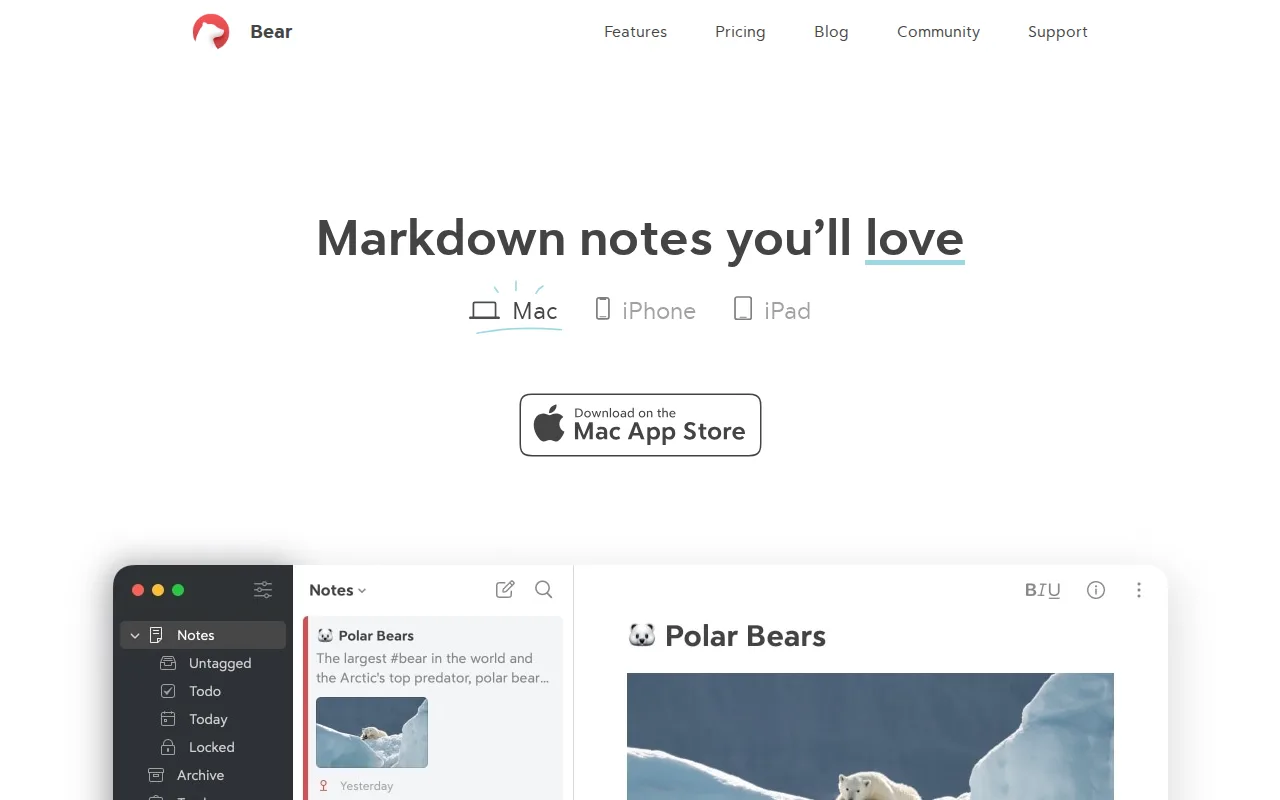
Bear is the best Microsoft OneNote alternative for writers and students working only on Apple hardware who want a fast markdown editor instead of a canvas. Bear replaces folders with nested hashtags such as #work/projects/2026, and one search bar filters by tag, title, and body text at once, which is a sharper retrieval model than Microsoft OneNote's notebooks, sections, and pages on a free-form canvas. Bear is made by the independent studio Shiny Frog, holds 4.6/5 from 34 Product Hunt reviews where Microsoft OneNote has no external rating on record, and exports to DOCX, PDF, RTF, HTML, TextBundle, and ePub, more formats than most note apps offer. Bear Pro is $2.99/month or $29.99/year and adds iCloud sync, 28+ themes, and OCR search inside scanned images and PDFs. Microsoft OneNote is the better choice for anyone not entirely inside Apple's ecosystem, and for anyone who wants sync for free. Bear has no Windows, Linux, Android, or web client, so a single work PC breaks the workflow, where Microsoft OneNote runs on web, Windows, macOS, iOS, and Android. Bear's free tier is local-only, meaning cross-device sync costs $29.99/year against Microsoft OneNote's $0, and Bear has no built-in collaboration or note sharing for teams.
Compared to Microsoft OneNote: nested hashtags and one search bar filtering tag, title, and body at once instead of notebooks on a canvas, macOS and iOS only against Microsoft OneNote's five platforms, and $2.99/month for sync where Microsoft OneNote syncs free
Wins:Nested hashtag organization (#work/projects/2026) with a single search bar filtering by tag, title, and body text at once, a tighter retrieval model than Microsoft OneNote's free-form canvas · 4.6/5 from 34 Product Hunt reviews, where Microsoft OneNote has no external rating on record · Exports to DOCX, PDF, RTF, HTML, TextBundle, and ePub, and Bear Pro adds OCR search inside scanned images and PDFs
Loses:Apple-only: no Windows, Linux, Android, or web client, where Microsoft OneNote runs on web, Windows, macOS, iOS, and Android · The free tier is local-only, so cross-device sync requires Bear Pro at $2.99/month ($29.99/year), against Microsoft OneNote's free sync · No built-in collaboration or note sharing for teams, where Microsoft OneNote notebooks are shared and synced through OneDrive, and most themes plus OCR search sit behind the Pro subscription
Pros
- Distraction-free markdown editor with live preview and Apple Pencil sketch support.
- Nested hashtag system replaces rigid folders and doubles as instant search filtering.
- Exports to DOCX, PDF, RTF, HTML, TextBundle, and ePub, more formats than most note apps offer.
- Low subscription price ($2.99/month) compared to bundled productivity suites.
Cons
- No Windows, Linux, Android, or web client — Apple-only.
- iCloud sync, OCR search, and most themes are locked behind the Pro subscription; the free tier is local-only.
- No built-in collaboration or note-sharing features for teams.
Pricing: Free tier · paid from $2.99/mo — Free locally, then $2.99/month or $29.99/year for Bear Pro to sync across devices, vs Microsoft OneNote's $0 sync across five platforms (verified undefined NaN, NaN)
5.Apple Notes — best Microsoft OneNote alternative for apple users who want a free, preinstalled note app that syncs automatically across iPhone, iPad, and Mac without setting up a third-party account.
Apple Notes is the best Microsoft OneNote alternative for people whose devices are all Apple. Apple Notes is preinstalled on every iPhone, iPad, and Mac at no extra cost and syncs through iCloud with an existing Apple Account, so there is nothing to install and no Microsoft account to create. Its capture features go deeper into the OS than Microsoft OneNote's: Quick Note opens from Control Center or Safari without switching apps, Live Text searches inside scanned and handwritten pages, and document scanning corrects perspective automatically. Notes can be locked individually with a password or Face ID, and real-time collaboration with other Apple Account holders runs over iCloud. Microsoft OneNote is the better choice for anyone with a Windows PC or an Android phone. Apple Notes has no native Windows or Android client, leaving cross-platform users with the stripped-down iCloud.com web view, where Microsoft OneNote ships native Windows, macOS, iOS, and Android apps plus a full web app at onenote.com. Apple Notes also has no public API or plugin ecosystem, and its backlinking and database features are weak next to Notion or Obsidian. Its free storage is 5GB of iCloud shared with Mail, Photos, and device backups, the same size as the OneDrive allowance Microsoft OneNote draws on but spread across more services, so scans and images push users to iCloud+ from $0.99/month.
Compared to Microsoft OneNote: preinstalled on every iPhone, iPad, and Mac with no Microsoft account needed, Quick Note and Live Text search inside scanned and handwritten pages, and no native Windows or Android client where Microsoft OneNote ships both
Wins:Preinstalled and free on every iPhone, iPad, and Mac, needing only an existing Apple Account rather than a Microsoft account · Quick Note from Control Center or Safari, Live Text search inside scanned and handwritten pages, and document scanning with automatic perspective correction · Individual notes can be locked with a password or Face ID, and real-time collaboration runs over iCloud with other Apple Account holders
Loses:No native Windows or Android client, only the limited iCloud.com web view, where Microsoft OneNote ships native Windows, macOS, iOS, and Android apps plus a full web app · No public API or plugin ecosystem, and weak backlinking and database features next to Notion or Obsidian · The free 5GB of iCloud is shared with Mail, Photos, and device backups, so scans and images fill it quickly and push users to iCloud+ from $0.99/month
Pros
- Free and already installed on every iPhone, iPad, and Mac, no signup beyond an existing Apple Account
- Notes can be locked individually with a password or Face ID/Touch ID
- Built-in document scanning, Apple Pencil handwriting recognition, and Live Text search across scanned and handwritten content
- Real-time collaboration and sharing with other Apple Account holders via iCloud
Cons
- No native Windows or Android client, only a limited iCloud.com web view
- No public API or plugin ecosystem, unlike Notion or Obsidian
- Weak backlinking and database features compared to dedicated PKM tools
- Free iCloud storage (5GB total, shared with Photos and backups) fills up fast once notes include images or scans
Pricing: Free tier · paid from $0.99/mo — $0 for the app itself, the same as Microsoft OneNote, with iCloud+ from $0.99/month once attachments push past the free 5GB
Which one is right for you?
- You have years of scanned paper and PDFs and need OCR search across all of itEvernote
- Your notebooks have outgrown free-form pages and you want databases, filters, and linked viewsNotion
- You want your notes as plain files on your own disk with no account and no vendor lock-inObsidian
- You write in markdown on a Mac and iPhone and want tags instead of foldersBear
- You just want a free notes app already on your iPhone that syncs to your MacApple Notes
- You need a notes app that runs natively on Linux, which Microsoft OneNote does not supportObsidian
- Your team needs shared, permissioned pages rather than personal notebooksNotion
Frequently asked questions
Is there a free alternative to Microsoft OneNote?
- Obsidian is free without note or device limits and needs no sign-up, and Apple Notes is free on every iPhone, iPad, and Mac. Notion's free plan also gives a solo user unlimited pages and blocks, while Evernote's free tier stops at 50 notes and Bear's free tier is local-only.
What is the closest alternative to Microsoft OneNote?
- Evernote is the closest match: both organize captured material into notebooks, both run on web, Windows, macOS, iOS, and Android, and both handle scans, web clips, and audio alongside typed text. The split is price and search, since Microsoft OneNote is free with no caps while Evernote charges $14.99/month past 50 notes but searches scans with OCR.
Can Notion replace Microsoft OneNote?
- Yes for people who want structure, since Notion's databases, filters, and linked views solve exactly the problem of a OneNote notebook getting hard to search as it grows. No for handwriting-heavy or casual note-taking, where OneNote's free-form canvas is free and has a low learning curve against Notion's steep one and $10 to $20 per member per month for paid plans.
Which Microsoft OneNote alternative is cheapest?
- Obsidian and Apple Notes are both $0, matching Microsoft OneNote's own price, though Apple Notes only exists on Apple hardware. Among paid sync options, Bear Pro is cheapest at $2.99/month ($29.99/year), followed by Obsidian Sync at $4/user/month billed annually and Notion Plus at $10/member/month.
Which Microsoft OneNote alternative works on Linux?
- Notion and Obsidian both ship native Linux desktop apps, which Microsoft OneNote does not. Evernote, Bear, and Apple Notes have no Linux client, and Bear and Apple Notes are Apple-only.
Should I just stay on Microsoft OneNote?
- Stay if you want free, uncapped notebooks with handwriting and audio across web, Windows, macOS, iOS, and Android, because no alternative here matches that combination at $0. Switch if searching a large notebook has become the bottleneck, which is the specific weakness Evernote's OCR search, Notion's databases, and Obsidian's backlinks each address.