Standard Notes — An end-to-end encrypted, open-source note-taking app for web, desktop, and mobile, now owned by Proton, with a free tier and paid plans adding file storage and extra editors.

By Noahlast updated
Standard Notes screenshots & video
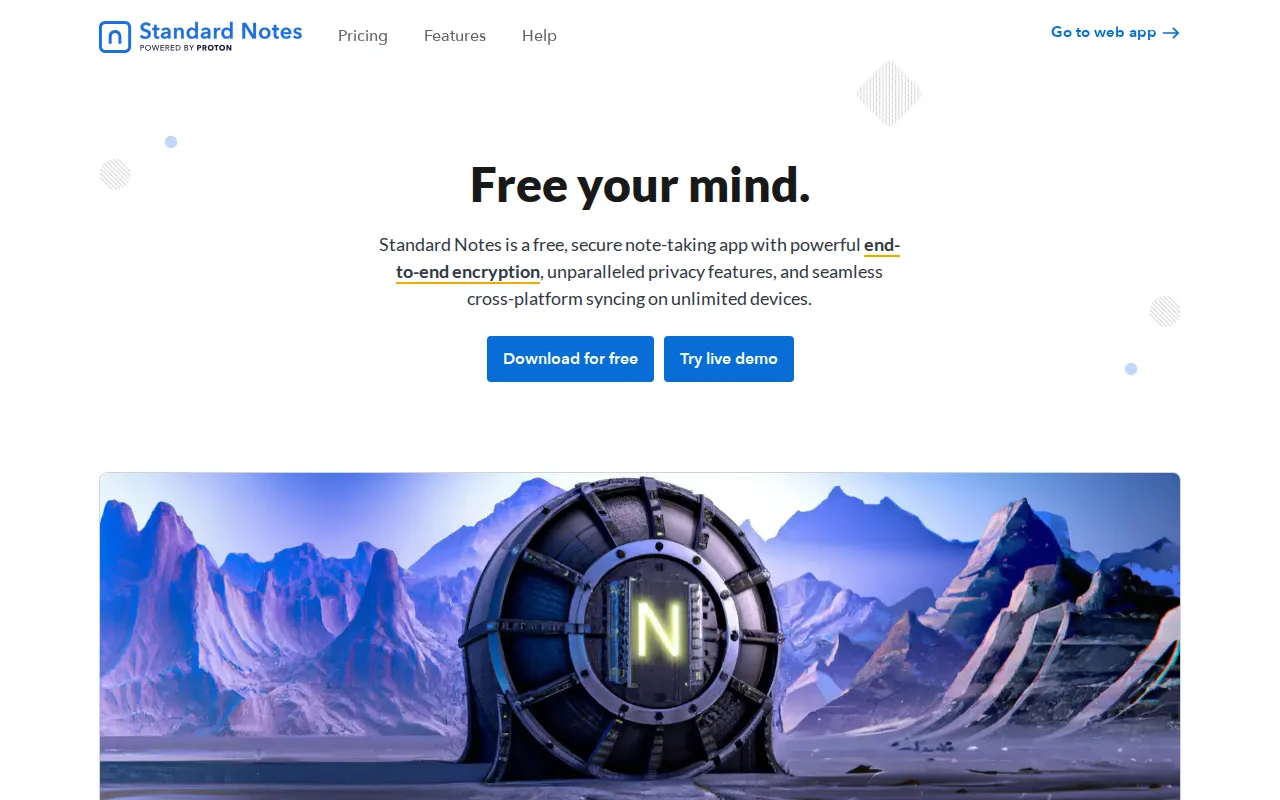
Standard Notes in 20 seconds
Best for: privacy-focused professionals who want a fully open-source, end-to-end encrypted notes app they can self-host
Pricing: Free tier with unlimited encrypted note sync; paid plan adds file storage and extra editors, exact current price not independently verified.
- Standard Notes is licensed under AGPL-3.0 and has 6.6K stars on its main GitHub repository.
- Proton AG acquired Standard Notes in April 2024, integrating it into Proton's privacy product family.
- The app runs on web, Windows, macOS, Linux, iOS, and Android from a shared open-source codebase.
- The free tier includes unlimited encrypted note sync across devices; paid tiers add extended history, more editors, and file storage.
- Standard Notes holds a 4.5-out-of-5 rating from 14 reviews on Capterra.
Limitations: Free tier's editor is intentionally plain compared to rich-text or block-based note apps.; Current paid-tier pricing is not transparently listed without starting a signup flow.; Smaller review footprint than mainstream note apps, limiting third-party integration coverage.
Top alternatives: Obsidian, Joplin, Notion, Evernote, Simplenote — full list
What is Standard Notes?
Standard Notes is an end-to-end encrypted note-taking app built for durability and privacy: notes are encrypted client-side before syncing, so Standard Notes itself cannot read user content. It supports web, Windows, macOS, Linux, iOS, and Android clients, all built from the same open-source codebase (AGPL-3.0), and the server can be self-hosted by users who want full control of their data. The free tier includes unlimited encrypted note sync across devices with a plain-text-focused editor. Paid tiers historically add features such as extended note version history, additional editors (rich text, markdown, code, spreadsheets), two-factor authentication, and encrypted file attachments. Proton AG acquired Standard Notes in April 2024, integrating it into Proton's privacy product suite alongside Proton Mail, Proton Drive, and Proton Docs, while keeping the app operating under its own brand and open-source codebase.
Standard Notes is an end-to-end encrypted, open-source note-taking application for professionals and privacy-focused users who want notes, to-dos, and files synced across unlimited devices without a vendor able to read their content. It runs on web, Windows, macOS, Linux, iOS, and Android, is licensed under AGPL-3.0 with source on GitHub (6.6K stars), and can be self-hosted. Proton AG acquired Standard Notes in April 2024, folding it into Proton's privacy-focused product family alongside Proton Mail and Proton Drive. The app offers a free tier with unlimited encrypted note sync, and paid plans add features like extended note history, additional rich-text and code editors, and encrypted file storage; exact current paid-tier pricing could not be independently verified because standardnotes.com blocked automated fetches.
Standout feature: Fully open-source (AGPL-3.0) client and server code that can be self-hosted, combined with end-to-end encryption that keeps even Standard Notes/Proton from reading note content.
Biggest weakness: The free tier's editor is intentionally minimal (plain text-focused), so richer formatting, extended note history, and file attachments require a paid plan whose current price is not transparently listed on the marketing site without navigating to a signup flow, and the plain-text-first design means it lacks the richer block-based editing found in competitors like Notion.
Pros
- Fully open-source and self-hostable (AGPL-3.0), letting privacy-conscious users run their own server.
- End-to-end encryption means Standard Notes cannot read note content, even after the Proton acquisition.
- Native apps across web, Windows, macOS, Linux, iOS, and Android from one shared codebase.
- Backed by Proton's infrastructure and funding since the April 2024 acquisition.
Cons
- Free tier's default editor is intentionally plain and minimal compared to rich-text or block-based note apps.
- Paid tier's exact current pricing is not clearly published on the marketing site without starting a signup flow.
- Smaller user base and review footprint than mainstream note apps, meaning fewer third-party integrations.
- Self-hosting the server requires technical setup that most users will skip in favor of the hosted service.
Standard Notes pricing
Free
| Plan | Price | Notes |
|---|---|---|
| Free | Free | Unlimited encrypted notes with sync across unlimited devices, using the standard plain-text and basic editors. |
| Paid plan | Custom | Adds extended note version history, additional editors (rich text, markdown, code), two-factor authentication, and encrypted file storage; exact current price not independently verified (standardnotes.com pricing page returned 403 to automated fetches; a third-party review mentioned a historical price near 50 EUR/year). |
What reviewers say
Scores belong to their platforms; we display them with attribution and never fold them into our own ratings.