6 Best Free Alternatives to Lusha in 2026
By Noahlast updated
Compared: free alternatives to Lusha
| Alternative | Best for | Learning curve | Price |
|---|---|---|---|
| Lushareference | Outbound sales teams that need verified direct-dial phone numbers and work emails while prospecting on LinkedIn, reachable through a Chrome extension rather than a separate export step | Low | Free |
| ZoomInfo | Building and enriching enterprise prospect lists with direct dials, org charts and buyer-intent signals synced into Salesforce or HubSpot under an annual contract | Moderate | Free |
| Apollo.io | Outbound sales teams that need verified decision-maker emails and phone numbers plus a built-in sequencer to run cold email and dialer campaigns without buying a separate data vendor. | Moderate | Free tier · paid from $59/mo |
| RocketReach | Looking up verified emails and mobile numbers for specific named prospects or candidates at self-serve prices, without an annual enterprise data contract | Low | Free tier · paid from $69/mo |
| Seamless.AI | B2B sales development reps and account executives who need to build outbound call and email lists of verified prospects, rather than teams looking to manage existing customer relationships. | Moderate | Free |
| Hunter | Sales and marketing teams that need to find and verify decision-maker emails at target companies and launch cold email sequences without switching tools. | Low | Free tier · paid from $34/mo |
| Mantis Ai | Web design and digital marketing agencies in Indian cities prospecting local businesses that have no website or weak SEO | Low | Free |
 Lusha
 ZoomInfo
 Apollo.io
 RocketReach
 Seamless.AI
 Hunter
 Mantis Ai
1ZoomInfo — best Lusha alternative for building and enriching enterprise prospect lists with direct dials, org charts and buyer-intent signals synced into Salesforce or HubSpot under an annual contract
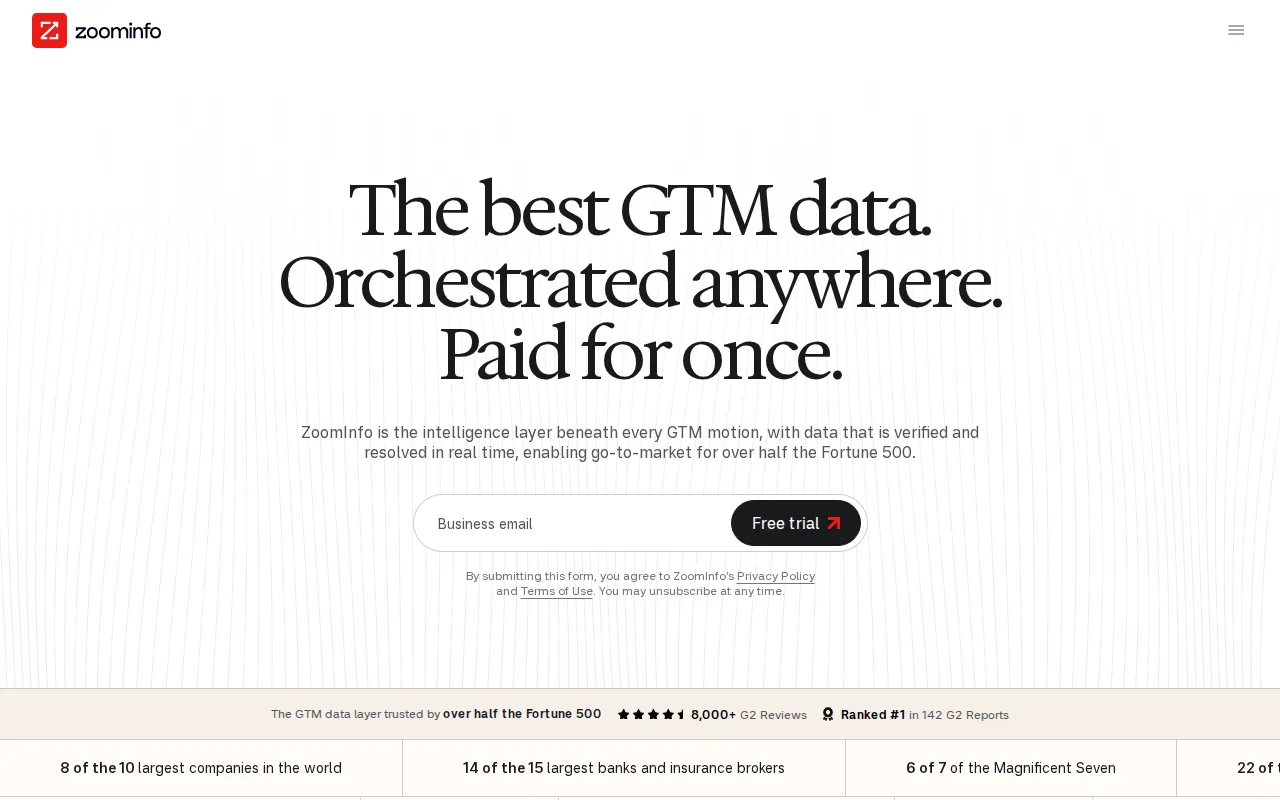
ZoomInfo is the best Lusha alternative for mid-market and enterprise teams that need more than contact reveals. ZoomInfo reports 500M+ contacts and 100M+ companies against Lusha's 290M+ contacts and 29M+ companies, including 135M+ verified phone numbers and 120M+ direct dials checked by 300+ human researchers. ZoomInfo puts org charts, technographics, website-visitor identification, Chorus call analysis and ABM display advertising in the same platform, integrates with 120+ tools including Microsoft Dynamics 365, Outreach and Salesloft, and ships iOS and Android apps where Lusha is web-only. Lusha is still the better choice for small teams and fast starts: Lusha's learning curve is rated low against ZoomInfo's moderate, ZoomInfo is aimed at companies with 100+ employees with a structured 90-day onboarding program, and most ZoomInfo contracts are billed annually upfront. Lusha's free plan gives 40 credits a month against ZoomInfo Lite's 10 export credits. Neither publishes paid prices, but Lusha states its credit costs, 1 per email and 5 per phone, while ZoomInfo charges a credit for every exported record, including CRM and API pulls, and ZoomInfo's pre-packaged CRM integrations carry a base cost plus a minimum bulk-credit purchase.
Compared to Lusha: 500M+ contacts and 100M+ companies against 290M+ and 29M+, org charts plus website-visitor identification and ABM ads in one platform, and annual custom contracts with a 90-day onboarding program
Wins:500M+ contacts and 100M+ companies with 135M+ verified phone numbers, against Lusha's 290M+ contacts and 29M+ companies · Org charts, technographics, website-visitor identification, Chorus call analysis and ABM display ads in the same platform · iOS and Android apps where Lusha is web-only, and 120+ integrations including Microsoft Dynamics 365, Outreach and Salesloft
Loses:ZoomInfo Lite gives 10 export credits a month, against Lusha's free 40 credits a month · Moderate learning curve and a 90-day onboarding program aimed at companies with 100+ employees, against Lusha's low learning curve · Most contracts are billed annually upfront, and pre-packaged CRM integrations carry a base cost plus a minimum bulk-credit purchase
Pros
- 500M+ contacts and 100M+ companies, including 135M+ verified phone numbers, 120M+ direct dials and 200M+ verified business emails, per ZoomInfo.
- Native Salesforce, HubSpot and Microsoft Dynamics 365 integrations plus 120+ others such as Outreach, Salesloft, Marketo and Snowflake.
- Intent signals, website-visitor identification, org charts and technographics sit in the same platform as the contact data.
- iOS and Android apps for customers; the iOS app holds 4.6/5 from 1,044 App Store ratings.
- ISO 27001, ISO 27701 and SOC 2 Type II certified, with TRUSTe GDPR and CCPA validation.
Cons
- No published prices; paid plans are quoted per deal and most are billed annually upfront.
- Every exported contact or company costs a credit, including records pulled by CRM and API integrations, so heavy enrichment raises the bill.
- Data skews toward North America: ZoomInfo counts 200M+ professionals and 34M+ companies outside North America, out of 500M+ contacts and 100M+ companies in total.
- The free Lite plan is limited to 10 export credits a month.
Pricing: Free — Both quote paid plans through sales; free tiers are ZoomInfo Lite's 10 export credits a month vs Lusha's 40 credits a month (verified October 23, 2026)
2Apollo.io — best Lusha alternative for outbound sales teams that need verified decision-maker emails and phone numbers plus a built-in sequencer to run cold email and dialer campaigns without buying a separate data vendor.
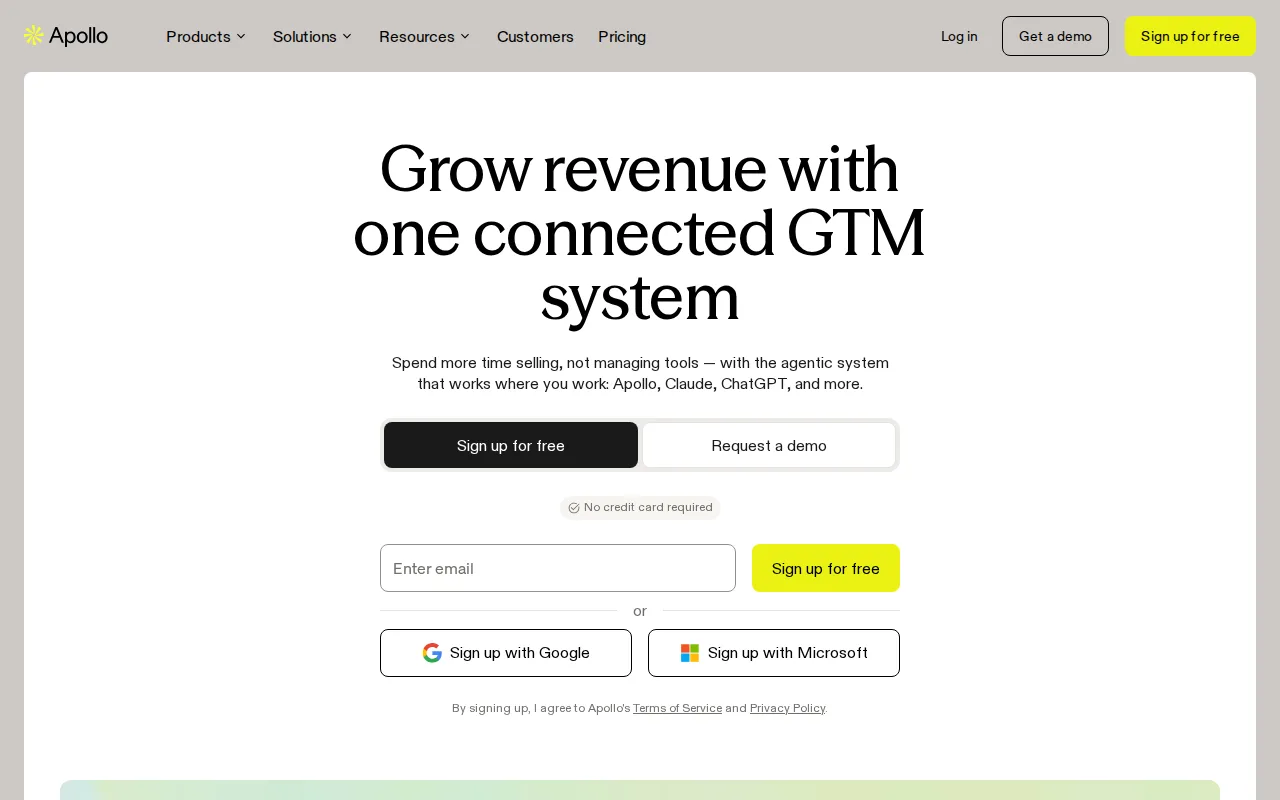
Apollo.io is the best Lusha alternative for outbound teams that want to find contacts and work them in the same tool, at a price they can see before talking to sales. Apollo.io publishes Basic at $59/month, Professional at $99/month and Organization at $149/month, while Lusha publishes only its free plan and routes paid buyers and any team over 5 seats to sales. Apollo.io pairs 240M+ contacts and 30M+ companies with email sequencing, A/B testing, a parallel dialer, conversation intelligence and AI agents that research accounts and draft outreach, where Lusha's listing centers on reveals, buying signals and CRM sync. Apollo.io lists 200+ integrations including Salesforce, HubSpot, Outreach and SalesLoft, and reports 4.7/5 across 9,690 reviews on its own pricing page. Lusha is still the better choice for reps who just need a quick reveal: Lusha's learning curve is rated low against Apollo.io's moderate, Lusha's credits come from one pool at 1 per email and 5 per phone where Apollo.io splits export, mobile and enrichment credits, and Lusha reports 290M+ verified contacts against Apollo.io's 240M+. Apollo.io's data also has known accuracy gaps on smaller and non-US companies, and sending from non-Gmail or Microsoft accounts requires a paid Apollo.io plan.
Compared to Lusha: published prices from $59/month instead of quote-only paid plans, sequencing and a parallel dialer built in, and 240M+ contacts against Lusha's 290M+
Wins:Published prices of $59, $99 and $149 a month, where Lusha's paid plans and any team over 5 seats go through sales · Email sequencing, A/B testing, a parallel dialer and conversation intelligence alongside the contact data · 200+ integrations including Outreach and SalesLoft, against Lusha's named Salesforce, HubSpot, monday CRM and Zoho integrations plus API
Loses:240M+ contacts and 30M+ companies against Lusha's 290M+ verified contacts and 29M+ companies · Separate export, mobile and enrichment credit pools, against Lusha's single pool at 1 credit per email and 5 per phone · Moderate learning curve against Lusha's low, and known accuracy gaps on smaller and non-US companies
Pros
- Large, frequently refreshed B2B contact database (240M+ contacts, 30M+ companies) bundled with outreach tools
- Free plan exists with no credit card required, useful for testing before committing
- 200+ integrations including Salesforce, HubSpot, Outreach, and SalesLoft reduce workflow disruption
- Parallel dialer and AI-drafted sequences let small teams run outbound without extra headcount
Cons
- Credit-based pricing (separate export, mobile, and enrichment credit pools) is hard to predict and can force mid-cycle top-ups
- Sending from non-Gmail/Microsoft email accounts requires a paid plan, not the free tier
- Enterprise-grade governance and security features are gated behind a custom-quoted Organization/Custom plan
- Contact data accuracy varies by region and company size, requiring manual verification for some records
Pricing: Free tier · paid from $59/mo — $59/month for Apollo.io Basic vs Lusha's quote-only paid plans; both have free plans (Lusha: 40 credits a month) (verified November 1, 2026)
3RocketReach — best Lusha alternative for looking up verified emails and mobile numbers for specific named prospects or candidates at self-serve prices, without an annual enterprise data contract
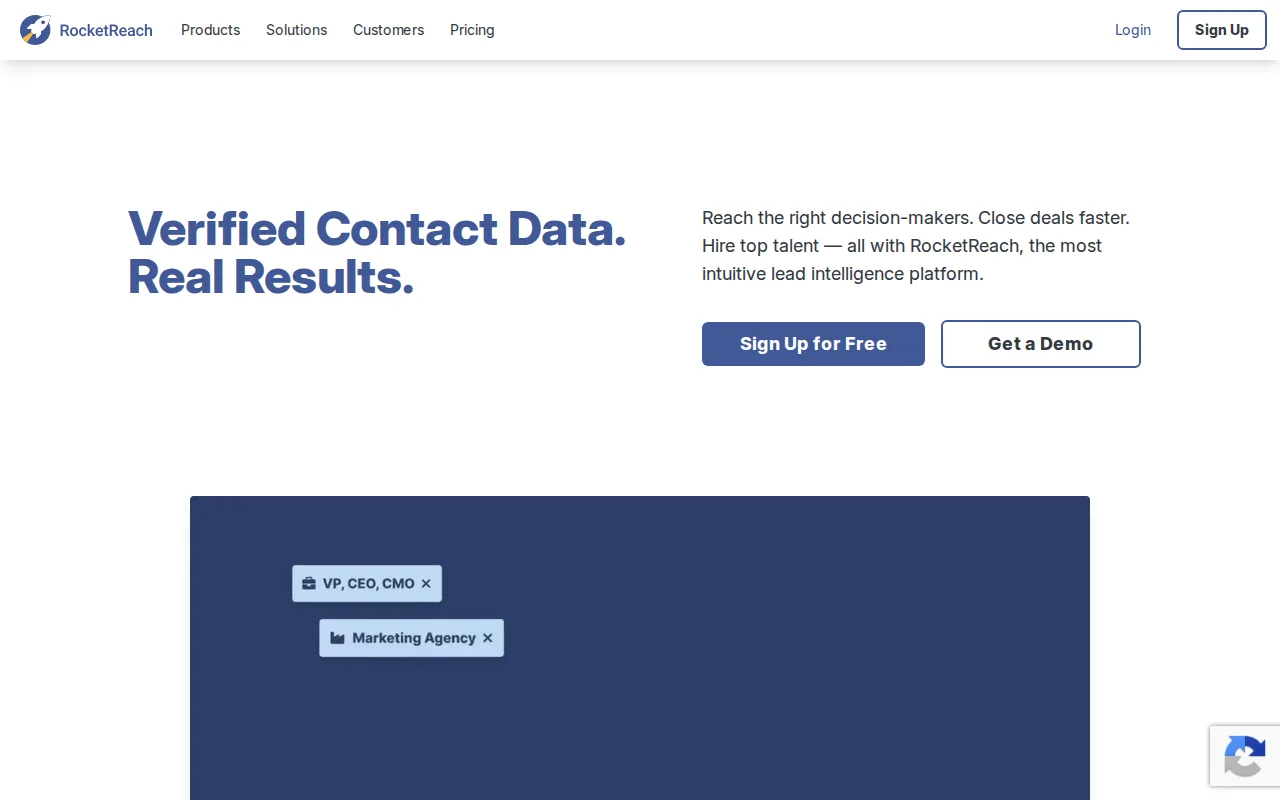
RocketReach is the best Lusha alternative for buyers who want a price list and predictable volume. RocketReach publishes every self-serve plan: $69/month for Essentials, $119/month for Pro + Phone and $209/month for Ultimate + Phone, or $399, $899 and $1,699 a year on annual plans with unlimited lookups under a 10,000-a-month fair-use cap. Lusha publishes only its 40-credit free plan, and a phone reveal there costs 5 credits, so phone-heavy prospecting burns through allotments fast. RocketReach reports 700M+ professional profiles at 60M+ companies against Lusha's 290M+ contacts and 29M+ companies, returns personal as well as work emails, refunds lookups that find no verified email or phone, and includes API and MCP access on every paid plan. Lusha is still the better choice for trying phone numbers before paying: Lusha's free plan reveals phones at 5 credits each from 40 monthly credits, while RocketReach's free account has 5 lookups and RocketReach's $69 Essentials plan excludes phone numbers entirely. Lusha also includes CRM integrations on its free plan, where RocketReach's Salesforce and HubSpot integrations start at $119/month, and Lusha adds 26 weekly-refreshed buying signals. RocketReach's Chrome extension holds 3.3/5 from 460 Chrome Web Store ratings.
Compared to Lusha: published self-serve prices from $69/month instead of quote-only plans, 700M+ profiles against Lusha's 290M+ contacts, and no phone numbers on the entry Essentials plan
Wins:Published prices from $69/month or $399/year, with no sales call, where Lusha's paid plans are quote-only · Annual plans give unlimited lookups under a 10,000-a-month fair-use cap, against Lusha's per-reveal credits (1 per email, 5 per phone) · 700M+ professional profiles with personal as well as work emails, and automatic refunds on lookups that find nothing verified
Loses:Free account has 5 lookups, against Lusha's 40 credits a month with phone reveals · Essentials ($69/month) has no phone numbers, and Salesforce and HubSpot integrations start at Pro + Phone ($119/month), where Lusha includes CRM integrations on its free plan · Annual plans cap exports at 1,200 to 20,000 a year, and the Chrome extension holds 3.3/5 from 460 Chrome Web Store ratings
Pros
- Published self-serve prices from $69/month, or $399/year on annual Essentials, with no sales call required.
- Lookups are refunded automatically when no verified email or phone is found.
- Annual plans include unlimited lookups up to a 10,000-per-month fair-use cap.
- API and MCP access on every paid plan, plus Salesforce, HubSpot, Outreach, Salesloft and Bullhorn integrations from Pro + Phone.
- Returns personal as well as work emails across 700M+ professional profiles.
Cons
- Essentials ($69/month or $399/year) excludes phone numbers; phones start at Pro + Phone ($119/month).
- Exports, which include API calls, bulk lookups, CSV downloads and CRM pushes, are capped even on the unlimited annual plans.
- The free account has only 5 lookups.
- The Chrome extension holds 3.3/5 from 460 ratings on the Chrome Web Store.
Pricing: Free tier · paid from $69/mo — $69/month (Essentials, billed monthly) or $399/year vs Lusha's quote-only paid plans; free tiers are 5 lookups vs 40 credits a month (verified October 23, 2026)
4Seamless.AI — best Lusha alternative for B2B sales development reps and account executives who need to build outbound call and email lists of verified prospects, rather than teams looking to manage existing customer relationships.

Seamless.AI is the best Lusha alternative for SDRs who call as much as they email. Seamless.AI searches the web in real time for business emails, direct dials and cell phones, reports 414M+ phone numbers and 1.8B+ verified business emails, and charges one credit per email or phone lookup, where Lusha charges 5 credits for a phone reveal against 1 for an email. Seamless.AI's free plan gives 50 credits with no credit card, against Lusha's 40 a month, and Seamless.AI's engagement hub adds email sending, an AI dialer and social selling on top of the data. A 100% credit-back guarantee refunds Seamless.AI credits for invalid emails automatically, and Seamless.AI integrates with 6,000+ tools. Lusha is still the better choice for teams that want the data without a heavier platform: Lusha's learning curve is rated low against Seamless.AI's moderate, and Lusha includes 26 weekly-refreshed buying signals, while Seamless.AI sells Buyer Intent Data, AI Assistant, Data Enrichment and Autopilot as paid add-ons. Neither publishes paid prices, and Lusha's SOC 2 Type II, ISO 27701 and ISO/IEC 42001 certifications have no counterpart in Seamless.AI's listing.
Compared to Lusha: one credit per phone lookup instead of five, an AI dialer and email sending built in, and buyer intent sold as a paid add-on
Wins:One credit per email or phone lookup, where Lusha charges 5 credits for a phone reveal · 414M+ phone numbers and 1.8B+ verified business emails reported, found by real-time web search, with automatic credit refunds for invalid emails · Engagement hub with email sending, an AI dialer and social selling, plus 6,000+ integrations
Loses:Buyer Intent Data, AI Assistant, Data Enrichment and Autopilot are paid add-ons, where Lusha layers 26 weekly-refreshed buying signals onto its data · Moderate learning curve against Lusha's low · No security certifications in the listing, where Lusha holds SOC 2 Type II, ISO 27701 and ISO/IEC 42001
Pros
- Free plan gives 50 credits with no credit card required, covering email addresses, cell phones, and export download.
- 100% credit-back protection automatically refunds credits for invalid emails.
- Real-time search engine claims 1.8B+ verified business emails and 414M+ phone numbers, updated continuously.
- Chrome extension finds contact data directly on LinkedIn and other websites while browsing.
- Integrates with 6,000+ tools plus MCP connections for Claude and ChatGPT.
Cons
- No public pricing for Pro or Enterprise plans; both require contacting sales for a quote.
- Free tier's 50 credits are consumed quickly since every email or phone lookup uses one.
- AI Assistant, Data Enrichment, Autopilot, and Buyer Intent Data are paid add-ons, not included by default.
- Advanced org management and dedicated success manager are reserved for Enterprise, not Pro.
Pricing: Free — Free 50 credits (1 per lookup) vs Lusha's 40 credits a month (5 per phone); both quote paid plans through sales (verified September 27, 2026)
5Hunter — best Lusha alternative for sales and marketing teams that need to find and verify decision-maker emails at target companies and launch cold email sequences without switching tools.
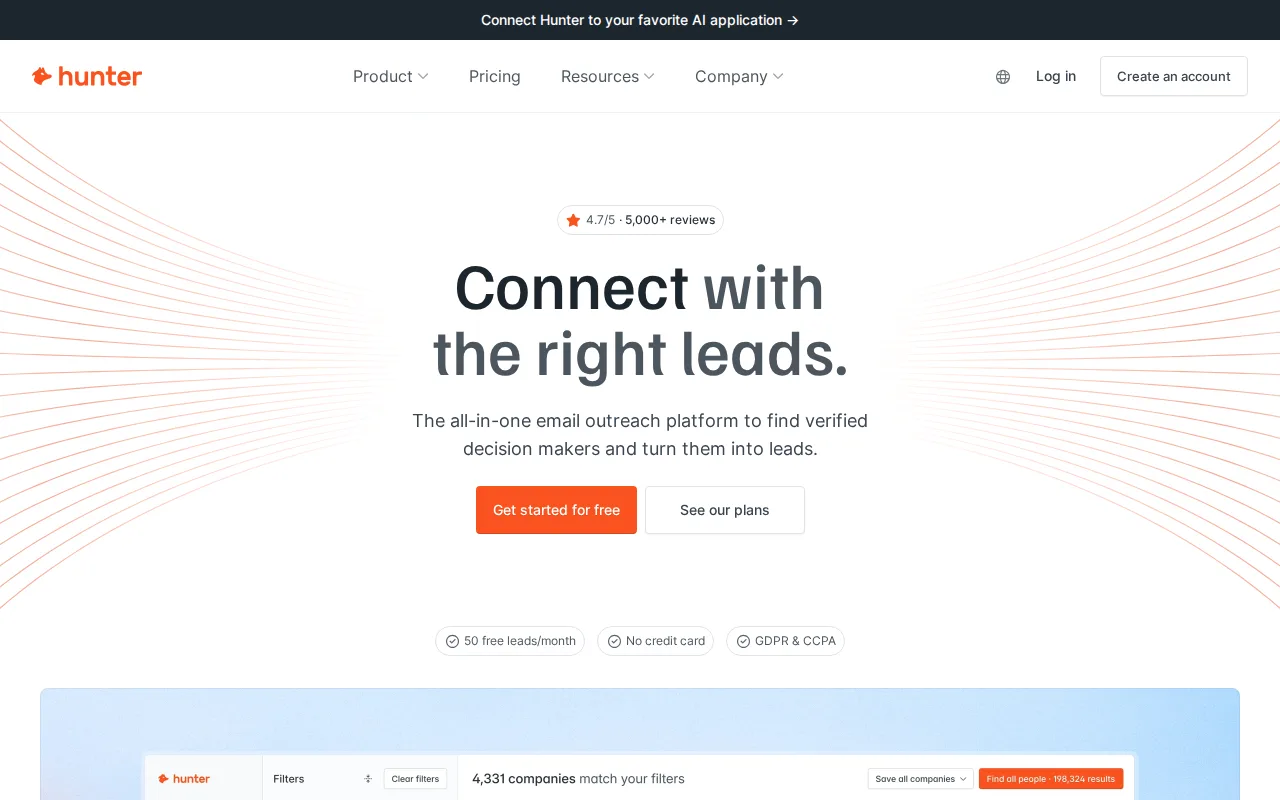
Hunter is the best Lusha alternative for teams that prospect by email and want published, self-serve pricing. Hunter Starter costs $34/month billed annually or $49 billed monthly for 2,000 credits a month, Growth $104 for 10,000 and Scale $209 for 25,000 on annual billing, while Lusha publishes only its free plan and sends paid buyers to sales. Hunter combines Domain Search, Email Finder, an Email Verifier, the Discover lead database with buying-signal filters, and Sequences for cold email, so a team can find, verify and send from one dashboard. Hunter's free plan gives 50 credits a month, 1 connected email account and 500 recipients per sequence, against Lusha's 40 credits a month, and both tools have a low learning curve. Lusha is still the better choice for anyone who needs phone numbers: Hunter's listing covers email only, while Lusha reveals direct dials at 5 credits each. Lusha also reports 290M+ verified contacts against Hunter's 150M+ verified emails, publishes a US count of 87.8M contacts, and holds SOC 2 Type II, ISO 27701 and ISO/IEC 42001 certification, which Hunter's listing does not mention.
Compared to Lusha: published prices from $34/month billed annually instead of quote-only plans, built-in email verification and cold email sequences, and email only with no phone numbers in the listing
Wins:Published prices: Starter $34, Growth $104 and Scale $209 per month billed annually, where Lusha's paid plans are quote-only · Email Verifier and Sequences built in, with up to 20 connected email accounts on Scale · Free plan gives 50 credits a month and 500 recipients per sequence, against Lusha's 40 credits a month
Loses:Listing covers email only, where Lusha reveals direct-dial phone numbers · 150M+ verified emails against Lusha's 290M+ verified contacts at 29M+ companies · No security certifications listed, where Lusha holds SOC 2 Type II, ISO 27701 and ISO/IEC 42001
Pros
- Free tier with 50 credits/month and no credit card required
- Combines lead finding, verification, and cold email sequences in one platform
- Browser extension, Google Sheets add-on, API, and MCP server for AI tools
- Annual billing cuts listed monthly prices by roughly 30%
Cons
- Credit-based pricing model makes costs harder to predict than flat per-seat pricing
- Monthly billing costs noticeably more than annual (e.g., Starter is $49/month billed monthly vs $34/month billed yearly)
- Free plan is capped at 50 credits/month, limiting it to very light use
- No listed native desktop or mobile app; access is via web, browser extension, or API
Pricing: Free tier · paid from $34/mo — $34/month billed annually ($49 monthly) for Hunter Starter's 2,000 credits a month vs Lusha's quote-only paid plans (verified September 27, 2026)
6Mantis Ai — best Lusha alternative for web design and digital marketing agencies in Indian cities prospecting local businesses that have no website or weak SEO
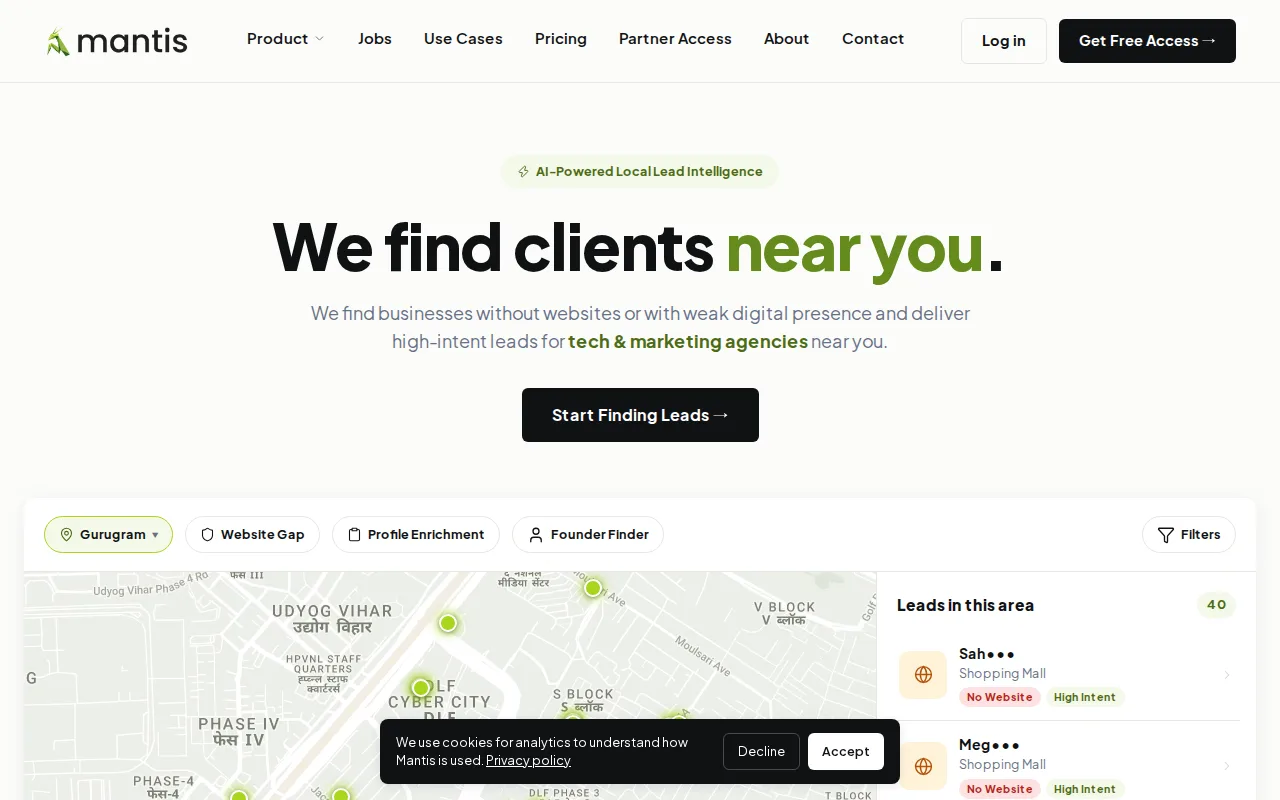
Mantis Ai is a Lusha alternative for one specific buyer: a web design, development or marketing agency selling to local businesses, mostly in Indian cities. Lusha serves reps targeting named buyers at 29M+ companies; Mantis Ai instead scans an area on a map, checks local businesses across 50+ live sources such as Google Maps, business websites and social profiles, and flags those with no website or weak SEO, ranked by an intent score built from that gap plus review volume and rating. Re-searching an already-scanned area is free, new accounts get 500 credits once (about 100 leads with contact details) against Lusha's 40 credits a month, and Mantis Ai publishes plan prices where Lusha does not: ₹1,999 for 2,000 credits, ₹3,499 for 4,000 and ₹7,499 for 10,000, on 30-day plans that never auto-renew. Lusha is the better choice for B2B sales and recruiting: Lusha reports 290M+ verified contacts with 87.8M in the US, while Mantis Ai lists 717 no-website businesses in London and 493 in Los Angeles against 2,000+ in several Indian cities. A fully enriched Mantis Ai lead costs 63 credits, Mantis Ai prices only in rupees, and Lusha has native Salesforce and HubSpot integrations and MCP connectors where Mantis Ai exports to CSV, Excel or a CRM.
Compared to Lusha: map scans of local businesses instead of B2B contact reveals, published rupee prices from ₹1,999 against quote-only plans, and coverage concentrated in Indian cities
Wins:Flags local businesses with no website or weak SEO and ranks them by intent, before any contact details are bought · 500 free credits at signup (about 100 leads with contact details) and free re-searches of scanned areas, against Lusha's 40 credits a month · Published plan prices (₹1,999, ₹3,499 and ₹7,499 per 30 days) with credits that never expire and no auto-renewal, where Lusha's paid plans are quote-only
Loses:No database of named B2B buyers; Lusha reports 290M+ verified contacts at 29M+ companies, 87.8M in the US · Coverage outside India is thin, with 717 no-website businesses listed for London and 493 for Los Angeles, and prices are in rupees only · A fully enriched lead costs 63 credits: 5 for the lead, 8 for a verified email, 30 for a verified phone and 20 for the decision-maker
Pros
- Searching an area that has already been scanned is free and unlimited; credits are spent only on new live lookups and contact details.
- Flags businesses with no website or weak SEO, the exact gap web and marketing agencies sell into.
- 500 free credits at signup, about 100 leads with contact details, with no card required.
- Credits never expire and 30-day plans never auto-renew.
- Shared team pipeline with stages and follow-ups, plus CSV and Excel export.
Cons
- Prices are listed only in Indian rupees, and paid plans are sold as 30-day blocks.
- Fully enriched leads are expensive in credits: a verified email (8), verified phone (30) and decision-maker lookup (20) on top of the 5-credit lead.
- Coverage outside India is sparse: 717 no-website businesses listed for London and 493 for Los Angeles versus 2,000+ in several Indian cities.
Pricing: Free — ₹1,999 for 2,000 credits on a 30-day plan (INR only) vs Lusha's quote-only paid plans (verified October 23, 2026)