5 Best Alternatives to Formbricks for Web in 2026
By Noahlast updated pricing verified
Compared: Formbricks alternatives that run on Web
| Alternative | Best for | Standout | Biggest weakness | Learning curve | Price |
|---|---|---|---|---|---|
| Formbricksreference | product and CX teams that need GDPR-compliant, self-hostable in-product surveys with precise attribute-based targeting | Fully open source with a self-hostable community edition, so teams with strict data-residency or privacy requirements can run Formbricks entirely on their own infrastructure instead of trusting a third party with response data. | Response limits on paid cloud tiers are low relative to price: the $74/month Pro plan caps at 2,000 responses/month before dynamic overage billing kicks in, which can get expensive fast for high-traffic products compared to flat-rate competitors. | Moderate | Free tier · paid from $74/mo |
| Typeform | marketing and product teams that want higher form-completion rates through a conversational, one-question-at-a-time design and are willing to pay per response volume rather than per user | The one-question-at-a-time conversational form format, which Typeform's own conversion data and third-party comparisons consistently cite as improving completion rates over traditional multi-field forms. | The free plan was cut from 100 to just 10 responses/month in February 2026, and response caps rather than user seats are the main pricing lever, so a single high-traffic form can force an upgrade even for a one-person team. | Low | Free tier · paid from $28/mo |
| SurveyMonkey | HR, customer-experience, and market-research teams that need to run surveys at volume and want response-based pricing rather than a flat per-seat fee | Response-based pricing tiers (50,000-100,000 responses/year) paired with a deep library of validated survey templates and built-in AI question and results summarization. | Team plans require a minimum of 3 users even for a single active survey creator, and useful features like white-label branding and advanced logic are locked behind the $92/user/month Premier tier, a steep jump from the $30 Advantage tier. | Low | Free tier · paid from $30/mo |
| Hotjar | small teams and site owners who want session recordings and heatmaps without a self-serve paid tier, using the free plan's 200,000-session monthly allowance | The free tier now allows 200,000 sessions per month after the Contentsquare merger, roughly 190 times the legacy standalone Hotjar free plan's 35-sessions-per-day cap. | There is no self-serve paid tier: any plan beyond the free tier requires contacting sales for a custom quote, with no public per-seat or per-session dollar pricing, making budgeting difficult compared to analytics tools with transparent paid tiers. | Low | Free |
| Tally | founders and small teams who want advanced form features (conditional logic, payments, e-signatures) without paying for them, and only need a paid plan to remove branding or add a custom domain | The free plan includes conditional logic, payment collection, and e-signatures with no submission cap, features most competitors reserve for paid tiers. | The free plan keeps "Powered by Tally" branding on every form and offers no custom domain, so any team that needs a professional, unbranded form must jump straight to the $24/month Pro tier — there's no low-cost branding-removal option in between. | Low | Free tier · paid from $24/mo |
| Qualtrics | large enterprises running unified CX, EX, and market-research programs across many channels who have budget for a six-figure annual contract and dedicated admin resources | A single platform spanning customer experience, employee experience, and market research, with AI "Experience Agents" that automatically trigger interventions when feedback signals cross a defined threshold. | No pricing is published anywhere; every product line requires a sales demo, and third-party buyer data shows contracts ranging from about $6,500/year for small deployments to well over $650,000/year for full enterprise rollouts, with implementation services adding $5,000-$20,000 more. | Steep | Custom pricing |
 Formbricks
 Typeform
 SurveyMonkey
 Hotjar
 Tally
Tally Qualtrics
1.Typeform — best Formbricks alternative for marketing and product teams that want higher form-completion rates through a conversational, one-question-at-a-time design and are willing to pay per response volume rather than per user
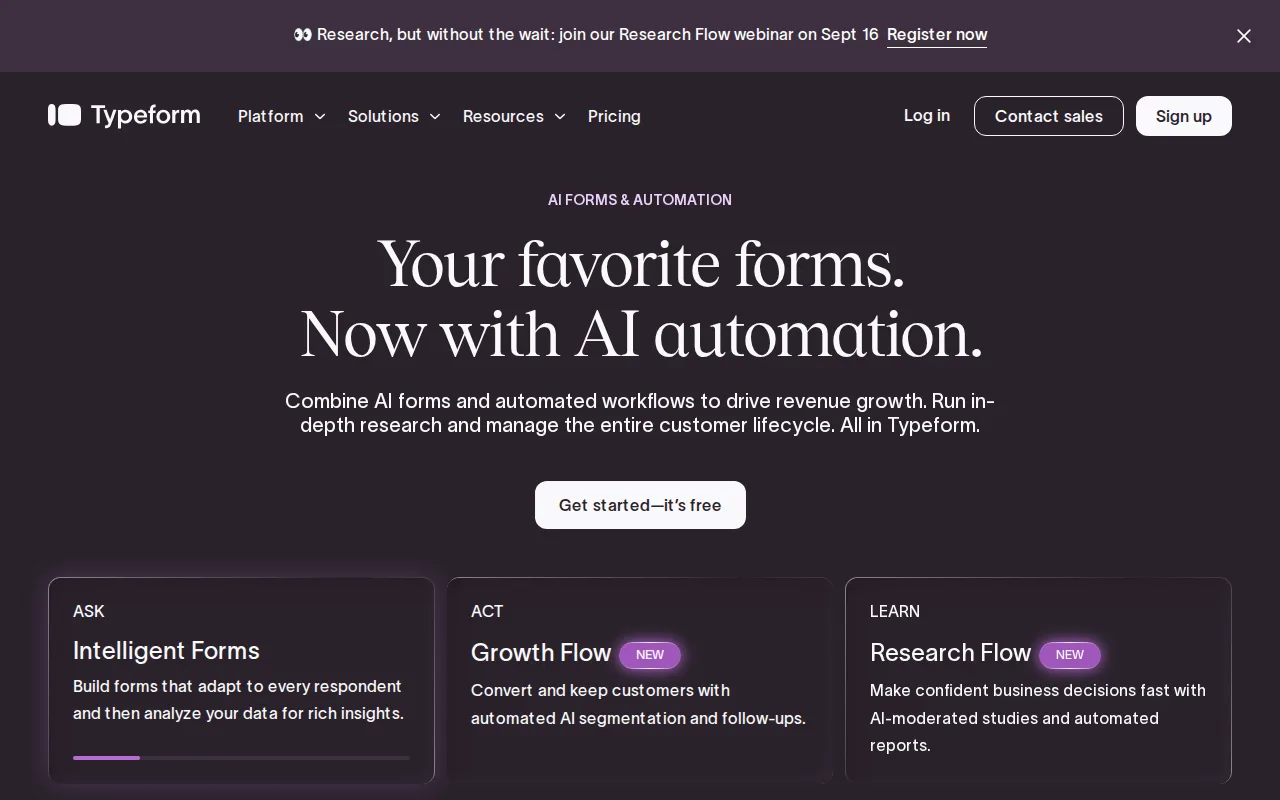
Typeform is the best Formbricks alternative for marketing and product teams that want a one-question-at-a-time conversational format proven to raise completion rates, a design approach Formbricks' context doesn't emphasize. Typeform holds a 4.7/5 rating from 974 Capterra reviews, far more review volume than Formbricks' 2 Capterra reviews and 23 Product Hunt reviews combined, and its Basic tier starts at $28/month billed annually with AI-powered form creation built in. Typeform's native integrations with Salesforce, HubSpot, and Google Sheets give marketing teams direct data routing without the custom webhooks Formbricks requires for the same result. Formbricks is still the better choice for teams that need GDPR-compliant self-hosting or want to avoid response-based pricing entirely: Typeform's free plan was cut from 100 to just 10 responses/month in February 2026, and its pricing scales on response volume rather than Formbricks' combination of a free unlimited self-hosted community edition and a flat-rate cloud plan starting at $74/month for 2,000 responses.
Compared to Formbricks: far larger review base (974 vs 2 Capterra reviews), one-question-at-a-time format proven to raise completion rates, native Salesforce and HubSpot integrations without custom webhooks
Wins:4.7/5 rating from 974 Capterra reviews, versus Formbricks' 2 Capterra reviews and 23 Product Hunt reviews · One-question-at-a-time conversational format widely cited as improving completion rates over standard forms · Native integrations with Salesforce, HubSpot, and Google Sheets, avoiding the custom webhook setup Formbricks needs for equivalent routing
Loses:Free plan was cut from 100 to just 10 responses/month in February 2026, far below Formbricks' free Hobby tier's 250 responses/month or Formbricks' unlimited self-hosted community edition · No self-hosting or open-source option, unlike Formbricks' fully open source, self-hostable codebase · No in-product or event-triggered surveys with attribute-based segment targeting the way Formbricks offers
Pros
- One-question-at-a-time format is widely cited as improving form completion rates versus traditional scrolling forms.
- AI-powered form creation on paid plans speeds up building forms from a prompt or existing document.
- Native integrations with Salesforce, HubSpot, and Google Sheets avoid manual data export.
- Annual billing cuts the effective monthly price by roughly 30% versus month-to-month across every tier.
Cons
- Free plan responses were cut from 100/month to 10/month in a February 2026 change, making it impractical for anything beyond testing.
- Pricing scales on response volume, not just users, so a single popular form can force an upgrade regardless of team size.
- No native mobile app; form building and management are web-only, unlike SurveyMonkey's dedicated iOS/Android apps.
- Branding removal requires the Plus tier ($56/month annually), unlike some competitors that include it at the entry paid tier.
Pricing: Free tier · paid from $28/mo — $28/month Basic vs Formbricks' $74/month Pro (or free self-hosted) (verified undefined NaN, NaN)
2.SurveyMonkey — best Formbricks alternative for HR, customer-experience, and market-research teams that need to run surveys at volume and want response-based pricing rather than a flat per-seat fee
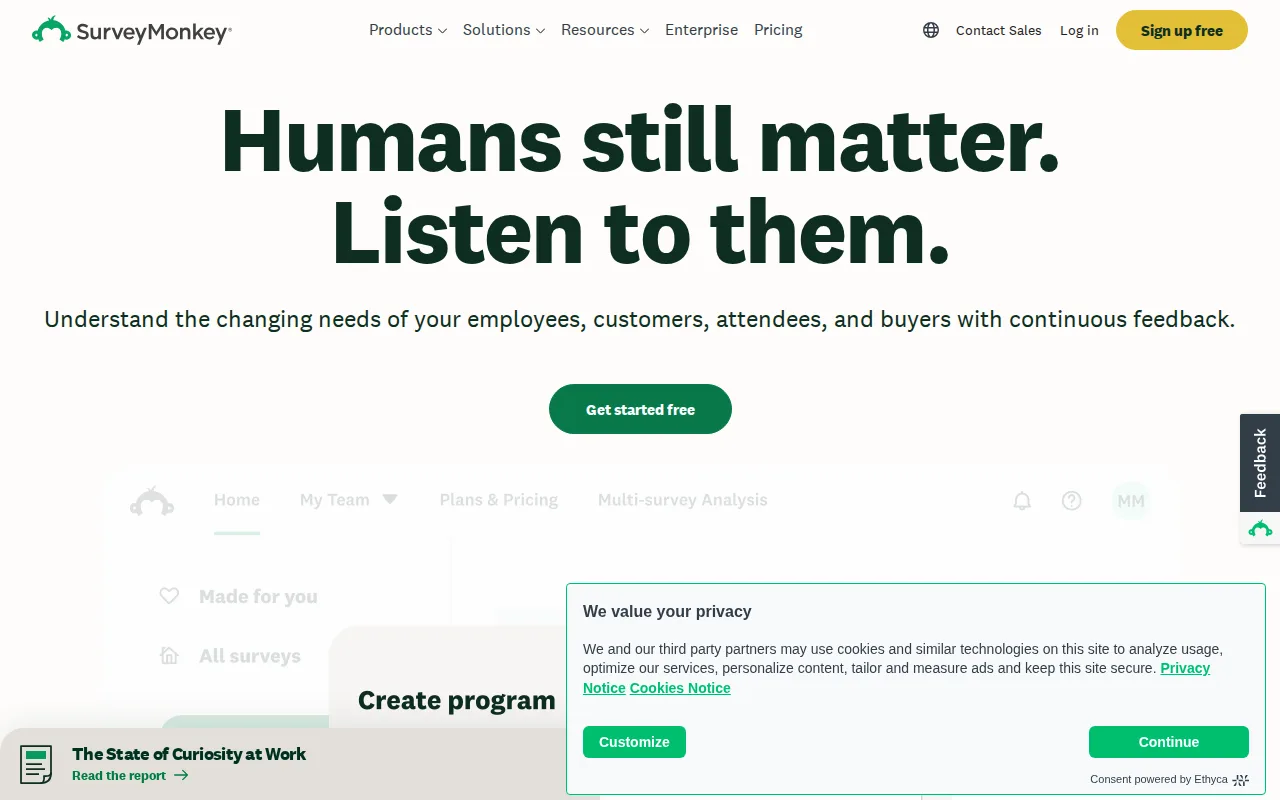
SurveyMonkey is the best Formbricks alternative for HR, customer-experience, and market-research teams that need to run surveys at volume with a deep library of pre-validated templates, something Formbricks' smaller integration and template library doesn't match. SurveyMonkey holds a 4.6/5 rating from 10,494 Capterra reviews, over 5,000 times the review volume behind Formbricks' 2 Capterra reviews, and its Team Advantage plan covers 50,000 responses/year for $30/user/month, a response allotment far above Formbricks' 2,000-responses/month Pro tier at $74/month. SurveyMonkey also ships native iOS and Android apps for offline survey collection, platforms Formbricks lists (web, iOS, Android) but with a smaller feature-parity track record. Formbricks is still the better choice for teams that need strict data-residency guarantees or in-product, event-triggered surveys with segment-based targeting: SurveyMonkey has no self-hosting option, while Formbricks' open source community edition can run entirely on a team's own infrastructure, and SurveyMonkey's Team plans require a minimum of 3 users even for a single active survey creator.
Compared to Formbricks: far larger review base (10,494 vs 2 Capterra reviews), higher response allotment per dollar (50,000 responses/year at $30/user/month vs 2,000/month at $74/month), deep pre-validated template library
Wins:4.6/5 rating from 10,494 Capterra reviews, over 5,000 times Formbricks' 2-review sample · Team Advantage plan covers 50,000 responses/year for $30/user/month, a far larger allotment than Formbricks' 2,000 responses/month at $74/month · Large library of pre-validated survey templates plus AI-assisted analysis of open-text responses
Loses:No self-hosting or open-source option; Formbricks' community edition can run entirely on a team's own infrastructure for free · Team plans require a minimum of 3 users even for a single active survey creator, a floor Formbricks' flat per-workspace pricing doesn't impose · No native in-product survey triggering with attribute- and segment-based targeting the way Formbricks offers
Pros
- Free tier lets individuals test the product before committing to a paid seat.
- Large library of pre-validated survey templates and question types speeds up survey creation.
- AI-assisted survey summarization surfaces themes in open-text responses automatically.
- Native iOS and Android apps support offline survey collection at events and in the field.
Cons
- Team plans require a 3-user minimum, expensive for a single power user who wants Team-tier features.
- Jump from Team Advantage ($30/user/month) to Team Premier ($92/user/month) is steep for teams that need just one Premier-only feature like white labeling.
- Response overages beyond the annual cap bill at $0.15 per additional response, which can add up quickly for high-volume campaigns.
- Free plan question and response limits are restrictive enough that most real use cases require upgrading.
Pricing: Free tier · paid from $30/mo — $30/user/month Team Advantage vs Formbricks' $74/month Pro (or free self-hosted) (verified undefined NaN, NaN)
3.Hotjar — best Formbricks alternative for small teams and site owners who want session recordings and heatmaps without a self-serve paid tier, using the free plan's 200,000-session monthly allowance
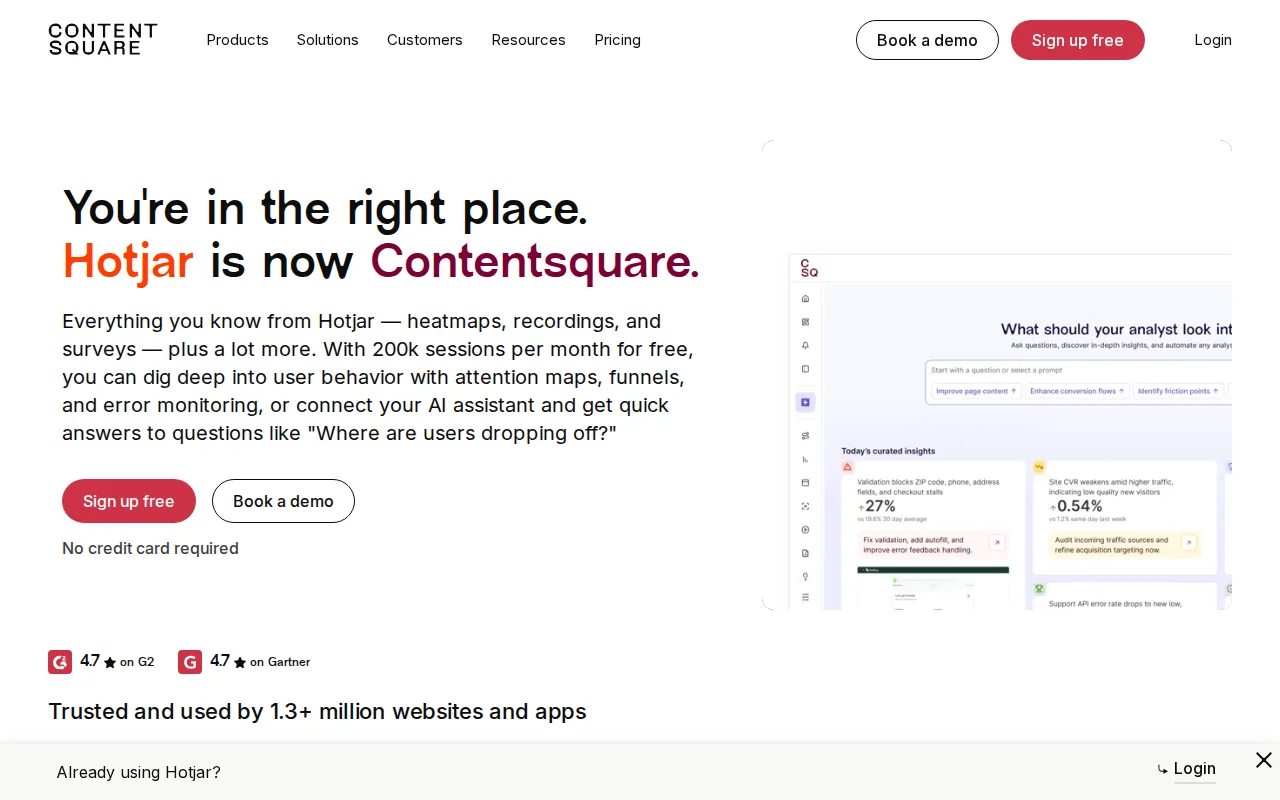
Hotjar (now part of Contentsquare) is the best Formbricks alternative for teams that want on-site surveys paired with heatmaps and session recordings in one product, a combination Formbricks' survey-only feature set doesn't offer. Hotjar's Free plan covers 200,000 sessions per month and 100 survey responses per month at no cost, a far larger free allotment than Formbricks' Hobby tier's 250 responses/month, and Hotjar holds a 4.6/5 rating from 545 Capterra reviews, over 270 times Formbricks' 2-review sample. Hotjar's Sense AI insights and error/performance monitoring are bundled into the free tier, capabilities Formbricks' context doesn't document. Formbricks is still the better choice for teams that need self-hostable, GDPR-guaranteed survey infrastructure or precise event-triggered targeting: Hotjar has no self-hosting option and any plan beyond Free requires a sales conversation with no published pricing, while Formbricks' open source community edition is free and unlimited, and Formbricks' attribute- and segment-based targeting is purpose-built for surveys rather than adapted from a broader analytics product.
Compared to Formbricks: far larger free-tier session allotment (200,000 sessions/month vs 250 responses/month), far larger review base (545 vs 2 Capterra reviews), bundles heatmaps and session recordings alongside surveys
Wins:Free plan covers 200,000 sessions/month and 100 survey responses/month, a far larger free allotment than Formbricks' 250 responses/month Hobby tier · 4.6/5 rating from 545 Capterra reviews, over 270 times Formbricks' 2-review sample · Combines heatmaps, session recordings, and surveys in one product rather than requiring a separate analytics tool
Loses:No self-hosting option; Formbricks' community edition is free, unlimited, and self-hostable for strict data-residency needs · No public pricing for any tier beyond Free — Growth and Enterprise require a sales conversation, unlike Formbricks' published $74/month Pro and $325/month Scale tiers · No purpose-built attribute- or segment-based survey targeting comparable to Formbricks' own targeting system
Pros
- Free tier covers 200,000 sessions/month, far above most competitors' free allowances.
- Combines heatmaps, session recordings, and surveys in one product rather than requiring separate tools.
- Error and performance monitoring plus AI-generated insights (Sense AI) are included even on the free plan.
- 10+ built-in integrations (Slack, Jira, Unbounce, and others) work without custom development.
Cons
- No public pricing for any tier beyond Free; Growth and Enterprise require a sales conversation.
- The brand and product are mid-transition into Contentsquare, which may confuse users looking for the standalone Hotjar product they knew.
- Website-only; there is no dedicated mobile app for reviewing recordings or heatmaps on the go.
- Competing free tiers, like Microsoft Clarity, offer unlimited sessions rather than a 200,000-session cap.
Pricing: Free (verified undefined NaN, NaN)
4.Tally — best Formbricks alternative for founders and small teams who want advanced form features (conditional logic, payments, e-signatures) without paying for them, and only need a paid plan to remove branding or add a custom domain
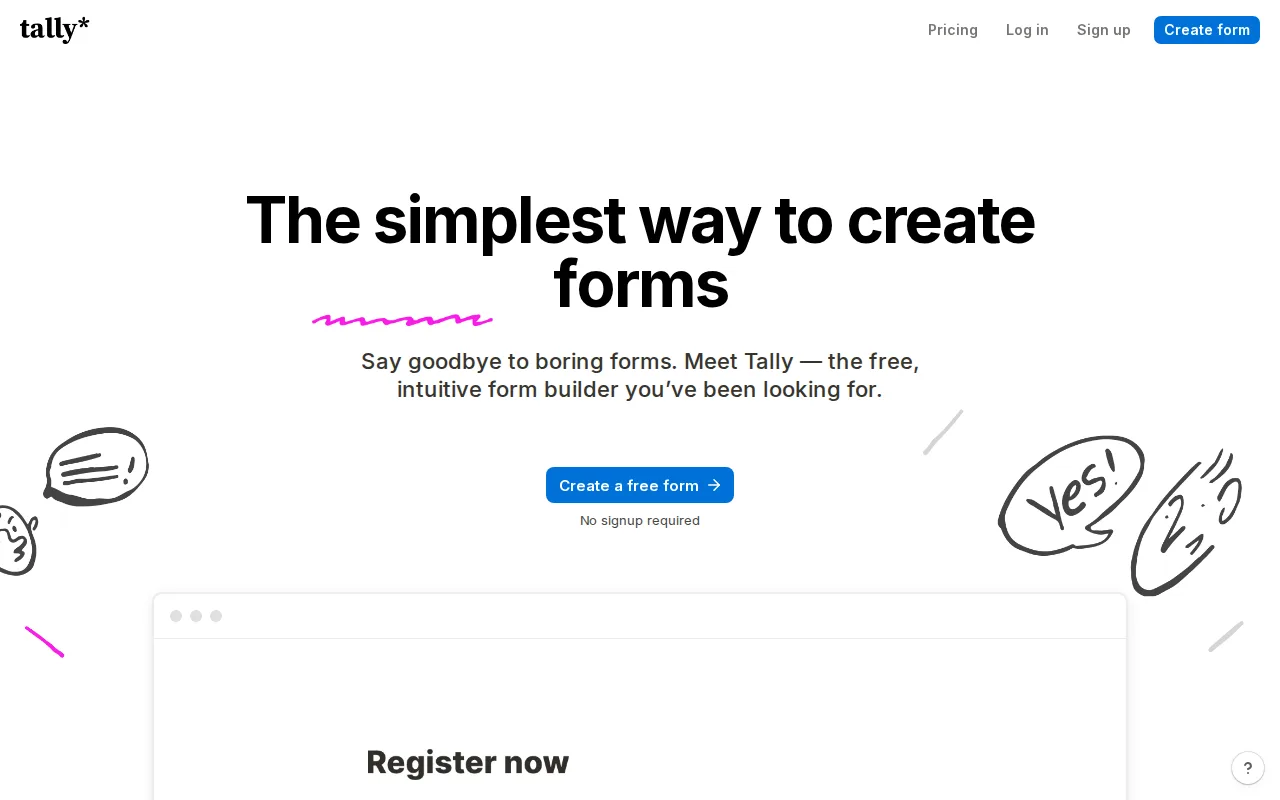
Tally is the best Formbricks alternative for founders and small teams that want unlimited forms and submissions on a free plan, a more generous free allotment than Formbricks' Hobby tier's 250-responses-per-month cap. Tally's free plan includes conditional logic, payment collection, and e-signatures with no submission cap (subject to fair-use limits), and Tally is EU-hosted and GDPR-compliant without cookie tracking, matching Formbricks' own privacy-first, Frankfurt-hosted positioning. Paid tiers are also cheaper at the entry point: Tally's Pro plan is $24/month versus Formbricks' Pro plan at $74/month for 2,000 responses. Formbricks is still the better choice for product teams that need in-product, event-triggered surveys with precise attribute- and segment-based targeting or a fully self-hostable open source codebase: Tally has no self-hosting option and no iOS/Android SDKs for native in-app surveys, while Formbricks ships dedicated mobile SDKs and can run entirely on a team's own infrastructure via its open source community edition.
Compared to Formbricks: unlimited free forms and submissions vs 250 responses/month free cap, cheaper Pro tier ($24/mo vs $74/mo), no self-hosting or mobile SDK option
Wins:Free plan has no cap on forms or submissions (subject to fair-use limits), versus Formbricks' 250-responses-per-month Hobby tier · Pro tier costs $24/month, well under Formbricks' $74/month Pro tier for 2,000 responses · EU-hosted, GDPR-compliant, and cookie-free by default, matching Formbricks' own privacy-first positioning without requiring self-hosting
Loses:No self-hosting or open source option; Formbricks' community edition can run entirely on a team's own infrastructure · No iOS or Android SDKs for native in-app surveys, unlike Formbricks' dedicated mobile SDKs · No attribute- or segment-based event-triggered survey targeting comparable to Formbricks' precise in-product targeting
Pros
- Free plan has no cap on forms or submissions and includes payments, signatures, and conditional logic.
- Document-style editor is faster to build in than block-and-canvas competitors for anyone comfortable typing in Notion.
- EU-hosted, GDPR-compliant, and doesn't use cookie tracking by default.
- Embeds cleanly into WordPress, Webflow, and Framer sites via iframe or popup.
Cons
- Removing Tally's branding requires the $24/month Pro plan; there's no cheaper branding-removal add-on.
- Jump from Pro ($24) to Business ($74) is steep for teams that need only one or two compliance features.
- "Fair use" limits on the free plan aren't published as hard numbers, leaving high-volume users uncertain when they'll be asked to upgrade.
Pricing: Free tier · paid from $24/mo — $24/month Pro vs Formbricks' $74/month Pro (or free self-hosted) (verified undefined NaN, NaN)
5.Qualtrics — best Formbricks alternative for large enterprises running unified CX, EX, and market-research programs across many channels who have budget for a six-figure annual contract and dedicated admin resources
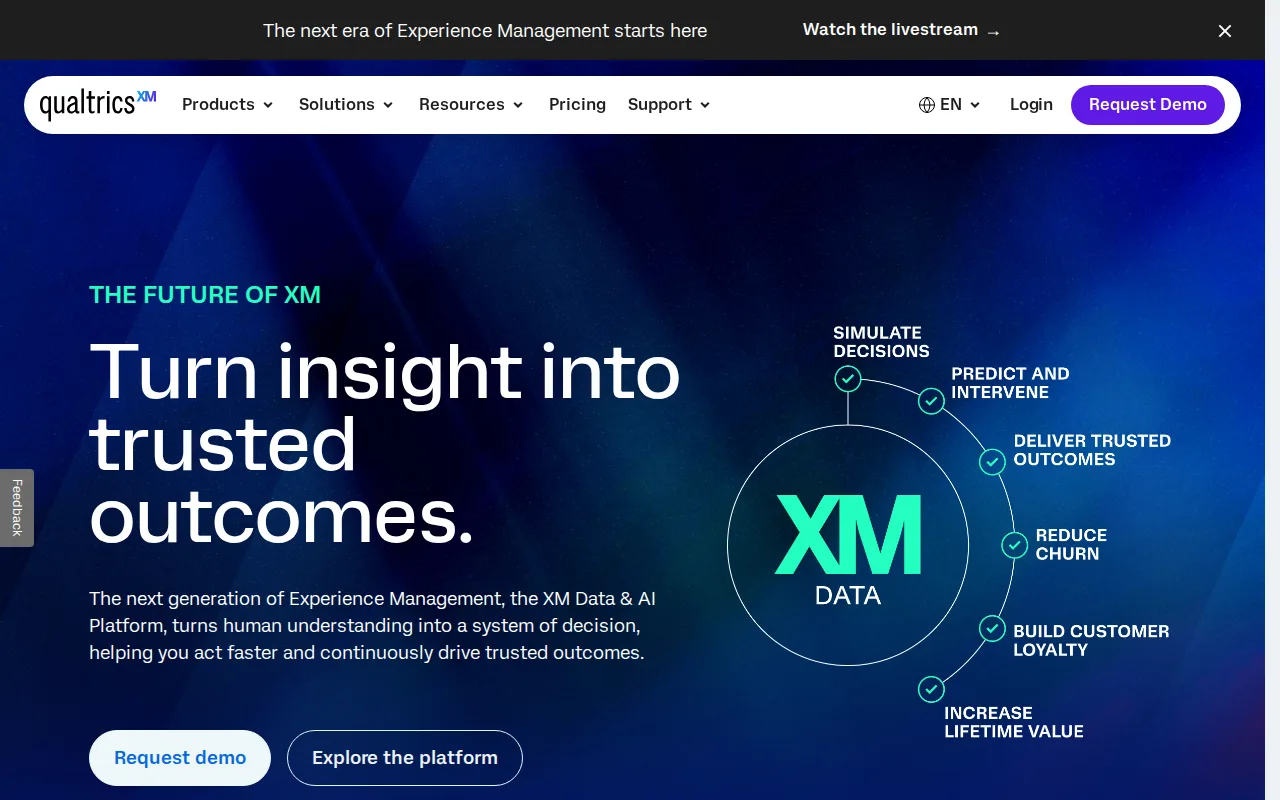
Qualtrics is the best Formbricks alternative for large enterprises running unified customer experience, employee experience, and market research programs across many channels, a scale Formbricks' product, built for product and CX teams, doesn't target. Qualtrics' AI-driven Experience Agents automatically trigger interventions when a feedback signal crosses a threshold, a more advanced automation layer than Formbricks' current feature set documents, and its G2 listings each carry thousands of reviews averaging around 4.3-4.4/5, a far larger evidence base than Formbricks' 2 Capterra and 23 Product Hunt reviews. Third-party buyer data puts typical Qualtrics contracts anywhere from roughly $6,500/year for small deployments to well over $650,000/year for large enterprise rollouts. Formbricks is still the dramatically better choice for smaller teams and self-hosting requirements: Qualtrics publishes no pricing anywhere and requires a sales demo for every product line, while Formbricks' pricing is fully published starting at a free Hobby tier, and Formbricks' open source codebase lets teams self-host at no licensing cost at all, something Qualtrics' closed, enterprise-quoted model doesn't offer.
Compared to Formbricks: unifies CX, EX, and market research in one enterprise platform, AI Experience Agents that trigger automated interventions, far larger review evidence base across thousands of G2 reviews
Wins:Unifies customer experience, employee experience, and market research in one platform, beyond Formbricks' survey-and-feedback focus · AI-driven Experience Agents automatically trigger workflows when a feedback signal crosses a defined threshold · G2 listings carry thousands of reviews averaging around 4.3-4.4/5, a far larger evidence base than Formbricks' 25 combined reviews
Loses:No published pricing anywhere; every quote requires a sales demo, unlike Formbricks' fully published tiers starting free · Third-party buyer data shows average enterprise contracts near $650,000/year, vastly more than Formbricks' $325/month Scale tier · No self-hosting or open source option, unlike Formbricks' free, self-hostable community edition
Pros
- Unifies CX, EX, and market research data in one platform instead of separate point tools.
- AI-driven text and sentiment analytics surface themes across large volumes of open-ended feedback automatically.
- Experience Agents can trigger automated workflows the moment a feedback signal crosses a threshold.
- Deep integration ecosystem and long track record with large retail, healthcare, and financial-services customers.
Cons
- No published pricing anywhere; every quote requires a sales demo and negotiation.
- Third-party buyer data shows average enterprise contracts near $650,000/year, well above most survey-tool budgets.
- Implementation and professional services commonly add $5,000-$20,000 on top of the software fee.
- Steep learning curve for teams setting up advanced logic, quotas, or multi-channel workflows without dedicated admin support.
Pricing: Custom pricing