3 Best Free Alternatives to Mailchimp in 2026
By Noahlast updated pricing verified
Compared: free alternatives to Mailchimp
| Alternative | Best for | Standout | Biggest weakness | Learning curve | Price |
|---|---|---|---|---|---|
| Mailchimpreference | small businesses and e-commerce brands that want to run email and SMS campaigns with built-in automation and AI content tools without a separate marketing stack | A drag-and-drop email builder combined with e-commerce automation triggers (abandoned cart, order follow-up) and AI content tools, backed by 300+ third-party integrations. | Pricing scales with contact-list size and jumps sharply between tiers ($13 to $20 to $350/month), so growing lists get expensive fast, and reviewers describe the cost as disproportionate to list growth on the higher tiers; the Free plan's support is email-only and expires after 30 days. | Low | Free tier · paid from $13/mo |
| Klaviyo | ecommerce and D2C brands on Shopify, WooCommerce, BigCommerce, or Magento that want email and SMS marketing driven by real order and browsing data rather than a generic contact list | Native, deep ecommerce platform integrations (especially Shopify) that sync orders, products, and browsing events into customer profiles automatically, powering behavior-triggered flows without manual data wiring. | Pricing scales with total profile count, so costs rise automatically as a store's list grows even if send volume doesn't; reviewers also cite a real learning curve for building advanced flows and segments, and email support is limited to the first 60 days on the free plan. | Moderate | Free |
| Brevo | small businesses and marketers with large but mostly-inactive contact lists who want to be billed by emails sent rather than penalized for contacts stored | Prices every plan by monthly email volume rather than contact-list size, so accounts with large stored contact lists don't pay the premium that contact-based competitors like Mailchimp charge for the same sending activity. | The Free plan caps out at just 300 emails/day (roughly 9,000/month), and features like marketing automation and landing pages require jumping past Starter to the Business tier, a bigger price step than some competitors' mid-tier plans. | Low | Free tier · paid from $9/mo |
| Kit | individual creators and newsletter writers who want list building, automation, and paid-newsletter monetization in one platform rather than general-purpose e-commerce email marketing software | Built-in support for selling paid newsletter subscriptions and digital products directly to subscribers, rather than treating monetization as a separate add-on outside the email platform. | Like most subscriber-count-based email pricing, cost scales up automatically as a creator's list grows, and reporting/analytics on the entry Creator tier are noticeably thinner than on Creator Pro, pushing serious growth-focused creators toward the pricier tier. | Moderate | Free tier · paid from $25/mo |
 Mailchimp
 Klaviyo
 Brevo
Brevo Kit
Kit1.Klaviyo — best Mailchimp alternative for ecommerce and D2C brands on Shopify, WooCommerce, BigCommerce, or Magento that want email and SMS marketing driven by real order and browsing data rather than a generic contact list
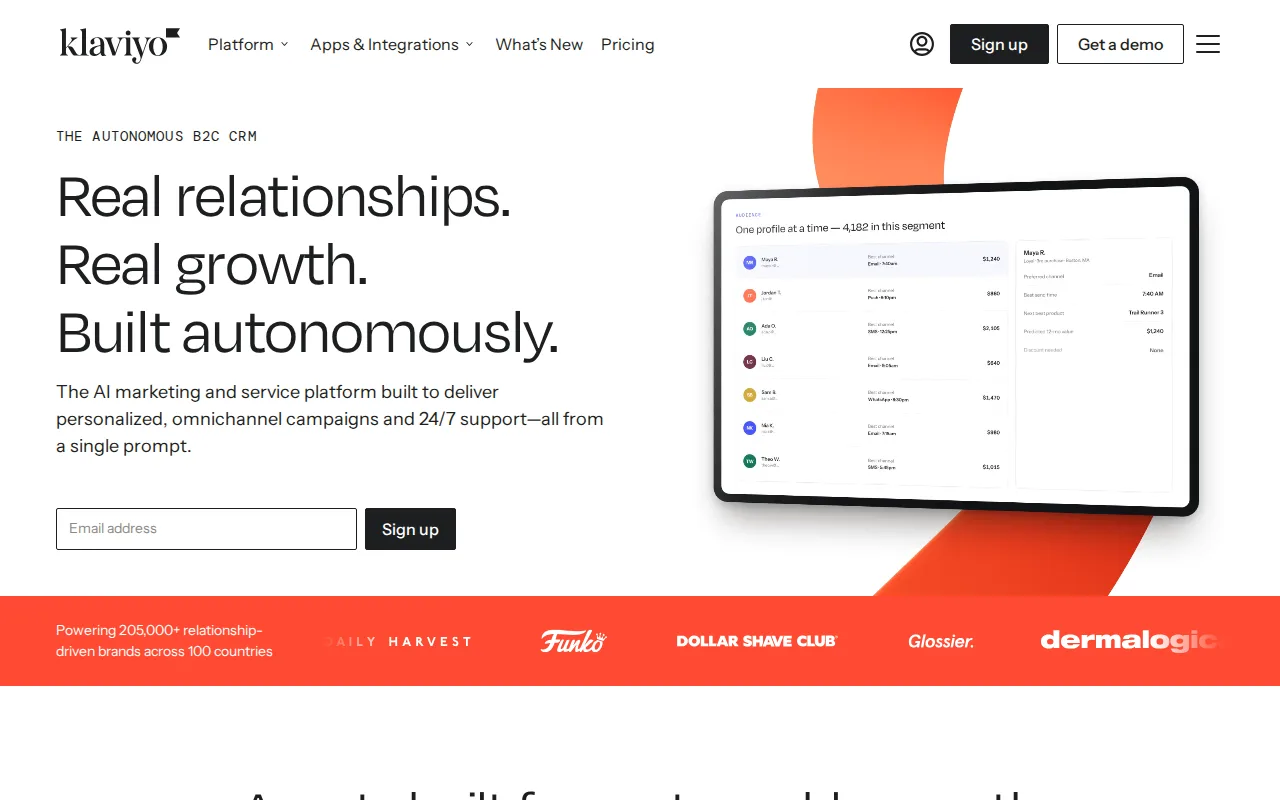
Klaviyo is the best Mailchimp alternative for ecommerce and D2C brands on Shopify, WooCommerce, BigCommerce, or Magento that want email and SMS marketing driven by real order and browsing data instead of a generic contact list. Klaviyo's native integrations sync product catalogs, order data, and customer events automatically, powering behavior-triggered flows like abandoned-cart emails and post-purchase sequences without manual data wiring, and Klaviyo reports over 205,000 brands use the platform across 100 countries. Klaviyo's Free plan covers up to 250 active profiles and 500 email sends/month, matching Mailchimp's own free-tier caps, plus $5 of monthly SMS/mobile credit that Mailchimp's free tier doesn't include. Mailchimp is still the better choice for anyone who wants a fixed, easily comparable starting price: Klaviyo's paid Email/Email+SMS tiers price by active profile count rather than a flat fee, and the exact starting dollar figure wasn't captured as a fixed number, unlike Mailchimp's clearly published $13/month Essentials tier, and newer AI features (Composer, Customer Agent) are separate paid add-ons on top of the base plan.
Compared to Mailchimp: native, deep ecommerce integrations (Shopify, WooCommerce, BigCommerce, Magento) sync orders and products automatically, unified customer profiles drive email, SMS, RCS, WhatsApp, and push from the same data, free plan adds $5 of monthly SMS credit Mailchimp's free tier doesn't include
Wins:Native, deep ecommerce integrations (Shopify, WooCommerce, BigCommerce, Magento) sync orders and products automatically, a stronger ecommerce data pipeline than Mailchimp's third-party integrations · Unified customer profiles drive email, SMS, RCS, WhatsApp, and push from the same behavioral data · Free plan includes $5 of monthly SMS/mobile credit on top of 250 profiles and 500 email sends, which Mailchimp's free tier doesn't include
Loses:Paid Email/Email+SMS tiers price by active profile count with no fixed starting dollar figure captured, unlike Mailchimp's clearly published $13/month Essentials tier · Newer AI features (Composer, Customer Agent) are priced as separate add-ons on top of the base plan · Building advanced segments and multi-step flows has a real learning curve for non-marketers, similar to Mailchimp's own automation complexity at higher tiers
Pros
- Deep native integrations with Shopify, WooCommerce, BigCommerce, and Magento sync order and product data automatically.
- Unified customer profiles let one platform drive email, SMS, RCS, WhatsApp, and push from the same behavioral data.
- Free plan (250 profiles, 500 emails/month) is enough to fully test the platform before paying.
- Strong prebuilt automation flows for abandoned cart, post-purchase, and win-back sequences.
Cons
- Per-profile pricing means costs climb automatically as a store's contact list grows, independent of send volume.
- Newer AI features (Composer, Customer Agent) are priced as separate add-ons on top of the base plan.
- Free-tier email support only covers the first 60 days.
- Building advanced segments and multi-step flows has a real learning curve for non-marketers.
Pricing: Free — Free (250 profiles, 500 sends, $5 SMS credit) matches Mailchimp's free tier; Klaviyo's paid tiers scale by profile count with no fixed starting number captured, versus Mailchimp's published $13/month Essentials (verified undefined NaN, NaN)
2.Brevo — best Mailchimp alternative for small businesses and marketers with large but mostly-inactive contact lists who want to be billed by emails sent rather than penalized for contacts stored
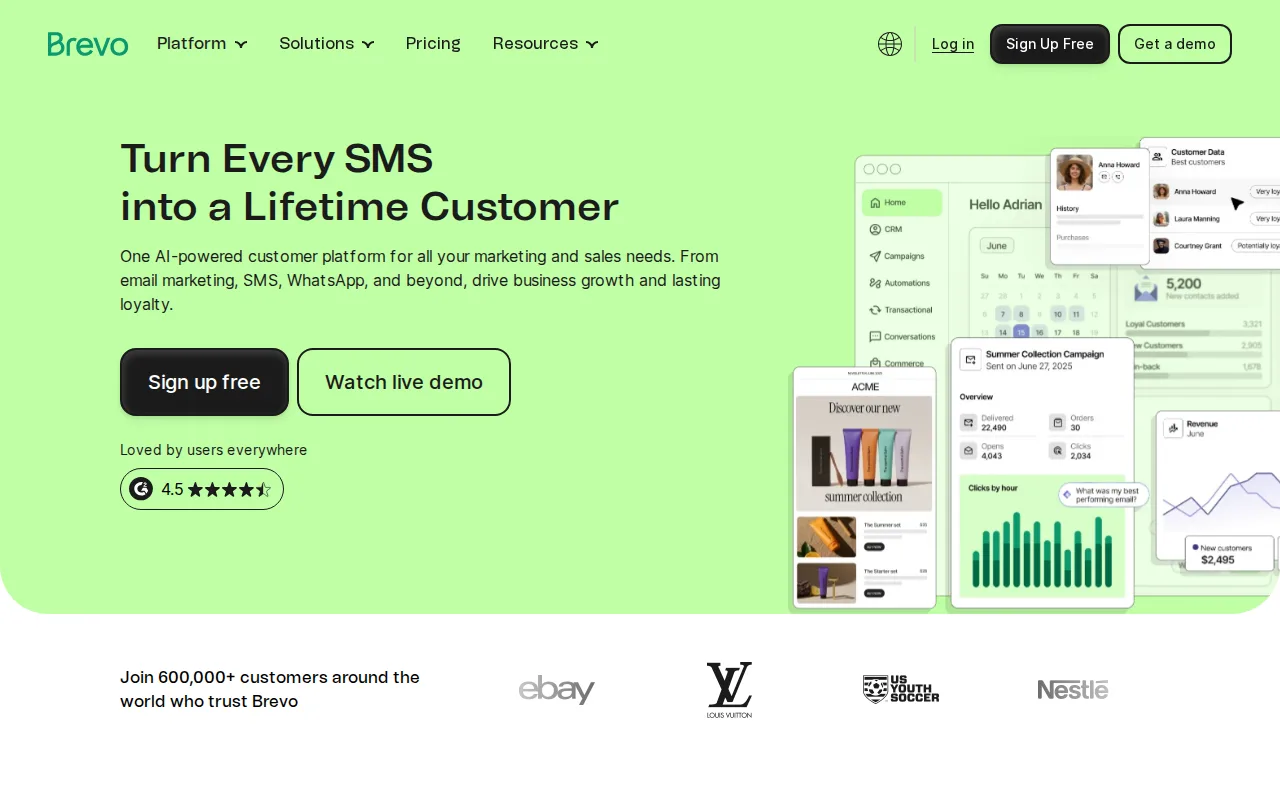
Brevo is the best Mailchimp alternative for small businesses and marketers with large but mostly-inactive contact lists who want to be billed by emails sent rather than penalized for contacts stored. Brevo's Free plan sends up to 300 emails/day with unlimited stored contacts, a structurally different model from Mailchimp's 250-contact free cap, and every paid Brevo plan includes unlimited contacts since pricing is based on email volume instead. Brevo's Starter plan runs from roughly $9/month for 5,000 emails, cheaper than Mailchimp's $13/month Essentials tier, and Brevo holds a 4.6/5 rating from 3,512 Capterra reviews, above Mailchimp's own 4.5/5 from 17,674 reviews. Mailchimp is still the better choice for teams that specifically want AI content tools and marketing automation bundled at a lower tier: Brevo's marketing automation and landing pages require jumping to the Business tier, a bigger price step than Mailchimp's Standard tier provides, and Brevo's free plan's 300 emails/day cap (roughly 9,000/month) is restrictive for anything beyond very small lists.
Compared to Mailchimp: unlimited stored contacts on every plan since pricing is based on email volume, not contact count, cheaper entry price (~$9/month Starter vs $13/month Essentials), higher Capterra rating (4.6/5 vs 4.5/5)
Wins:Unlimited stored contacts on every paid plan since pricing is based on email volume, not contact count, unlike Mailchimp's contact-based pricing · Starter plan runs from roughly $9/month, cheaper than Mailchimp's $13/month Essentials tier · 4.6/5 Capterra rating from 3,512 reviews, above Mailchimp's own 4.5/5 from 17,674 reviews
Loses:Marketing automation and landing pages require the pricier Business tier, a bigger jump than Mailchimp's Standard tier provides · Free plan's 300 emails/day cap (roughly 9,000/month) is restrictive for anything beyond very small lists · Some users report unclear account policy and compliance enforcement that can affect sending reliability
Pros
- Every paid plan includes unlimited stored contacts, since pricing is based on email volume instead.
- Free plan requires no credit card and includes core email marketing functionality.
- Bundles SMS, live chat, and a lightweight CRM alongside email in one platform.
- Transactional email and SMS APIs are available on the same account as marketing campaigns.
Cons
- Free plan's 300 emails/day cap is restrictive for anything beyond very small lists.
- Marketing automation and landing pages require the Business tier, a larger jump than Starter alone provides.
- Some users report unclear account policy and compliance enforcement that can affect sending reliability.
- Higher-volume Starter pricing (up to ~$69/month for 100,000 emails) scales quickly compared to flat-rate competitors.
Pricing: Free tier · paid from $9/mo — Free (300 emails/day, unlimited contacts) or ~$9/month Starter vs Mailchimp's free tier (250 contacts, 500 sends) or $13/month Essentials
3.Kit — best Mailchimp alternative for individual creators and newsletter writers who want list building, automation, and paid-newsletter monetization in one platform rather than general-purpose e-commerce email marketing software
Kit is the best Mailchimp alternative for individual creators and newsletter writers who want list building, automation, and paid-newsletter monetization in one platform rather than Mailchimp's general-purpose, e-commerce-leaning tool. Kit's free plan supports unlimited landing pages, forms, and broadcast emails for a capped subscriber list, and it natively supports selling paid newsletter subscriptions and digital products directly to an audience, a monetization layer Mailchimp doesn't build in. Kit's Creator tier starts at $25/month, and free account migration is included when moving an existing list over from another platform. Mailchimp is still the better choice for teams that need a broader marketing stack beyond email: Kit has no native mobile app and is web-only, unlike Mailchimp's iOS and Android apps, and Kit's advanced reporting and Facebook custom audience syncing require the pricier Creator Pro tier, similar to how Mailchimp gates automation and predictive segmentation behind its own higher tiers.
Compared to Mailchimp: native support for selling paid newsletter subscriptions and digital products, free plan includes real list-building tools rather than a stripped-down trial, free migration support when moving an existing list over
Wins:Native support for selling paid newsletter subscriptions and digital products directly to subscribers, a monetization layer Mailchimp doesn't build in · Free plan supports real list-building tools (unlimited landing pages, forms, broadcasts) rather than a stripped-down trial · Free migration support when moving an existing list over from another email platform, unlike Mailchimp's self-serve import
Loses:No native mobile app; the platform is web-only, unlike Mailchimp's iOS and Android apps · Advanced reporting and Facebook custom audience syncing require the pricier Creator Pro tier · Pricing scales with subscriber count, so cost grows automatically as a creator's list grows, similar to Mailchimp's own contact-based pricing model
Pros
- Free plan supports real list-building tools (unlimited landing pages, forms, broadcasts) rather than a stripped-down trial.
- Visual automation builder makes tag-based drip sequences approachable for non-technical creators.
- Native support for paid newsletter subscriptions and digital product sales without a separate platform.
- Free migration support when moving an existing list over from another email platform.
Cons
- Pricing scales with subscriber count, so cost grows automatically as a creator's list grows, independent of send volume.
- Advanced reporting and Facebook custom audience syncing require the pricier Creator Pro tier.
- No native mobile app; the platform is web-only.
- Automation builder has a learning curve for creators new to tag-based (rather than list-based) email marketing.
Pricing: Free tier · paid from $25/mo — $25/month Creator (starting tier, scales with subscriber count) vs Mailchimp's $13/month Essentials — Kit starts higher but includes monetization tools Mailchimp lacks