Klaviyo — An email and SMS marketing platform built for ecommerce brands, unifying customer data into one CRM to power personalized, automated campaigns.

By Noahlast updated pricing verified
Klaviyo screenshots & video
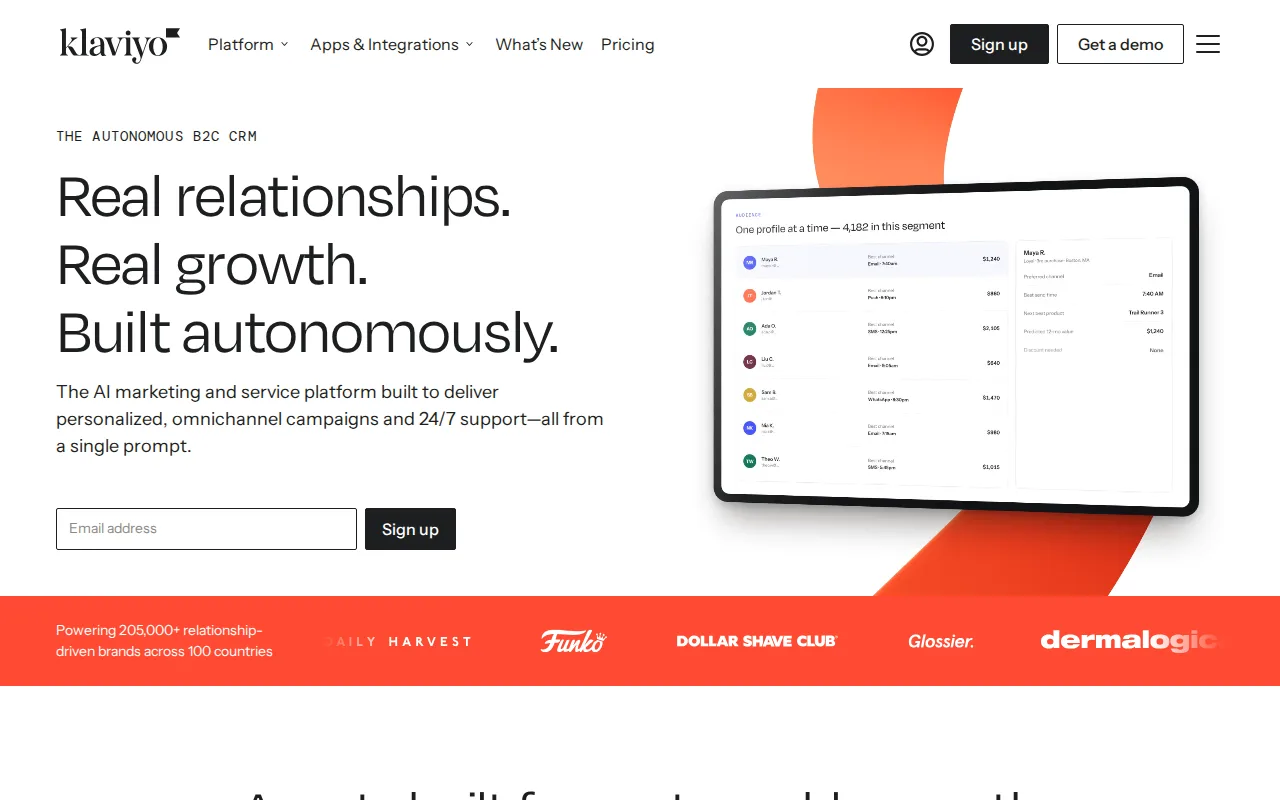
Klaviyo in 20 seconds
Best for: ecommerce and D2C brands that want email/SMS marketing driven by real order and browsing data
Pricing: Free up to 250 profiles/500 emails/month; paid Email and Email+SMS plans scale by profile count (exact starting price not published as a flat number).
- Klaviyo's Free plan covers up to 250 active profiles, 500 email sends/month, and $5 of mobile message credit/month.
- Klaviyo reports over 205,000 brands use the platform across 100 countries.
- Paid Email and Email+SMS plans are priced by active profile count rather than a flat monthly fee.
- Klaviyo has native integrations with Shopify, WooCommerce, BigCommerce, and Magento.
- Composer (AI campaign builder) and Customer Agent (AI support) are sold as separate paid add-ons on top of core plans.
Limitations: Per-profile pricing rises automatically as a store's contact list grows, regardless of send volume.; Free-tier email support only covers the first 60 days.; Advanced flows and segmentation carry a real learning curve for non-marketers.
Top alternatives: Mailchimp, Omnisend, ActiveCampaign, Braze, Iterable — full list
What is Klaviyo?
Klaviyo is a customer data and marketing automation platform purpose-built for ecommerce. Instead of treating email, SMS, and other channels as separate tools, Klaviyo stores every customer's order history, browsing behavior, and campaign engagement in one profile, then uses that unified data to trigger personalized flows: abandoned-cart emails, post-purchase sequences, win-back campaigns, and predictive analytics like customer lifetime value. The platform's core strength is its ecommerce integrations. Native, deep connections to Shopify, WooCommerce, BigCommerce, and Magento sync product catalogs, order data, and customer events automatically, which is what differentiates Klaviyo from general-purpose email tools like Mailchimp for online retailers. Klaviyo has more recently expanded beyond email/SMS into a broader "B2C CRM" positioning, adding a Customer Agent for automated support ticket resolution, an AI campaign-building assistant called Composer, and channels for RCS, WhatsApp, and mobile push, all billed as separate add-ons layered on top of the core Email/SMS plans. Pricing is usage-based: the free tier caps out at 250 profiles and 500 monthly email sends, and every paid tier above that scales by the number of active profiles in the account rather than a flat per-seat fee, which means cost grows automatically as a brand's list grows. It's aimed at marketing teams at ecommerce and D2C brands, from solo store owners on the free plan up to large retailers running Klaviyo's Enterprise tier with dedicated support.
Klaviyo is a B2C marketing platform that unifies customer and order data into a single profile so ecommerce brands can send personalized email, SMS, RCS, WhatsApp, and push campaigns from one place. It's built for online retailers and D2C brands, with deep native integrations into Shopify, WooCommerce, BigCommerce, and Magento, and Klaviyo reports over 205,000 brands use it across 100 countries. The Free plan covers up to 250 profiles, 500 email sends per month, and $5 of SMS/mobile credit at no cost; paid Email and Email+SMS plans then scale in price with total contact count rather than a flat monthly fee. Reviewers consistently praise its segmentation and automation depth for ecommerce use cases, while flagging that per-profile pricing climbs quickly as a list grows and that the platform has a real learning curve for non-marketers.
Standout feature: Native, deep ecommerce platform integrations (especially Shopify) that sync orders, products, and browsing events into customer profiles automatically, powering behavior-triggered flows without manual data wiring.
Biggest weakness: Pricing scales with total profile count, so costs rise automatically as a store's list grows even if send volume doesn't; reviewers also cite a real learning curve for building advanced flows and segments, and email support is limited to the first 60 days on the free plan.
Pros
- Deep native integrations with Shopify, WooCommerce, BigCommerce, and Magento sync order and product data automatically.
- Unified customer profiles let one platform drive email, SMS, RCS, WhatsApp, and push from the same behavioral data.
- Free plan (250 profiles, 500 emails/month) is enough to fully test the platform before paying.
- Strong prebuilt automation flows for abandoned cart, post-purchase, and win-back sequences.
Cons
- Per-profile pricing means costs climb automatically as a store's contact list grows, independent of send volume.
- Newer AI features (Composer, Customer Agent) are priced as separate add-ons on top of the base plan.
- Free-tier email support only covers the first 60 days.
- Building advanced segments and multi-step flows has a real learning curve for non-marketers.
Klaviyo pricing
Free · verified from the vendor's pricing page
| Plan | Price | Notes |
|---|---|---|
| Free | Free | Up to 250 active profiles, 500 email sends/month, and $5 of mobile (SMS/MMS) message credit/month. Includes drag-and-drop email/SMS editors, basic segmentation, and Klaviyo Academy access; email support only for the first 60 days. |
| Email / Email+SMS (paid) | Custom | Priced per active profile count rather than a flat fee; cost rises in tiers as the contact list grows past 250 profiles. Klaviyo's on-site calculator did not expose a fixed starting number, so no dollar figure is reported to avoid publishing a stale or incorrect price. Composer (AI campaign builder) and Customer Agent (AI support) are separate paid add-ons. |
| Enterprise | Custom | Custom-quoted plan for large-list senders, with dedicated support and higher sending limits. Requires contacting Klaviyo sales. |
What reviewers say
Scores belong to their platforms; we display them with attribution and never fold them into our own ratings.