6 Best Free Alternatives to Jan in 2026
By Noahlast updated pricing verified
Compared: free alternatives to Jan
| Alternative | Best for | Standout | Biggest weakness | Learning curve | Price |
|---|---|---|---|---|---|
| Janreference | developers and privacy-conscious users who want to run open-weight LLMs entirely offline while keeping the option to plug in cloud models from one interface | Runs open models like Llama, Gemma, and Qwen fully offline on local hardware via a bundled llama.cpp engine, while exposing an OpenAI-compatible API server for other apps to call. | The advertised Memory feature for persistent context across chats is still listed as coming soon, and running larger open models locally requires meaningful RAM/GPU resources that make performance uneven compared to cloud-only chat apps. | Low | Free |
| LM Studio | developers and privacy-conscious users who want to run open-weight LLMs locally on their own hardware, with an OpenAI-compatible API server for integrating local models into other tools | Runs open-weight models entirely on-device via llama.cpp and MLX with zero cloud dependency, while still exposing an OpenAI-compatible local API server so existing tools built for cloud LLM APIs can point at a local model instead. | Running larger local models at usable speed requires substantial RAM or a capable GPU, so users on modest hardware are effectively limited to smaller quantized models or pushed toward the optional paid cloud-inference tier; the Bionic Pass subscription tier also has no published pricing yet. | Moderate | Free |
| Ollama | developers who want to run open-weight LLMs locally for privacy, offline use, or air-gapped applications, with optional cloud access for models too large to run on local hardware | Local inference stays entirely on-device by default with no telemetry, and the same CLI/API surface extends to paid cloud models when a task needs more compute than local hardware provides. | Local model quality and speed are bounded by the user's own hardware (RAM, GPU/VRAM), so running larger models still requires either capable hardware or upgrading to the paid cloud tier, and Max plan signups are currently paused while Ollama adds capacity. | Low | Free tier · paid from $20/mo |
| Msty | individuals who want a polished, one-click desktop app for comparing local and cloud LLM responses side by side without command-line setup | Parallel multiverse chats let a user send one prompt to multiple local and cloud models simultaneously and compare the responses side by side in the same window. | Closed source with no public GitHub repository for the core app, and the company has not yet completed SOC 2 or ISO 27001 certification, which limits adoption for security-conscious teams evaluating Msty against open-source alternatives. | Low | Free tier · paid from $149/yr |
| Open WebUI | individuals, startups, and regulated organizations that want a self-hosted, vendor-independent chat interface for local or API-based AI models | Full self-hosted control over AI model routing and chat data, connecting to local runners like Ollama or cloud providers such as OpenAI and Anthropic, with air-gapped and data-residency deployment options for regulated industries. | The core product is source-available rather than a standard OSI open-source license, since the Open WebUI License requires preserving Open WebUI branding unless an Enterprise license is purchased, and self-hosting requires ongoing maintenance of Docker/Ollama infrastructure that a hosted chatbot service does not. | Moderate | Free |
| AnythingLLM | developers and privacy-sensitive teams that want document chat and agents running on their own hardware, with no per-token bill and no files leaving the machine | One install bundles a local model runner, a document knowledge base, and tool-using agents with no account or API key, including a meeting assistant that transcribes and summarizes calls on-device without a bot joining the call. | Mobile is Android-only — there is no iOS app — and the newer Magic features that make AnythingLLM work system-wide are capped by daily usage limits unless you buy a Desktop Pro license whose price appears nowhere on anythingllm.com or docs.anythingllm.com. Answer quality is also bounded by whatever model your own hardware can run, which varies far more than a fixed cloud model. | Moderate | Free tier · paid from $50/mo |
| Nomic | AEC firms that need AI agents to check drawing sets and submittal packages against building codes and specs across hundreds of pages | Domain-specific document parsing that indexes 200-plus page drawing sets and 800-plus page specs and cites answers against 380+ building codes, rather than relying on general-purpose foundation model reasoning. | The Business plan requires a 25-seat minimum at $40/user/month, which locks out smaller teams from file integrations, SSO, and the Agent API unless they buy at least 25 seats; AI usage is also metered separately as a dollar balance on top of the seat price. | Moderate | Free tier · paid from $20/mo |
 Jan
Jan LM Studio
 Ollama
 Msty
Msty Open WebUI
 AnythingLLM
 Nomic
Nomic1.LM Studio — best Jan alternative for developers and privacy-conscious users who want to run open-weight LLMs locally on their own hardware, with an OpenAI-compatible API server for integrating local models into other tools
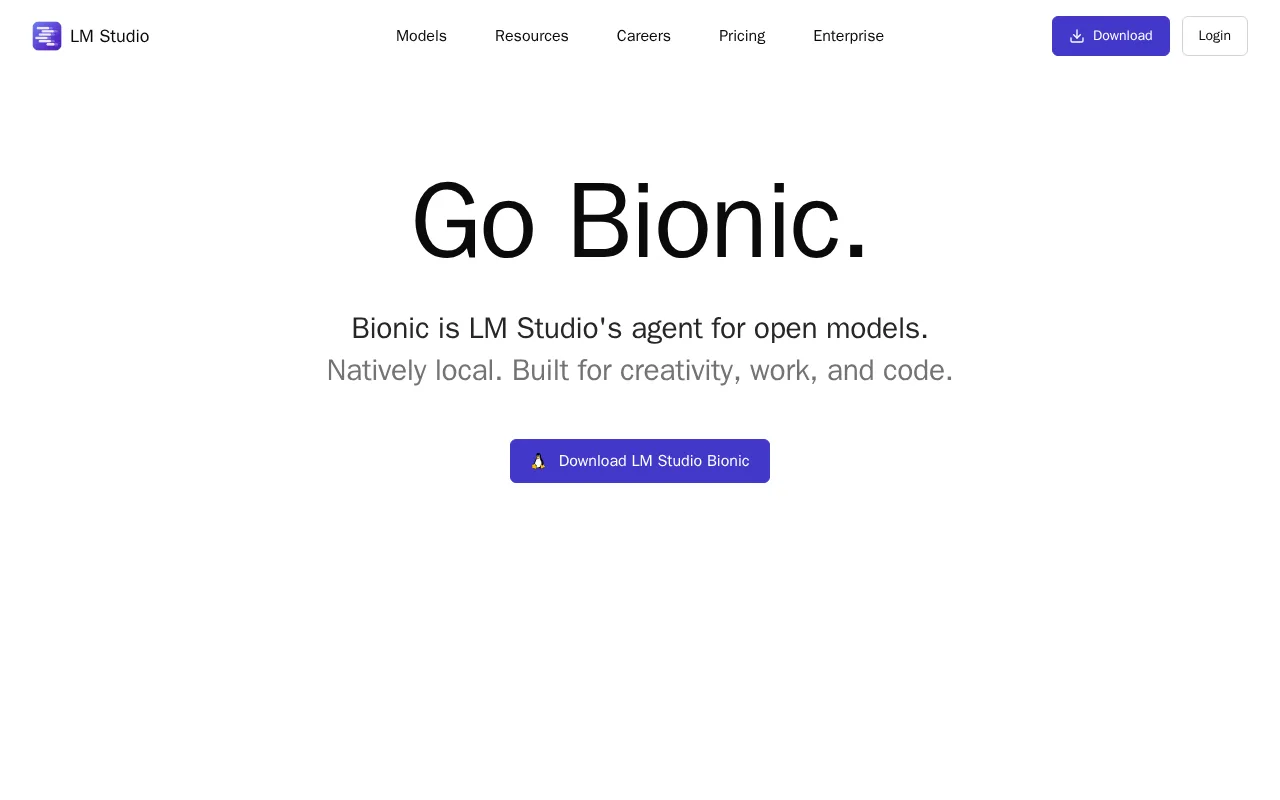
LM Studio is the best Jan alternative for developers and hobbyists who want a polished desktop app for discovering, downloading, and running open-weight models locally via llama.cpp and MLX, plus an optional pay-as-you-go cloud tier when local hardware isn't enough. LM Studio's core app is free with no account required, matching Jan's own no-account, fully free local model, and it holds a 4.7/5 rating from 4 Product Hunt reviews, a small sample similar in size to Jan's own unrated profile in our listing data. LM Studio's Bionic Agent adds an agentic mode for coding and document tasks with automatic saving, and LM Link syncs configurations across up to 5 devices, features beyond Jan's current feature set. Jan remains the better choice for anyone who specifically wants a fully open-source client: LM Studio itself is closed-source freeware, built on open-source llama.cpp and MLX engines but not open source itself, unlike Jan's Apache 2.0 license and public GitHub repository with 44,000+ stars. LM Studio's optional cloud tier bills per million tokens (roughly $0.13 to $3.00 per million, depending on model size), a metered cost Jan doesn't impose since Jan has no built-in cloud billing layer of its own.
Compared to Jan: Bionic Agent adds an agentic mode for coding and document tasks with automatic saving, LM Link syncs configurations across up to 5 devices, optional pay-as-you-go cloud tier fills the gap when local hardware can't run larger models
Wins:Bionic Agent adds an agentic mode for coding and document tasks with automatic saving · LM Link syncs configurations across up to 5 devices · Optional pay-as-you-go cloud tier (roughly $0.13-$3.00 per million tokens) fills the gap when local hardware can't run larger models
Loses:Closed-source freeware, not open source, unlike Jan's Apache 2.0 license and public GitHub repository with 44,000+ stars · Very thin public review base (4 total on Product Hunt) makes it hard to gauge broad user sentiment · Bionic Pass subscription tier has no published pricing yet ("coming soon")
Pros
- Entirely free for local model use with no account or subscription required.
- Runs models on-device via llama.cpp and MLX, keeping data off the cloud by default.
- Built-in OpenAI-compatible API server lets other tools call local models as a drop-in cloud API replacement.
- Optional pay-as-you-go cloud tier fills the gap when local hardware can't run larger models, without forcing a subscription.
Cons
- Running larger models well requires substantial RAM or a capable GPU; modest hardware is limited to smaller quantized models.
- Bionic Pass subscription tier has no published pricing yet ("coming soon").
- LM Studio itself is closed-source freeware, not open-source, despite being built on open-source inference engines.
- Very thin public review base (4 total on Product Hunt) makes it hard to gauge broad user sentiment.
Pricing: Free — LM Studio's free core app vs Jan's fully free Apache 2.0 license (LM Studio adds an optional $0.13-$3.00/million-token cloud tier Jan doesn't have) (verified undefined NaN, NaN)
2.Ollama — best Jan alternative for developers who want to run open-weight LLMs locally for privacy, offline use, or air-gapped applications, with optional cloud access for models too large to run on local hardware
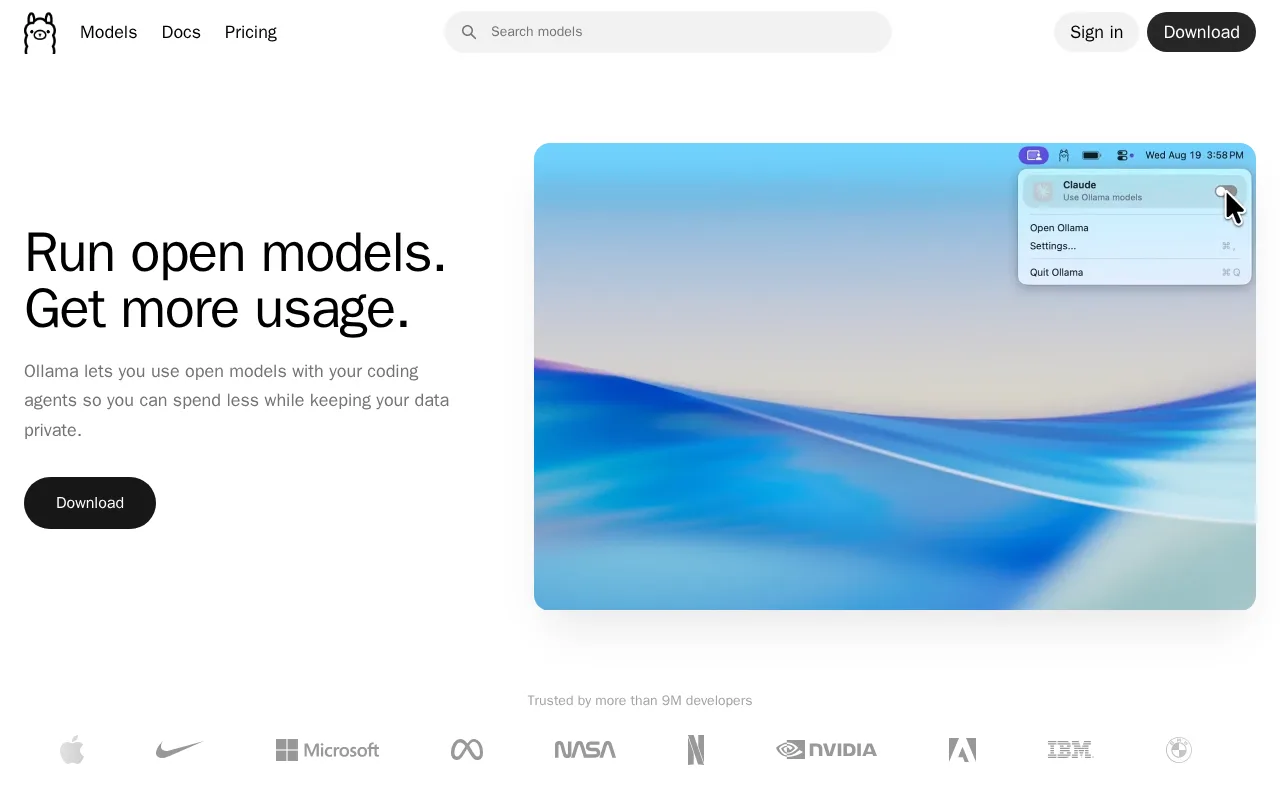
Ollama is the best Jan alternative for developers who want a simple CLI and REST API for running open models locally, backed by 40,000+ community tools and editor integrations. Ollama is MIT-licensed and open source, similar to Jan's own Apache 2.0 license, and holds a 5/5 rating from 40 Product Hunt reviews, the largest external review sample among Jan's tracked alternatives. Ollama's free tier runs local models with no telemetry, and an optional Pro cloud tier costs $20/month for larger cloud models and roughly 50x the free usage, a metered cloud option Jan's own profile doesn't describe. Jan remains the better choice for anyone who wants a native desktop chat interface without touching a command line: Ollama's core interaction model is CLI- and API-first, while Jan ships a ChatGPT-style desktop interface out of the box, and Ollama's Team plan requires a 5-seat minimum ($125/month), a bigger commitment than Jan's individual, account-free use. Ollama's Max plan ($100/month) is also currently paused for new signups while the company adds capacity.
Compared to Jan: 5/5 rating from 40 Product Hunt reviews, the largest external review sample among Jan's tracked alternatives, MIT-licensed, open source, with 40,000+ community tool and editor integrations, optional Pro cloud tier ($20/month) accesses larger models than local hardware can run
Wins:5/5 rating from 40 Product Hunt reviews, the largest external review sample among Jan's tracked alternatives · MIT-licensed, open source, with 40,000+ community tool and editor integrations · Optional Pro cloud tier ($20/month) accesses larger cloud models with roughly 50x the free usage
Loses:Core interaction model is CLI- and API-first, unlike Jan's ChatGPT-style desktop interface out of the box · Team plan requires a 5-seat minimum ($125/month), a bigger commitment than Jan's individual, account-free use · Max plan ($100/month) is currently paused for new signups while capacity is added
Pros
- Core local runtime is free, open source (MIT), and requires no account to run models offline.
- No telemetry from local inference; data never leaves the device unless a cloud model is explicitly used.
- Simple CLI and REST API make it easy to integrate into existing developer tools and 40,000+ community integrations.
- Cloud tier extends the same interface to larger models when local hardware isn't enough.
Cons
- Local performance depends entirely on the user's own hardware; larger models need significant RAM or GPU VRAM to run well.
- Max plan ($100/month) is currently paused for new signups while Ollama adds capacity.
- Cloud usage limits reset on 5-hour and 7-day cycles, which can be restrictive for bursty workloads compared to flat monthly quotas.
- Team plan has a 5-seat minimum ($125/month), which is a meaningful jump for very small teams.
Pricing: Free tier · paid from $20/mo — Ollama's free local tier plus optional $20/month Pro cloud tier vs Jan's fully free Apache 2.0 license with no built-in cloud billing (verified undefined NaN, NaN)
3.Msty — best Jan alternative for individuals who want a polished, one-click desktop app for comparing local and cloud LLM responses side by side without command-line setup
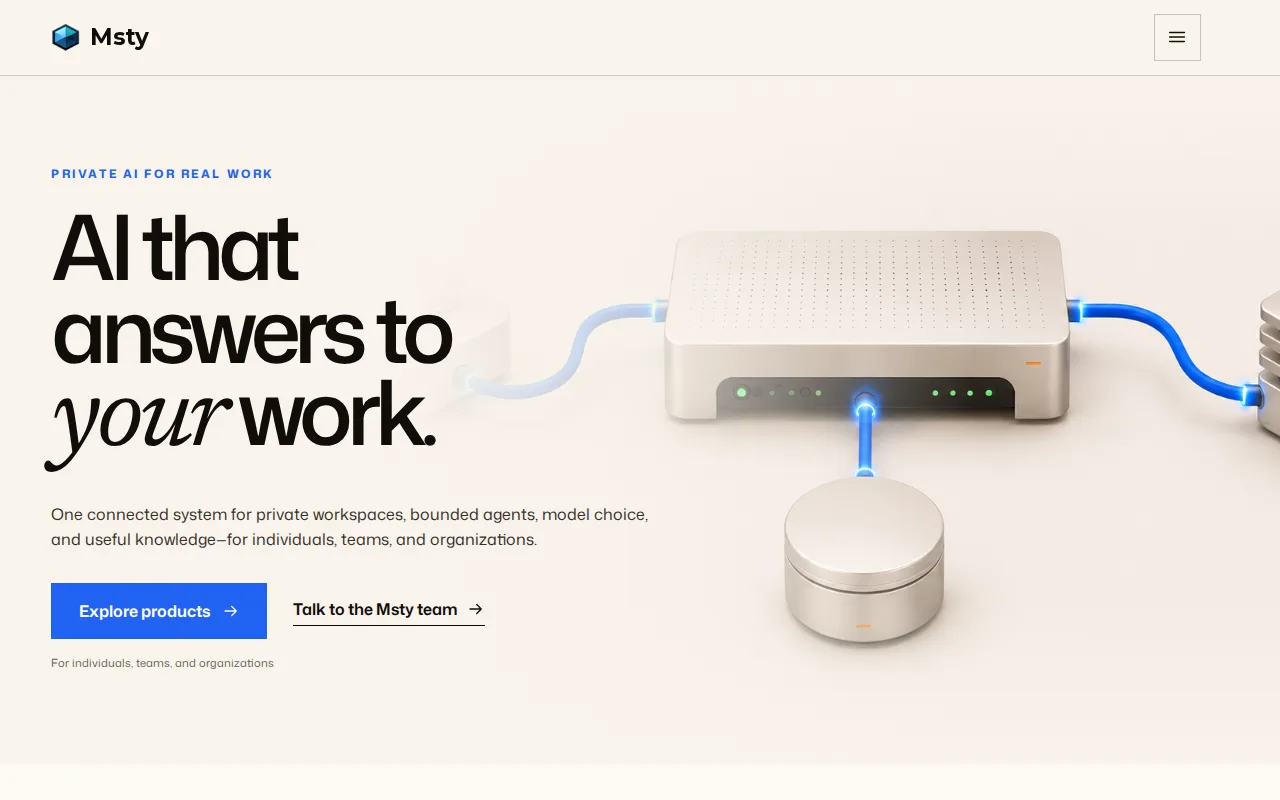
Msty is the best Jan alternative for individuals who want to run the same prompt against multiple local and cloud models at once and compare the responses side by side, a feature called parallel multiverse chats. Msty's core Studio app has been free forever since July 2025, matching Jan's own fully free, no-account model, and it connects to more than a dozen cloud providers (OpenAI, Anthropic, DeepSeek, and others) alongside local models via a bundled MLX/llama.cpp engine, more cloud-provider breadth than Jan's own profile describes. A paid Aurum tier costs $149/year or $349 as a one-time lifetime purchase, adding Azure/Bedrock connections and Studio Assistants on top of the free core. Jan remains the better choice for anyone who specifically wants an open-source client: Msty is closed source with no public GitHub repository, unlike Jan's Apache 2.0 license and 44,000+ GitHub stars, and Msty has not yet completed SOC 2 or ISO 27001 certification, a gap for security-conscious teams comparing it against open-source alternatives like Jan.
Compared to Jan: parallel multiverse chats compare multiple local and cloud models' answers to the same prompt at once, connects to 12+ cloud providers alongside local models in one interface, core Studio app free forever since July 2025, no account required
Wins:Parallel multiverse chats compare multiple local and cloud models' answers to the same prompt at once, a comparison feature Jan's profile doesn't describe · Connects to 12+ cloud providers (OpenAI, Anthropic, DeepSeek, and others) alongside local models in one interface · Core Studio app has been free forever since July 2025, matching Jan's no-account, fully free model
Loses:Closed source with no public GitHub repository, unlike Jan's Apache 2.0 license and 44,000+ GitHub stars · Has not yet completed SOC 2 or ISO 27001 certification, a gap for security-conscious teams · No web or mobile client, the same desktop-only limitation Jan itself has
Pros
- Core Studio app is free forever with no account required and fully local data storage.
- One-click local model downloads via a bundled MLX/llama.cpp engine, no separate Ollama install needed.
- Parallel multiverse chats compare multiple models' answers to the same prompt at once.
- Connects to 12+ cloud providers alongside local models in the same interface.
Cons
- Closed source, unlike direct competitors Jan and Open WebUI.
- No SOC 2 or ISO 27001 certification yet, a gap for enterprise buyers.
- No web or mobile client; desktop only (Windows, macOS, Linux).
- Go (agent product) and Stack (knowledge layer) are still in beta or listed as coming soon.
Pricing: Free tier · paid from $149/yr — Msty's free Studio core (Aurum add-on $149/year or $349 lifetime) vs Jan's fully free Apache 2.0 license with no paid tier at all (verified undefined NaN, NaN)
4.Open WebUI — best Jan alternative for individuals, startups, and regulated organizations that want a self-hosted, vendor-independent chat interface for local or API-based AI models
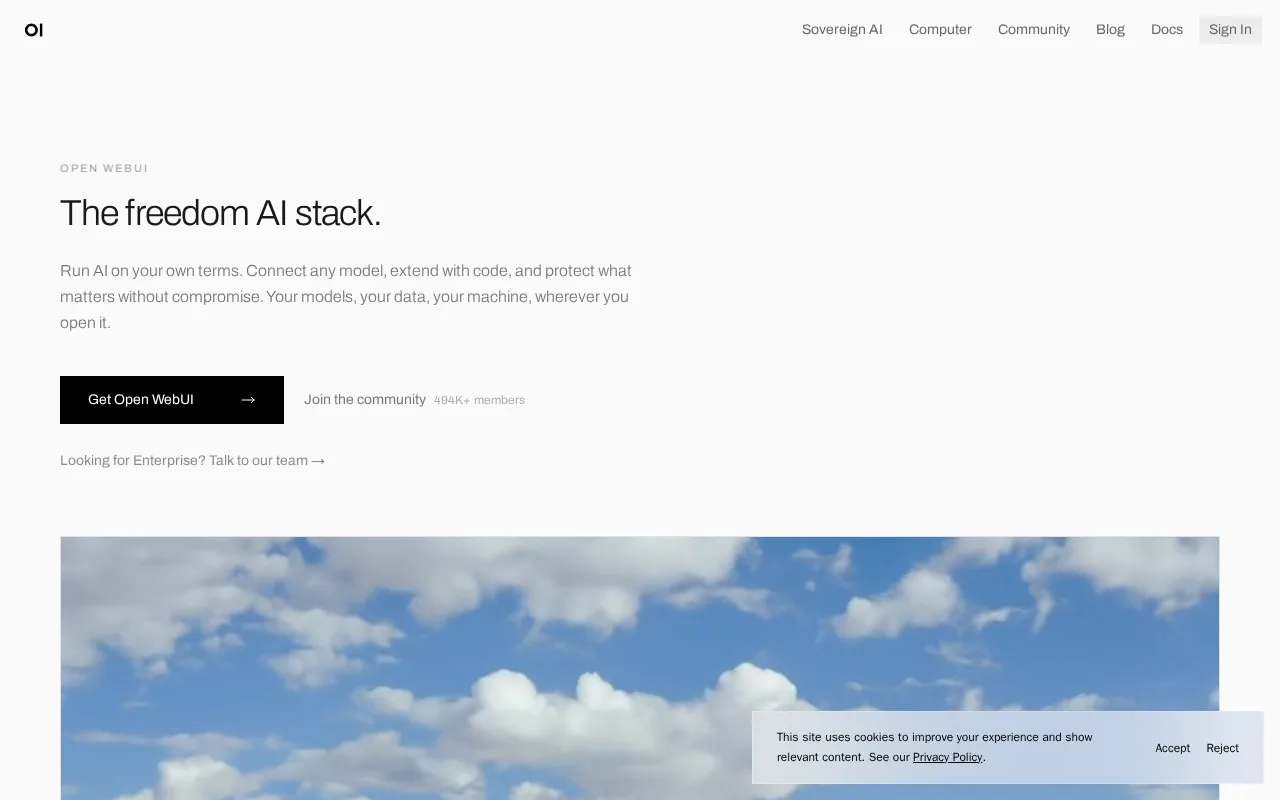
Open WebUI is the best Jan alternative for individuals, startups, and regulated enterprises that want full self-hosted control over AI model routing and chat data, from a homelab running one Ollama model to institutional air-gapped installs. Open WebUI is free to self-host with a one-command Docker or pip install, no account required, matching Jan's own free, no-account model, and it connects to both local runners like Ollama and cloud APIs such as OpenAI and Anthropic from one interface. Its community includes 478,000+ members sharing prompts, tools, and custom functions, a far larger public community than Jan's profile describes. Jan remains the better choice for anyone who wants a native desktop app rather than infrastructure to maintain: Open WebUI requires ongoing Docker and, typically, a separate Ollama or model-serving backend, unlike Jan's native Windows, macOS, and Linux installers, and Open WebUI's core license is source-available rather than a standard OSI open-source license, since it requires preserving Open WebUI branding unless an Enterprise license is purchased, a more restrictive model than Jan's Apache 2.0.
Compared to Jan: connects to both local runners (Ollama) and cloud APIs from one self-hosted interface, 478,000+ community members sharing prompts, tools, and custom functions, air-gapped and data-residency deployment options suit regulated industries
Wins:Connects to both local runners (Ollama) and cloud APIs (OpenAI, Anthropic, and compatible providers) from one self-hosted interface · 478,000+ community members sharing prompts, tools, and custom functions, a far larger public community than Jan's profile describes · Air-gapped and data-residency-controlled deployment options suit regulated industries
Loses:Requires ongoing Docker and, typically, a separate Ollama or model-serving backend, unlike Jan's native Windows, macOS, and Linux installers · Core license is source-available rather than a standard OSI open-source license, requiring preserved branding unless an Enterprise license is purchased, more restrictive than Jan's Apache 2.0 · Enterprise pricing (SSO, RBAC, audit logs, branding removal) is not published and requires a sales conversation
Pros
- Free to self-host with a one-command Docker or pip install, no account required.
- Connects to both local model runners (Ollama) and cloud APIs (OpenAI, Anthropic, and compatible providers) from one interface.
- Air-gapped and data-residency-controlled deployment options suit regulated industries.
- Large community library (478,000+ members) sharing prompts, tools, and custom functions.
Cons
- Source-available Open WebUI License requires preserving Open WebUI branding unless an Enterprise license is purchased, which is not a standard OSI open-source license.
- Self-hosting requires ongoing maintenance of Docker and, typically, a separate Ollama or model-serving backend.
- Enterprise pricing (SSO, RBAC, audit logs, branding removal) is not published and requires a sales conversation.
- No official native mobile app; access on phones is through the web interface.
Pricing: Free — Open WebUI's free self-hosted Community tier vs Jan's fully free Apache 2.0 license (Open WebUI's Enterprise tier is custom-quoted, unlike Jan, which has no paid tier at all)
5.AnythingLLM — best Jan alternative for developers and privacy-sensitive teams that want document chat and agents running on their own hardware, with no per-token bill and no files leaving the machine
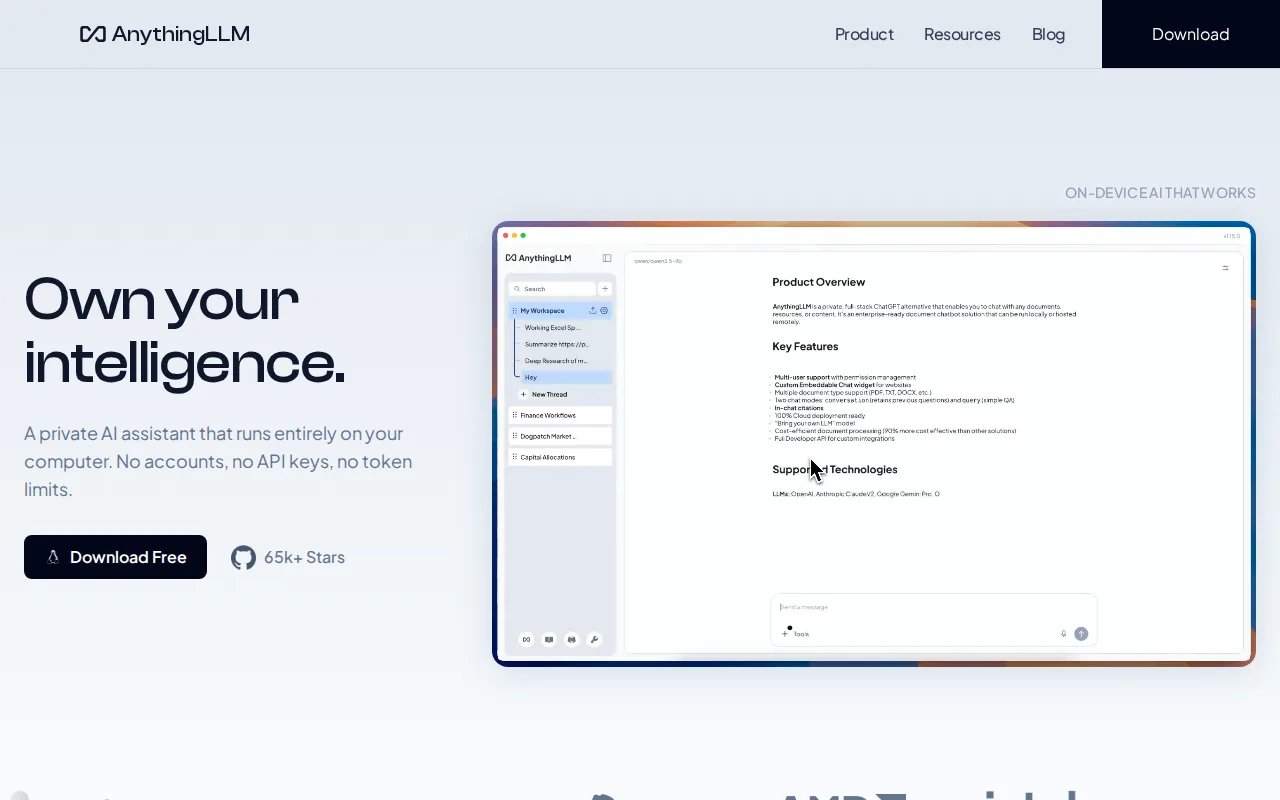
AnythingLLM is listed as one of Jan's tracked alternatives in the local and offline LLM chat space, but no verified pricing, platform, rating, or feature details for AnythingLLM were captured in our listing data — every profile field beyond its name and URL (anythingllm.com) came back null. Jan, by contrast, is fully documented here: it's open source under Apache 2.0, ships native builds for Windows, macOS, and Linux, and reports more than 44,000 GitHub stars and over 6.3 million downloads. Readers who want to evaluate AnythingLLM directly should check anythingllm.com for its current pricing, licensing, and platform support, since none of those specifics could be confirmed from the data available here. Jan remains the well-documented choice for anyone who wants a verified profile before switching: its Apache 2.0 license, no-account local-first design, and OpenAI-compatible API server are all confirmed facts, while AnythingLLM's equivalent details are simply not established in this comparison.
Compared to Jan: listed as a tracked local-LLM alternative though no verified pricing or platform data is available, name and URL (anythingllm.com) confirmed while pricing, license, and feature details are not, current specs should be verified directly at anythingllm.com before comparing
Loses:No verified pricing or licensing information available in our listing data, unlike Jan's confirmed Apache 2.0, fully free license · No verified platform support (Windows/macOS/Linux) or feature list available in our listing data, unlike Jan's documented cross-platform, offline-first design · No external rating or review data available in our listing data to compare against Jan's 44,000+ GitHub stars and 6.3 million downloads
Pros
- MIT-licensed on GitHub with more than 66,000 stars and over 5 million Docker pulls, and free to self-host for unlimited users.
- The desktop app runs with no account, no API key, and no token limits; documents, embeddings, and chat history stay on the machine.
- Works with local runtimes (Ollama, LM Studio, LocalAI, KoboldCPP) and cloud providers (OpenAI, Anthropic, Google Gemini, Groq, Mistral, OpenRouter) behind the same interface.
- The meeting assistant transcribes and summarizes calls entirely on-device, with no bot joining the meeting.
- Self-hosted deployments include multi-user tenant isolation, fine-grained admin controls, and white-labeling without a paid tier.
Cons
- No iOS app; the mobile client ships only on Google Play and as a manual APK download.
- The Magic features have daily free-usage caps, and the Desktop Pro subscription that lifts them has no price published on the site or in the docs.
- AnythingLLM Cloud starts at $50/month for the whole instance and still requires you to bring your own LLM API key, so the model bill is separate.
- Output quality depends on which local model your hardware can run, so results are less predictable than a hosted assistant on a fixed model.
Pricing: Free tier · paid from $50/mo (verified undefined NaN, NaN)
6.Nomic — best Jan alternative for AEC firms that need AI agents to check drawing sets and submittal packages against building codes and specs across hundreds of pages

GPT4All is listed as one of Jan's tracked alternatives in the local and offline LLM chat space, but no verified pricing, platform, rating, or feature details for GPT4All were captured in our listing data — every profile field beyond its name and URL (nomic.ai) came back null. Jan, by contrast, is fully documented here: it's open source under Apache 2.0, ships native builds for Windows, macOS, and Linux, and reports more than 44,000 GitHub stars and over 6.3 million downloads. Readers who want to evaluate GPT4All directly should check nomic.ai for its current pricing, licensing, and platform support, since none of those specifics could be confirmed from the data available here. Jan remains the well-documented choice for anyone who wants a verified profile before switching: its Apache 2.0 license, no-account local-first design, and OpenAI-compatible API server are all confirmed facts, while GPT4All's equivalent details are simply not established in this comparison.
Compared to Jan: listed as a tracked local-LLM alternative though no verified pricing or platform data is available, name and URL (nomic.ai) confirmed while pricing, license, and feature details are not, current specs should be verified directly at nomic.ai before comparing
Loses:No verified pricing or licensing information available in our listing data, unlike Jan's confirmed Apache 2.0, fully free license · No verified platform support (Windows/macOS/Linux) or feature list available in our listing data, unlike Jan's documented cross-platform, offline-first design · No external rating or review data available in our listing data to compare against Jan's 44,000+ GitHub stars and 6.3 million downloads
Pros
- Domain-specific parsing handles large, complex AEC documents (200+ page drawings, 800+ page specs) that general AI tools struggle with
- Connects directly to existing systems (Autodesk Construction Cloud, Bentley ProjectWise, SharePoint, Box, Dropbox, Egnyte) without migrating files
- Cited answers reference specific drawings and building codes rather than unsourced AI output
- Free tier requires no credit card and covers core platform surfaces for individual trial use
Cons
- Business tier enforces a 25-seat minimum at $40/user/month, a steep jump for teams smaller than 25
- Agent API and file integrations are locked behind the Business tier or higher
- Narrow focus on architecture, engineering, and construction workflows makes it unsuitable outside that vertical
- AI usage is billed as a separate metered dollar balance on top of the per-seat price, adding a variable cost to plan for
Pricing: Free tier · paid from $20/mo (verified undefined NaN, NaN)