Open WebUI — A self-hosted, source-available chat interface for running AI models locally or connecting to cloud providers, giving individuals and organizations full control over their AI data.

By Noahlast updated
Open WebUI screenshots & video
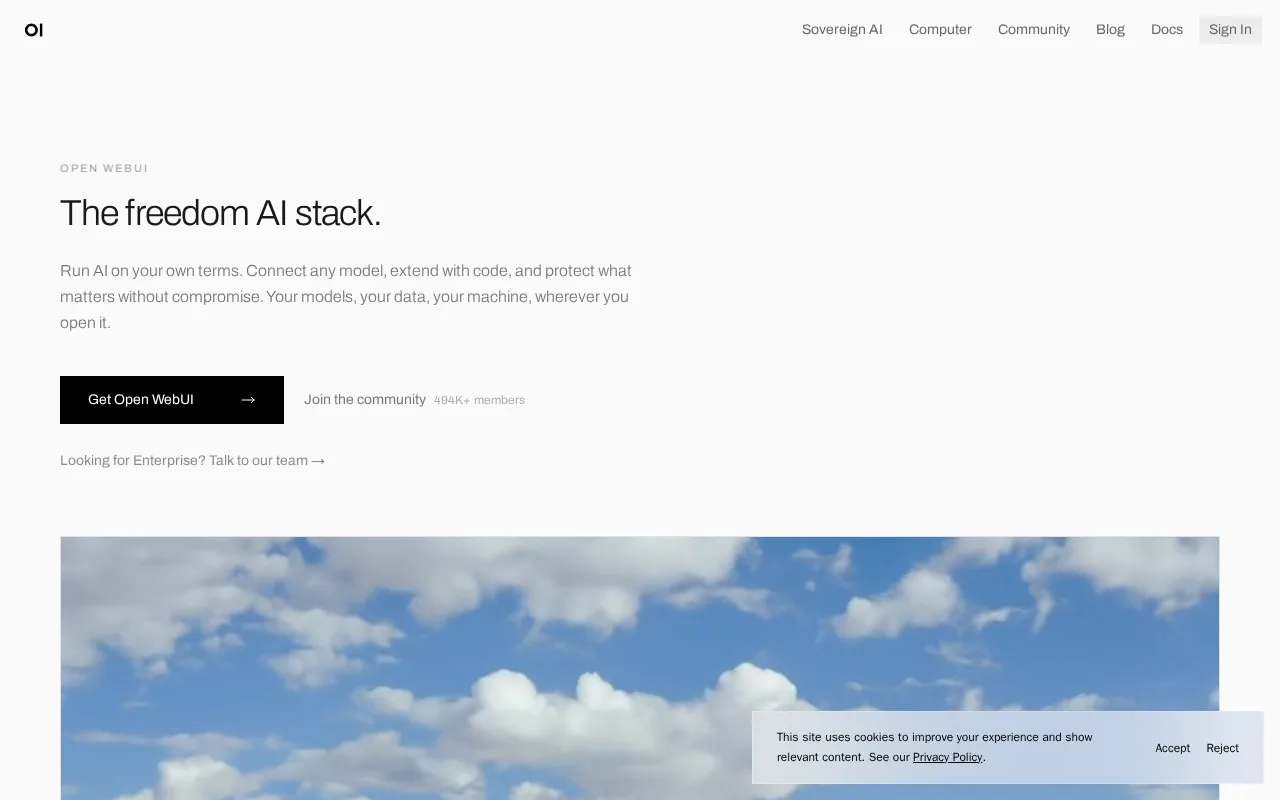
Open WebUI in 20 seconds
Best for: individuals, startups, and regulated organizations that want a self-hosted, vendor-independent AI chat interface
Pricing: Free to self-host; Enterprise adds SSO, RBAC, audit logs, and branding removal at custom, sales-quoted pricing.
- Open WebUI is free to self-host via a one-command Docker or pip install.
- Open WebUI is released under the source-available Open WebUI License, which requires preserving Open WebUI branding unless an Enterprise license is purchased.
- Open WebUI connects to local model runners like Ollama and cloud APIs such as OpenAI and Anthropic.
- Open WebUI's GitHub repository has roughly 149.4k stars.
- Open WebUI holds a 4.0/5 rating from 5 reviews on Product Hunt.
Limitations: Source-available license requires preserving Open WebUI branding unless an Enterprise license is purchased.; Self-hosting requires ongoing Docker/model-serving infrastructure maintenance.; Enterprise pricing is not published and requires a sales conversation.
Top alternatives: LibreChat, Ollama, LM Studio, AnythingLLM — full list
What is Open WebUI?
Open WebUI is a self-hosted, extensible web interface for interacting with AI models, whether run locally through Ollama or accessed via OpenAI-, Anthropic-, or other API-compatible cloud providers. It gives individuals and organizations full ownership of their chat data and model routing instead of relying on a vendor-hosted chatbot, and it supports Python-based pipelines for custom retrieval-augmented generation, voice and vision input, and air-gapped or data-residency-controlled deployments for regulated industries. The core product is free to self-host with a one-command Docker or pip installation and no account required. It is released under a source-available Open WebUI License that permits free use and modification but requires preserving Open WebUI branding at scale; organizations that need to remove or replace that branding, or that want SSO, RBAC, and audit logs, purchase an Enterprise license with custom pricing. A community library of prompts, tools, and functions with 478,000+ members supports the open ecosystem around the project.
Open WebUI is a self-hosted AI chat interface that connects to local model runners like Ollama or to cloud APIs such as OpenAI and Anthropic, letting users run a ChatGPT-style interface entirely under their own infrastructure. It is built for privacy-conscious individuals, startups, and regulated enterprises that want sovereign AI deployments, from a homelab running one Ollama model to institutional air-gapped installs. Open WebUI is free to self-host with a one-command Docker or pip install, released under a source-available Open WebUI License that requires preserving Open WebUI branding unless an Enterprise license is purchased for custom branding, SSO, RBAC, and audit logs. It runs on Linux, macOS, and Windows (via Docker), with a community of 478,000+ members sharing prompts, tools, and custom functions.
Standout feature: Full self-hosted control over AI model routing and chat data, connecting to local runners like Ollama or cloud providers such as OpenAI and Anthropic, with air-gapped and data-residency deployment options for regulated industries.
Biggest weakness: The core product is source-available rather than a standard OSI open-source license, since the Open WebUI License requires preserving Open WebUI branding unless an Enterprise license is purchased, and self-hosting requires ongoing maintenance of Docker/Ollama infrastructure that a hosted chatbot service does not.
Pros
- Free to self-host with a one-command Docker or pip install, no account required.
- Connects to both local model runners (Ollama) and cloud APIs (OpenAI, Anthropic, and compatible providers) from one interface.
- Air-gapped and data-residency-controlled deployment options suit regulated industries.
- Large community library (478,000+ members) sharing prompts, tools, and custom functions.
Cons
- Source-available Open WebUI License requires preserving Open WebUI branding unless an Enterprise license is purchased, which is not a standard OSI open-source license.
- Self-hosting requires ongoing maintenance of Docker and, typically, a separate Ollama or model-serving backend.
- Enterprise pricing (SSO, RBAC, audit logs, branding removal) is not published and requires a sales conversation.
- No official native mobile app; access on phones is through the web interface.
Open WebUI pricing
Free
| Plan | Price | Notes |
|---|---|---|
| Community | Free | Free to self-host via Docker or pip, source-available under the Open WebUI License, which requires preserving Open WebUI branding. |
| Enterprise | Custom | Custom pricing via sales contact; adds SSO, RBAC, audit logs, and a license to remove or replace Open WebUI branding for regulated or large-scale deployments. |
What reviewers say
Scores belong to their platforms; we display them with attribution and never fold them into our own ratings.