4 Best Free Alternatives to SurveyMonkey in 2026
By Noahlast updated pricing verified
All 5 SurveyMonkey alternatives
Compared: free alternatives to SurveyMonkey
| Alternative | Best for | Standout | Biggest weakness | Learning curve | Price |
|---|---|---|---|---|---|
| SurveyMonkeyreference | HR, customer-experience, and market-research teams that need to run surveys at volume and want response-based pricing rather than a flat per-seat fee | Response-based pricing tiers (50,000-100,000 responses/year) paired with a deep library of validated survey templates and built-in AI question and results summarization. | Team plans require a minimum of 3 users even for a single active survey creator, and useful features like white-label branding and advanced logic are locked behind the $92/user/month Premier tier, a steep jump from the $30 Advantage tier. | Low | Free tier · paid from $30/mo |
| Typeform | marketing and product teams that want higher form-completion rates through a conversational, one-question-at-a-time design and are willing to pay per response volume rather than per user | The one-question-at-a-time conversational form format, which Typeform's own conversion data and third-party comparisons consistently cite as improving completion rates over traditional multi-field forms. | The free plan was cut from 100 to just 10 responses/month in February 2026, and response caps rather than user seats are the main pricing lever, so a single high-traffic form can force an upgrade even for a one-person team. | Low | Free tier · paid from $28/mo |
| Google Forms | individuals and small teams who need a free, fast survey or intake form that dumps responses straight into a Google Sheet, without complex branching or payment collection | Zero-cost unlimited forms and responses bundled into every Google account, with responses landing live in a connected Google Sheet for immediate analysis. | Design and branding options are minimal — no custom domains and limited theming on personal accounts — and multi-page conditional logic is far more limited than dedicated tools like Typeform or Jotform. | Low | Free tier · paid from $7/mo |
| Jotform | small businesses and individuals building surveys, applications, or payment-collecting forms who need more submission volume than Google Forms offers without Typeform's higher price | Gold tier includes HIPAA-friendly form handling for healthcare-related data collection, a compliance feature most form builders in this price range do not offer. | Monthly submission caps (100 on Starter, 1,000 on Bronze) are counted per account, not per form, so a single popular form can exhaust the monthly limit and block all other forms from accepting responses until the next billing cycle or an upgrade. | Low | Free tier · paid from $34/mo |
| Microsoft Forms | individuals and teams already on Microsoft 365 who need a quick survey, quiz, or poll embedded in Teams or SharePoint without adopting a separate forms tool | Native embedding inside Teams, SharePoint, and OneNote, plus branching logic that works identically for both graded quizzes and standard surveys. | The free personal tier caps responses at 200 per form, and unlocking the 1,000-response tier means paying for a full Microsoft 365 subscription rather than a Forms-specific upgrade, which is a poor trade for anyone who only needs the survey tool. | Low | Free tier · paid from $9.99/mo |
 SurveyMonkey
 Typeform
 Google Forms
 Jotform
 Microsoft Forms
1.Typeform — best SurveyMonkey alternative for marketing and product teams that want higher form-completion rates through a conversational, one-question-at-a-time design and are willing to pay per response volume rather than per user
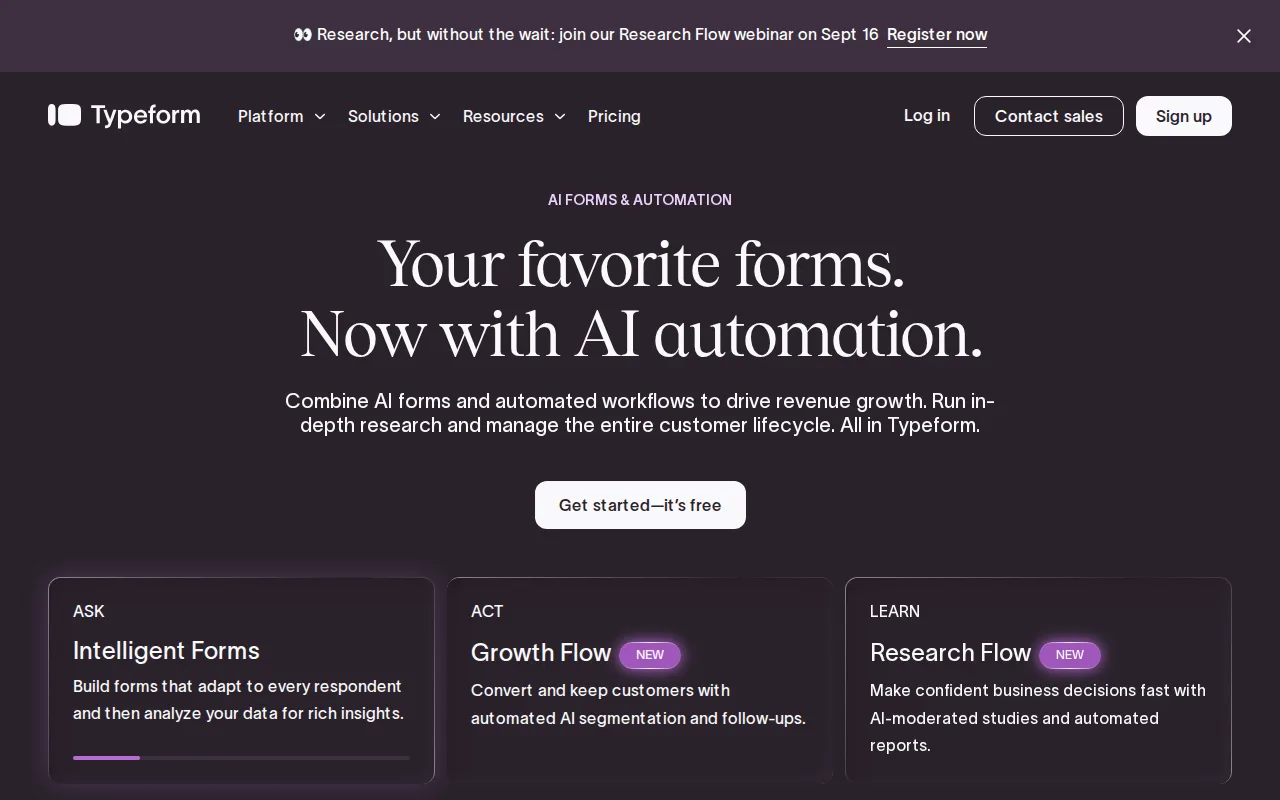
Typeform is the best SurveyMonkey alternative for marketing and product teams that want a one-question-at-a-time conversational format instead of a traditional multi-field survey. Typeform's own conversion data and third-party comparisons cite the format as improving completion rates over scrolling forms like SurveyMonkey's, and Typeform's Basic plan starts at $28/month billed annually for a single user with no minimum seat count, compared to SurveyMonkey's Team Advantage plan, which costs $30/user/month and requires a minimum of 3 users even for one active creator. Typeform holds a 4.7/5 rating from 974 Capterra reviews, edging out SurveyMonkey's 4.6/5 from 10,494 reviews on the same platform. AI-powered form creation on paid Typeform plans speeds up building forms from a prompt or existing document, and native integrations with Salesforce, HubSpot, and Google Sheets avoid manual data export. SurveyMonkey is still the better choice for teams that need real response volume without hitting a hard cap: Typeform's free plan was cut from 100 to just 10 responses/month in February 2026, and its paid tiers price by response volume rather than user seats, so a single popular form can force an upgrade even for a one-person team, unlike SurveyMonkey's higher fixed response allowances (50,000-100,000/year) on its Team plans.
Compared to SurveyMonkey: no 3-user minimum on paid plans, higher Capterra rating (4.7/5 vs 4.6/5), AI-powered form creation on paid tiers
Wins:No 3-user minimum on paid plans, unlike SurveyMonkey's Team Advantage floor of 3 users · 4.7/5 rating from 974 Capterra reviews vs SurveyMonkey's 4.6/5 from 10,494 reviews · One-question-at-a-time format widely cited as improving completion rates over scrolling forms like SurveyMonkey's
Loses:Free plan caps at just 10 responses/month after a February 2026 cut, tighter than SurveyMonkey's free tier · Response caps rather than user seats are the main pricing lever, so a single popular form can force an upgrade regardless of team size · No native mobile app, unlike SurveyMonkey's dedicated iOS/Android apps for offline field collection
Pros
- One-question-at-a-time format is widely cited as improving form completion rates versus traditional scrolling forms.
- AI-powered form creation on paid plans speeds up building forms from a prompt or existing document.
- Native integrations with Salesforce, HubSpot, and Google Sheets avoid manual data export.
- Annual billing cuts the effective monthly price by roughly 30% versus month-to-month across every tier.
Cons
- Free plan responses were cut from 100/month to 10/month in a February 2026 change, making it impractical for anything beyond testing.
- Pricing scales on response volume, not just users, so a single popular form can force an upgrade regardless of team size.
- No native mobile app; form building and management are web-only, unlike SurveyMonkey's dedicated iOS/Android apps.
- Branding removal requires the Plus tier ($56/month annually), unlike some competitors that include it at the entry paid tier.
Pricing: Free tier · paid from $28/mo — $28/month Basic (billed annually, 1 user) vs SurveyMonkey's $30/user/month Team Advantage (3-user minimum, so $90/month minimum) (verified undefined NaN, NaN)
2.Google Forms — best SurveyMonkey alternative for individuals and small teams who need a free, fast survey or intake form that dumps responses straight into a Google Sheet, without complex branching or payment collection
Google Forms is the best SurveyMonkey alternative for individuals and small teams who need a free, fast survey with unlimited responses rather than a paid response-capped plan. Google Forms is free for individuals with no response cap of its own — the only ceiling is the 15GB of storage shared across a free Google account — compared to SurveyMonkey's Team plans, which start at $30/user/month with a 50,000-response annual cap and a 3-user minimum. Google Forms holds a 4.7/5 rating from 11,534 Capterra reviews, more review volume than SurveyMonkey's own 10,494 Capterra reviews. Responses sync live into a linked Google Sheet for immediate analysis, and organizations that need admin controls and branding removal can add Google Forms through a Google Workspace Business Starter plan at $7/user/month. SurveyMonkey is still the better choice for teams that need advanced survey design: Google Forms has minimal design customization, no custom domains, and limited theming, and its multi-page conditional logic is far more limited than SurveyMonkey's advanced logic and multilingual survey support, which is reserved for SurveyMonkey's own Team Premier tier at $92/user/month.
Compared to SurveyMonkey: free with no response cap vs $30/user/month with a 50,000-response annual limit, higher Capterra review volume (11,534 vs 10,494), no 3-user minimum
Wins:Free for individuals with no response cap of its own, vs SurveyMonkey's $30/user/month plan capped at 50,000 responses/year · 4.7/5 rating from 11,534 Capterra reviews, more review volume than SurveyMonkey's 10,494 Capterra reviews · No 3-user minimum, unlike SurveyMonkey's Team Advantage plan
Loses:Minimal design customization — no custom domains, limited theming — versus SurveyMonkey's premium themes · Multi-page conditional logic is far more limited than SurveyMonkey's advanced logic, reserved for Team Premier at $92/user/month · No native payment collection; requires a third-party Workspace Marketplace add-on
Pros
- Free for unlimited forms and responses on any Google account.
- Responses sync live into Google Sheets for immediate analysis.
- Conditional logic (skip/branch questions) and an auto-graded quiz mode are built in at no cost.
- Real-time collaborative editing, matching Google Docs and Sheets.
Cons
- Minimal design customization — no custom domains, limited theming, and Google branding stays on personal accounts.
- No native payment collection; requires a third-party add-on through the Google Workspace Marketplace.
- Advanced multi-page logic and white-labeling require paid competitors like Typeform or Jotform.
Pricing: Free tier · paid from $7/mo — $0 free tier vs SurveyMonkey's $30/user/month Team Advantage (3-user minimum); Google Workspace Business Starter adds admin controls from $7/user/month
3.Jotform — best SurveyMonkey alternative for small businesses and individuals building surveys, applications, or payment-collecting forms who need more submission volume than Google Forms offers without Typeform's higher price
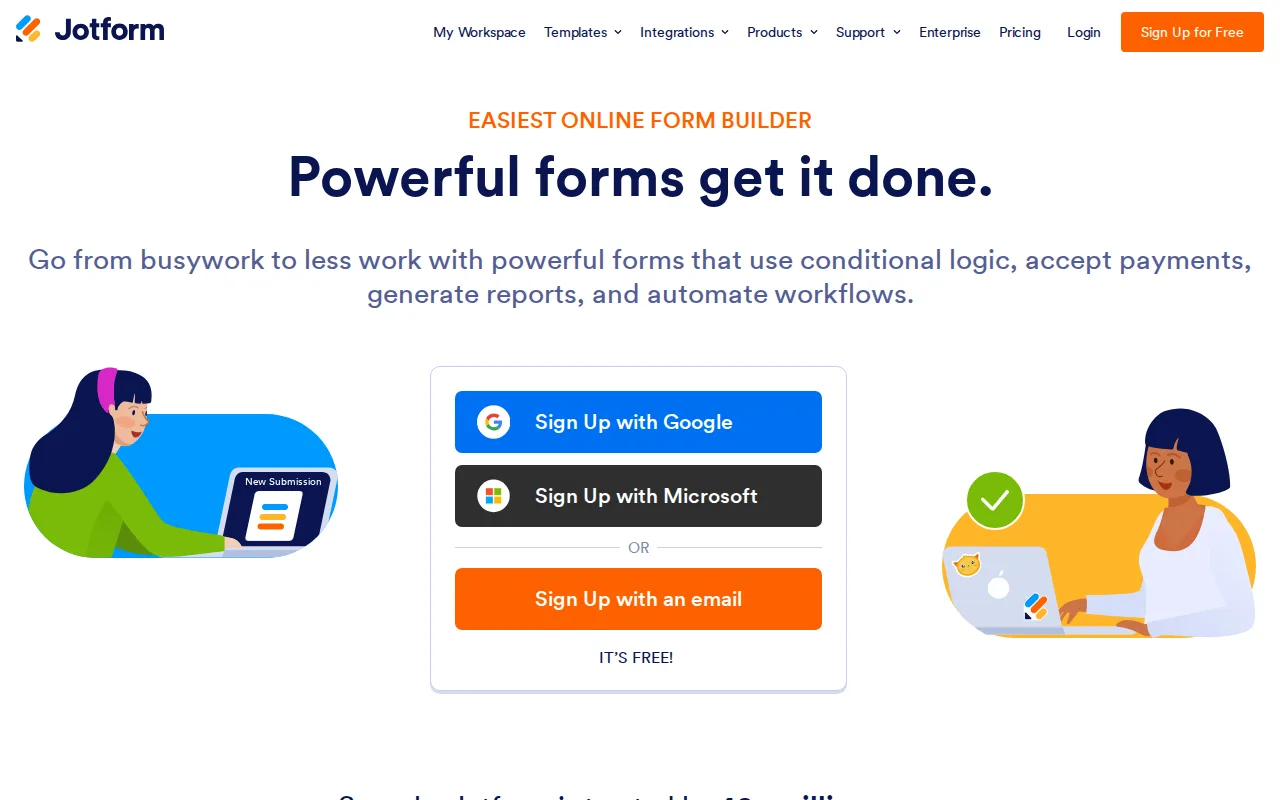
Jotform is the best SurveyMonkey alternative for small businesses and individuals building surveys, applications, or payment-collecting forms who need more submission volume than a free tool offers without SurveyMonkey's per-seat, 3-user-minimum pricing. Jotform's free Starter plan covers 5 active forms and 100 monthly submissions with Jotform branding, and paid Bronze starts at $34/month billed annually for 25 forms and 1,000 monthly submissions — a single-user price point, unlike SurveyMonkey's Team Advantage plan, which costs $30/user/month and requires at least 3 users. Jotform holds a 4.7/5 rating from 2,919 Capterra reviews, with pricing independently verified on 2026-08-21T10:09:16.905Z. Payment collection through Stripe, PayPal, and other processors is built into the form builder rather than requiring a separate integration, and Jotform's Gold tier adds HIPAA-friendly form handling for healthcare intake, a compliance feature SurveyMonkey doesn't list. SurveyMonkey is still the better choice for larger teams running high-volume survey campaigns: Jotform's monthly submission caps apply account-wide rather than per form, so one high-traffic form can block submissions on all other forms, while SurveyMonkey's response caps run as high as 100,000 per year on its Team Premier plan.
Compared to SurveyMonkey: no 3-user minimum on paid plans, built-in payment collection (Stripe, PayPal) without a separate integration, HIPAA-friendly forms on the Gold tier
Wins:No 3-user minimum on paid plans, unlike SurveyMonkey's Team Advantage floor of 3 users at $30/user/month · Payment collection (Stripe, PayPal, and others) is built into the form builder rather than requiring a separate integration · Gold tier's HIPAA-friendly capability supports healthcare intake forms, a compliance feature SurveyMonkey doesn't list
Loses:Monthly submission limits apply account-wide, so one high-traffic form can block submissions on all other forms · 4.7/5 rating from 2,919 Capterra reviews, a smaller sample than SurveyMonkey's 10,494 Capterra reviews · Response volume on paid Jotform tiers (up to 10,000/month on Gold) is smaller than SurveyMonkey's 100,000/year Team Premier cap
Pros
- Free Starter plan is a real, ongoing free tier, not a time-limited trial.
- Payment collection (Stripe, PayPal, and others) is built into the form builder rather than requiring a separate integration.
- Gold tier's HIPAA-friendly capability supports healthcare intake forms without a separate compliance product.
- Nonprofits and educational institutions get 50% off paid tiers.
Cons
- Monthly submission limits apply account-wide, so one high-traffic form can block submissions on all other forms.
- Jotform branding stays on forms until upgrading to a paid Bronze tier or higher.
- Jumping from Starter's 100 monthly submissions to meaningful volume (1,000+ on Bronze) requires a $34-39/month commitment.
- Enterprise pricing is not published and requires a sales conversation for unlimited usage.
Pricing: Free tier · paid from $34/mo — $34/month Bronze (billed annually, no seat minimum) vs SurveyMonkey's $30/user/month Team Advantage (3-user minimum, effectively $90/month minimum) (verified undefined NaN, NaN)
4.Microsoft Forms — best SurveyMonkey alternative for individuals and teams already on Microsoft 365 who need a quick survey, quiz, or poll embedded in Teams or SharePoint without adopting a separate forms tool
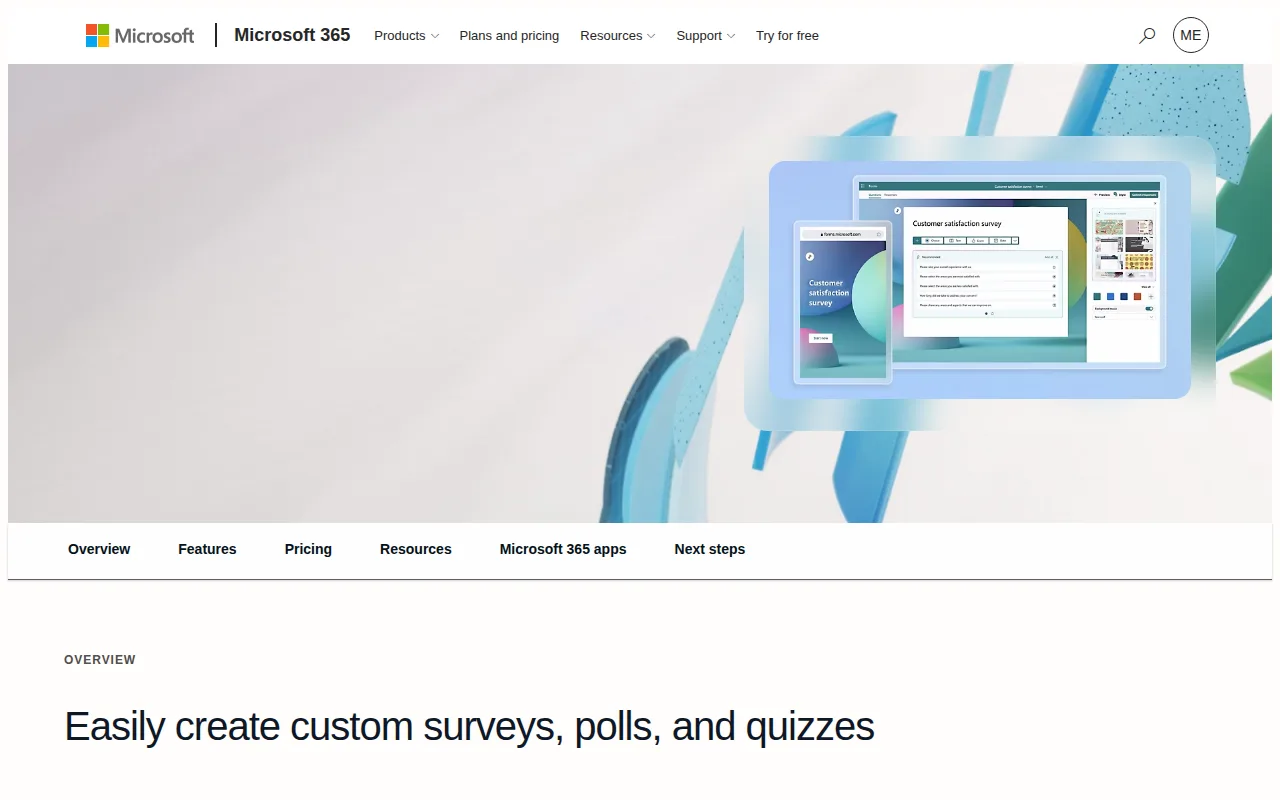
Microsoft Forms is the best SurveyMonkey alternative for individuals and teams already on Microsoft 365 who need a quick survey, quiz, or poll embedded in Teams or SharePoint without adopting a separate paid tool. The free personal tier of Microsoft Forms caps responses at 200 per form at no cost, and upgrading to a Microsoft 365 Personal subscription at $9.99/month raises the cap to 1,000 responses while also bundling the full Microsoft 365 desktop app suite and 1TB of OneDrive storage — a bundled cost far below SurveyMonkey's $30/user/month Team Advantage plan, which requires a 3-user minimum. Microsoft Forms holds a 4.6/5 rating from 327 Capterra reviews, close to SurveyMonkey's 4.6/5 from 10,494 reviews, though on a much smaller review sample. Forms embeds directly in Teams, SharePoint, and OneNote without extra plugins, and its branching logic works identically for both standard surveys and auto-graded quizzes. SurveyMonkey is still the better choice for organizations running surveys at real volume: Microsoft Forms' response cap tops out at 1,000 per form even on a paid Microsoft 365 plan, far below SurveyMonkey's 50,000-100,000 annual response allowances, and Microsoft Forms lacks SurveyMonkey's large library of pre-validated survey templates and AI-assisted response summarization.
Compared to SurveyMonkey: bundled into an existing Microsoft 365 subscription rather than a separate $30/user/month plan, no 3-user minimum, native embedding in Teams, SharePoint, and OneNote
Wins:Bundled into an existing Microsoft 365 subscription ($9.99/month Personal) rather than a separate survey-tool cost · No 3-user minimum, unlike SurveyMonkey's Team Advantage plan at $30/user/month · Native embedding in Teams, SharePoint, and OneNote without extra plugins
Loses:Response cap tops out at 1,000 per form even on a paid Microsoft 365 plan, far below SurveyMonkey's 50,000-100,000 annual allowances · Customization (themes, question types, logic) is more limited than SurveyMonkey's dedicated survey tooling · No large library of pre-validated survey templates or AI-assisted response summarization like SurveyMonkey offers
Pros
- Free tier requires only a Microsoft account, no separate signup.
- Branching logic works for both standard surveys and auto-graded quizzes.
- Embeds directly into Teams, SharePoint, and OneNote without extra plugins.
- Responses export straight into Excel for further analysis.
Cons
- Free tier is capped at 200 responses per form.
- Higher response limits require a full Microsoft 365 subscription, not a Forms-only upgrade.
- Customization (themes, question types, logic) is more limited than dedicated survey tools like Typeform or SurveyMonkey.
- No native offline data-collection mode for field surveys.
Pricing: Free tier · paid from $9.99/mo — $9.99/month Microsoft 365 Personal (bundled) vs SurveyMonkey's $30/user/month Team Advantage (3-user minimum)