3 Best Alternatives to PocketBase in 2026
By Noahlast updated pricing verified

From our data: All three alternatives compared to PocketBase (Supabase, Firebase, Appwrite) offer both a free tier and an official managed cloud hosting option, something PocketBase itself doesn't provide since every deployment is self-hosted; sorted by GitHub stars among the two open-source alternatives with a star count on file, Supabase's 108,000+ stars is the largest, ahead of PocketBase's own 60,000+ and Appwrite's 57.1K.
 Supabase
 Firebase
 Appwrite
How we picked
- Rating coverage is uneven: Supabase holds a 5.0/5 rating from 861 Product Hunt reviews and Firebase holds a 4.6/5 rating from 767 Capterra reviews, both large review bases, while Appwrite carries no external rating in our listing data and PocketBase itself holds a 5/5 rating from just 6 Product Hunt reviews.
- GitHub star counts are a directly comparable open-source-adoption signal: PocketBase has over 60,000 stars, Supabase's core repository has more than 108,000 stars, and Appwrite has 57.1K stars, giving a rough sense of relative community size, though GitHub stars aren't a usage metric.
- All three alternatives compared here, unlike PocketBase itself, offer an official managed cloud hosting option: Supabase and Firebase both have a free managed tier, and Appwrite offers Appwrite Cloud's free tier alongside its self-hosted option, while PocketBase has no official managed cloud product at all, only self-hosting.
- Pricing verification dates cluster within the same broad session: Firebase, Appwrite, and PocketBase's own pricing were all verified 2026-08-21, while Supabase's pricing carries an earlier verification timestamp (2026-08-21T06:53) from the same day, so figures across all four reflect a consistent recent snapshot.
Paid placement never alters editorial rank — read the full methodology.
PocketBase alternatives at a glance
| Alternative | Best for | Standout | Biggest weakness | Learning curve | Price |
|---|---|---|---|---|---|
| PocketBasereference | developers who want a single-binary backend (database, auth, storage, realtime API) for a side project or small-to-medium app without assembling separate services | The entire backend — SQLite database, authentication, file storage, and a realtime REST API — ships as one portable executable with no separate services to provision. | There is no official managed cloud hosting, so scaling, backups, and uptime are entirely the developer's responsibility, and SQLite's single-writer model makes PocketBase a weaker fit for applications with heavy concurrent write traffic than a Postgres-backed platform. | Low | Free |
| Supabase | developers who want a Postgres-based backend (auth, storage, realtime, auto-generated APIs) they can self-host later, rather than committing to a proprietary NoSQL platform like Firebase | Auto-generated REST, GraphQL, and Realtime APIs derived straight from a project's Postgres schema, with Row Level Security enforcing per-row authorization at the database layer instead of in application code. | Pricing beyond the $25/month Pro base is usage-based and billed per project rather than per account, so teams running multiple projects or exceeding the 100,000 MAU / 250GB egress limits can see invoices climb well past the advertised starting price. | Moderate | Free tier · paid from $25/mo |
| Firebase | mobile and web developers who want a fully managed backend (database, auth, hosting, functions) without provisioning or maintaining their own servers | A single integrated platform spanning database, authentication, hosting, serverless functions, crash reporting, and analytics, all provisioned and scaled automatically by Google. | Blaze-plan costs are usage-based across many separate metered services (reads/writes, bandwidth, function invocations, storage), so bills can escalate unpredictably at scale, and Firestore's proprietary NoSQL data model creates real migration lock-in compared to SQL-based backends. | Moderate | Free |
| Appwrite | developer teams building web, mobile, or Flutter apps that want a Firebase-style backend (auth, database, storage, functions) they can self-host for free instead of relying solely on a vendor's cloud | Fully self-hostable under a permissive BSD-3-Clause license, so teams can run the entire backend on their own infrastructure at no licensing cost instead of being locked into Appwrite's hosted cloud. | The free Appwrite Cloud tier pauses projects after a week of inactivity and offers only community support, and self-hosting shifts the operational burden (updates, scaling, backups) onto the team instead of a managed vendor, which is a real cost some reviewers note as a steeper setup than a pure SaaS backend. | Moderate | Free tier · paid from $25/mo |
 PocketBase
1.Supabase — best PocketBase alternative for developers who want a Postgres-based backend (auth, storage, realtime, auto-generated APIs) they can self-host later, rather than committing to a proprietary NoSQL platform like Firebase
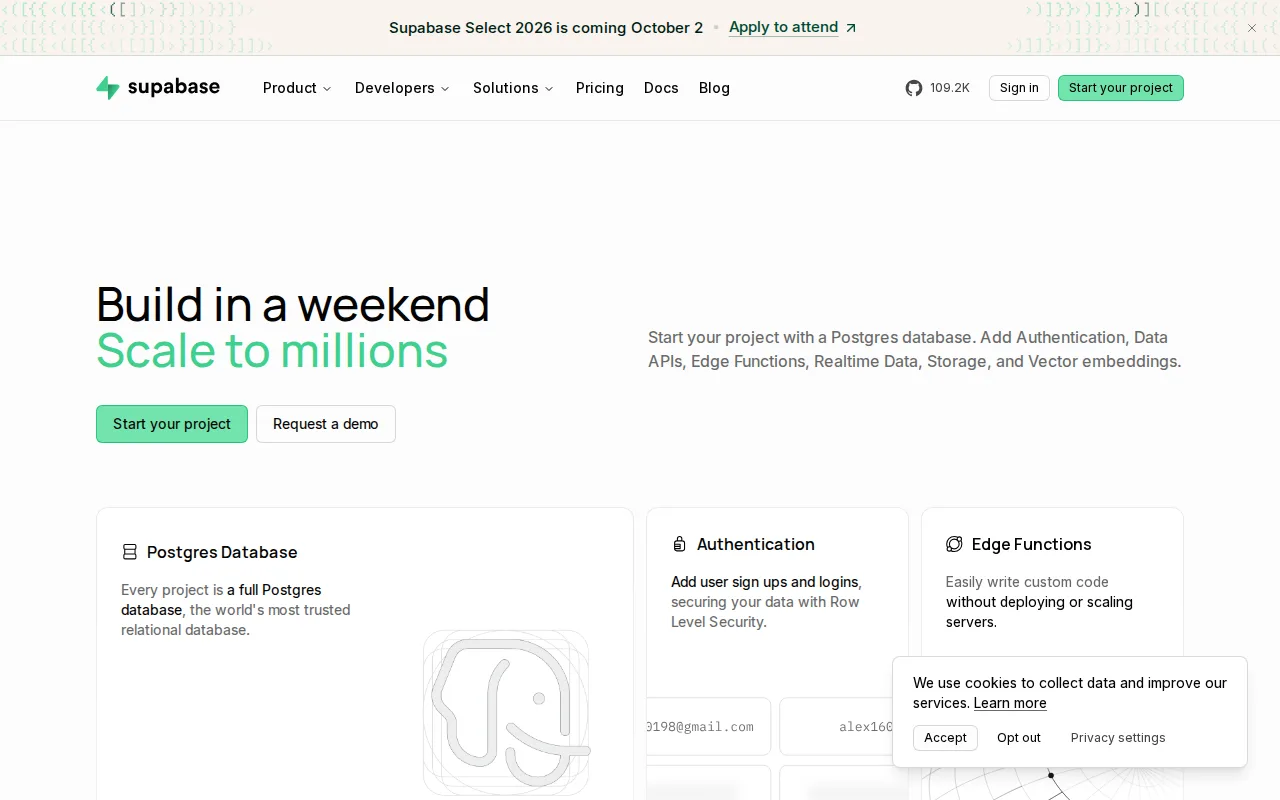
Supabase is the best PocketBase alternative for developers who want a Postgres-based backend, auth, storage, realtime, and auto-generated APIs, that they can self-host later rather than committing only to PocketBase's single-binary SQLite model. Supabase holds a 5.0/5 rating from 861 Product Hunt reviews, far more review volume than PocketBase's own 5/5 rating from just 6 Product Hunt reviews. Supabase's Free plan covers up to 2 active projects with a 500MB database and 50,000 monthly active users at $0/month, comparable to PocketBase's entirely free self-hosted model, and Supabase's core stack (Postgres, PostgREST, GoTrue auth, Realtime, Storage) is Apache-2.0 licensed and self-hostable from a GitHub repository with more than 108,000 stars, nearly double PocketBase's own 60,000+ stars. Unlike PocketBase's embedded SQLite database, which has a single-writer model that limits write concurrency, Supabase runs on a full Postgres database that handles heavier concurrent write traffic. PocketBase remains the better choice for developers who specifically want a single portable executable with zero separate services to provision: Supabase's Pro tier at $25/month bills compute per project rather than per account, and MAU or egress overages can produce unpredictable invoices at scale, a cost complexity PocketBase's entirely free, self-hosted model doesn't have.
Compared to PocketBase: 5.0/5 rating from 861 Product Hunt reviews vs PocketBase's 5/5 from just 6 reviews, Postgres database with no single-writer limit vs PocketBase's embedded SQLite, official managed cloud hosting (free tier) vs PocketBase's self-hosted-only model with no managed option
Wins:5.0/5 rating from 861 Product Hunt reviews, far more review volume than PocketBase's 5/5 from just 6 reviews · Full Postgres database avoids the single-writer concurrency limit of PocketBase's embedded SQLite, better suited to heavy concurrent write traffic · Official managed cloud hosting (free tier available) means scaling, backups, and uptime aren't entirely the developer's own responsibility, unlike PocketBase's self-hosted-only model
Loses:Not a single portable executable; running the full stack requires more moving parts than PocketBase's one-binary deployment · Compute is billed per project on the $25/month Pro tier, so accounts running several projects stack recurring charges beyond the flat fee · Row Level Security has a steeper learning curve than PocketBase's simpler built-in admin dashboard for teams new to SQL
Pros
- Full Postgres database rather than a proprietary NoSQL store, so existing SQL skills and extensions like pgvector and PostGIS carry over directly.
- Auto-generates REST, GraphQL, and Realtime APIs from the schema, with Row Level Security for per-row authorization.
- Apache-2.0-licensed core stack is self-hostable, avoiding hard vendor lock-in.
- Free tier includes unlimited API requests, 50,000 monthly active users, and a 500MB database with no time limit on the account.
Cons
- Compute is billed per project, so accounts running several projects stack recurring charges beyond the flat $25/month Pro fee.
- MAU overage ($0.00325/user past 100,000) and egress overage ($0.09/GB past 250GB) can produce unpredictable invoices at scale.
- Free-tier projects pause automatically after 1 week of inactivity.
- Row Level Security has a steeper learning curve than Firebase's simpler client-side security rules for teams new to SQL.
Pricing: Free tier · paid from $25/mo — $0/month (Free, 2 projects, 500MB database) matches PocketBase's $0 self-hosted cost; Supabase's Pro tier adds $25/month for expanded limits and email support (verified undefined NaN, NaN)
2.Firebase — best PocketBase alternative for mobile and web developers who want a fully managed backend (database, auth, hosting, functions) without provisioning or maintaining their own servers
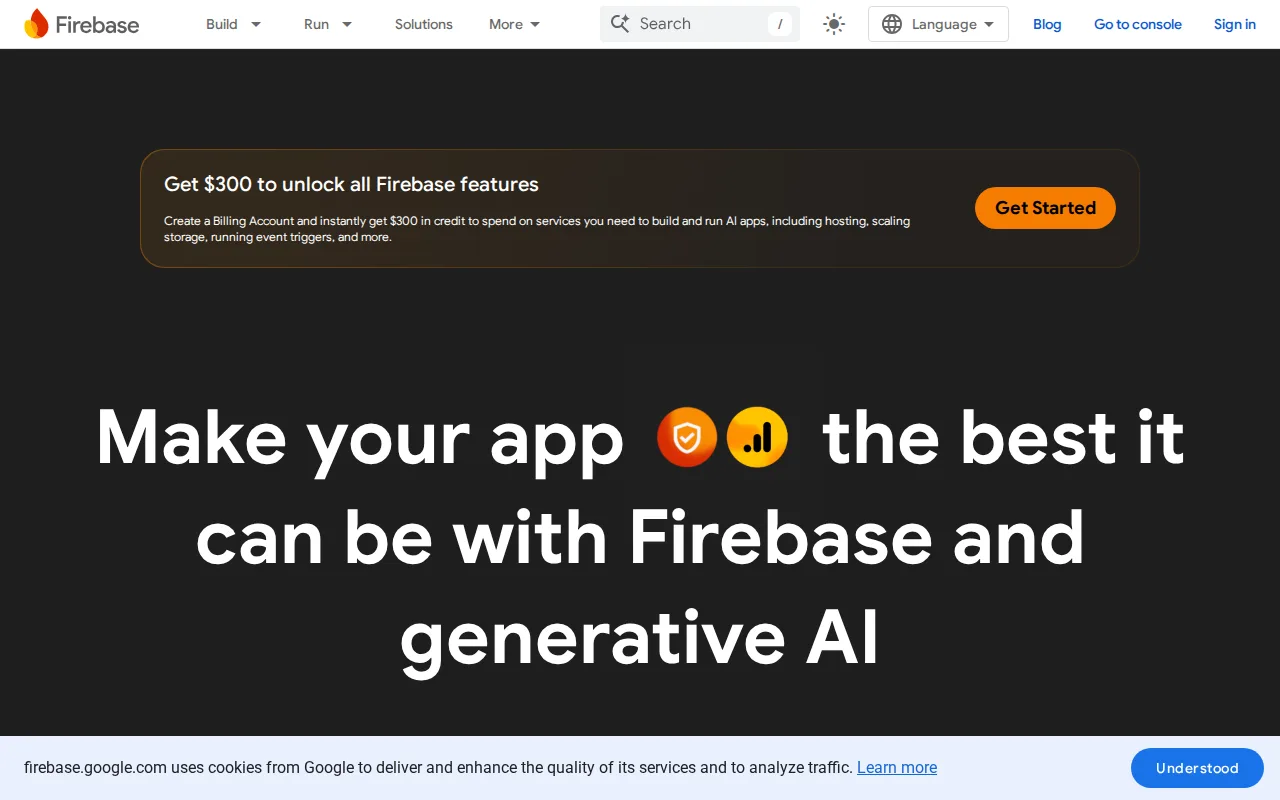
Firebase is the best PocketBase alternative for mobile and web developers who want a fully managed backend, database, auth, hosting, and functions, with no server to provision or maintain themselves, unlike PocketBase's self-hosted-only model. Firebase holds a 4.6/5 rating from 767 Capterra reviews, a much larger review base than PocketBase's 5/5 rating from just 6 Product Hunt reviews. Firebase's free Spark plan requires no payment method and includes 1GiB of Firestore storage, 50,000 monthly active Authentication users, and 2 million Cloud Function invocations per month, a generous quota structure distinct from PocketBase's entirely free but fully self-managed model. Firebase's operational tooling, Crashlytics for crash reporting, Google Analytics, Performance Monitoring, and Cloud Messaging for push notifications, extends well beyond PocketBase's core database-auth-storage-API bundle, which has no built-in crash reporting or analytics layer. PocketBase remains the better choice for developers who specifically want a single portable executable with an embedded SQL database and no vendor lock-in: Firebase's Blaze pay-as-you-go pricing spans many separately metered services, making cost forecasting difficult at scale, and Firestore's proprietary NoSQL data model creates real migration lock-in, unlike PocketBase's plain SQLite database and MIT-licensed source that's fully available to inspect and modify.
Compared to PocketBase: fully managed infrastructure with no server to provision vs PocketBase's self-hosted-only model, 4.6/5 rating from 767 Capterra reviews vs PocketBase's 5/5 from just 6 reviews, integrated operational tooling (Crashlytics, Analytics, Performance Monitoring) vs PocketBase's core database-auth-storage-API bundle with no built-in analytics
Wins:Fully managed infrastructure removes the need to provision or scale servers manually, unlike PocketBase's entirely self-hosted, self-maintained model · 4.6/5 rating from 767 Capterra reviews, a much larger review base than PocketBase's 5/5 from just 6 reviews · Integrated operational tooling (Crashlytics, Analytics, Performance Monitoring, Remote Config) reduces the need for separate third-party services PocketBase doesn't include
Loses:Firestore's proprietary NoSQL data model creates lock-in and a steeper query-design learning curve than PocketBase's plain SQLite database · Blaze pay-as-you-go pricing spans many separately metered services, making cost forecasting harder than PocketBase's entirely free self-hosted model · Not open source; Firebase's source isn't available to inspect or modify, unlike PocketBase's MIT-licensed codebase
Pros
- Generous free Spark tier with no payment method required, suitable for prototypes and small apps.
- Fully managed infrastructure removes the need to provision or scale servers manually.
- Deep, well-documented SDKs across iOS, Android, web, Flutter, Unity, and C++.
- Integrated operational tooling (Crashlytics, Analytics, Remote Config) reduces the need for separate third-party services.
Cons
- Blaze pay-as-you-go pricing spans many separately metered services, making cost forecasting difficult at scale.
- Firestore's proprietary NoSQL model creates lock-in and a steeper query-design learning curve than SQL databases.
- Some reviewers report recurring bugs and instability in certain SDK versions.
- Complex security rules (Firestore/Realtime Database) require careful configuration to avoid open or over-restrictive access.
Pricing: Free — $0/month (Spark, no payment method required, fixed generous quotas) vs PocketBase's $0 self-hosted cost; Firebase's Blaze plan then bills usage beyond Spark's quotas at metered Google Cloud rates (verified undefined NaN, NaN)
3.Appwrite — best PocketBase alternative for developer teams building web, mobile, or Flutter apps that want a Firebase-style backend (auth, database, storage, functions) they can self-host for free instead of relying solely on a vendor's cloud
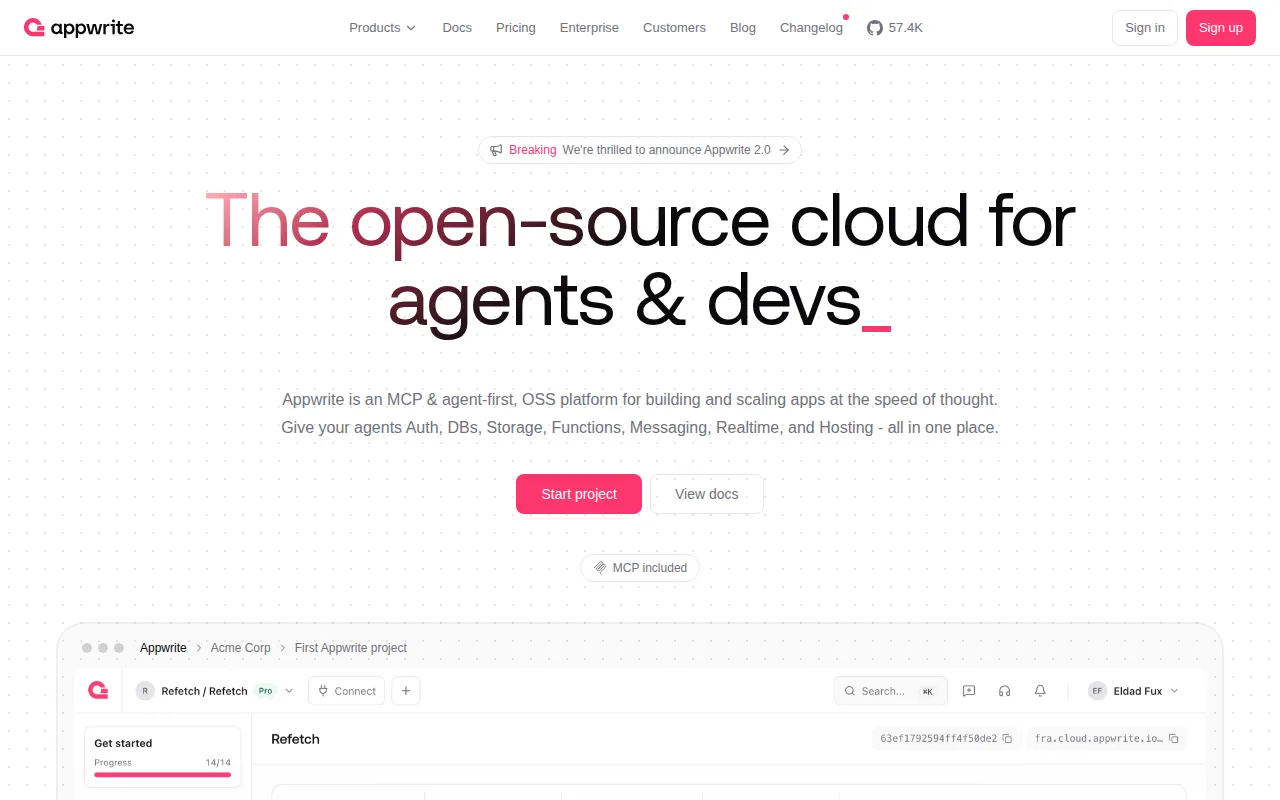
Appwrite is the best PocketBase alternative for developer teams that want a Firebase-style backend, auth, database, storage, functions, and messaging, they can self-host for free, the closest match to PocketBase's own self-hosted, no-vendor-lock-in philosophy among these three alternatives. Appwrite is BSD-3-Clause licensed and self-hosting is entirely free, matching PocketBase's own MIT-licensed, cost-free self-hosted model, and Appwrite has accumulated 57.1K GitHub stars, a comparable community size to PocketBase's own 60,000+ stars. Unlike PocketBase, which has no official managed cloud offering at all, Appwrite Cloud gives teams a managed hosting option with a free tier (2GB storage, 750K monthly executions, community support) alongside the self-hosted path, plus a Pro tier at $25/month with 150GB storage and email support for teams that outgrow the free Cloud plan. Appwrite's SDK coverage spans React, Next.js, Vue, Svelte, iOS, Android, and Flutter, a broader framework list than PocketBase's own React, Vue, Svelte, and Flutter SDK coverage documents. PocketBase remains the better choice for developers who specifically want the entire backend as one portable single-binary executable with an embedded SQLite database: Appwrite's free Cloud tier pauses projects after a week of inactivity and offers only community support, and self-hosting Appwrite shifts the same operational burden, updates, scaling, backups, onto the team that PocketBase's own self-hosted model also requires, without PocketBase's single-file simplicity.
Compared to PocketBase: same free, self-hostable model (BSD-3-Clause vs PocketBase's MIT) but with an added managed Appwrite Cloud option PocketBase doesn't offer, 57.1K GitHub stars close to PocketBase's 60,000+, broader SDK coverage (React, Next.js, Vue, Svelte, iOS, Android, Flutter) vs PocketBase's narrower JavaScript/Dart client SDK list
Wins:Appwrite Cloud offers an official managed hosting option with a free tier, something PocketBase doesn't provide at all since every PocketBase deployment is self-hosted · Broader SDK coverage across React, Next.js, Vue, Svelte, Astro, Angular, Nuxt, and mobile platforms including Flutter, wider than PocketBase's documented client SDK list · Single unified API covers auth, database, storage, functions, and messaging, similar in scope to PocketBase but with messaging added
Loses:Not distributed as a single portable executable; setup involves more moving parts than PocketBase's one-binary deployment · Free Appwrite Cloud tier pauses projects after a week of inactivity and offers only community support · Reviewers note initial setup can be more complex than newcomers expect for a 'quick MVP' backend, a complexity PocketBase's single-binary start avoids
Pros
- Fully open source (BSD-3-Clause) and self-hostable for free, avoiding vendor lock-in on a core backend.
- Single platform covers auth, database, storage, functions, and messaging instead of stitching together separate services.
- Broad SDK coverage across major frontend frameworks and mobile platforms including Flutter.
- Free Appwrite Cloud tier is usable for real projects, not just a sandbox, with 75K monthly active users included.
Cons
- Free Cloud tier projects pause after a week of inactivity and get community-only support.
- Self-hosting requires managing updates, scaling, and backups yourself, shifting operational work onto the team.
- Reviewers note initial setup can be more complex than newcomers expect for a 'quick MVP' backend.
- Enterprise features (SSO, compliance certifications, SLAs) require a custom-quote plan rather than being available at a fixed price.
Pricing: Free tier · paid from $25/mo — $0 (self-hosted, BSD-3-Clause) matches PocketBase's $0 self-hosted cost; Appwrite Cloud adds a free tier plus a $25/month Pro tier PocketBase doesn't offer since it has no managed cloud (verified undefined NaN, NaN)
Which one is right for you?
- You want a Postgres-based backend instead of PocketBase's SQLite, with the option to self-host later.Supabase
- You want a fully managed backend with no server to provision, plus built-in crash reporting and analytics.Firebase
- You want a self-hostable, Firebase-style backend as close as possible to PocketBase's own philosophy, with an optional managed cloud.Appwrite
- You're hitting SQLite's single-writer concurrency limits and need a database built for heavier concurrent writes.Supabase
- You want the most-reviewed, highest-rated alternative to PocketBase among these three.Supabase
- You need broad SDK coverage across many frontend frameworks plus native mobile and Flutter support.Appwrite
Frequently asked questions
What is the best alternative to PocketBase?
- Supabase is the best alternative to PocketBase for most developers, holding a 5.0/5 rating from 861 Product Hunt reviews and offering a Postgres-based backend that can also be self-hosted. Firebase suits teams wanting a fully managed backend with no server at all, and Appwrite is the closest self-hostable match to PocketBase's own philosophy.
Is there a free alternative to PocketBase?
- Yes, all three alternatives compared here (Supabase, Firebase, Appwrite) offer a free tier, matching PocketBase's own free, open-source cost structure. Supabase and Appwrite are also free to self-host entirely, the closest match to PocketBase's zero-cost self-hosted model.
Can Supabase replace PocketBase?
- Supabase can replace PocketBase for teams that want a full Postgres database instead of PocketBase's embedded SQLite, since both bundle auth, storage, and realtime APIs and can be self-hosted. Supabase isn't distributed as a single portable executable the way PocketBase is, so teams valuing PocketBase's one-binary simplicity should weigh that difference.
What is the closest alternative to PocketBase for self-hosting?
- Appwrite is the closest self-hostable alternative to PocketBase, licensed under BSD-3-Clause with free self-hosting and 57.1K GitHub stars, close to PocketBase's own 60,000+. Unlike PocketBase, Appwrite also offers an official managed Appwrite Cloud option with a free tier for teams that don't want to self-host.
Does PocketBase have an official managed cloud hosting option like Firebase or Supabase?
- No, PocketBase has no official managed cloud offering at all; every deployment is self-hosted and self-maintained. Firebase, Supabase, and Appwrite all offer an official managed cloud hosting option with a free tier, a structural difference from PocketBase's self-hosted-only model.