Firebase — Google's mobile and web app development platform bundling a NoSQL database, authentication, hosting, and serverless functions on a free Spark plan or pay-as-you-go Blaze plan.

By Noahlast updated pricing verified
Firebase screenshots & video
Firebase in 20 seconds
Best for: mobile and web developers who want a fully managed backend without running their own servers
Pricing: Spark plan free with fixed quotas; Blaze plan pay-as-you-go on top of the same free quotas, billed at Google Cloud rates.
- Firebase's free Spark plan requires no payment method and includes 50,000 monthly active Authentication users.
- The Blaze pay-as-you-go plan keeps all Spark free quotas and bills usage beyond them at Google Cloud rates.
- Firebase holds a 4.6/5 rating from 767 reviews on Capterra.
- Firebase supports iOS, Android, web, Flutter, Unity, and C++ SDKs.
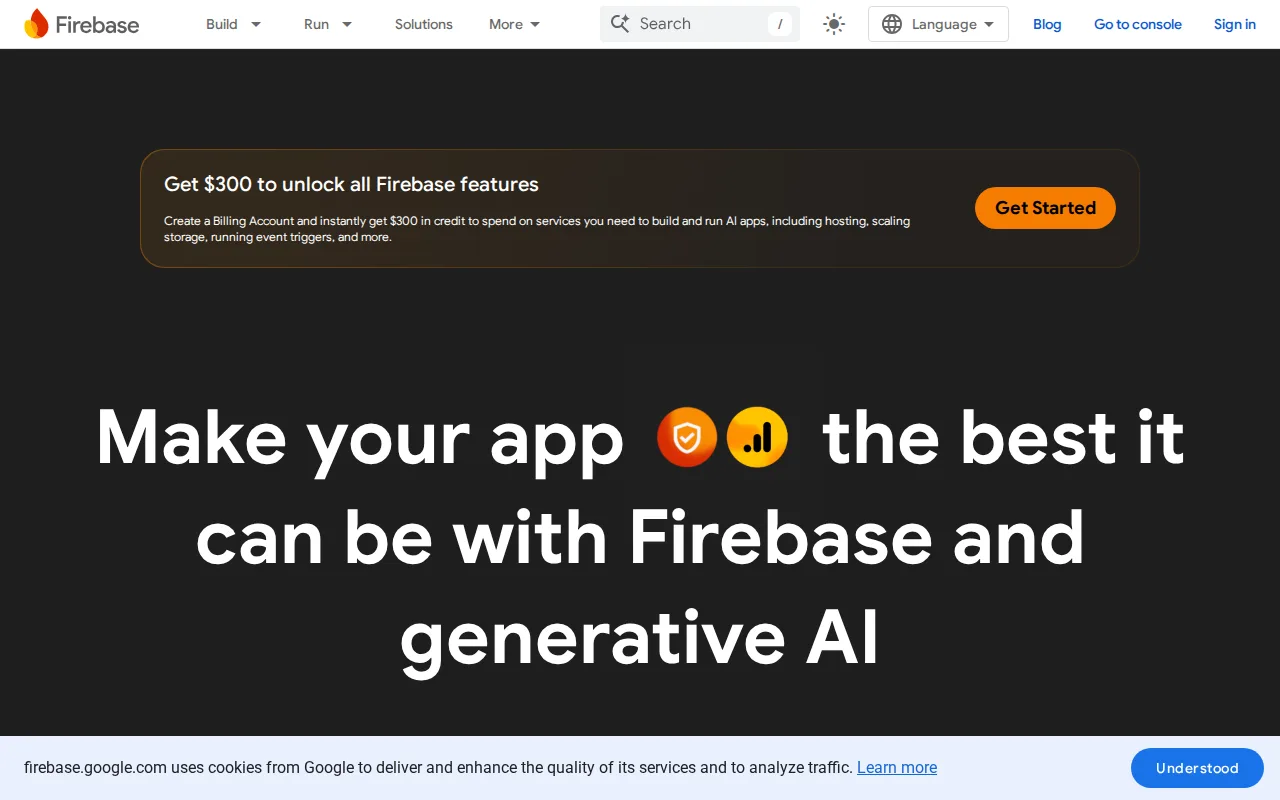
- New Blaze billing accounts can receive $300 in free credit.
Limitations: Usage-based Blaze pricing across many metered services makes cost forecasting difficult at scale.; Firestore's proprietary NoSQL data model creates migration lock-in compared to SQL-based backends.; Some reviewers report recurring bugs and instability in certain SDK versions.
Top alternatives: Supabase, Appwrite, MongoDB Atlas, PocketBase, Convex — full list
What is Firebase?
Firebase is Google's backend-as-a-service platform for building mobile and web apps without managing your own servers. Its "Build" products form the core backend: Firestore (a document-based NoSQL database) or the older Realtime Database, Authentication with over 20 sign-in methods, Cloud Storage for files, App Hosting for web apps, and Cloud Functions for serverless backend logic. Its "Run" products cover app operations: Crashlytics for crash reporting, Google Analytics for usage tracking, Performance Monitoring, Remote Config for feature flags and A/B testing, and Cloud Messaging for push notifications. Firebase also offers Firebase AI Logic for integrating generative AI into apps. It supports iOS, Android, web, Flutter, Unity, and C++ SDKs, and is used by companies including NPR, Duolingo, and Venmo. Firebase runs on two plans: the free Spark plan with fixed usage quotas and no billing account required, and the pay-as-you-go Blaze plan, which keeps the same free quotas but bills usage beyond them at underlying Google Cloud rates.
Firebase is Google's app development platform, bundling a Firestore or Realtime NoSQL database, authentication with 50,000 free monthly active users, Cloud Storage, App Hosting, and Cloud Functions, alongside operational tools like Crashlytics and Google Analytics. The free Spark plan covers generous fixed quotas (1GiB Firestore storage, 50K reads/day, 2M function invocations/month) with no payment method required; the Blaze plan is pay-as-you-go on top of those same free quotas, billed through Google Cloud pricing (for example $5/GB for Realtime Database storage beyond 1GiB, $0.40 per million function invocations beyond 2M). It holds a 4.6/5 rating from 767 reviews on Capterra. Firebase is best for mobile and web developers who want a fully managed backend without running their own servers, though reviewers flag that Blaze-plan costs can escalate unpredictably at scale and that Firestore's proprietary NoSQL model creates lock-in versus SQL-based alternatives.
Standout feature: A single integrated platform spanning database, authentication, hosting, serverless functions, crash reporting, and analytics, all provisioned and scaled automatically by Google.
Biggest weakness: Blaze-plan costs are usage-based across many separate metered services (reads/writes, bandwidth, function invocations, storage), so bills can escalate unpredictably at scale, and Firestore's proprietary NoSQL data model creates real migration lock-in compared to SQL-based backends.
Pros
- Generous free Spark tier with no payment method required, suitable for prototypes and small apps.
- Fully managed infrastructure removes the need to provision or scale servers manually.
- Deep, well-documented SDKs across iOS, Android, web, Flutter, Unity, and C++.
- Integrated operational tooling (Crashlytics, Analytics, Remote Config) reduces the need for separate third-party services.
Cons
- Blaze pay-as-you-go pricing spans many separately metered services, making cost forecasting difficult at scale.
- Firestore's proprietary NoSQL model creates lock-in and a steeper query-design learning curve than SQL databases.
- Some reviewers report recurring bugs and instability in certain SDK versions.
- Complex security rules (Firestore/Realtime Database) require careful configuration to avoid open or over-restrictive access.
Firebase pricing
Free · verified from the vendor's pricing page
| Plan | Price | Notes |
|---|---|---|
| Spark | Free | No payment method required. 1GiB Firestore storage (50K reads/20K writes per day), 1GiB Realtime Database (100 connections, 10GiB/month downloads), 50K monthly active Authentication users, 10GiB Hosting storage, 2M Cloud Function invocations/month, 5GiB Cloud Storage. Analytics, Crashlytics, Cloud Messaging, and Performance Monitoring are always free. |
| Blaze | Free | Pay-as-you-go: includes all Spark quotas free, then bills usage beyond them at Google Cloud rates (e.g. $5/GB for Realtime Database storage over 1GiB, $0.40 per million Cloud Function invocations over 2M, $0.026/GB for legacy Cloud Storage over 5GiB). New billing accounts can receive $300 in free credit. |
What reviewers say
Scores belong to their platforms; we display them with attribution and never fold them into our own ratings.