5 Best Alternatives to Mixpanel in 2026
By Noahlast updated pricing verified
From our data: All 5 alternatives listed here (Amplitude, PostHog, Google Analytics, Heap, Pendo) carry a free tier, matching Mixpanel's own free plan, and Amplitude's is the most generous by event volume at 2 million events/month, double Mixpanel's 1-million-event cap.
 Amplitude
 PostHog
 Google Analytics
 Heap
Heap Pendo
PendoHow we picked
- Ranking leaned on verified pricing dates: Mixpanel, Amplitude, PostHog, Google Analytics, Heap, and Pendo all have independently verified, on-site pricing, so every price comparison in this list rests on figures confirmed the same day.
- External review-platform ratings anchored quality signals: Amplitude (4.6/5 from 68 Capterra reviews), Heap (4.5/5 from 42 Capterra reviews), and Pendo (4.5/5 from 238 Capterra reviews) all post real review evidence, while PostHog's 5.0/5 comes from 253 Product Hunt reviews and Google Analytics leads on raw volume at 4.7/5 from 8,101 Capterra reviews.
- Free-tier generosity was compared directly by event/session volume: Amplitude's free tier covers 2 million events/month, double Mixpanel's own 1 million, while PostHog's free tier covers 1 million events plus 5,000 session replays, and Google Analytics is free with no meaningful traffic cap at all.
- Published, self-serve pricing mattered where several competitors hide it: Mixpanel, Amplitude's Growth tier, Heap's Growth/Pro/Premier tiers, and Pendo's Base/Core/Ultimate tiers all require a sales conversation for exact numbers, a limitation shared across most of this category rather than unique to any one tool.
Paid placement never alters editorial rank — read the full methodology.
Mixpanel alternatives at a glance
| Alternative | Best for | Standout | Biggest weakness | Learning curve | Price |
|---|---|---|---|---|---|
| Mixpanelreference | product teams tracking funnels, retention, and feature adoption across web and mobile without writing SQL | Behavioral cohorts and multi-touch attribution built on Mixpanel's proprietary Arb query engine, fast enough for ad hoc exploration across tens of millions of monthly events. | Growth-plan pricing is not published as a flat number; it scales with event volume through a calculator, which makes budgeting harder to predict than a fixed per-seat price, and event-based pricing can get expensive fast for high-traffic products compared to flat-rate competitors. | Moderate | Free |
| Amplitude | product teams that need behavioral analytics, session replay, and lightweight experimentation in one tool, and prefer usage-based pricing tied to event volume over per-seat licensing | Bundles product analytics, session replay, and feature experimentation under one usage-based pricing model, plus native MCP connectivity so AI coding tools like Claude and Cursor can query product data directly. | Pricing above the free 2-million-event tier is usage-based and largely hidden behind "contact sales" for Growth and Enterprise, making it hard to budget for a scaling product without a sales conversation; heavy instrumentation can also drive event volume, and cost, up faster than teams expect. | Moderate | Free |
| PostHog | product and engineering teams who want analytics, session replay, feature flags, and error tracking in one platform instead of stitching together separate tools | One platform combining product analytics, session replay, feature flags/A-B testing, error tracking, and a data warehouse, each billed on its own usage-based rate that drops at higher volume. | Usage-based pricing across many separate products (events, replays, flags, surveys, data warehouse rows) makes total monthly cost harder to predict than a single flat per-seat price, and some enterprise features live in a separate proprietary ('ee') license rather than the fully open-source core. | Moderate | Free |
| Google Analytics | businesses that want free, event-based web and app analytics tightly integrated with Google Ads for campaign measurement | Free, unlimited-scale analytics for most businesses, with machine-learning-driven insights and direct integration into Google Ads for measuring campaign ROI without a separate tool. | The GA4 event-based data model and reorganized interface represented a steep relearning curve for teams used to the older Universal Analytics, and standard GA4 properties still apply data sampling and shorter retention windows that only Google Analytics 360's custom, undisclosed pricing removes. | Moderate | Free |
| Heap | product teams that want non-technical staff to build and adjust event funnels retroactively, without waiting on engineering to instrument new tracking code | Autocapture records every interaction from install without requiring events to be pre-defined, so teams can build new funnels against historical data instead of only data collected after an event was manually tagged. | Pricing above the 10,000-session free tier is not published; Growth, Pro, and Premier all require a sales conversation, and reviewers report costs climbing sharply as session volume scales, prompting some teams to switch at renewal. | Low | Free |
| Pendo | product and revenue teams at mid-size to enterprise software companies who need in-app guidance and usage analytics without writing custom instrumentation code for every feature | Agent Analytics and Pendo MCP extend the platform beyond classic product analytics into monitoring how users interact with AI agents inside a product, letting teams and tools like Claude query usage data through natural language. | Every paid tier is quoted individually with no published pricing, so buyers cannot compare costs without a sales conversation; reviewers also note access control is coarse, with limited permission tiers and basic users retaining broad creation rights. | Moderate | Free |
 Mixpanel
1.Amplitude — best Mixpanel alternative for product teams that need behavioral analytics, session replay, and lightweight experimentation in one tool, and prefer usage-based pricing tied to event volume over per-seat licensing
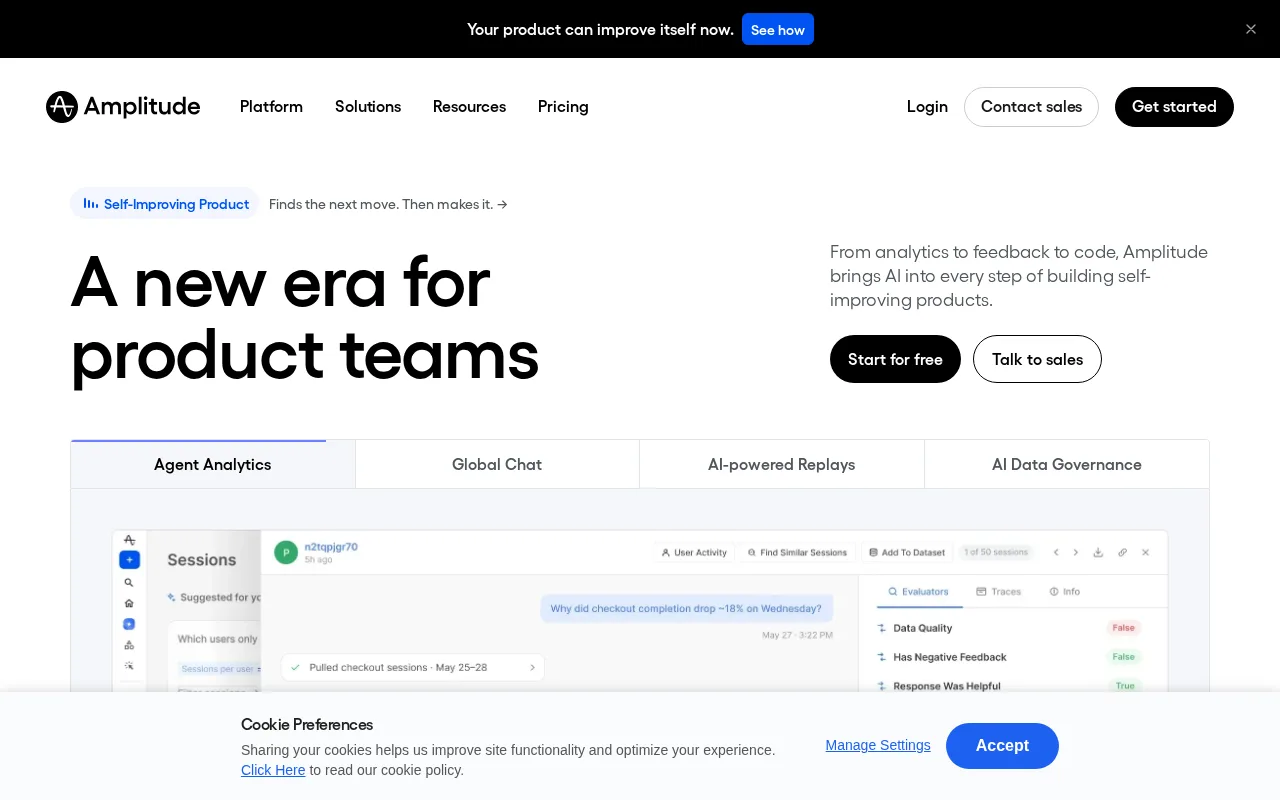
Amplitude is the best Mixpanel alternative for product teams that want behavioral analytics, session replay, and feature experimentation bundled into one platform under usage-based pricing tied to event volume. Amplitude's Free plan covers up to 2 million tracked events per month with no credit card required, double Mixpanel's own free tier of 1 million events, and it includes AI agents, 10,000 monthly session replays, and MCP connectivity for tools like Claude and Cursor at no cost. Amplitude holds a 4.6/5 rating from 68 Capterra reviews, close to Mixpanel's 4.5/5 from 146 Capterra reviews though with less review volume. Both tools ship SDKs across major languages and bundle session replay and experimentation directly into the analytics product rather than requiring separate tools. Mixpanel is still the better choice for teams that want fast, ad hoc querying across tens of millions of events via its proprietary Arb engine, or that prioritize its stronger combined review count (146 Capterra plus 90 Product Hunt reviews): Amplitude's Growth and Enterprise pricing beyond the free tier is largely hidden behind "contact sales," the same opacity Mixpanel's own Growth plan has past its 1M free events.
Compared to Mixpanel: a larger free tier (2M events/month vs 1M), session replay and MCP connectivity for Claude and Cursor included free, native SDKs across TypeScript, Python, Go, Swift, and Kotlin
Wins:Free tier covers 2 million events/month with no credit card required, double Mixpanel's 1 million free events · AI agents, MCP connectivity, and 10,000 monthly session replays included free · SDKs across TypeScript, Python, Go, Swift, and Kotlin cover most product stacks
Loses:Lower combined review volume (68 Capterra reviews) than Mixpanel's 146 Capterra plus 90 Product Hunt reviews · No equivalent to Mixpanel's proprietary Arb query engine built specifically for fast ad hoc queries across tens of millions of events · Growth and Enterprise pricing beyond the free tier is largely hidden behind "contact sales," the same limitation Mixpanel's own Growth plan has
Pros
- Free tier covers 2 million events/month with no credit card required, generous compared to many analytics competitors.
- Session replay and feature experimentation are built in, reducing the need for separate tools.
- Native MCP support lets AI coding assistants query product analytics data directly.
- SDKs across TypeScript, Python, Go, Swift, and Kotlin cover most product stacks.
Cons
- Growth and Enterprise pricing is not published; both require a sales conversation to get a quote.
- Usage-based pricing means costs can rise with instrumentation depth, not just company size or seats.
- Advanced session replay volume (beyond the free tier's 10,000/month) requires moving to a paid plan.
- Setup and event-taxonomy design require more upfront planning than simpler analytics tools.
Pricing: Free — Free up to 2M events/month, then usage-based, vs Mixpanel's free tier up to 1M events/month, then usage-based (verified undefined NaN, NaN)
2.PostHog — best Mixpanel alternative for product and engineering teams who want analytics, session replay, feature flags, and error tracking in one platform instead of stitching together separate tools
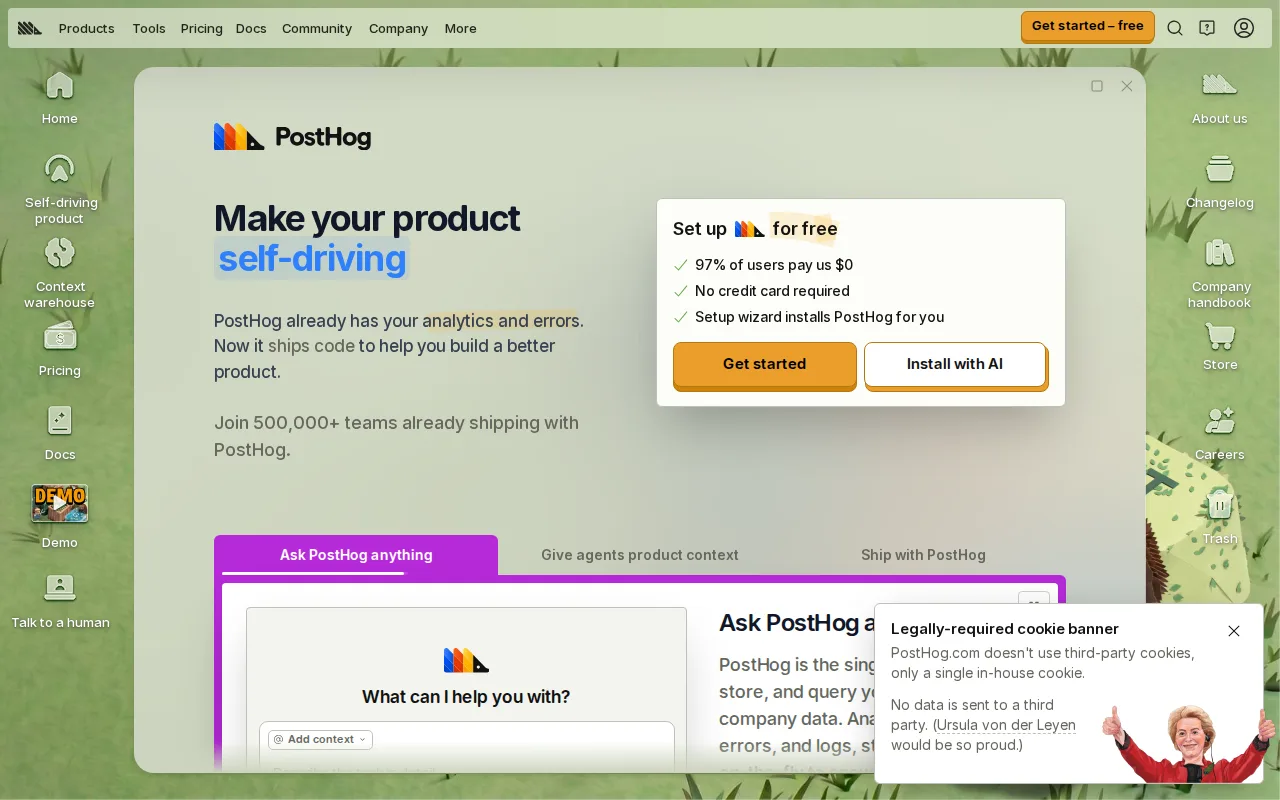
PostHog is the best Mixpanel alternative for product and engineering teams who want analytics, session replay, feature flags, error tracking, and surveys bundled into one open-source platform instead of assembling several point tools. PostHog's Free plan includes 1 million analytics events, 5,000 session replays, 1 million feature flag requests, and 100,000 error tracking exceptions per month with no credit card required, matching Mixpanel's own 1 million free events but adding replay, flags, and error tracking Mixpanel's free tier doesn't include. PostHog holds a 5.0/5 rating from 253 Product Hunt reviews, more review volume than Mixpanel's 90 Product Hunt reviews. PostHog's core is MIT-licensed and available on GitHub, with a dedicated posthog-foss repository for teams that want strictly open-source code, unlike Mixpanel, which is fully closed-source. Mixpanel is still the better choice for teams that specifically need fast ad hoc queries across very large event volumes via a purpose-built query engine (Arb) or that prefer a single, more focused analytics product: PostHog's usage-based pricing spans several separately billed products (events, replays, flags, surveys, data warehouse), making total monthly cost harder to forecast than Mixpanel's single event-based pricing model.
Compared to Mixpanel: bundles session replay, feature flags, error tracking, and surveys alongside analytics in one open-source tool, an MIT-licensed core on GitHub vs Mixpanel's closed-source codebase, 253 Product Hunt reviews vs Mixpanel's 90
Wins:Free tier bundles session replay, feature flags, and error tracking alongside analytics, none of which Mixpanel's free tier includes · MIT-licensed, open-source core on GitHub, with a dedicated posthog-foss repository, unlike Mixpanel's closed-source codebase · 253 Product Hunt reviews at 5.0/5, more review volume than Mixpanel's 90 Product Hunt reviews
Loses:No equivalent to Mixpanel's proprietary Arb query engine purpose-built for fast ad hoc queries at scale · Usage-based pricing spans multiple separately billed products, harder to forecast than Mixpanel's single event-based model · Lower Capterra review count than Mixpanel's 146 Capterra reviews (PostHog's rating comes from Product Hunt only)
Pros
- Combines analytics, session replay, feature flags, error tracking, and surveys in one platform.
- Generous free tier: 1M analytics events and 5,000 session replays per month with no credit card required.
- MIT-licensed core with source available on GitHub, plus a dedicated posthog-foss repository for strictly open-source use.
- Choice of US or EU cloud region, or self-hosting.
Cons
- Usage-based pricing spans multiple products independently, making total monthly cost harder to forecast than flat per-seat pricing.
- Some enterprise features are gated behind a separate proprietary license (the 'ee' directory), not the fully open-source core.
- Self-hosting PostHog at scale requires more operational overhead than using the managed cloud.
- The breadth of bundled tools (analytics, replay, flags, surveys, data warehouse) means new users face a wider surface area to learn than a single-purpose analytics tool.
Pricing: Free — Free up to 1M events/month (plus 5,000 replays), then usage-based, vs Mixpanel's free tier up to 1M events/month, then usage-based (verified undefined NaN, NaN)
3.Google Analytics — best Mixpanel alternative for businesses that want free, event-based web and app analytics tightly integrated with Google Ads for campaign measurement
Google Analytics is the best Mixpanel alternative for businesses that want free, event-based web and app analytics with no meaningful traffic cap, tightly integrated with Google Ads for campaign measurement. Google Analytics 4 is free for businesses of any size, unlike Mixpanel's free tier, which caps at 1 million events per month before usage-based billing begins. Google Analytics holds a 4.7/5 rating from 8,101 Capterra reviews, by far the largest review count of any tool in this comparison and dramatically more than Mixpanel's 146 Capterra reviews. Like Mixpanel, GA4 uses an event-based data model rather than the older session-based approach, and it adds machine-learning-driven insights like predicted churn and purchase likelihood built in at no extra cost. Mixpanel is still the better choice for product teams that need discrete, no-SQL-required funnel and retention analysis built specifically around product usage rather than marketing-site traffic: GA4's event model and reorganized interface represent a real relearning curve for teams used to older analytics tools, and its enterprise tier, Google Analytics 360, requires a sales conversation for pricing, same as Mixpanel's own Enterprise plan.
Compared to Mixpanel: completely free for businesses of any size with no meaningful traffic cap, a 4.7/5 rating from 8,101 Capterra reviews vs Mixpanel's 146, native Google Ads integration for campaign ROI measurement
Wins:Completely free for businesses of any size, unlike Mixpanel's 1M-event free-tier cap before usage-based billing · 8,101 Capterra reviews at 4.7/5, by far the largest review count of any tool in this comparison · Native Google Ads integration ties analytics directly to campaign performance at no extra cost
Loses:Not built specifically around discrete product-usage funnels and retention the way Mixpanel is · GA4's event-based model and reorganized interface represent a real relearning curve for teams used to older tools · Standard properties apply data sampling and shorter retention windows that only the custom-priced 360 tier removes
Pros
- Free for businesses of any size, with no meaningful traffic cap for most use cases.
- Deep, native integration with Google Ads for tying analytics directly to campaign performance.
- Cross-platform (web + app) tracking in a single GA4 property.
- Machine-learning-driven insights (predictive metrics, anomaly detection) built in at no extra cost.
Cons
- GA4's event-based model and menu reorganization created a steep relearning curve versus the older Universal Analytics.
- Standard (free) properties apply data sampling and shorter data-retention windows than the paid 360 tier.
- Google Analytics 360 pricing is not published and requires a sales conversation, making budgeting difficult upfront.
- Some users report GA4 reports are harder to pull and customize compared to the legacy interface.
Pricing: Free — Free for businesses of any size vs Mixpanel's free tier up to 1M events/month, then usage-based (verified undefined NaN, NaN)
4.Heap — best Mixpanel alternative for product teams that want non-technical staff to build and adjust event funnels retroactively, without waiting on engineering to instrument new tracking code
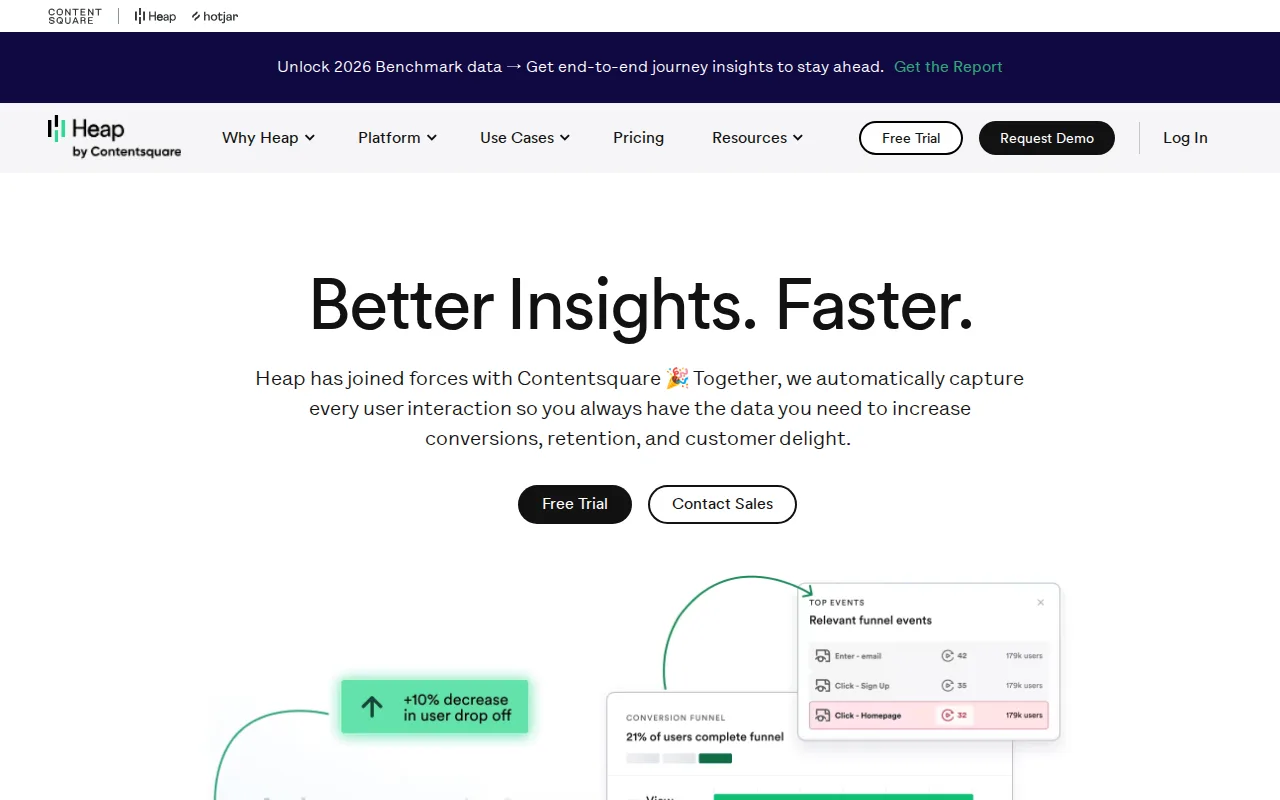
Heap is the best Mixpanel alternative for product teams that want non-technical staff to build and adjust event funnels retroactively, without waiting on engineering to instrument new tracking code the way Mixpanel typically requires. Heap's autocapture model records every click, tap, and form submission from install through a single snippet, so a product manager can define a new funnel step after the fact and see historical data for it immediately, a structural difference from Mixpanel's manual event-tagging approach. Heap's Free plan covers up to 10,000 monthly sessions and 6 months of history, and it holds a 4.5/5 rating from 42 Capterra reviews, close to Mixpanel's 4.5/5 from 146 Capterra reviews though with less review volume. Heap is now owned by Contentsquare, feeding its analytics and session replay into a broader digital experience platform. Mixpanel is still the better choice for teams that specifically want a genuinely free tier scaled by events rather than sessions: Heap's Growth, Pro, and Premier pricing above the 10,000-session free tier is not published and requires a sales conversation, and reviewers report costs rising sharply as session volume scales, prompting some teams to switch at renewal.
Compared to Mixpanel: autocapture records every interaction from install, letting teams build funnels against historical data with no manual event tagging, now backed by Contentsquare's broader digital experience platform
Wins:Autocapture records every interaction on install, so new funnels can be built against historical data with no re-instrumentation, unlike Mixpanel's manual event-tagging model · Non-technical team members can define and adjust tracked events without engineering involvement · Free tier includes SSO and unlimited enrichment sources, not just a stripped-down trial
Loses:No published pricing above the 10,000-session free tier; Growth, Pro, and Premier all require a sales quote, unlike Mixpanel's clearer free-to-usage-based path · Lower review volume (42 Capterra reviews) than Mixpanel's combined 146 Capterra plus 90 Product Hunt reviews · Session replay is an add-on rather than included in the base Pro plan
Pros
- Autocapture records every interaction on install, so new funnels can be built against historical data with no re-instrumentation.
- Non-technical team members can define and adjust tracked events without engineering involvement.
- Sense AI enables natural-language queries against behavioral data.
- Free tier includes SSO and unlimited enrichment sources, not just a stripped-down trial.
Cons
- No published pricing above the 10,000-session free tier; Growth, Pro, and Premier require a sales quote.
- Reviewers report costs rising sharply as monthly session volume grows.
- Session replay is an add-on rather than included in the base Pro plan.
- Now part of Contentsquare following acquisition, which has changed roadmap priorities for some long-time users.
Pricing: Free — Free up to 10,000 sessions/month, then custom quote, vs Mixpanel's free tier up to 1M events/month, then usage-based (verified undefined NaN, NaN)
5.Pendo — best Mixpanel alternative for product and revenue teams at mid-size to enterprise software companies who need in-app guidance and usage analytics without writing custom instrumentation code for every feature
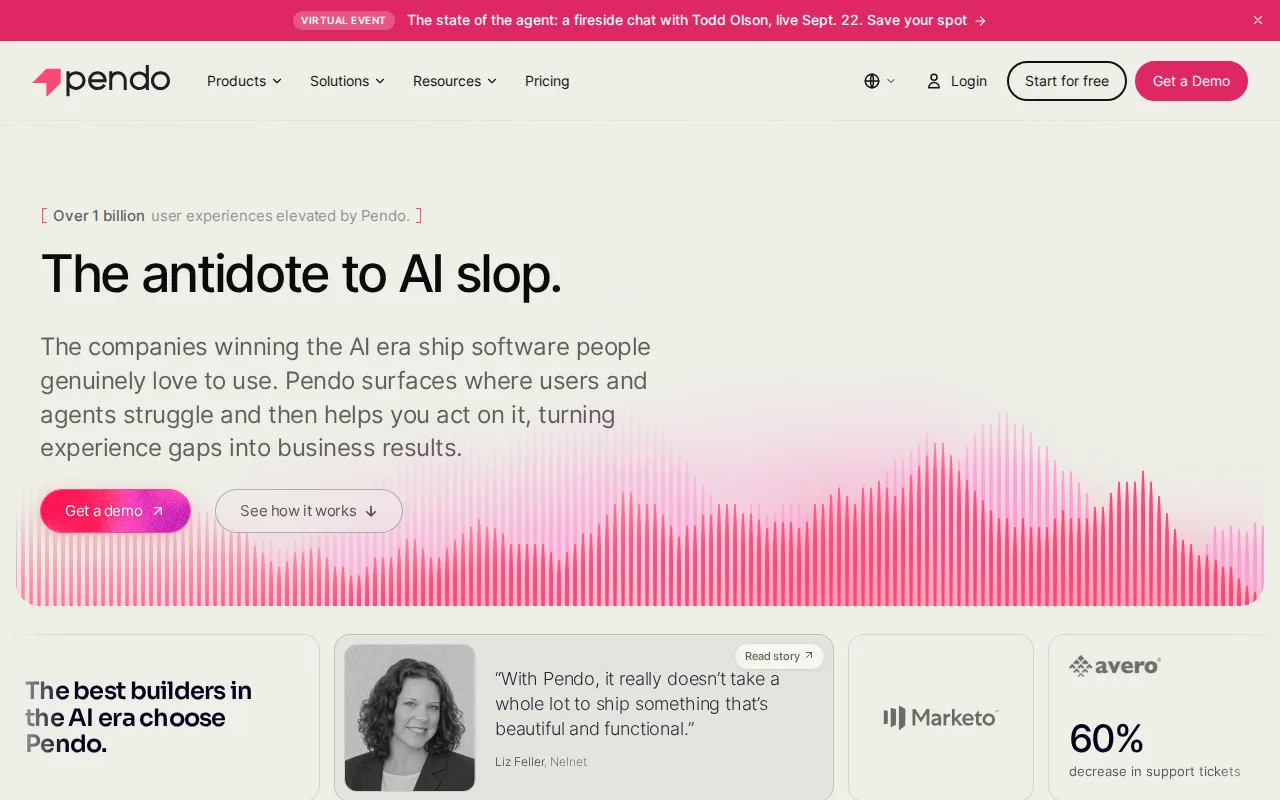
Pendo is the best Mixpanel alternative for product and revenue teams that need in-app guides, walkthroughs, and feedback surveys layered directly on top of usage analytics, without requiring engineering resources for every change, a combination Mixpanel's analytics-only product doesn't offer. Pendo's Free plan covers up to 500 monthly active users with real product analytics, in-app guides, and Pendo-branded roadmaps and NPS surveys, and the company reports tracking over 40 trillion events across 18,000+ apps and agents. Pendo holds a 4.5/5 rating from 238 Capterra reviews, more review volume than Mixpanel's 146 Capterra reviews, with reviewers specifically praising customer service. Pendo's Agent Analytics and Pendo MCP extend the platform to monitor how users interact with AI agents inside a product, letting tools like Claude query usage data through natural language, similar in spirit to Mixpanel's own MCP integrations for Slack, Claude, ChatGPT, and Cursor. Mixpanel is still the better choice for teams that want a leaner, analytics-focused tool with a straightforward free-to-paid path: every one of Pendo's paid tiers (Base, Core, Ultimate) is quoted individually with no published pricing, while Mixpanel at least publishes its free-tier limits clearly before usage-based billing kicks in.
Compared to Mixpanel: in-app guides, walkthroughs, and feedback surveys built directly on top of usage analytics, a 4.5/5 rating from 238 Capterra reviews vs Mixpanel's 146, Agent Analytics for monitoring AI-feature usage
Wins:In-app guides and walkthroughs can be built and published without engineering involvement, a capability Mixpanel's analytics-only product lacks · 4.5/5 rating from 238 Capterra reviews vs Mixpanel's 146 Capterra reviews · Free plan covers up to 500 MAU with real product analytics and in-app guides, not just a time-limited trial
Loses:Every paid tier (Base, Core, Ultimate) is quoted individually with no published pricing, less transparent than Mixpanel's stated free-tier limits · Access control is coarse, with limited permission tiers and broad default rights for basic users · In-app surveys do not support multi-select response options, limiting nuanced feedback collection
Pros
- Free plan covers up to 500 MAU with real product analytics and in-app guides, not just a time-limited trial.
- In-app guides and walkthroughs can be built and published without engineering involvement.
- Leo AI assistant and Agent Analytics extend the platform to monitor AI-feature usage, not just traditional UI events.
- Capterra reviewers rate customer service 4.5/5, citing a communicative, responsive support team.
Cons
- No published pricing for any paid tier; Base, Core, and Ultimate are all custom quotes scaled to MAU.
- Access control is coarse, with limited permission tiers and broad default rights for basic users.
- In-app surveys do not support multi-select response options, limiting nuanced feedback collection.
- Some reviewers report occasional platform stability issues as new features are still being built out.
Pricing: Free — Free up to 500 MAU, then custom quote, vs Mixpanel's free tier up to 1M events/month, then usage-based (verified undefined NaN, NaN)
Which one is right for you?
- You want behavioral analytics, session replay, and experimentation bundled together with a larger free event tierAmplitude
- You want analytics, session replay, feature flags, and error tracking in one open-source, self-hostable toolPostHog
- You want free, unlimited-scale web and app analytics tied directly to Google Ads campaign measurementGoogle Analytics
- You want non-technical staff to build funnels retroactively without engineering re-instrumenting tracking codeHeap
- You want in-app guides and feedback surveys layered on top of usage analytics, not just analytics alonePendo
Frequently asked questions
Is there a free alternative to Mixpanel?
- Yes — Amplitude's free tier covers up to 2 million events/month (double Mixpanel's 1 million), PostHog's free tier covers 1 million events plus session replay, and Google Analytics is completely free for businesses of any size with no meaningful traffic cap.
What is the closest alternative to Mixpanel?
- Amplitude is the closest match: both are event-based product analytics platforms with free tiers, session replay, experimentation, and MCP integrations for AI coding tools, differing mainly in free-tier size (2M vs 1M events) and query engine.
Can Amplitude replace Mixpanel?
- Yes for most product teams, since Amplitude covers the same funnel, retention, and cohort analysis with a larger free tier and bundled session replay. Teams that specifically rely on Mixpanel's proprietary Arb engine for fast ad hoc queries across very large event volumes should evaluate that need directly, since query performance at scale isn't detailed for Amplitude in this data.
Which Mixpanel alternative has the most generous free tier?
- Amplitude, whose free plan covers up to 2 million tracked events per month with no credit card required, compared to Mixpanel's own 1 million free events, PostHog's 1 million events, and Google Analytics' unlimited free tier for any business size.
Is Google Analytics a good Mixpanel replacement for product analytics?
- Partially — Google Analytics is completely free and event-based like Mixpanel, but it's built primarily for website and app traffic tied to marketing and Google Ads, so product teams that need deep funnel, cohort, and retention analysis without SQL are typically better served by Mixpanel, Amplitude, or PostHog.
Which Mixpanel alternative adds in-app guides and user feedback tools?
- Pendo, which layers in-app guides, walkthroughs, and NPS/feedback surveys directly on top of usage analytics, a combination Mixpanel's analytics-only product doesn't offer.