2 Best Alternatives to IntelliJ IDEA in 2026
By Noahlast updated

The best alternative to IntelliJ IDEA is Visual Studio Code. Other top alternatives are Cursor — 2 options compared below with verified pricing, pros and cons, and honest weaknesses.
How we picked
- Fit first: every listed tool replaces the core job of the product on this page.
- Pricing is read from each vendor's pricing page; the verification date is shown above.
- Third-party review scores are displayed with counts and linked to their source.
- Likes and “I use this” marks from signed-in users feed the ordering.
Paid placement never alters editorial rank — read the full methodology.
IntelliJ IDEA alternatives at a glance
| Alternative | Best for | Standout | Biggest weakness | Learning curve | Price |
|---|---|---|---|---|---|
| IntelliJ IDEAreference | Java and Kotlin developers who want the strongest JVM-focused IDE, using the free Community edition unless they specifically need Ultimate's web-framework or database tooling | The Community edition is a genuinely full-featured, free, open-source Java/Kotlin IDE, not a crippled trial, so most individual developers never need to pay unless they touch specific Ultimate-only frameworks or database tools. | Ultimate's per-seat annual subscription is expensive for individuals compared to fully free competitors like Visual Studio Code or Eclipse, and figuring out whether a project genuinely needs Ultimate-only features (versus staying on free Community) is not always obvious upfront. | Moderate | Free tier · paid from $169/yr |
| Visual Studio Code | developers across nearly any language or stack who want a fast, free, extensible editor with strong Git integration and a large extension ecosystem, rather than a full paid IDE | An extension marketplace of over 80,000 extensions that turns a lightweight base editor into a full language- or framework-specific IDE, combined with first-class Git and remote-development support. | The official Microsoft-branded build is not fully open source in practice (telemetry and the curated marketplace ship under a separate license from the MIT-licensed core), and heavy extension use can noticeably slow startup time and memory usage compared to lighter editors like Sublime Text. | Low | Free |
| Cursor | software teams that want autonomous AI agents handling multi-file changes and PR reviews directly inside their editor and CI pipeline | Cloud agents that keep working on long-running tasks (hours or days) independent of the local machine, combined with a Slack and GitHub-integrated review workflow. | Usage-based pricing on top of the subscription (extra Agent requests, Bugbot) can make monthly costs unpredictable for heavy users, and the jump from Pro ($20/month) to Ultra ($200/month) is steep for teams that outgrow Pro's Agent limits. | Moderate | Free tier · paid from $20/mo |
 IntelliJ IDEA
 Visual Studio Code
 Cursor
1.Visual Studio Code — best IntelliJ IDEA alternative for developers across nearly any language or stack who want a fast, free, extensible editor with strong Git integration and a large extension ecosystem, rather than a full paid IDE
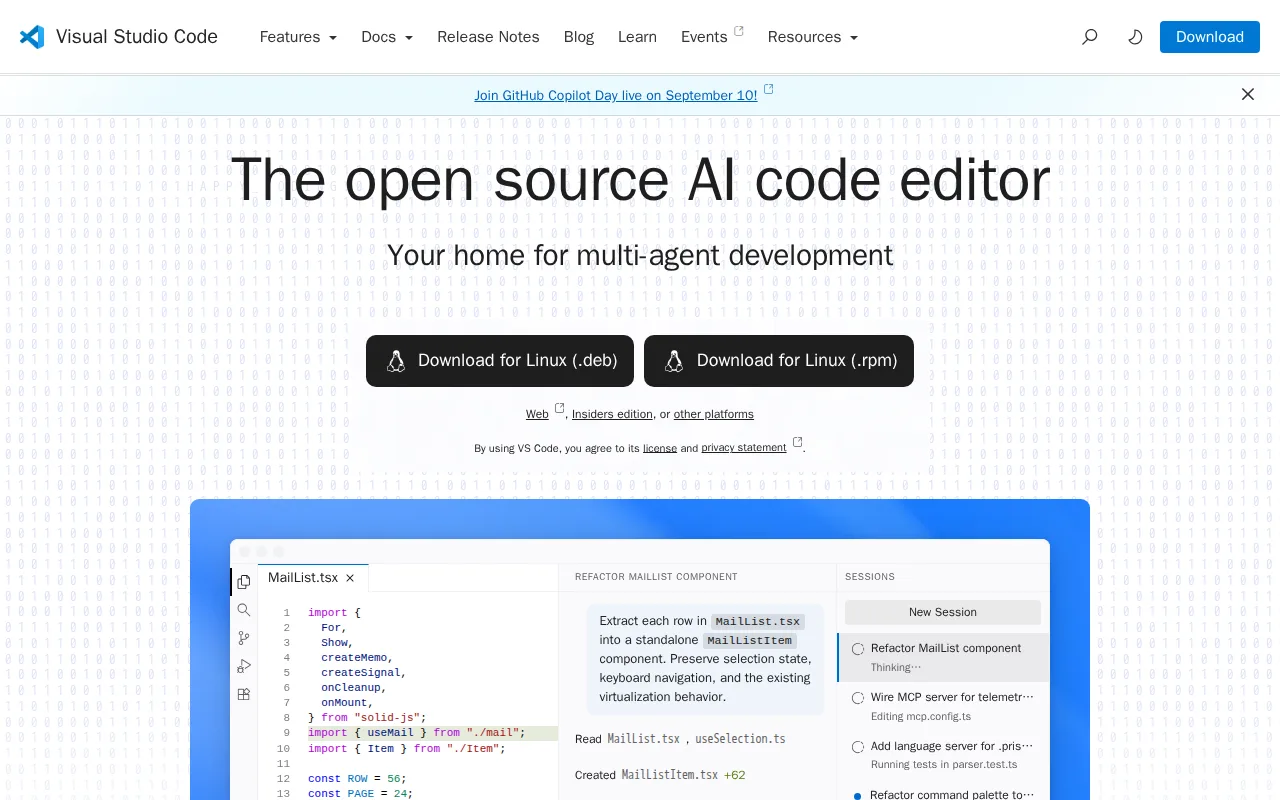
A free, lighter-weight editor with Java extensions, the most common comparison for developers weighing IntelliJ IDEA's heavier feature set against a leaner free tool.
Pros
- Free for individual and commercial use with no paid tier gating core editor functionality.
- Extension marketplace covers virtually every language, framework, and workflow, from linting to remote containers.
- Built-in Git integration and an integrated terminal remove the need for separate tools for basic version control.
- Runs identically across Windows, macOS, Linux, and the browser via vscode.dev.
Cons
- Performance degrades with many extensions installed, especially on large codebases or lower-end hardware.
- The official build's telemetry and marketplace terms sit under a separate Microsoft license, distinct from the MIT-licensed open-source core.
- Advanced refactoring and language-specific tooling generally lag behind dedicated JetBrains IDEs for languages like Java or C#.
- AI features increasingly nudge users toward GitHub Copilot, which is a separate paid subscription for full functionality.
Pricing: Free (verified undefined NaN, NaN)
2.Cursor — best IntelliJ IDEA alternative for software teams that want autonomous AI agents handling multi-file changes and PR reviews directly inside their editor and CI pipeline
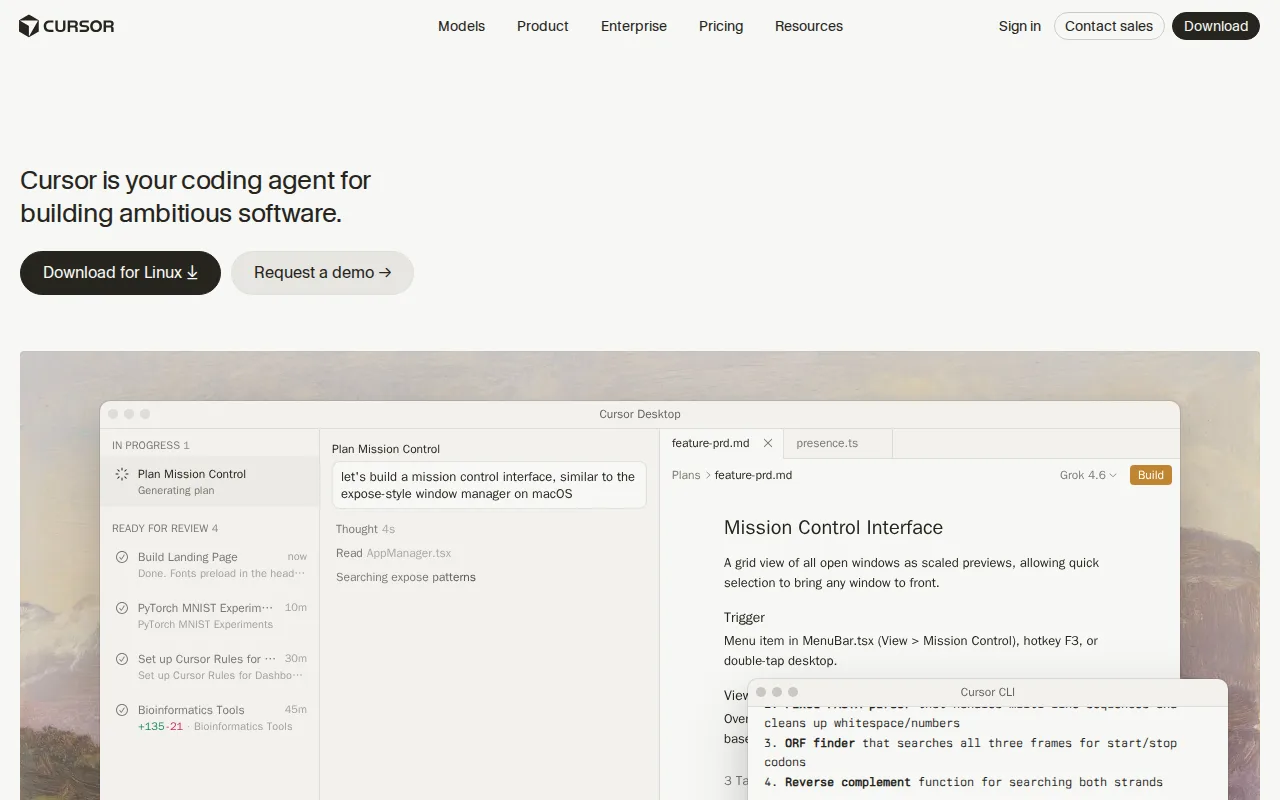
An AI-native code editor competing for developers prioritizing AI-assisted coding workflows over IntelliJ's deep language-specific tooling.
Pros
- Autonomous agents can plan, write, test, and open pull requests with minimal hand-holding.
- Multi-model support (Grok, Claude, Cursor's own Composer) avoids lock-in to a single AI provider.
- Cloud agents keep running on long tasks without tying up the developer's local machine.
- Free Hobby tier requires no credit card, making it easy to evaluate before paying.
Cons
- Usage-based charges on top of the subscription make total monthly cost harder to predict than a flat fee.
- Steep price jump from Pro ($20/month) to Ultra ($200/month) for teams needing higher Agent limits.
- Requires comfort delegating multi-file changes to an agent, a real workflow shift for developers used to manual review of every diff.
- No iOS or Android app; Cursor is desktop- and CLI-only.
Pricing: Free tier · paid from $20/mo