IntelliJ IDEA — A JetBrains IDE for Java and Kotlin development, free and open source in its Community edition, with a paid Ultimate edition for web, enterprise, and database tooling.

By Noahlast updated
IntelliJ IDEA screenshots & video
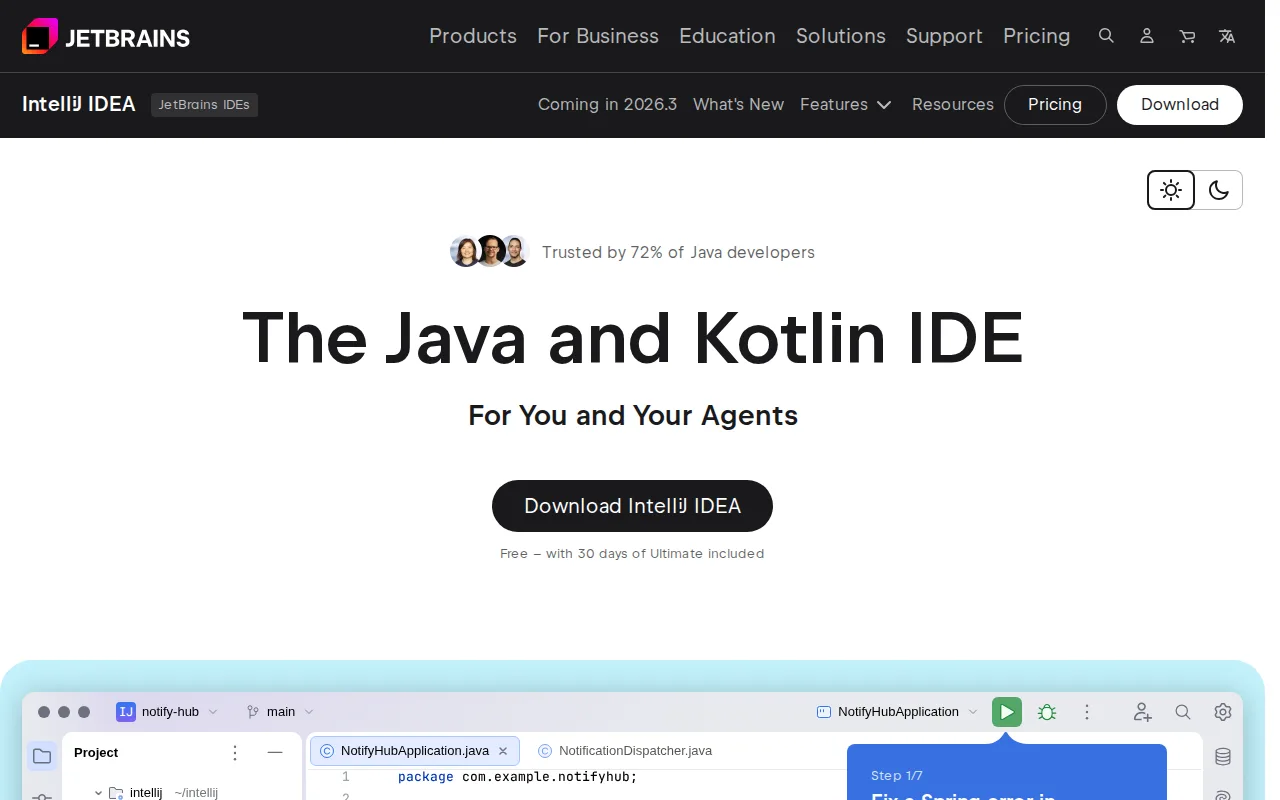
IntelliJ IDEA in 20 seconds
Best for: Java and Kotlin developers who want the strongest JVM-focused IDE
Pricing: Community edition is free; Ultimate is a paid annual subscription with individual and (higher-priced) organization tiers, with loyalty discounts on renewal.
- IntelliJ IDEA Community edition is free and open source under the Apache 2.0 license.
- IntelliJ IDEA Ultimate is a paid subscription with separate individual and organization pricing tiers.
- Ultimate adds web/enterprise framework support, database tools, and profiling on top of Community.
- The open-source Community codebase on GitHub (JetBrains/intellij-community) has 20.5k stars.
- IntelliJ IDEA holds a 4.7/5 rating from 1,259 reviews on Capterra.
Limitations: Ultimate is a recurring subscription cost rather than a one-time purchase.; Uses more RAM and takes longer to start than lighter editors like Visual Studio Code.; It is not always obvious which projects genuinely require Ultimate versus free Community.; Organization licensing costs more per seat than individual licensing.
Top alternatives: Visual Studio Code, Eclipse, NetBeans, Cursor — full list
What is IntelliJ IDEA?
IntelliJ IDEA is an integrated development environment from JetBrains built around deep Java and Kotlin language support: code completion, refactoring tools, integrated debugging, build tool integration (Maven, Gradle), and version control, all tuned for JVM-based development. The Community edition is free, open source under the Apache 2.0 license, and covers core Java, Kotlin, Groovy, and Android development. The Ultimate edition is a paid, closed-source superset that adds support for web and enterprise frameworks (Spring, Jakarta EE, JavaScript/TypeScript, and others), built-in database client tools, application server deployment, and code profiling. Because Ultimate is a strict superset of Community's functionality, teams typically start on the free Community edition and upgrade only when a specific Ultimate-only capability, like database tooling or a web framework, becomes necessary.
IntelliJ IDEA is a JetBrains integrated development environment built primarily for Java and Kotlin, distributed as two editions: the free, open-source Community edition (Apache 2.0 license) for core Java/Kotlin/Android development, and the paid Ultimate edition, which adds web framework support (Spring, JavaScript/TypeScript), built-in database tools, application server integration, and profiling. Ultimate is sold as an annual or monthly subscription with JetBrains' typical multi-year discount structure, where the per-year price drops in the second and third years of continuous renewal; organization licenses cost more than individual licenses. IntelliJ IDEA competes with Visual Studio Code plus Java extensions on the free side, and with Eclipse for a fully free Java IDE, while Ultimate competes with paid IDE bundles for teams that need integrated database and web-framework tooling out of the box.
Standout feature: The Community edition is a genuinely full-featured, free, open-source Java/Kotlin IDE, not a crippled trial, so most individual developers never need to pay unless they touch specific Ultimate-only frameworks or database tools.
Biggest weakness: Ultimate's per-seat annual subscription is expensive for individuals compared to fully free competitors like Visual Studio Code or Eclipse, and figuring out whether a project genuinely needs Ultimate-only features (versus staying on free Community) is not always obvious upfront.
Pros
- Community edition is completely free and open source with no feature countdown or nag screens.
- Deep, JetBrains-grade refactoring, code completion, and debugging tools tuned specifically for Java and Kotlin.
- Ultimate adds integrated database tools and web-framework support without needing separate plugins from third parties.
- Strong out-of-the-box Gradle/Maven build tool integration reduces project setup friction.
Cons
- Ultimate is a recurring per-seat subscription rather than a one-time purchase, an ongoing cost for teams that need its features.
- Heavier resource usage (RAM and startup time) than lighter editors like Visual Studio Code, especially on large codebases.
- The line between what requires Ultimate versus what Community already covers is not always clear to new users.
- Organization/business licensing costs meaningfully more per seat than individual licensing, a real budget factor for teams standardizing on Ultimate.
IntelliJ IDEA pricing
Free tier · paid from $169/yr
| Plan | Price | Notes |
|---|---|---|
| Community | Free | Free and open source (Apache 2.0); core Java, Kotlin, Groovy, and Android development, no expiration or feature paywall. |
| Ultimate (Individual) | $169/yr | First-year price for an individual annual subscription; JetBrains applies loyalty discounts in subsequent renewal years. Adds web/enterprise framework support, database tools, and profiling on top of Community. |
| Ultimate (Organization) | $599/yr | First-year price per user for a business/organization annual subscription; JetBrains applies loyalty discounts in subsequent renewal years. |
What reviewers say
Scores belong to their platforms; we display them with attribution and never fold them into our own ratings.