5 Best Alternatives to DaisyDisk for Windows in 2026
By Noahlast updated
Compared: DaisyDisk alternatives that run on Windows
| Alternative | Best for | Learning curve | Price |
|---|---|---|---|
| DaisyDiskreference | Mac users who need to visually locate large files and free up storage on an internal or external drive without manually browsing folders | Low | Pricing not verified |
| WizTree | Windows and macOS users who need to quickly find and clear large files or folders eating up local disk space, especially on NTFS drives. | Low | Free tier · paid from $25 one-time |
| WinDirStat | Finding which folders and files are filling a Windows drive or file server before deciding what to delete, archive or compress | Low | Free |
| TreeSize | Auditing which folders, file types and owners fill Windows file servers and network shares, with scheduled scans and exported storage reports | Low | Free tier · paid from $25.20/yr |
| CCleaner | Windows or Mac users who want to reclaim disk space, clear browser/app junk, and keep device drivers updated without manually hunting for updates | Low | Free tier · paid from $44.95/yr |
| BleachBit | Freeing space and wiping browser and application traces on Windows and Linux machines with a free cleaner that previews every file before deleting it | Low | Free |
 DaisyDisk
 WizTree
 WinDirStat
 TreeSize
 CCleaner
 BleachBit
1WizTree — best DaisyDisk alternative for windows and macOS users who need to quickly find and clear large files or folders eating up local disk space, especially on NTFS drives.
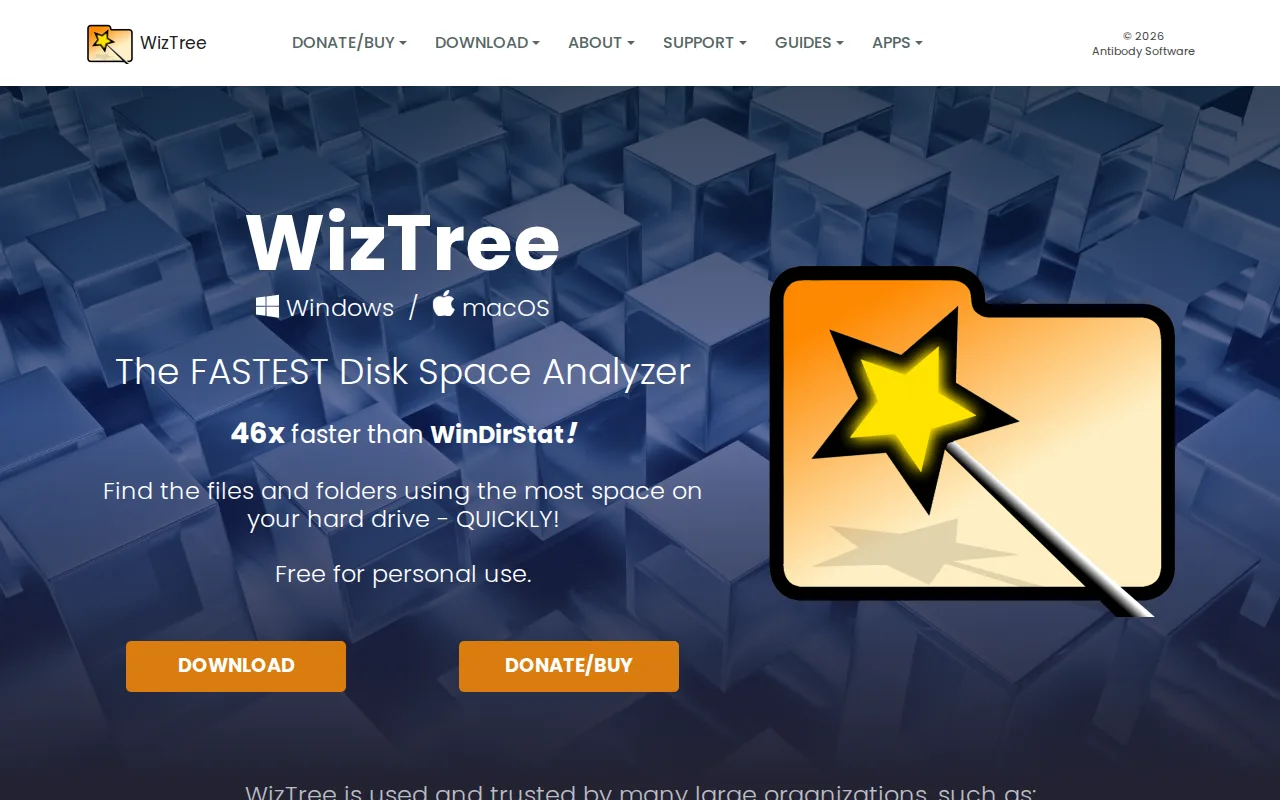
WizTree is the best DaisyDisk alternative for people who need the same kind of disk map on both a Mac and a Windows PC. DaisyDisk runs only on macOS and iOS, while WizTree from Antibody Software runs on macOS and Windows and shows a treemap of disk usage, a sortable file-size list and a duplicate-file finder, which DaisyDisk's listing says it does not include. On Windows NTFS drives WizTree reads the Master File Table directly, and the vendor claims scans up to 46x faster than WinDirStat. WizTree is free for personal use with no time limit, where DaisyDisk's trial lets you scan but restricts deleting until you buy a license; an optional WizTree supporter code costs $25 one-time. DaisyDisk is still the better choice for many Mac-only users. WizTree's speed shortcut does not apply to its macOS version, and its interface is utilitarian and not aimed at less technical users, where DaisyDisk offers a clickable sunburst chart and a drag-to-Collector batch delete. WizTree has no iPhone or iPad app, and business use needs a paid supporter code priced by staff count, from $100 one-time for up to 5 staff.
Compared to DaisyDisk: runs on Windows as well as macOS, free for personal use with a duplicate finder, a utilitarian interface whose fast scan applies only to Windows NTFS drives
Wins:Runs on Windows as well as macOS, where DaisyDisk has no Windows version · Free for personal use with no time limit, where DaisyDisk's trial restricts deletion until you pay · Includes a duplicate-file finder, which DaisyDisk's listing says it lacks · Reads the NTFS Master File Table directly on Windows, and the vendor claims scans up to 46x faster than WinDirStat
Loses:The fast Master File Table scan does not apply to the macOS version · The interface is utilitarian and not aimed at less technical users, unlike DaisyDisk's clickable sunburst and Collector · No iPhone or iPad app, where DaisyDisk has a companion iOS app · Commercial use requires a supporter code from $100 one-time for up to 5 staff
Pros
- Scans large NTFS drives in seconds by reading the Master File Table directly
- Free for personal use with no time limit
- Visual treemap plus sortable file list makes large files easy to spot
- Perpetual one-time license for commercial use instead of a recurring subscription
Cons
- Commercial use of any kind requires a paid supporter code, priced by staff count
- Supporter codes only include free upgrades for versions released within one year of purchase
- No Linux version
- Interface is utilitarian, not aimed at less technical users
Pricing: Free tier · paid from $25 one-time — Free for personal use or $25 one-time for an individual supporter code; DaisyDisk's listing publishes no price to compare (verified September 23, 2026)
2WinDirStat — best DaisyDisk alternative for finding which folders and files are filling a Windows drive or file server before deciding what to delete, archive or compress
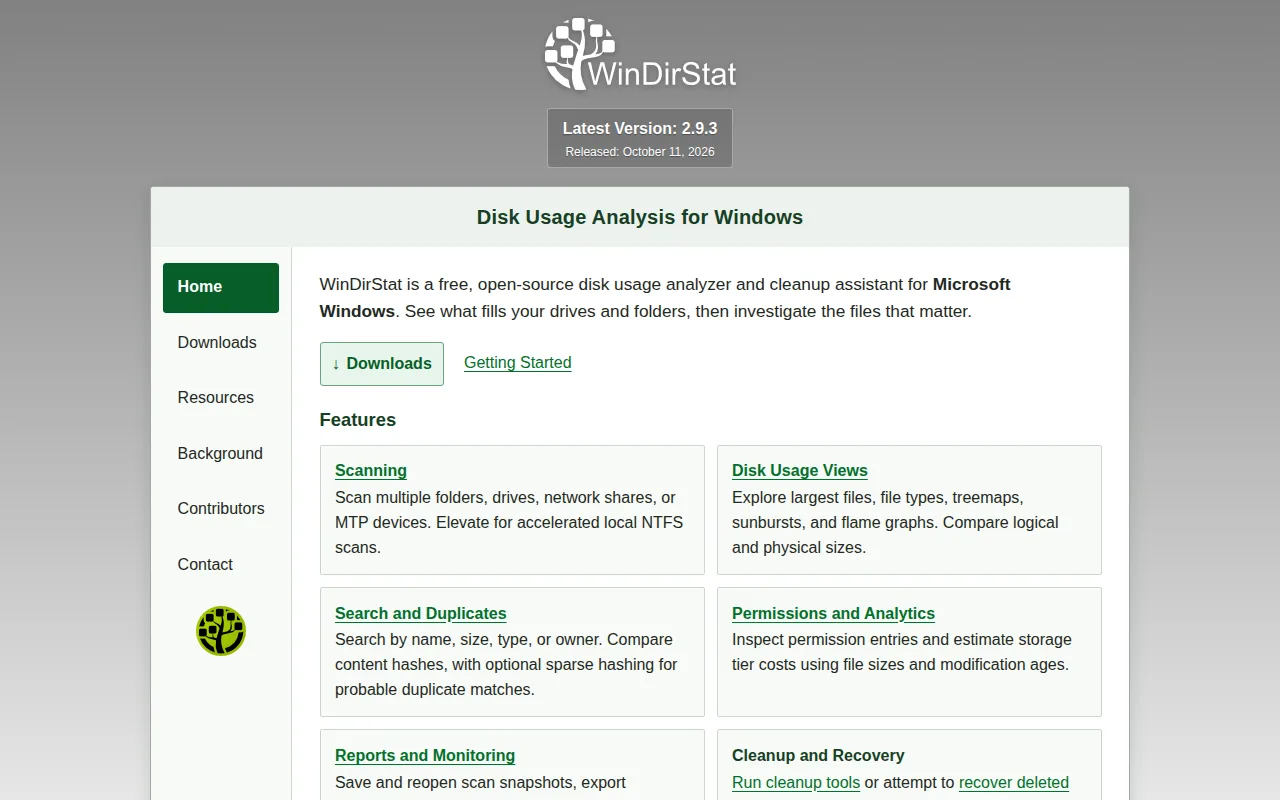
WinDirStat is the best DaisyDisk alternative for anyone who needs DaisyDisk's kind of visual disk map on a Windows PC, where DaisyDisk does not run. WinDirStat shows the whole drive as a treemap in which every rectangle is a file sized by space, and version 2.x adds a sunburst chart like DaisyDisk's, a flame graph, largest-file and file-type views, and duplicate detection by content hash, which DaisyDisk's listing says it lacks. WinDirStat is free for personal and commercial use under the GNU GPL v3 or later, with no paid edition or account, where DaisyDisk is a paid app whose trial restricts how much you can delete. WinDirStat runs on Windows 7 through 11 and Windows Server 2008 R2 through 2025, exports scans to CSV and JSON, and can recover deleted files on NTFS, exFAT and FAT drives. DaisyDisk is still the better choice on a Mac, because WinDirStat runs only on Windows and its own project points Mac users to other tools. DaisyDisk also has an iPhone and iPad companion app, and WinDirStat's fast scan needs administrator rights on a local NTFS drive.
Compared to DaisyDisk: free and open source under the GPL v3, duplicate detection by content hash DaisyDisk lacks, Windows only with no macOS version
Wins:Free for personal and commercial use under the GPL v3, where DaisyDisk requires a paid license for full deletion · Detects duplicates by content hash, which DaisyDisk's listing says it does not include · Treemap, sunburst and flame-graph views plus CSV and JSON export of scan results · Runs on Windows 7 through 11 and Windows Server 2008 R2 through 2025, where DaisyDisk has no Windows version
Loses:Windows only, with no macOS or iOS version, so it cannot replace DaisyDisk on a Mac · Fast scanning needs administrator rights on a local NTFS drive · No Collector-style tray in its listing; every deletion is chosen by hand
Pros
- Free and open source under the GNU GPL v3 or later, for personal and commercial use.
- Treemap, sunburst and flame-graph views make large files and folders obvious at a glance.
- Accelerated scanning reads the NTFS Master File Table directly when run as administrator.
- Finds duplicates by content hash and can replace them with hardlinks or shrink files with NTFS compression.
- Portable ZIP plus winget, Chocolatey, Scoop and Microsoft Store installs for x64, x86 and ARM64.
Cons
- Windows only; the project points Mac and Linux users to GrandPerspective and QDirStat.
- Fast MFT scanning requires admin rights and a local NTFS drive; network shares and phones scan more slowly.
- No automatic junk detection or scheduled cleaning; every deletion is chosen by hand.
Pricing: Free — WinDirStat costs $0 for any use; DaisyDisk's listing publishes no price to compare (verified October 23, 2026)
3TreeSize — best DaisyDisk alternative for auditing which folders, file types and owners fill Windows file servers and network shares, with scheduled scans and exported storage reports
TreeSize is the best DaisyDisk alternative for IT teams that need to audit storage on Windows machines and file servers rather than tidy up one Mac. DaisyDisk runs only on macOS and iOS; TreeSize from JAM Software runs on Windows and scans local drives, network shares and cloud-synced folders, showing usage as folder trees, pie charts, bar charts and a treemap. TreeSize Personal at $25.20/user/year adds largest-file filters, usage-over-time comparison and a duplicate finder, which DaisyDisk's listing says it lacks, and TreeSize Professional at $49.20/user/year adds command-line and task scheduler options, PDF, Excel and HTML exports, and network drive and UNC path scanning. All editions run on-premise, so scanned data never leaves the machine. DaisyDisk is still the better choice for anyone on a Mac, because TreeSize has no macOS or Linux version. TreeSize Free is also limited to personal, non-commercial use and cannot run on Windows Server, and per-user, per-year licensing adds up for larger teams, while DaisyDisk's sunburst chart and drag-to-Collector delete suit one person clearing one drive.
Compared to DaisyDisk: scans Windows drives, network shares and cloud-synced folders, scheduled scans and PDF, Excel and HTML reports in Professional, no macOS version
Wins:Runs on Windows and scans network shares and cloud-synced folders, where DaisyDisk has no Windows version · Duplicate finder in TreeSize Personal at $25.20/user/year, which DaisyDisk's listing says it lacks · Professional adds command-line and task scheduler automation plus PDF, Excel, HTML and CSV reports
Loses:Windows only, with no macOS or iOS version · TreeSize Free is limited to personal, non-commercial use and cannot run on Windows Server · Per-user, per-year licensing, with network drive and UNC path scanning reserved for Professional at $49.20/user/year
Pros
- TreeSize Free costs nothing for private use and still includes a size-sorted folder tree, treemap chart, PDF export and phone scanning over MTP or WebDAV.
- Local NTFS drives are scanned through the Master File Table, and Professional uses up to 32 parallel threads on network targets.
- Paid editions scan far more than local disks: Windows Server shares, SharePoint, Google Drive, Amazon S3, Azure Blob Storage, Outlook mailboxes and Linux over SSH (in Personal only on a home network).
- Checksum-based duplicate search can replace copies with hardlinks, symlinks or shortcuts and previews planned changes before running them.
- Runs fully on-premises; JAM Software states that no scan data leaves the machine and that its servers are located in Germany.
Cons
- Windows only; there is no macOS or Linux version, and Linux machines can only be scanned remotely over SSH.
- TreeSize Free is restricted to private, non-commercial use and no longer runs on Windows Server, and Personal is licensed for home networks only.
- Professional is sold only as a subscription that stops working when it lapses; only TreeSize Personal is also offered as a $50 perpetual license.
- Scheduled scans, command-line automation and the portable USB install require Professional, not Personal.
Pricing: Free tier · paid from $25.20/yr — $25.20/user/year for Personal or $49.20/user/year for Professional; DaisyDisk's listing publishes no price to compare (verified October 26, 2026)
4CCleaner — best DaisyDisk alternative for windows or Mac users who want to reclaim disk space, clear browser/app junk, and keep device drivers updated without manually hunting for updates
CCleaner is the best DaisyDisk alternative for people who would rather have junk found and deleted for them than hunt for large files in a chart. CCleaner, made by Piriform under Gen Digital and around since 2004, clears temporary files, browser history and caches in its free tier, and CCleaner Pro at $44.95/year for one device adds a driver updater, a performance optimizer, automated cleaning and cleanup of unnecessary files inside connected Google Drive and OneDrive accounts. CCleaner runs on Windows, macOS, Android and iOS, so one brand covers a Mac, a PC and phones, where DaisyDisk covers only macOS and iOS. DaisyDisk is still the better choice for finding what actually fills a drive. CCleaner's listing names no sunburst, treemap or folder-size view, so large forgotten files outside junk locations stay hidden, while DaisyDisk maps every folder into clickable rings and batches deletions through its Collector. CCleaner also carries the history of a 2017 supply-chain attack in which signed installers shipped with malware, and its registry cleaning can remove entries a user still needs if used carelessly.
Compared to DaisyDisk: one-click junk and browser cleaning instead of a disk map, apps for Windows and Android as well as macOS and iOS, a 2017 installer malware incident
Wins:Free tier deletes temporary files, browser history and caches without browsing a chart · Runs on Windows and Android as well as macOS and iOS, where DaisyDisk covers only Apple devices · Pro at $44.95/year adds a driver updater, automated cleaning and Google Drive and OneDrive cleanup
Loses:No sunburst, treemap or folder-size view in its listing, so large files outside junk locations stay hidden · A 2017 supply-chain attack distributed malware inside signed CCleaner installers · Registry cleaning can remove entries a user still needs if used carelessly
Pros
- Free tier covers basic junk-file and browser cleaning with no cost
- Driver Updater and cloud-drive cleaning (Google Drive, OneDrive) are useful features rivals often charge more for
- Available across Windows, Mac, Android, and iOS under one brand
- 30-day money-back guarantee on paid plans
Cons
- Past malware-in-installer incident (2017) remains a trust concern for some IT buyers
- Real feature parity (driver updates, automation) requires a paid annual subscription, not the free version
- Multi-device pricing jumps from $44.95 for 1 device to $64.95 for 3-5 devices, which can feel steep for single extra devices
- Registry-cleaning utilities like this carry inherent risk of removing entries a user still needs if used carelessly
Pricing: Free tier · paid from $44.95/yr — $44.95/year for CCleaner Pro on one device; DaisyDisk's listing publishes no price to compare (verified November 1, 2026)
5BleachBit — best DaisyDisk alternative for freeing space and wiping browser and application traces on Windows and Linux machines with a free cleaner that previews every file before deleting it
BleachBit is the best DaisyDisk alternative for Windows and Linux users who want a free cleaner rather than a paid disk map. BleachBit is free under the GPLv3 with no ads, telemetry or paid edition, where DaisyDisk is a paid app whose trial restricts deleting. BleachBit ships per-application cleaners for browser caches, cookies, history, temp files, logs and package-manager caches, previews every file before deleting it, shreds files, overwrites free disk space, and supports scripted cleanup from the command line. It has 7,200+ GitHub stars, is translated into 61 languages, and runs installed or portable. DaisyDisk is still the better choice on a Mac and for finding large files. BleachBit's macOS build is experimental with limited features, and BleachBit only cleans known junk locations with no disk-usage map or duplicate finder, so a forgotten folder of videos never shows up, while DaisyDisk maps every folder on the drive and batches deletions through its Collector. BleachBit's password and cookie cleaners can also sign users out of sites if ticked without care.
Compared to DaisyDisk: free under the GPLv3 instead of a paid license, junk and privacy cleaners for Windows and Linux, no disk-usage map and only an experimental macOS build
Wins:Free for any use under the GPLv3, with no ads, telemetry or paid edition · Runs on Windows and Linux, where DaisyDisk covers only macOS and iOS · Shreds files and overwrites free disk space, and previews every file before deletion
Loses:No disk-usage map or duplicate finder; it only cleans known junk locations · macOS support is experimental with limited features, where DaisyDisk is built for the Mac · Password and cookie cleaners sign users out of sites if ticked without care
Pros
- Free and open source under the GPLv3, with no ads, telemetry, registration or paid upsell.
- Preview lists every file before deletion, so nothing is removed blindly.
- Shreds files and wipes free space, useful before selling or handing over a machine.
- Command-line interface and CleanerML rules support scripted cleanup across many machines.
- winapp2.ini import adds thousands of community-maintained Windows cleaners.
Cons
- macOS support is experimental with limited features; FreeBSD and macOS builds are still maturing.
- No disk-space visualizer, duplicate finder or uninstaller; it only cleans known junk locations.
- Distribution repositories often ship outdated versions (Linux Mint 22.3 ships 4.6.0), so users need the project's own packages.
- Cleaners for saved passwords and cookies can sign users out of sites if selected carelessly.
Pricing: Free — BleachBit costs $0 for any use; DaisyDisk's listing publishes no price to compare (verified November 1, 2026)