5 Best Alternatives to SourceHut for Web in 2026
By Noahlast updated pricing verified
Compared: SourceHut alternatives that run on Web
| Alternative | Best for | Standout | Biggest weakness | Learning curve | Price |
|---|---|---|---|---|---|
| SourceHutreference | developers and open-source maintainers who want a JavaScript-free, self-hostable forge with email-based patch review instead of a pull-request UI | Every service (git hosting, CI, mailing lists, tickets, chat) works without JavaScript and without an account for contributors, and the entire platform is open source and self-hostable. | The email-based patch review workflow (rather than a pull-request UI) and text-first, JavaScript-free interface are a steep departure from GitHub/GitLab conventions that many developers new to the platform find unfamiliar and slower to adopt; the platform also remains in public alpha with fewer polished collaboration features than mainstream forges. | Steep | Free tier · paid from $4/mo |
| GitHub | development teams that want Git hosting combined with integrated CI/CD, project tracking, and code review in a single platform, from individual open-source maintainers up to large enterprises requiring SSO and compliance | The largest network effect of any Git host: most open-source projects, package registries, and third-party dev tools integrate with GitHub first, making it the default home for public collaboration. | Team and Enterprise pricing shown ($4 and $21 per user/month) are promotional first-year rates, so costs increase after the first 12 months, and reviewers note that GitHub Actions configuration and navigating large repositories with many branches, workflows, and pull requests has a steeper learning curve than plain Git usage. | Moderate | Free tier · paid from $4/mo |
| GitLab | engineering teams that want source control, CI/CD, and security scanning in one application instead of assembling separate tools for each function | Security and compliance scanning (SAST, DAST, dependency and container scanning) is built into the Ultimate tier as a native part of the CI/CD pipeline, rather than a bolt-on third-party integration. | The jump from Premium to Ultimate is steep (roughly $29 to $99/user/month), pricing the deepest security features out of reach for many teams, and GitLab's dense, feature-heavy interface has a real learning curve compared to GitHub's simpler workflow. | Steep | Free tier · paid from $29/mo |
| Codeberg | open-source maintainers and FOSS projects that want ad-free, non-commercial Git hosting without a corporate owner behind it | Run entirely as a non-profit association (Codeberg e.V.) rather than a company, with no ads, no third-party tracking, and terms of use that explicitly restrict LLM-generated content and cryptocurrency projects. | There is no enterprise plan, SLA, or paid support contract to buy — Codeberg runs on volunteer effort and donations, so organizations that need guaranteed uptime commitments or a support escalation path have no paid tier to purchase. | Low | Free |
| Gitea | teams that want to self-host Git repository hosting, CI/CD, and package management with unlimited free users, upgrading to Enterprise only for SSO and compliance features | The open-source edition is genuinely free with unlimited users and repositories and no artificial seat caps, unlike many self-hosted Git platforms that gate user limits behind a paid tier. | Gitea Enterprise requires a mandatory 1-year commitment paid online rather than flexible monthly billing, and Gitea Cloud's actual subscription price is not published anywhere on the pricing page, requiring signup just to see a number. | Moderate | Free tier · paid from $9.50/mo |
| Bitbucket | teams already standardized on Jira and Confluence who want Git hosting and CI/CD that links natively to issue tracking without a separate integration | Native, bidirectional linking between commits/branches and Jira issues, including smart commits that transition issue status from a commit message, plus built-in Pipelines CI/CD without a third-party runner. | No self-hosted option since Atlassian retired Bitbucket Server/Data Center in 2024, and its third-party app and integration marketplace is far smaller than GitHub's, so teams outside the Atlassian ecosystem get less added value per dollar. | Low | Free tier · paid from $3.65/mo |
 SourceHut
 GitHub
 GitLab
 Codeberg
 Gitea
Gitea Bitbucket
1.GitHub — best SourceHut alternative for development teams that want Git hosting combined with integrated CI/CD, project tracking, and code review in a single platform, from individual open-source maintainers up to large enterprises requiring SSO and compliance

GitHub is the best SourceHut alternative for developers who want the largest network of open-source projects, integrations, and third-party tooling built around one Git host. GitHub's Free plan includes unlimited public and private repositories with 2,000 CI/CD minutes/month at $0, a broader baseline than SourceHut's model where builds.sr.ht requires a paid $4-$12/month subscription with no free CI tier at all. GitHub holds a 4.8/5 rating from 6,198 Capterra reviews, the deepest review evidence among all six products in this comparison, versus zero external ratings recorded for SourceHut. GitHub Actions, Codespaces cloud dev environments, and Advanced Security tooling are built into the same platform rather than requiring the mailing-list-based patch workflow SourceHut is built around. SourceHut is still the better choice for developers who specifically want a JavaScript-free, ad-free, tracker-free, and AI-feature-free forge, or who prefer email-based patch review over a pull-request UI: GitHub's Team and Enterprise pricing ($4 and $21 per user/month) are promotional first-year rates that increase afterward, and GitHub Actions configuration has a real learning curve SourceHut's minimal tooling avoids entirely.
Compared to SourceHut: free CI/CD (2,000 minutes/month) vs SourceHut's paid-only builds.sr.ht, GitHub Actions and Codespaces built into the core platform, far deeper review evidence (6,198 Capterra reviews vs none recorded for SourceHut)
Wins:Free tier includes 2,000 CI/CD minutes/month at $0; SourceHut's builds.sr.ht CI service requires a paid $4-$12/month subscription with no free tier · 4.8/5 rating from 6,198 Capterra reviews, versus zero external ratings recorded for SourceHut · GitHub Actions, Codespaces, and Advanced Security are native platform features, not separate mailing-list-based tools
Loses:Relies on JavaScript and third-party trackers throughout the interface, unlike SourceHut's JavaScript-free, ad-free, tracker-free design · Team and Enterprise pricing ($4 and $21/user/month) are promotional first-year rates that rise afterward, unlike SourceHut's flat pay-what-you-can tiers · Uses a pull-request UI rather than SourceHut's email-based patch review workflow, which some open-source maintainers prefer
Pros
- Free tier includes unlimited public and private repositories with no user-count restriction.
- The largest ecosystem of open-source projects, integrations, and third-party tooling of any Git host.
- GitHub Actions and Codespaces provide integrated CI/CD and cloud dev environments without separate tools.
- Frequent, well-communicated platform updates and a large community that resolves issues quickly.
Cons
- Team and Enterprise pricing ($4 and $21 per user/month) are introductory rates for the first 12 months, increasing afterward.
- GitHub Actions and repository security settings have a steeper learning curve for teams new to CI/CD configuration.
- Navigating and discovering content in very large repositories with many branches and workflows can be difficult.
- Advanced Security features (secret scanning, code scanning at scale) are largely gated behind Enterprise pricing.
Pricing: Free tier · paid from $4/mo — Free (2,000 CI minutes/month) or $4/user/month Team vs SourceHut's $4-$12/month self-selected tiers (CI not included on the free tier) (verified undefined NaN, NaN)
2.GitLab — best SourceHut alternative for engineering teams that want source control, CI/CD, and security scanning in one application instead of assembling separate tools for each function

GitLab is the best SourceHut alternative for engineering teams that want source control, CI/CD, and security scanning in one application rather than SourceHut's more minimal, JavaScript-free service set. GitLab's Free tier costs $0/user/month with core Git hosting and CI/CD, and its Community Edition is MIT-licensed and free to self-host with no user limit, similar in spirit to SourceHut's own fully open-source AGPL/BSD model. GitLab's Ultimate tier adds SAST, DAST, dependency, and container security scanning natively in the CI/CD pipeline, a depth of built-in security tooling SourceHut's minimal forge doesn't offer. GitLab holds a 4.6/5 rating from 1,224 Capterra reviews and 5/5 from 13 Product Hunt reviews, more independent review evidence than SourceHut has recorded. SourceHut is still the better choice for developers who want the lightest possible, JavaScript-free interface with email-based patch review instead of GitLab's dense, feature-heavy UI: the jump from GitLab Premium to Ultimate is steep (roughly $29 to $99/user/month), and GitLab's interface has a real learning curve SourceHut's minimal tooling avoids.
Compared to SourceHut: free tier with core Git hosting and CI/CD at $0/user/month, Ultimate tier adds native SAST/DAST/dependency security scanning, more review evidence (1,224 Capterra reviews vs none recorded for SourceHut)
Wins:Free tier includes core Git hosting and CI/CD at $0/user/month; SourceHut's builds.sr.ht CI requires a paid $4+/month subscription · Ultimate tier's native SAST, DAST, dependency, and container scanning go beyond SourceHut's minimal service set · 4.6/5 rating from 1,224 Capterra reviews plus 5/5 from 13 Product Hunt reviews, versus no external ratings recorded for SourceHut
Loses:Dense, feature-heavy interface relies on JavaScript throughout, unlike SourceHut's JavaScript-free design · Ultimate tier costs roughly $99/user/month, a steep jump from Premium's $29/user/month, far above SourceHut's flat $4-$12/month tiers · Uses a merge-request UI rather than SourceHut's email-based patch review workflow
Pros
- CI/CD, issue tracking, and code review are native to the platform rather than third-party add-ons.
- Community Edition is genuinely open source (MIT) and free to self-host with no artificial user cap.
- Ultimate tier includes built-in security scanning (SAST, DAST, dependency scanning) as part of the pipeline.
- Self-managed and SaaS deployment options give teams a real choice on data residency and control.
Cons
- Ultimate tier costs roughly $99/user/month, a steep jump from Premium's $29/user/month, pricing advanced security scanning out of reach for smaller teams.
- Interface density and the sheer number of features create a steeper learning curve than GitHub for new users.
- Self-managed instances can be resource-intensive to run and upgrade, especially at Ultimate-tier feature scope.
- Third-party integration marketplace is smaller than GitHub's, since GitLab favors native built-in features over an app ecosystem.
Pricing: Free tier · paid from $29/mo — Free (core Git + CI/CD) or $29/user/month Premium vs SourceHut's $4-$12/month self-selected tiers
3.Codeberg — best SourceHut alternative for open-source maintainers and FOSS projects that want ad-free, non-commercial Git hosting without a corporate owner behind it

Codeberg is the best SourceHut alternative for open-source maintainers who want ad-free, non-commercial Git hosting run by a non-profit rather than a company, closely matching SourceHut's own no-ads, no-tracking, no-AI ethos. Codeberg is completely free with no paid tier at all, funded entirely by Codeberg e.V. membership and donations, compared with SourceHut's model where every service beyond basic hosting is optional but builds.sr.ht and chat.sr.ht require a $4-$12/month subscription. Both platforms explicitly avoid ads and third-party tracking, and Codeberg additionally restricts LLM-generated content and cryptocurrency projects in its terms of use, a policy stance SourceHut doesn't state. Codeberg bundles CI/CD (Woodpecker), static site hosting (Pages), and localization (Weblate) alongside Git hosting, all included at $0. SourceHut is still the better choice for developers who specifically want email-based patch review, a Mercurial hosting option alongside Git, or a project that has chosen to directly fund a paid pay-what-you-can model instead of donations: Codeberg has no enterprise plan, SLA, or paid support contract at any price, and its infrastructure and support capacity scale with volunteer effort rather than subscription revenue.
Compared to SourceHut: completely free with no paid tier at all vs SourceHut's $4-$12/month tiers for CI and chat, bundles CI/CD (Woodpecker), Pages, and Weblate translation at no cost, terms of use explicitly restrict LLM-generated content and cryptocurrency projects
Wins:Completely free with no paid tier at all; SourceHut requires a $4-$12/month subscription for its CI (builds.sr.ht) and chat (chat.sr.ht) services · Bundles CI/CD (Woodpecker), static site hosting (Pages), and localization (Weblate) alongside Git hosting at no cost · Terms of use explicitly restrict LLM-generated content and cryptocurrency projects, a stance SourceHut doesn't publish
Loses:No email-based patch review workflow; Codeberg uses a standard pull-request model instead of SourceHut's mailing-list system · No Mercurial hosting alongside Git, unlike SourceHut which supports both · No enterprise plan, SLA, or paid support contract at any price, relying entirely on volunteer effort and donations
Pros
- Completely free with no paid tier, ads, or third-party tracking.
- Bundles CI/CD (Woodpecker), static site hosting (Pages), and localization (Weblate) alongside Git hosting.
- Run as a non-profit association rather than a venture-backed company, aligning incentives with FOSS projects rather than growth targets.
- European hosting, relevant for projects with GDPR or data-residency preferences.
Cons
- No enterprise plan, SLA, or paid support contract available at any price.
- Smaller ecosystem and fewer third-party integrations than GitHub.
- Terms of use restrict LLM-generated content and cryptocurrency projects, which rules out some use cases GitHub and GitLab allow.
- As a donation-funded non-profit, infrastructure and support capacity scale with volunteer effort and donations rather than a predictable budget.
Pricing: Free (verified undefined NaN, NaN)
4.Gitea — best SourceHut alternative for teams that want to self-host Git repository hosting, CI/CD, and package management with unlimited free users, upgrading to Enterprise only for SSO and compliance features
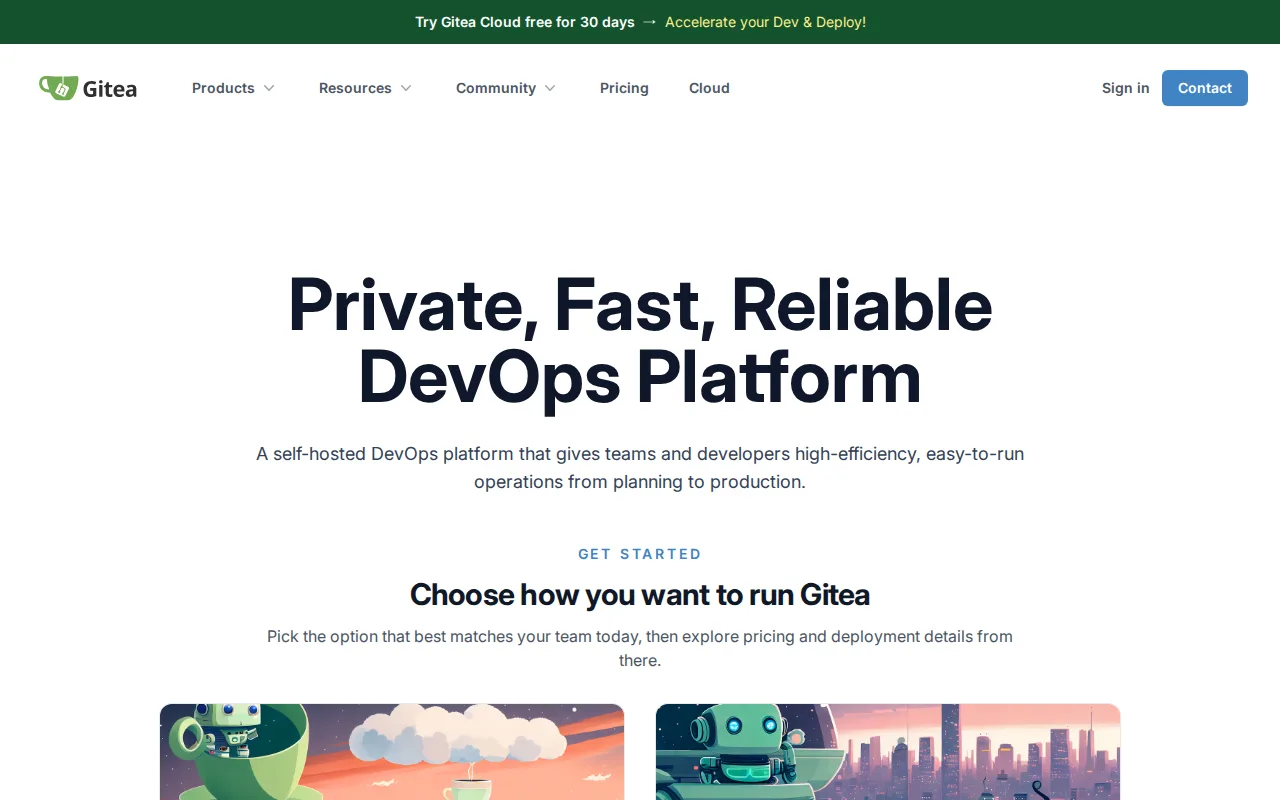
Gitea is the best SourceHut alternative for teams that want to self-host a lightweight Git forge with CI/CD included for free, rather than paying SourceHut's $4+/month rate for builds.sr.ht. Gitea's open-source edition is MIT-licensed and free with unlimited users and repositories, and Gitea Actions (CI/CD) is included in that free self-hosted tier, unlike SourceHut where builds.sr.ht requires a paid subscription with no free tier at all. Gitea is written in Go and runs comfortably on small VPS instances or Raspberry Pi-class hardware, and supports 20+ package registry formats (npm, PyPI, Maven, Cargo) built in, broader package management than SourceHut's minimal service set offers. Gitea holds a 5/5 rating from 9 Product Hunt reviews, more independent review evidence than SourceHut has recorded. SourceHut is still the better choice for developers who specifically want email-based patch review over a pull-request UI, or a platform with zero commercial upsell path: Gitea Enterprise requires a mandatory 1-year commitment for SSO and audit logs, and Gitea Cloud's subscription price isn't published anywhere on the site, a transparency gap SourceHut's flat, published $4/$8/$12 tiers avoid.
Compared to SourceHut: free self-hosted CI/CD (Gitea Actions) included at no cost vs SourceHut's paid-only builds.sr.ht, 20+ package registry formats built in, lightweight enough to run on a Raspberry Pi
Wins:Open-source edition is free with unlimited users, repositories, and Gitea Actions CI/CD; SourceHut's builds.sr.ht CI requires a paid $4+/month subscription · Supports 20+ package registry formats (npm, PyPI, Maven, Cargo) built in, broader than SourceHut's service set · 5/5 rating from 9 Product Hunt reviews, versus no external ratings recorded for SourceHut
Loses:No email-based patch review workflow; Gitea uses a standard pull-request model instead of SourceHut's mailing-list system · Gitea Enterprise requires a mandatory 1-year online-paid commitment, unlike SourceHut's flexible monthly self-selected tiers · Gitea Cloud's subscription price isn't published on the site, unlike SourceHut's transparent $4/$8/$12 pricing
Pros
- Open-source core is free with unlimited users and repositories, no artificial caps.
- Lightweight Go binary runs comfortably on small servers, unlike heavier self-hosted alternatives.
- Gitea Actions is compatible with existing GitHub Actions workflow syntax, easing migration.
- Supports 20+ package registry formats (npm, PyPI, Maven, Cargo, and more) built in.
Cons
- Gitea Enterprise requires a 1-year commitment with online payment rather than flexible monthly billing.
- Gitea Cloud pricing is not published on the site; the number is only revealed after starting the signup flow.
- Smaller third-party integration and marketplace ecosystem than GitHub or GitLab.
- Self-hosted deployments still require the team to manage updates, backups, and uptime themselves on the free tier.
Pricing: Free tier · paid from $9.50/mo — Free (self-hosted, unlimited users) or $9.50/user/month Enterprise vs SourceHut's $4-$12/month self-selected tiers (verified undefined NaN, NaN)
5.Bitbucket — best SourceHut alternative for teams already standardized on Jira and Confluence who want Git hosting and CI/CD that links natively to issue tracking without a separate integration
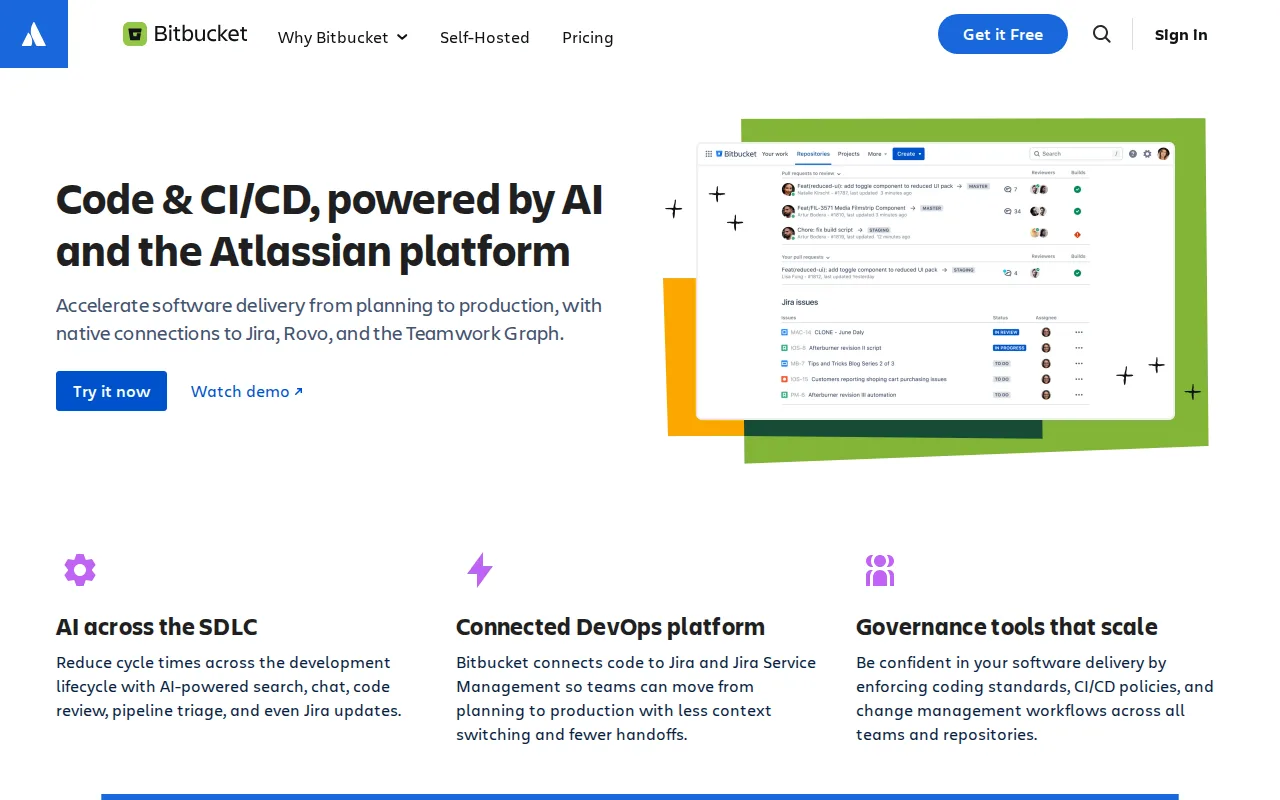
Bitbucket is the best SourceHut alternative for teams already using Jira for issue tracking and Confluence for documentation who want commits and branches to link natively to Jira issues, a workflow SourceHut's todo.sr.ht ticket tracker doesn't replicate. Bitbucket's Free plan covers up to 5 users with 1GB Git LFS storage and 50 Pipelines CI/CD minutes/month at $0, and Standard then costs $3.65/user/month, cheaper than SourceHut's $4/month entry tier. Bitbucket's built-in Pipelines CI/CD runs without a separate tool, unlike SourceHut's builds.sr.ht, which requires its own paid subscription on top of hosting. Bitbucket holds a 4.6/5 rating from 1,347 Capterra reviews, versus no external ratings recorded for SourceHut. SourceHut is still the better choice for developers who want a fully open-source, self-hostable platform: Atlassian retired Bitbucket Server/Data Center in 2024, so Bitbucket has no self-hosted option at any price, while SourceHut remains AGPL/BSD-licensed and self-hostable from source, and Bitbucket's third-party integration marketplace is far smaller than SourceHut's core Unix-philosophy design assumes developers will build around it themselves.
Compared to SourceHut: free tier for up to 5 users with built-in Pipelines CI/CD at $0, cheaper Standard tier ($3.65/user/month vs SourceHut's $4/month entry tier), native bidirectional linking to Jira issues and smart commits
Wins:Free tier covers up to 5 users with 1GB LFS storage and 50 Pipelines CI/CD minutes/month at $0; SourceHut's CI (builds.sr.ht) requires a paid subscription with no free tier · Standard tier costs $3.65/user/month, cheaper than SourceHut's $4/month entry-level tier · 4.6/5 rating from 1,347 Capterra reviews, versus no external ratings recorded for SourceHut
Loses:No self-hosted option since Atlassian retired Bitbucket Server/Data Center in 2024, unlike SourceHut which is self-hostable from source under AGPL/BSD · Closed-source, cloud-only platform, unlike SourceHut's fully open-source codebase · Third-party integration marketplace is much smaller than GitHub's and doesn't match SourceHut's Unix-philosophy composability
Pros
- Native Jira and Confluence integration links commits and branches directly to issues without extra configuration.
- Built-in Pipelines CI/CD runs without needing a separate tool like CircleCI or GitHub Actions.
- Free plan covers up to 5 users with unlimited private repositories, useful for small teams.
- Community and academic organizations get free plans with expanded storage and build minutes.
Cons
- No self-hosted edition since Bitbucket Server/Data Center was discontinued in 2024; every plan is cloud-only.
- Free tier caps out at 5 users, smaller than GitHub's free-tier user allowance.
- Third-party integration marketplace is much smaller than GitHub's, reducing value for teams outside the Atlassian suite.
- Extra Pipelines build minutes or LFS storage cost $10/month per add-on block rather than being bundled into higher tiers.
Pricing: Free tier · paid from $3.65/mo — $3.65/user/month Standard (free up to 5 users) vs SourceHut's $4/month self-selected entry tier (verified undefined NaN, NaN)