5 Best Alternatives to Shopify in 2026
By Noahlast updated pricing verified

From our data: 2 of the 5 alternatives listed here (WooCommerce, Wix) have a $0 starting price, and the median starting price across the four alternatives with a published number (WooCommerce $0, BigCommerce $29, Wix $0, Squarespace $16; Adobe Commerce publishes no pricing at all) is $8/month, well under Shopify's $39/month Basic plan.
 WooCommerce
 Wix
Wix BigCommerce
 Adobe Commerce (Magento)
How we picked
- Pricing verification dates were weighted: WooCommerce, BigCommerce, and Shopify itself all carry verified pricing timestamps from live vendor pages, while Wix's and Squarespace's tiers were not independently reverified.
- External review-platform ratings were compared directly: WooCommerce (4.5/5 from 1,047 Capterra reviews) matches Shopify's own 4.5/5 from 6,707 reviews, while Squarespace (4.6/5 from 3,417 reviews) edges slightly above it.
- Zero-platform-fee licensing was treated as a distinct signal from subscription price: WooCommerce's core plugin carries no revenue share at all, a structural difference from Shopify's and BigCommerce's percentage-based fee models on non-approved payment processors.
- Adobe Commerce's lack of published pricing (every deployment requires a custom sales quote) was noted explicitly rather than estimated, since inventing a dollar figure would violate the no-fabrication rule for a product whose site quotes no numbers.
Paid placement never alters editorial rank — read the full methodology.
Shopify alternatives at a glance
| Alternative | Best for | Standout | Biggest weakness | Learning curve | Price |
|---|---|---|---|---|---|
| Shopifyreference | solo entrepreneurs and growing merchants who want an all-in-one hosted platform for building an online store, accepting payments, and selling across multiple channels without managing their own hosting | A fully hosted, all-in-one platform combining storefront builder, high-converting checkout (Shop Pay), inventory, and multichannel selling (social, marketplaces, in-person POS), backed by a 21,000+ app ecosystem. | Card processing rates and third-party app costs stack on top of the base subscription, and reviewers say total cost climbs quickly once apps, themes, and higher-tier shipping discounts are added; using a payment processor other than Shopify Payments also adds extra transaction fees on top of the plan price. | Moderate | From $39/mo |
| WooCommerce | merchants and developers who want full control of their online store's code, data, and payment processor without paying a platform revenue share, and who are comfortable managing WordPress hosting | Zero platform fees or revenue share on the core plugin — unlike Shopify or BigCommerce, WooCommerce doesn't take a cut of sales, and every payment gateway is allowed rather than one default processor. | The "free" plugin's true cost is diffuse and easy to underestimate: hosting, a payment processor, security/backups, and the premium extensions most real stores need (advanced shipping, subscriptions, specific gateways) are all separate purchases from separate vendors, so total monthly cost can land close to or above Shopify's all-in-one pricing once a store scales. | Steep | Free |
| BigCommerce | mid-market and enterprise merchants who want headless API access and payment-processor choice built into every tier instead of paying per-app to unlock them | Open SaaS architecture bundles headless commerce APIs, multi-currency checkout, and payment-processor choice into every plan, and waives its platform fee entirely when merchants use an approved payment partner. | Plans are capped by trailing-twelve-month GMV and auto-upgrade as a store grows, and routing payments through a non-approved processor adds a 2.0% (Core) to 0.6% (Scale) fee on top of the processor's own rate. | Moderate | From $29/mo |
| Wix | small businesses and freelancers who want an AI-assisted site builder with a genuinely free published-site option before committing to a paid plan | The Wix App Market, a marketplace of first- and third-party apps (booking, forms, chat, marketing tools) that extends the core site editor without custom code, paired with an AI-assisted site generator. | Templates cannot be changed after a site is published without rebuilding it from scratch, and the jump from Business ($39/month) to Business Elite ($159/month) is steep for stores that need just one advanced feature; the free plan keeps Wix branding and ads on the published site. | Low | Free tier · paid from $17/mo |
| Squarespace | small businesses and creative freelancers who want a designed-looking marketing site or online store without a developer, and don't need pixel-level control over every layout | Fluid Engine, an editor that lets users place content freely on a responsive grid while Squarespace automatically reflows the layout for every screen size. | No permanently free plan and no way to switch templates on an existing site without rebuilding the layout; Core-tier e-commerce still carries a 3% transaction fee on top of payment processing, and advanced customization requires learning Squarespace's own CSS/JS injection system rather than standard tooling. | Low | From $16/mo |
| Adobe Commerce (Magento) | large B2B and B2C retailers running multi-brand or multi-region storefronts who need custom catalogs, negotiated pricing, and dedicated infrastructure | Combines B2B and B2C selling in a single platform, with custom catalogs, account hierarchies, and negotiated pricing for wholesale buyers alongside a standard retail storefront. | No published pricing anywhere on Adobe's site; every deal requires a sales quote, and Capterra reviewers report slow project launches, high development and agency costs, and heavy reliance on specialized Magento developers, especially for teams without in-house commerce expertise. | Steep | Custom pricing |
 Shopify
 Squarespace
1.WooCommerce — best Shopify alternative for merchants and developers who want full control of their online store's code, data, and payment processor without paying a platform revenue share, and who are comfortable managing WordPress hosting
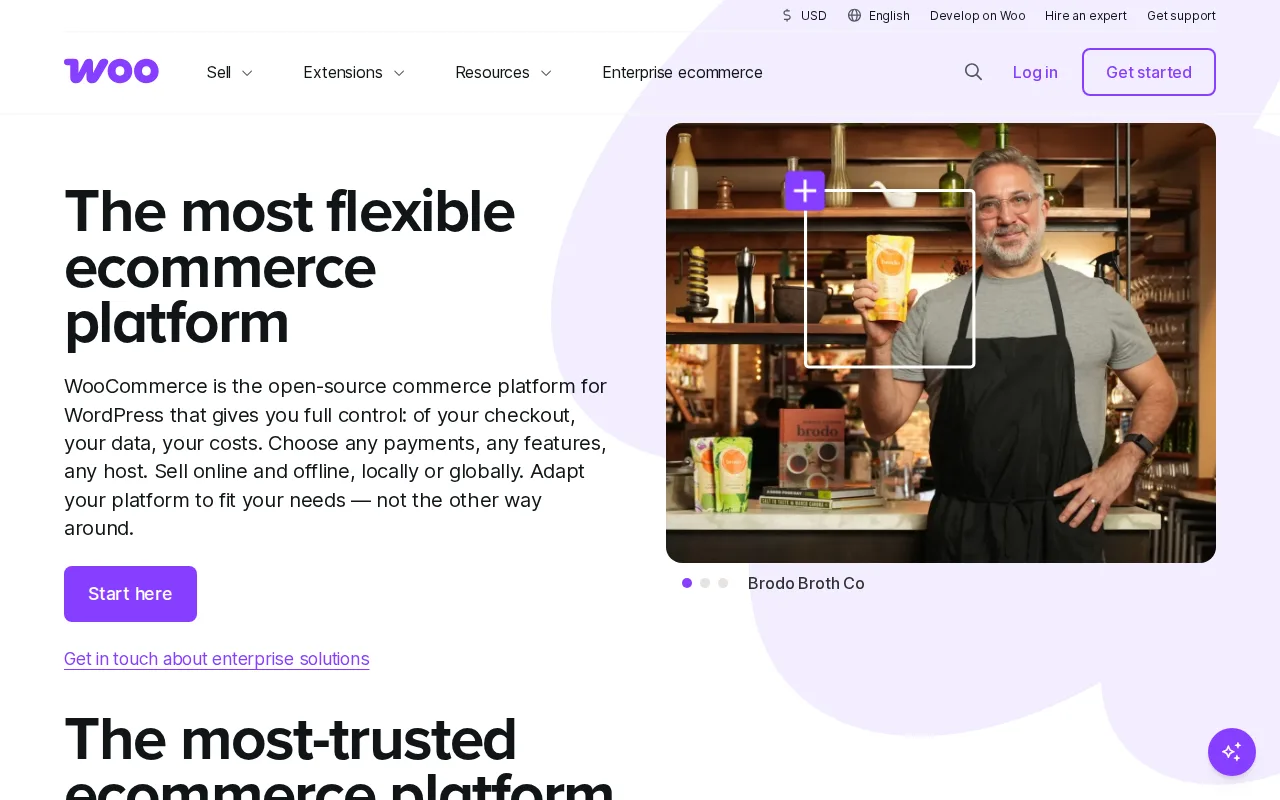
WooCommerce is the best Shopify alternative for merchants and developers who want full control of their store's code, data, and payment processor without paying a platform revenue share. WooCommerce's core plugin is free forever with unlimited products, orders, and API access and 0% platform fee, a direct contrast with Shopify, whose Basic plan costs $39/month and which charges extra transaction fees for any payment processor other than Shopify Payments. WooCommerce is open source (GPL) with source on GitHub (10,500+ stars) and native iOS/Android apps for store management, and it holds a 4.5/5 rating from 1,047 Capterra reviews, matching Shopify's own 4.5/5 from 6,707 reviews. Shopify is still the better choice for merchants who want predictable, all-in-one pricing without managing separate vendors: WooCommerce's true cost is spread across separate hosting ($25-350/month), a payment processor (roughly 2.5-2.9% + 30 cents per transaction via WooPayments), and premium extensions ($29-299/year each), which can land close to or above Shopify's bundled pricing once a store scales, and running WordPress requires more technical setup than Shopify's fully hosted platform.
Compared to Shopify: 0% platform fee and no revenue share on the core plugin, full data ownership and free choice of payment gateway, comparable Capterra rating (4.5/5 vs 4.5/5) from a smaller but substantial review base
Wins:Core plugin is free forever with unlimited products, orders, and API access and no platform fee, unlike Shopify's $39/month Basic plan plus non-Shopify-Payments transaction fees · Full data ownership and free choice of payment gateway since the store is self-hosted · Open source (GPL) with an active GitHub community (10,500+ stars), unlike Shopify's closed-source platform
Loses:Total cost is spread across separate hosting ($25-350/month), payment processing, and extension purchases, harder to budget upfront than Shopify's bundled pricing · Requires managing WordPress itself (updates, security, backups) unless paying for managed hosting · Steeper setup and maintenance learning curve than Shopify's fully hosted platform, especially for non-technical merchants
Pros
- No platform fee or revenue share on sales, unlike Shopify's percentage-based plans.
- Full data ownership and free choice of payment gateway since the store is self-hosted.
- Open-source (GPL) with a large plugin/theme ecosystem and an active GitHub community (10,500+ stars).
- Unlimited products, orders, and API calls with no plan-based caps.
Cons
- Total cost is spread across separate hosting, payment processing, and extension purchases, making it harder to budget upfront than an all-in-one platform.
- Requires managing WordPress itself (updates, security, backups) unless paying for managed hosting.
- Steeper setup and maintenance learning curve than hosted platforms like Shopify, especially for non-technical merchants.
Pricing: Free — $0/month core plugin (plus separate hosting and processing costs) vs Shopify's $39/month Basic (verified undefined NaN, NaN)
2.BigCommerce — best Shopify alternative for mid-market and enterprise merchants who want headless API access and payment-processor choice built into every tier instead of paying per-app to unlock them
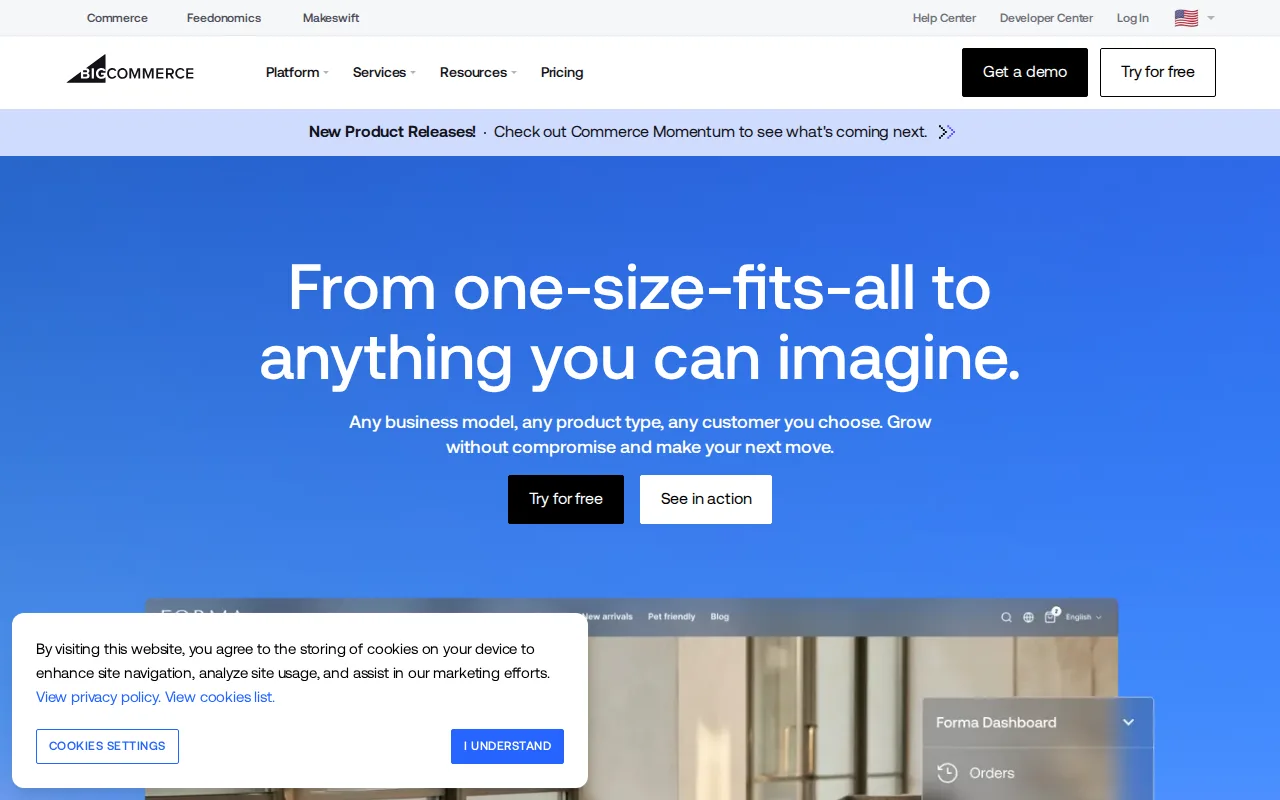
BigCommerce is the best Shopify alternative for mid-market and enterprise merchants who want headless API access, multi-currency checkout, and payment-processor choice included at every tier instead of paying per-app to unlock them. BigCommerce's Core plan starts at $29/month billed annually, cheaper than Shopify's $39/month (or $29/month annual) Basic plan at the same price point, and BigCommerce waives its platform fee entirely when merchants use an approved payment partner, unlike Shopify's added fees for non-Shopify Payments processors. BigCommerce's plans auto-upgrade based on trailing-twelve-month sales rather than requiring a manual plan change, and it holds a 4.4/5 rating from 340 Capterra reviews. Shopify is still the better choice for merchants who want the largest app and theme ecosystem: BigCommerce's third-party app and theme marketplace is smaller than Shopify's 21,000+ app store, and BigCommerce's Scale plan adds a 0.9% overage fee on GMV above $33,333/month even for merchants using approved payment partners, a cap Shopify's flat per-tier pricing doesn't impose.
Compared to Shopify: headless commerce APIs, multi-currency checkout, and payment-processor choice included at every tier, platform fee waived entirely with an approved payment partner, plans auto-upgrade by sales volume instead of a manual switch
Wins:Headless commerce APIs, multi-currency support, and single-page checkout are included at every tier rather than sold as separate apps · Platform fee is waived entirely when merchants use an approved payment partner, avoiding Shopify's extra fee for non-Shopify Payments processors · Core plan costs $29/month billed annually vs Shopify's $39/month standard Basic rate
Loses:Smaller third-party app and theme ecosystem than Shopify's 21,000+ app store · Plans are capped by trailing-twelve-month GMV and auto-upgrade as a store grows, regardless of feature need · Scale plan adds a 0.9% overage fee on GMV above $33,333/month even for approved payment partners
Pros
- Headless commerce APIs, multi-currency support, and single-page checkout are included at every tier rather than sold as separate apps.
- Payment-processor choice avoids the extra fee Shopify charges for using a non-Shopify Payments processor.
- Built-in Feedonomics integration pushes listings to Amazon, eBay, Walmart, Google, Meta, and TikTok from one dashboard.
- No long-term contract required on Core, Growth, or Scale; cancel month-to-month.
Cons
- GMV-based tier ceilings force automatic upgrades as sales grow, regardless of how many features a merchant actually needs.
- Scale plan adds a 0.9% overage fee on GMV above $33,333/month even for merchants who stay on approved payment partners.
- Smaller third-party app and theme ecosystem than Shopify's marketplace.
- Performance-tier custom pricing requires a sales conversation rather than transparent self-service checkout.
Pricing: From $29/mo — $29/month Core (billed annually) vs Shopify's $39/month Basic (or $29/month billed annually) (verified undefined NaN, NaN)
3.Wix — best Shopify alternative for small businesses and freelancers who want an AI-assisted site builder with a genuinely free published-site option before committing to a paid plan

Wix is the best Shopify alternative for small businesses and freelancers who want a genuinely free published site with an AI-assisted builder before committing to e-commerce spending. Wix's Free plan publishes a live site on a Wix subdomain, something Shopify doesn't offer at all since it has no permanent free tier, only a 3-day trial followed by $1/month for 3 months. Wix's Business tier with full Wix Stores e-commerce costs $39/month billed annually, close to Shopify's $39/month Basic plan, and the Wix App Market extends functionality without custom code for booking, forms, and marketing tools. Wix holds a 4.4/5 rating from 10,760 Capterra reviews. Shopify is still the better choice for merchants who are serious about scaling e-commerce specifically: Wix templates cannot be changed after a site is published without rebuilding it from scratch, the free plan carries Wix branding and ads rather than a clean storefront, and Wix's checkout and multichannel selling tools are less purpose-built for commerce at scale than Shopify's dedicated Shop Pay checkout and 21,000+ app ecosystem.
Compared to Shopify: genuinely free published site vs no free tier at all, comparable e-commerce tier pricing ($39/month Business vs $39/month Basic), AI-assisted site generator for fast first drafts
Wins:Free plan publishes a live site, not just a builder trial, unlike Shopify's lack of any permanent free tier · AI-assisted site generator (ADI) creates a starter site from a short questionnaire · Drag-and-drop editor allows freeform element placement, more flexible than fixed-section builders
Loses:Templates cannot be swapped after a site is published without rebuilding the entire layout, unlike Shopify's theme-switching flexibility · Checkout and multichannel selling tools are less purpose-built for commerce at scale than Shopify's dedicated Shop Pay and app ecosystem · Free-plan sites carry Wix branding and ads and publish on a wix.com subdomain, not a custom domain
Pros
- Genuinely free plan publishes a live site, not just a builder trial, though with Wix branding and ads.
- Drag-and-drop editor allows freeform element placement, more flexible than fixed-section builders.
- AI-assisted site generator (ADI) creates a starter site from a short questionnaire, useful for fast first drafts.
- Wix App Market extends functionality without custom code for booking, forms, chat, and marketing.
Cons
- Templates cannot be swapped after a site is published without rebuilding the entire layout.
- Free-plan sites carry Wix branding and ads and publish on a wix.com subdomain, not a custom domain.
- Business Elite jumps to $159/month billed annually, a steep increase from Business at $39/month for stores that need just one advanced feature.
- Site performance and page speed lag behind custom-built or more code-flexible platforms as site complexity grows.
Pricing: Free tier · paid from $17/mo — $0/month Free (or $39/month Business for full e-commerce) vs Shopify's $39/month Basic
4.Squarespace — best Shopify alternative for small businesses and creative freelancers who want a designed-looking marketing site or online store without a developer, and don't need pixel-level control over every layout

Squarespace is the best Shopify alternative for small businesses and creative freelancers who want a designed-looking marketing site or store without hiring a developer. Squarespace's Basic plan starts at $16/month billed annually, cheaper than Shopify's $39/month Basic tier, and template and design quality is consistently rated above most drag-and-drop competitors; Fluid Engine lets users place content freely on a responsive grid while Squarespace automatically reflows the layout for every screen size. Squarespace holds a 4.6/5 rating from 3,417 Capterra reviews, above Shopify's own 4.5/5 from 6,707 reviews, and its Plus and Advanced tiers remove e-commerce transaction fees entirely. Shopify is still the better choice for merchants who need multichannel selling and a large app ecosystem to extend functionality: Squarespace's Core-tier e-commerce still carries a 3% transaction fee on top of payment processing, its app marketplace is far smaller than Shopify's 21,000+ apps, and there's no permanently free Squarespace plan at all, only a 14-day trial.
Compared to Shopify: cheaper entry tier ($16/month Basic vs $39/month), higher Capterra rating (4.6/5 vs 4.5/5), Fluid Engine's auto-reflowing responsive layout vs Shopify's fixed theme sections
Wins:Basic plan costs $16/month billed annually, well under Shopify's $39/month Basic plan · 4.6/5 rating from 3,417 Capterra reviews, above Shopify's 4.5/5 from 6,707 reviews · Fluid Engine lets users place content freely on a responsive grid that auto-adapts across screen sizes
Loses:Core-tier e-commerce still carries a 3% transaction fee on top of payment processing · Much smaller third-party app ecosystem than Shopify's 21,000+ app store · No permanently free plan; every plan starts as a 14-day trial that converts to paid billing
Pros
- Template and design quality is consistently rated above most drag-and-drop competitors.
- E-commerce, email campaigns, and scheduling are built into the same subscription, no separate app needed for most small stores.
- Fluid Engine gives more direct layout control than fixed-section builders while still auto-adapting to mobile.
- Squarespace Payments processing fees drop as customers move up tiers, with 0% Squarespace transaction fees on Plus and Advanced.
Cons
- No free tier; every plan starts as a 14-day trial that requires a credit card-free signup but converts to paid billing.
- Templates can't be swapped after a site is built without substantial rework.
- Basic and Core tiers lack phone support, and Core still charges a 3% transaction fee on e-commerce sales.
- Monthly (non-annual) billing costs meaningfully more per month than the advertised annual rates.
Pricing: From $16/mo — $16/month Basic vs Shopify's $39/month Basic
5.Adobe Commerce (Magento) — best Shopify alternative for large B2B and B2C retailers running multi-brand or multi-region storefronts who need custom catalogs, negotiated pricing, and dedicated infrastructure
Adobe Commerce is the best Shopify alternative for large B2B and B2C retailers running multi-brand or multi-region storefronts that need custom catalogs and negotiated wholesale pricing, capabilities beyond Shopify's Plus tier's standard feature set. Adobe Commerce combines B2B and B2C selling in a single platform, including custom catalogs and account hierarchies for wholesale buyers, and ships in both a multi-tenant SaaS model and a single-tenant PaaS deployment for dedicated infrastructure, offering more deployment flexibility than Shopify's single hosted model. Adobe Commerce holds a 4.3/5 rating from 661 Capterra reviews, and a related free, self-hosted Magento Open Source edition exists for teams that want the core codebase without Adobe's managed infrastructure. Shopify is by far the better choice for the vast majority of merchants, especially smaller ones: Adobe Commerce publishes no pricing at all, with every deployment requiring a custom sales quote, unlike Shopify's transparent $39-$2,300+/month tier list, and Capterra reviewers report slow project launches and high development costs that typically require specialized Magento developers or an agency, a much steeper implementation path than Shopify's quick-launch, no-code storefront.
Compared to Shopify: combines B2B and B2C selling with custom catalogs and account hierarchies, deployment flexibility between multi-tenant SaaS and single-tenant PaaS, a free self-hosted Magento Open Source edition exists
Wins:Handles B2B and B2C selling models in one platform, including custom catalogs and negotiated pricing for wholesale accounts, beyond Shopify Plus's standard feature set · Deployment flexibility between multi-tenant SaaS and single-tenant PaaS for dedicated infrastructure needs · A free, self-hosted Magento Open Source edition exists for teams that want the core codebase without ongoing platform fees
Loses:No published pricing anywhere; every deployment requires a custom sales quote, unlike Shopify's transparent $39-$2,300+/month tiers · Capterra reviewers report expensive, slow implementations that typically require specialized developers or an agency · Steep learning curve and heavy IT dependency make it a poor fit for merchants without dedicated technical staff, unlike Shopify's quick-launch model
Pros
- Handles B2B and B2C selling models in one platform, including custom catalogs and negotiated pricing for wholesale accounts.
- Large ecosystem of Magento developers, agencies, extensions, and themes built up over more than a decade.
- Scales to high order volumes with multi-site and multi-brand storefront support.
- Deployment flexibility between multi-tenant SaaS and single-tenant PaaS depending on infrastructure needs.
Cons
- No published pricing; every deployment requires a custom sales quote from Adobe.
- Reviewers report expensive, slow implementations that typically require specialized developers or an agency.
- Resource-intensive platform that can suffer performance and SEO issues without ongoing optimization work.
- Steep learning curve and heavy IT dependency make it a poor fit for businesses without dedicated technical staff.
Pricing: Custom pricing
Which one is right for you?
- You want full control of your store's code and payment processor with zero platform feesWooCommerce
- You need headless commerce APIs and payment-processor choice included at every plan tierBigCommerce
- You want a genuinely free published website before committing to e-commerce spendingWix
- You want the most designer-quality templates for a marketing site or small storeSquarespace
- You're a large B2B and B2C enterprise that needs custom catalogs and negotiated wholesale pricingAdobe Commerce (Magento)
- You want to avoid extra transaction fees when using a payment processor other than the platform's ownBigCommerce
Frequently asked questions
Is there a free alternative to Shopify?
- Not entirely for full e-commerce, but Wix's Free plan publishes a live site at no cost, and WooCommerce's core plugin is free forever with 0% platform fee, though hosting and payment processing still cost money separately, unlike Shopify's fully bundled subscription.
What is the closest alternative to Shopify?
- BigCommerce is the closest structural match: it's a fully hosted platform with tiered plans similar to Shopify's, but it includes headless APIs and payment-processor choice at every tier and waives its platform fee with an approved processor.
Can WooCommerce replace Shopify?
- Yes for merchants and developers comfortable managing WordPress hosting, since WooCommerce's core plugin has no platform fee and gives full data ownership. Merchants who want predictable, all-in-one pricing without managing separate hosting and extension vendors should stay on Shopify.
Which Shopify alternative is cheapest to start with?
- Squarespace's Basic plan starts at $16/month billed annually, and Wix's Free plan publishes a live site at no cost, both cheaper than Shopify's $39/month Basic tier, though neither includes Shopify's full multichannel selling and app ecosystem out of the box.
Is there an open-source alternative to Shopify?
- Yes — WooCommerce is a free, open-source (GPL) WordPress plugin with source published on GitHub, and Adobe Commerce has a related free, self-hosted Magento Open Source edition for larger technical teams.
Which Shopify alternative is best for large B2B and B2C enterprises?
- Adobe Commerce (Magento), which combines B2B and B2C selling with custom catalogs and negotiated wholesale pricing in one platform, though it requires a custom sales quote since no pricing is published.