4 Best Alternatives to Adobe Commerce (Magento) in 2026
By Noahlast updated
From our data: Three of the four alternatives compared to Adobe Commerce (Magento) publish a concrete starting price — Salesforce at $25/user/month, BigCommerce at $29/month, and Shopify at $39/month, a median of $29/month — while commercetools shares Adobe Commerce's own quote-only, no-published-price model; on reviews, Salesforce's 18,803 Capterra reviews are more than 28 times Adobe Commerce's own 661.
 Shopify
 BigCommerce
 Salesforce
 commercetools
How we picked
- All four alternatives carry verified pricing and Capterra review data captured on 2026-08-21, while Adobe Commerce itself publishes no pricing at all — every deployment requires a custom sales quote — so the price comparisons here weigh a known Adobe Commerce weakness (opacity) against each alternative's own published or partially published numbers.
- Review volume varies by more than three orders of magnitude: Salesforce's 18,803 Capterra reviews and Shopify's 6,707 dwarf commercetools' 17, while Adobe Commerce itself sits in between at 661 reviews (4.3/5), giving a real basis for comparing evidence depth rather than just star ratings.
- Three of the four alternatives — Shopify, BigCommerce, and Salesforce — publish a concrete starting price ($39, $29, and $25 respectively); commercetools, like Adobe Commerce itself, has no published starting price and is quote-based, so that pairing is compared on architecture and scale rather than dollar figures.
- Learning curve is recorded for all four alternatives and for Adobe Commerce itself (steep for Adobe Commerce, commercetools, and Salesforce; moderate for Shopify and BigCommerce), a real signal used directly in the differences below rather than an inferred claim.
Paid placement never alters editorial rank — read the full methodology.
Adobe Commerce (Magento) alternatives at a glance
| Alternative | Best for | Standout | Biggest weakness | Learning curve | Price |
|---|---|---|---|---|---|
| Adobe Commerce (Magento)reference | large B2B and B2C retailers running multi-brand or multi-region storefronts who need custom catalogs, negotiated pricing, and dedicated infrastructure | Combines B2B and B2C selling in a single platform, with custom catalogs, account hierarchies, and negotiated pricing for wholesale buyers alongside a standard retail storefront. | No published pricing anywhere on Adobe's site; every deal requires a sales quote, and Capterra reviewers report slow project launches, high development and agency costs, and heavy reliance on specialized Magento developers, especially for teams without in-house commerce expertise. | Steep | Custom pricing |
| Shopify | solo entrepreneurs and growing merchants who want an all-in-one hosted platform for building an online store, accepting payments, and selling across multiple channels without managing their own hosting | A fully hosted, all-in-one platform combining storefront builder, high-converting checkout (Shop Pay), inventory, and multichannel selling (social, marketplaces, in-person POS), backed by a 21,000+ app ecosystem. | Card processing rates and third-party app costs stack on top of the base subscription, and reviewers say total cost climbs quickly once apps, themes, and higher-tier shipping discounts are added; using a payment processor other than Shopify Payments also adds extra transaction fees on top of the plan price. | Moderate | From $39/mo |
| BigCommerce | mid-market and enterprise merchants who want headless API access and payment-processor choice built into every tier instead of paying per-app to unlock them | Open SaaS architecture bundles headless commerce APIs, multi-currency checkout, and payment-processor choice into every plan, and waives its platform fee entirely when merchants use an approved payment partner. | Plans are capped by trailing-twelve-month GMV and auto-upgrade as a store grows, and routing payments through a non-approved processor adds a 2.0% (Core) to 0.6% (Scale) fee on top of the processor's own rate. | Moderate | From $29/mo |
| commercetools | large enterprise retailers running unified B2C and B2B commerce across web, mobile, in-store, and AI shopping channels who need a fully custom frontend | MosAIc and AI Hub extend the commerce API layer to agent-driven shopping channels like ChatGPT, Gemini, and Copilot, alongside traditional headless storefront and POS integration | No public pricing at all — every deployment requires a sales conversation and typically a systems integrator, which makes commercetools impractical for small or mid-market merchants who want to evaluate cost before committing engineering time. | Steep | Custom pricing |
| Salesforce | mid-market to enterprise sales teams that need a highly customizable CRM with pipeline management, forecasting, and AI-driven automation, and can dedicate admin resources to configuring it | Deep customization of objects, workflows, and reporting combined with Agentforce AI automation and the largest CRM integration ecosystem (Slack, Tableau, thousands of AppExchange apps). | Pricing climbs steeply across tiers, from $25/user/month at Starter Suite to $550/user/month for the fully AI-enabled Agentforce 1 plan, and Pro Suite and above require annual billing commitments; reviewers consistently describe onboarding and admin training as extensive and time-consuming, and the platform's customization depth often requires a dedicated Salesforce admin to maintain properly. | Steep | From $25/mo |
 Adobe Commerce (Magento)
1.Shopify — best Adobe Commerce (Magento) alternative for solo entrepreneurs and growing merchants who want an all-in-one hosted platform for building an online store, accepting payments, and selling across multiple channels without managing their own hosting

Shopify is the best Adobe Commerce (Magento) alternative for solo entrepreneurs and growing merchants who want an all-in-one hosted platform without a custom sales quote. Shopify publishes its pricing plainly, starting at $39/month ($29/month billed annually) for the Basic plan, in direct contrast to Adobe Commerce, which has no published pricing anywhere and requires every deployment to go through a sales conversation. Shopify holds a 4.5/5 rating from 6,707 Capterra reviews, more than ten times Adobe Commerce's 661 reviews (4.3/5), and its 21,000+ app ecosystem lets merchants extend the store without hiring specialized developers, unlike Adobe Commerce, where Capterra reviewers report expensive, slow implementations that typically require an agency. Shopify's learning curve is rated moderate versus Adobe Commerce's steep rating. Adobe Commerce remains the better choice for large B2B and B2C retailers running multi-brand or multi-region storefronts that need custom catalogs, negotiated wholesale pricing, and dedicated infrastructure: Shopify's B2B catalog and negotiated-pricing tools are concentrated in its $2,300/month Plus tier, while Adobe Commerce builds account hierarchies and negotiated pricing into its core platform for exactly that use case, and Shopify's Liquid templating language has its own learning curve for deep storefront customization.
Compared to Adobe Commerce (Magento): publishes pricing plainly from $39/month vs Adobe Commerce's quote-only model, 4.5/5 from 6,707 Capterra reviews vs 661, moderate learning curve vs Adobe Commerce's steep curve
Wins:Publishes pricing plainly starting at $39/month ($29/month billed annually), unlike Adobe Commerce's quote-only, no-published-price model · 4.5/5 rating from 6,707 Capterra reviews, more than ten times Adobe Commerce's 661 · 21,000+ app ecosystem and a moderate learning curve let merchants extend the store without hiring specialized developers, unlike Adobe Commerce's reviewer-reported reliance on agencies
Loses:B2B catalogs and negotiated wholesale pricing are concentrated in the $2,300/month Plus tier, while Adobe Commerce builds account hierarchies and negotiated pricing into its core platform · Third-party apps and non-Shopify Payments transaction fees stack on top of the base subscription · Deep storefront customization requires learning Shopify's proprietary Liquid templating language
Pros
- Quick to launch an online store without managing hosting or server infrastructure.
- Reliable, high-converting built-in checkout (Shop Pay) and payment processing.
- Large app ecosystem (21,000+ apps) for extending functionality without custom development.
- Multichannel selling built in across social platforms, marketplaces, and in-person POS.
Cons
- Third-party apps and premium themes add up quickly beyond the base subscription price.
- Non-Shopify Payments processors incur extra transaction fees on every plan.
- Customizing beyond templates requires learning Shopify's proprietary Liquid templating language.
- Plus tier jumps to $2,300+/month, a large gap from Advanced's $399/month.
Pricing: From $39/mo — $39/month ($29/month billed annually), starting price published plainly, vs Adobe Commerce's quote-only pricing with no published starting figure (verified undefined NaN, NaN)
2.BigCommerce — best Adobe Commerce (Magento) alternative for mid-market and enterprise merchants who want headless API access and payment-processor choice built into every tier instead of paying per-app to unlock them
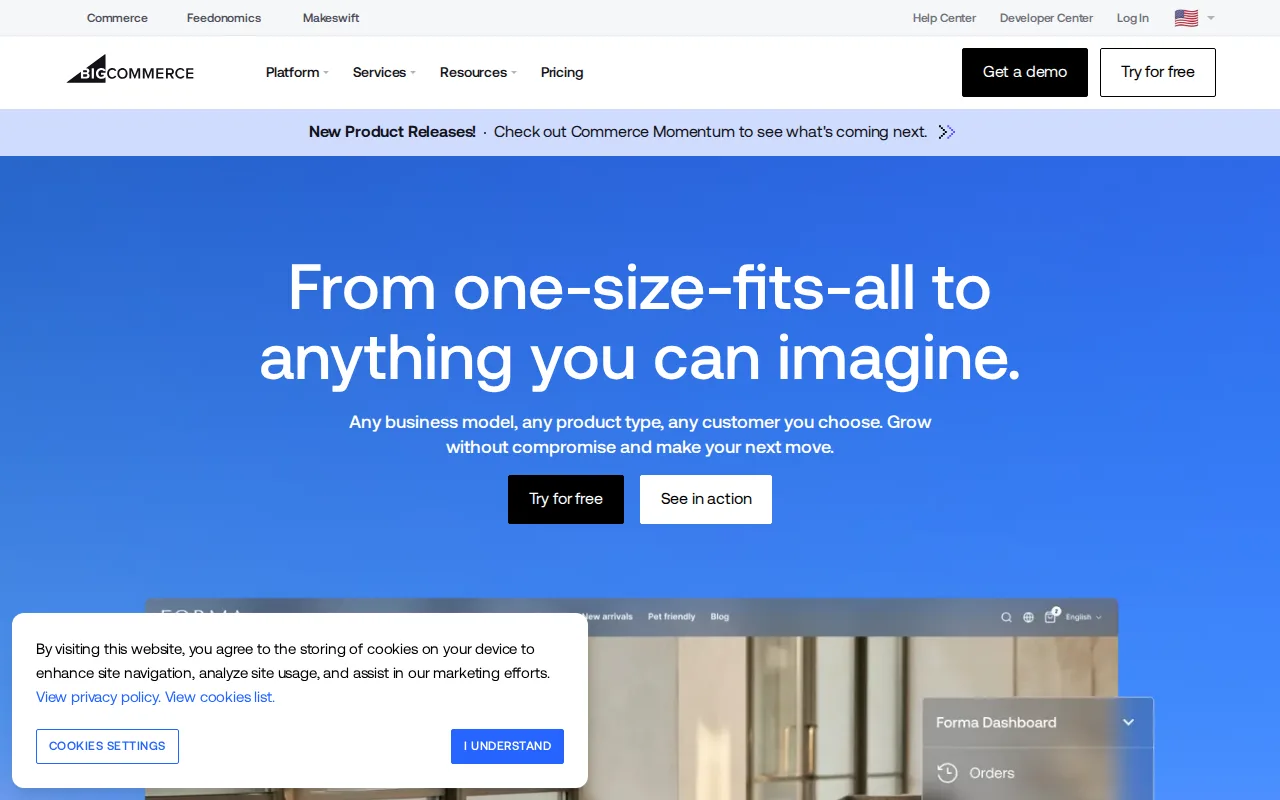
BigCommerce is the best Adobe Commerce (Magento) alternative for mid-market and enterprise merchants who want headless API access without paying custom-quote enterprise pricing to get it. BigCommerce's Core plan starts at $29/month billed annually ($39/month billed monthly), with headless commerce APIs, multi-currency support, and single-page checkout bundled into every tier rather than sold separately, a stark contrast to Adobe Commerce, which has no published pricing at all and requires a custom sales quote for every deployment. BigCommerce holds a 4.4/5 rating from 340 Capterra reviews, evidence Adobe Commerce's own 4.3/5 from 661 reviews doesn't clearly exceed given the narrower gap in scores. Both platforms carry a moderate-to-steep reputation for setup complexity, but BigCommerce's plans auto-upgrade by trailing-twelve-month sales volume rather than requiring a fresh sales negotiation, and merchants can choose their own payment processor instead of being locked into one. Adobe Commerce remains the better choice for large B2B and B2C retailers that specifically need custom catalogs, negotiated wholesale pricing, and dedicated single-tenant infrastructure at true enterprise scale: BigCommerce's Scale plan caps trailing-twelve-month sales at $1M with a $33,333/month GMV overage fee, while Adobe Commerce's Cloud Service and on-Cloud deployment models are built for retailers well beyond that volume with no GMV-based tier ceiling.
Compared to Adobe Commerce (Magento): headless APIs and multi-currency checkout bundled into every tier from $29/month, no custom quote required, GMV-based auto-upgrading tiers instead of Adobe Commerce's negotiated enterprise contracts
Wins:Publishes a concrete starting price ($29/month billed annually) where Adobe Commerce has none at all · Headless commerce APIs, multi-currency support, and single-page checkout are included at every tier rather than requiring a custom enterprise deployment · Payment-processor choice at every tier, avoiding the extra platform fee some competitors charge for using a non-default processor
Loses:GMV-based tier ceilings (up to $1M TTM sales on Scale, with a $33,333/month cap and 0.9% overage fee) don't match Adobe Commerce's scale for the largest multi-brand retailers · Smaller third-party app and theme ecosystem than larger competitors · No native B2B account-hierarchy and negotiated-wholesale-pricing depth built in the way Adobe Commerce's platform is purpose-built for B2B buyers
Pros
- Headless commerce APIs, multi-currency support, and single-page checkout are included at every tier rather than sold as separate apps.
- Payment-processor choice avoids the extra fee Shopify charges for using a non-Shopify Payments processor.
- Built-in Feedonomics integration pushes listings to Amazon, eBay, Walmart, Google, Meta, and TikTok from one dashboard.
- No long-term contract required on Core, Growth, or Scale; cancel month-to-month.
Cons
- GMV-based tier ceilings force automatic upgrades as sales grow, regardless of how many features a merchant actually needs.
- Scale plan adds a 0.9% overage fee on GMV above $33,333/month even for merchants who stay on approved payment partners.
- Smaller third-party app and theme ecosystem than Shopify's marketplace.
- Performance-tier custom pricing requires a sales conversation rather than transparent self-service checkout.
Pricing: From $29/mo — $29/month billed annually (Core), a published starting price, vs Adobe Commerce's quote-only pricing with no published starting figure (verified undefined NaN, NaN)
3.commercetools — best Adobe Commerce (Magento) alternative for large enterprise retailers running unified B2C and B2B commerce across web, mobile, in-store, and AI shopping channels who need a fully custom frontend
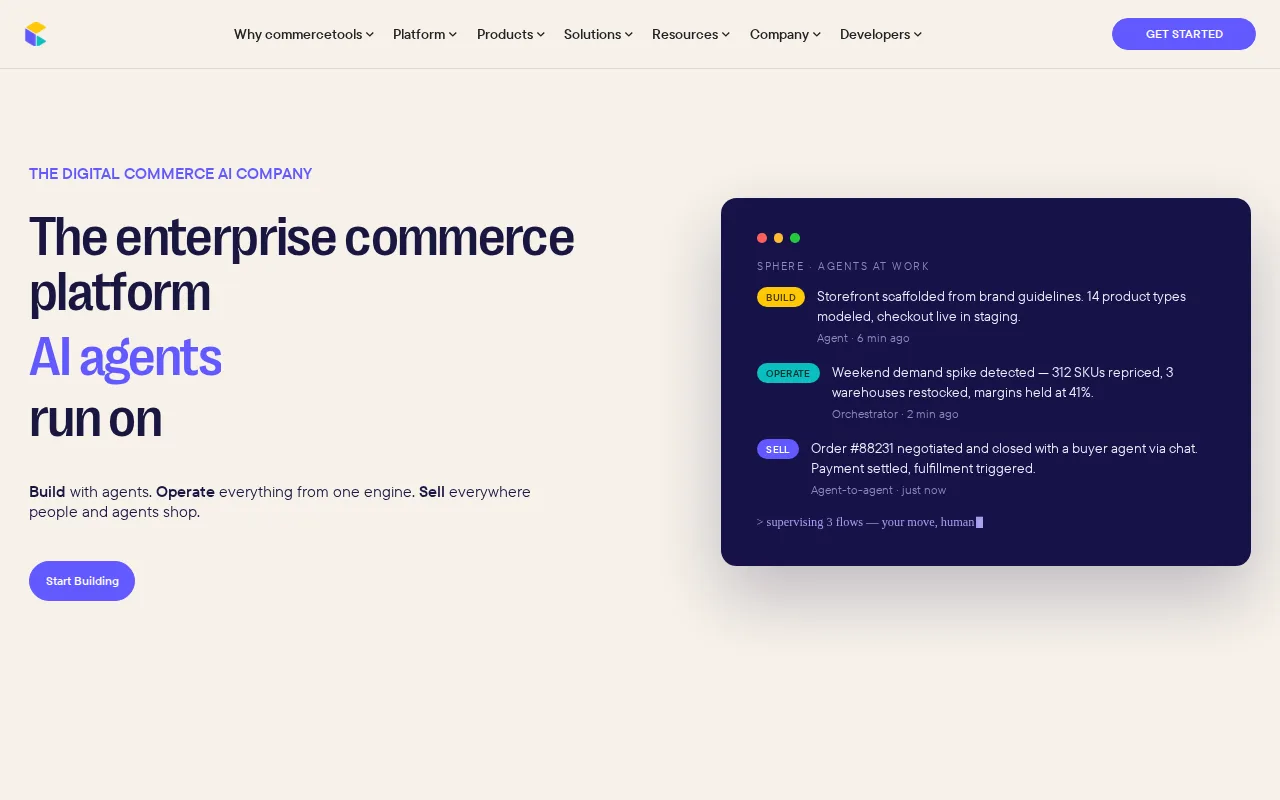
commercetools is the best Adobe Commerce (Magento) alternative for large enterprise retailers that need a fully headless, API-first commerce engine to power web, mobile, in-store, and AI shopping channels from one backend. Like Adobe Commerce, commercetools sells exclusively through custom enterprise contracts with no published pricing, but commercetools offers a 60-day free trial with full API and Merchant Center access, a self-serve evaluation path Adobe Commerce's listing doesn't document. commercetools holds a 4.6/5 rating from 17 Capterra reviews, the highest score in this comparison though on a far smaller review base than Adobe Commerce's 661. Its MosAIc and AI Hub tools extend the same commerce API layer to AI shopping agents like ChatGPT, Gemini, and Copilot, a forward-looking channel Adobe Commerce's own listing doesn't mention. Adobe Commerce remains the better choice for retailers who want an integrated storefront and commerce backend in one platform rather than building a custom frontend from scratch: commercetools is headless by design, meaning teams must build or buy a separate frontend, adding implementation time and typically requiring a systems integrator, while Adobe Commerce ships with its own storefront and B2B account-hierarchy tooling out of the box.
Compared to Adobe Commerce (Magento): 60-day free trial with full API access vs Adobe Commerce's quote-only evaluation path, 4.6/5 from 17 Capterra reviews (smaller sample than Adobe Commerce's 661), fully headless architecture requiring a separate frontend build
Wins:Offers a 60-day free trial with full API and Merchant Center access, a self-serve evaluation path Adobe Commerce's quote-only model doesn't offer · 4.6/5 rating from 17 Capterra reviews, the highest score among the alternatives compared here · MosAIc and AI Hub extend the commerce API layer to AI shopping agents like ChatGPT, Gemini, and Copilot
Loses:17 Capterra reviews is a far smaller evidence base than Adobe Commerce's own 661, making the 4.6/5 score less statistically reliable · Fully headless architecture requires building or buying a separate frontend, unlike Adobe Commerce's built-in storefront · Implementation typically requires a systems integrator, overkill for merchants who don't need commercetools' multi-channel, multi-region scale
Pros
- Fully headless architecture lets one commerce engine power web, mobile, in-store POS, and AI shopping channels.
- Unified B2C and B2B selling on a single platform rather than separate systems.
- Proven at large scale: reports over $110B in annualized GMV and 700M+ annual orders across customers.
- 60-day free trial gives full API and Merchant Center access before any purchase commitment.
Cons
- No published pricing; every deal requires direct sales engagement and typically runs into six or seven figures annually for large retailers.
- Headless architecture requires building or buying a frontend separately, adding implementation time and cost beyond the platform license.
- Steep learning curve and implementation complexity that usually requires a systems integrator, not a self-serve setup.
- Overkill for small or mid-market merchants who don't need multi-channel, multi-region commerce infrastructure.
Pricing: Custom pricing — Quote-based pricing with no published figure, the same quote-only model as Adobe Commerce; commercetools adds a 60-day free trial that Adobe Commerce's listing doesn't document
4.Salesforce — best Adobe Commerce (Magento) alternative for mid-market to enterprise sales teams that need a highly customizable CRM with pipeline management, forecasting, and AI-driven automation, and can dedicate admin resources to configuring it
Salesforce is the best Adobe Commerce (Magento) alternative for mid-market to enterprise sales teams that want commerce tightly bound to CRM, pipeline, and AI-driven automation rather than a standalone ecommerce backend. Salesforce publishes a Starter Suite price of $25/user/month, and while its top Agentforce 1 Sales plan climbs to $550/user/month, every tier in between has a listed dollar figure, unlike Adobe Commerce, which has no published pricing anywhere and requires a custom sales quote for every deployment. Salesforce holds a 4.4/5 rating from 18,803 Capterra reviews, by far the largest evidence base in this comparison and more than 28 times Adobe Commerce's own 661 reviews. Both platforms share a steep learning curve and typically require dedicated admin or developer resources to configure well. Adobe Commerce remains the better choice for large B2B and B2C retailers that specifically need a purpose-built ecommerce platform with custom catalogs and multi-brand storefronts rather than a CRM extended into commerce: Salesforce's core strength is sales pipeline, forecasting, and Agentforce automation, and pairing it with a full storefront and catalog system typically means integrating a separate commerce product rather than getting Adobe Commerce's dedicated multi-site, multi-brand storefront tooling out of the box.
Compared to Adobe Commerce (Magento): publishes tiered pricing from $25/user/month vs Adobe Commerce's quote-only model, 4.4/5 from 18,803 Capterra reviews vs 661, CRM and Agentforce AI automation built in rather than a dedicated storefront platform
Wins:Publishes concrete per-tier pricing starting at $25/user/month, unlike Adobe Commerce's quote-only model with no published figure · 4.4/5 rating from 18,803 Capterra reviews, more than 28 times Adobe Commerce's own 661 reviews · Deep CRM customization and Agentforce AI automation for lead qualification, forecasting, and deal insights that a dedicated commerce platform like Adobe Commerce doesn't provide
Loses:Pricing climbs steeply to $550/user/month at the top Agentforce 1 Sales tier, and Pro Suite and above require annual billing · No dedicated multi-brand, multi-site storefront and catalog tooling built specifically for retail commerce the way Adobe Commerce's platform is · Steep learning curve matching Adobe Commerce's own; reviewers describe admin training as extensive on both platforms
Pros
- Highly customizable objects, workflows, and reporting for complex sales processes.
- Deep integration ecosystem, including native Slack and Tableau integration plus thousands of AppExchange apps.
- AI-powered forecasting, deal insights, and Agentforce automation on higher tiers.
- Scales from small-team Starter Suite up through enterprise-grade Unlimited and Agentforce 1 plans.
Cons
- Pricing rises sharply across tiers, reaching $550/user/month for the top AI-enabled plan.
- Pro Suite and above require annual billing, reducing flexibility for growing teams.
- Steep learning curve; reviewers describe admin training as extensive and time-consuming.
- Deep customization often requires a dedicated Salesforce admin to configure and maintain.
Pricing: From $25/mo — $25/user/month (Starter Suite) published starting price vs Adobe Commerce's quote-only pricing with no published starting figure (verified undefined NaN, NaN)
Which one is right for you?
- You're a solo entrepreneur or growing merchant who wants a published starting price and a large app ecosystem instead of a sales quote.Shopify
- You're a mid-market merchant who wants headless commerce APIs and payment-processor choice bundled into every tier.BigCommerce
- You need commerce tightly integrated with CRM pipeline management, forecasting, and AI-driven sales automation.Salesforce
- You're a large enterprise retailer building a fully custom frontend across web, mobile, in-store, and AI shopping channels.commercetools
- You want to evaluate a headless platform with a self-serve free trial before committing to an enterprise sales conversation.commercetools
Frequently asked questions
What is the best alternative to Adobe Commerce (Magento)?
- Shopify is the best-reviewed alternative to Adobe Commerce, holding a 4.5/5 rating from 6,707 Capterra reviews and publishing pricing plainly from $39/month, versus Adobe Commerce's quote-only model with no published price. For headless API access without a custom quote, BigCommerce is the closer architectural match.
Is there a free alternative to Adobe Commerce (Magento)?
- No permanently free tier exists among the four alternatives compared here, matching Adobe Commerce's own lack of a free tier. Shopify offers a short trial, Salesforce a 30-day trial, and commercetools the longest evaluation window at 60 days with full API access.
Can Shopify replace Adobe Commerce (Magento)?
- Shopify can replace Adobe Commerce for most solo and growing merchants, since both provide a full storefront, catalog, and checkout system. Adobe Commerce remains the better fit for large B2B/B2C retailers needing custom catalogs and negotiated wholesale pricing built into the core platform, features Shopify concentrates in its $2,300/month Plus tier.
What is the closest alternative to Adobe Commerce (Magento) for headless commerce?
- commercetools is the closest alternative for fully headless, API-first commerce, sharing Adobe Commerce's quote-only pricing model but adding a 60-day free trial with full API access. BigCommerce is a lighter-weight headless option with published pricing from $29/month for merchants who don't need enterprise-scale custom contracts.
How does Adobe Commerce (Magento) pricing compare to its alternatives?
- Adobe Commerce has no published pricing at all, requiring a custom sales quote for every deployment, while three of its four compared alternatives publish concrete starting prices: Shopify at $39/month, BigCommerce at $29/month, and Salesforce at $25/user/month. Only commercetools shares Adobe Commerce's quote-only model.