commercetools — Headless, API-first commerce platform for enterprise B2C and B2B retailers, sold on custom enterprise contracts.

By Noahlast updated
commercetools screenshots & video
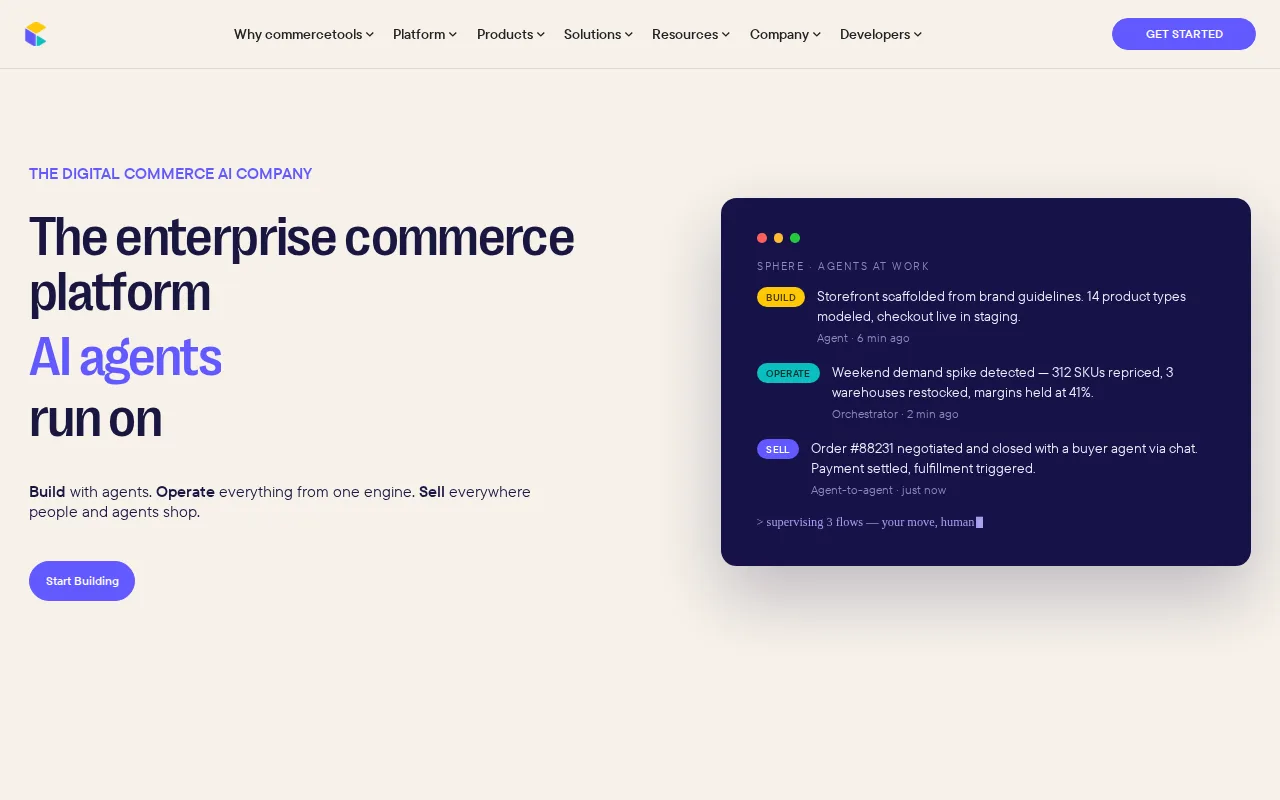
commercetools in 20 seconds
Best for: large enterprise retailers running unified B2C and B2B commerce across web, mobile, in-store, and AI shopping channels
Pricing: Custom, quote-based enterprise pricing tied to API usage, order volume, and catalog size; no published list price, 60-day free trial available.
- commercetools reports over 550 enterprise customers including Ulta Beauty, lululemon, Sephora, and BMW.
- The platform processes more than $110 billion in annualized GMV and over 700 million annual orders across customers.
- Pricing is entirely custom and quote-based; no list prices are published.
- commercetools offers a 60-day free trial with full API and Merchant Center access.
- commercetools holds a 4.6/5 rating from 17 reviews on Capterra.
Limitations: No published pricing; every purchase requires direct sales engagement.; Requires building or buying a separate frontend, adding implementation cost.; Overkill for small or mid-market merchants.
Top alternatives: Adobe Commerce (Magento), Salesforce Commerce Cloud, Shopify Plus, BigCommerce, Medusa — full list
What is commercetools?
commercetools is a headless commerce platform: instead of bundling a fixed storefront with its backend, it exposes catalog, cart, checkout, pricing, and order-management functionality through APIs that a retailer's own frontend (or a third-party frontend) calls directly. This architecture lets large retailers run the same commerce engine behind a website, mobile app, in-store point-of-sale, and increasingly AI shopping agents like ChatGPT or Copilot, without duplicating business logic per channel. commercetools reports over 550 enterprise customers processing more than $110 billion in annualized GMV, concentrated in retail, CPG, manufacturing, and automotive. Pricing is negotiated per contract based on usage (API calls, order volume, catalog size) rather than published as a flat rate, and implementation typically involves a systems integrator rather than a self-serve setup. The platform is not aimed at small or mid-market merchants — it competes for large enterprise contracts against Salesforce Commerce Cloud, SAP Commerce, and Adobe Commerce (Magento).
commercetools is a headless, API-first commerce platform that lets enterprise retailers build storefronts, checkout, and order management independently of a fixed frontend, serving over 550 customers including Ulta Beauty, lululemon, Sephora, and BMW. Pricing is entirely custom and quote-based — commercetools does not publish list prices — but the company offers a 60-day free trial with full API and Merchant Center access rather than a permanent free tier. The platform combines commerce APIs for catalog, cart, checkout, and order management with newer AI-oriented tools (MosAIc, AI Hub) aimed at agent-driven and conversational commerce, and it supports unified B2C and B2B selling from one engine across web, in-store, and emerging AI chat channels. commercetools targets large retail, CPG, and manufacturing organizations already running complex multi-channel operations, not small or mid-market merchants looking for a quick, self-serve setup.
Standout feature: MosAIc and AI Hub extend the commerce API layer to agent-driven shopping channels like ChatGPT, Gemini, and Copilot, alongside traditional headless storefront and POS integration
Biggest weakness: No public pricing at all — every deployment requires a sales conversation and typically a systems integrator, which makes commercetools impractical for small or mid-market merchants who want to evaluate cost before committing engineering time.
Pros
- Fully headless architecture lets one commerce engine power web, mobile, in-store POS, and AI shopping channels.
- Unified B2C and B2B selling on a single platform rather than separate systems.
- Proven at large scale: reports over $110B in annualized GMV and 700M+ annual orders across customers.
- 60-day free trial gives full API and Merchant Center access before any purchase commitment.
Cons
- No published pricing; every deal requires direct sales engagement and typically runs into six or seven figures annually for large retailers.
- Headless architecture requires building or buying a frontend separately, adding implementation time and cost beyond the platform license.
- Steep learning curve and implementation complexity that usually requires a systems integrator, not a self-serve setup.
- Overkill for small or mid-market merchants who don't need multi-channel, multi-region commerce infrastructure.
commercetools pricing
Custom pricing
| Plan | Price | Notes |
|---|---|---|
| Enterprise (custom) | Custom | Quote-based pricing tied to API usage, order volume, and catalog size; not published publicly. Third-party cost analyses report typical enterprise contracts in the low-to-high six figures annually, but commercetools does not confirm specific numbers. |
What reviewers say
Scores belong to their platforms; we display them with attribution and never fold them into our own ratings.