6 Best Alternatives to SaaSHub in 2026
By Noahlast updated

From our data: 3 of the 6 alternatives sell a one-time paid listing option for less than one month of SaaSHub's $99 featured slot, AlternativeTo at $5, findalternative.to (this site) at $29 and OpenAlternative at $97, while G2's $299 Starter plan and Capterra's $500 pay-per-click minimum cost more every month and Product Hunt sells no paid boost for a launch.
 AlternativeTo
 G2
 Capterra
 Product Hunt
 OpenAlternative
How we picked
- Ranked by fit with SaaSHub's job, a standing alternatives and comparison page for each product: AlternativeTo and findalternative.to (this site) do that job across all kinds of software, G2 and Capterra rank business software by verified reviews, Product Hunt runs one-day launches, and OpenAlternative covers open-source applications only.
- findalternative.to is the site publishing this page. It sits second because it builds the same alternatives and comparison pages SaaSHub does, not because of reach, and its section states that it launched in September 2026, lists 500+ products, has no user reviews and publishes no visitor numbers.
- Vendor costs come from each site's published terms, set against SaaSHub's free listing and $99/month featured slot: AlternativeTo's $5 priority review, the $29 one-time listing on findalternative.to (this site), G2's $299/month Starter plan, Capterra's $2 bids with a $500 monthly minimum, Product Hunt's free launch, and OpenAlternative's $97 and $137 packages.
- SaaSHub and AlternativeTo blocked automated reads, so their figures come from Internet Archive captures of their own pages taken in 2026. Figures for G2, Product Hunt, OpenAlternative and findalternative.to (this site) were read on their own sites in November 2026, and Capterra's come from search excerpts of its pages and G2's documentation.
- Audience figures are each site's own claims and were not measured independently: SaaSHub's 564,000+ monthly page views, OpenAlternative's 220,000 monthly visitors, G2's 100 million+ yearly visitors and Product Hunt's 1.5 million+ newsletter readers. No review-site score is on record here for any of the seven sites, so ratings did not order the list.
Paid placement never alters editorial rank — read the full methodology.
SaaSHub alternatives at a glance
| Alternative | Best for | Learning curve | Price |
|---|---|---|---|
| SaaSHubreference | comparing a SaaS product with its direct competitors, and for vendors, appearing on those competitors' alternatives pages for a flat $99 a month | Low | Free tier · paid from $99/mo |
| AlternativeTo | finding a community-vetted replacement for a specific desktop, mobile or web app, filtered by platform and license | Low | Free tier · paid from $5 one-time |
| findalternative.to | makers of new or niche software who want a permanent, comparison-ready listing next to the products they compete with, written so AI tools can read it, without paying for reviews or leads | Low | Free tier · paid from $29 one-time |
| G2 | B2B software vendors that can keep generating customer reviews and want Grid badges, buyer-intent data and reach across G2, Capterra, GetApp and Software Advice from one account, and buyers shortlisting business software from moderated peer reviews | Moderate | Free tier · paid from $299/mo |
| Capterra | small and mid-sized business buyers shortlisting software by category from verified reviews, and vendors that want to buy clicks by category across Capterra, GetApp and Software Advice instead of an annual review-site subscription | Moderate | Free tier · paid from $500/mo |
| Product Hunt | a team with a polished, clearly differentiated product and an engaged network that can be present for one full Pacific-time launch day, aiming for Product of the Day credibility and launch-day signups rather than an SEO backlink | Moderate | Free tier · paid from $5000 one-time |
| OpenAlternative | finding a self-hostable open-source replacement for a specific proprietary app, compared by GitHub stars and commit activity | Low | Free tier · paid from $97 one-time |
 SaaSHub
 findalternative.to
1AlternativeTo — best SaaSHub alternative for finding a community-vetted replacement for a specific desktop, mobile or web app, filtered by platform and license
AlternativeTo is the best SaaSHub alternative for finding a replacement for one specific app, because its lists rest on a large, visible community: AlternativeTo's October 2026 homepage showed 156,576 apps ranked by 2,046,354 user opinions, and each suggested alternative carries good-or-bad votes and comments explaining why it can replace the original. AlternativeTo filters by platform and license, including an open-source-only view, and covers consumer, desktop and mobile apps as well as SaaS. For makers, AlternativeTo states how long review takes, which SaaSHub does not: free submissions usually wait at least a few months, a one-time $5 priority review is usually done within 1-2 business days, and verified members skip the queue for free. SaaSHub is still the better choice for SaaS vendors who want predictable promotion and published numbers. SaaSHub sells a flat $99/month featured slot on competitors' alternatives pages and reports 564,000+ monthly page views, while AlternativeTo's Official Partner sponsorships have no public price and AlternativeTo publishes no visitor or referral numbers for makers. AlternativeTo's approval is also discretionary under a long decline list that includes single-purpose web tools, thin AI wrappers and regional or non-English apps, its rank algorithm is mostly secret, and it does not allow UTM tags on official website links.
Compared to SaaSHub: 156,576 apps ranked by 2,046,354 user opinions, with good-or-bad votes on each suggested alternative; a $5 one-time priority review usually done within 1-2 business days, where SaaSHub publishes no review timeline; and sponsorship only through an Official Partner program with no public price, against SaaSHub's flat $99/month featured slot
Wins:Shows its community scale: 2,046,354 user opinions behind 156,576 apps on the October 2026 homepage, with good-or-bad votes on each suggested alternative · States review times: free submissions usually wait at least a few months and a $5 priority review usually takes 1-2 business days, where SaaSHub publishes no review timeline · Verified members skip the review queue without paying
Loses:Free submissions usually wait at least a few months, with no date or queue position · Approval is discretionary, with declines for content sites, single-purpose web utilities, regional or non-English apps and thin AI wrappers · Publishes no visitor or referral numbers, where SaaSHub reports 564,000+ monthly page views and 30,600+ newsletter subscribers · Sponsorship runs only through an Official Partner program arranged by email, against SaaSHub's self-serve $99/month featured slot
Pros
- Free to browse and free to list, and the paid shortcut is cheap: a one-time $5 priority review that AlternativeTo usually completes within 1-2 business days.
- Large crowd-sourced catalog: 156,576 apps and 2,046,354 user opinions on the October 2026 homepage, across desktop, mobile and web software.
- Filters by platform and license, including an open-source-only view, and every alternative carries user votes on whether it is a good replacement.
- AlternativeTo's FAQ says paying for priority review has no effect on rank, likes or placement in alternatives lists, and Official Partner placements are labeled and use sponsored links.
- Admins review every new app and decline thin AI wrappers, AI tool directories and single-purpose web utilities.
Cons
- Free submissions usually wait at least a few months, and AlternativeTo gives no review date or queue position.
- Approval is discretionary and the decline list is long: content sites, calculators and converters, regional or non-English apps, games below its higher bar for games and thin wrappers around AI models.
- Most of the rank algorithm is secret beyond organic likes weighing heavily, so a newly approved app starts low in its alternatives lists until users like it.
- UTM tags are not allowed on official website links, so makers must rely on HTTP referrers to measure traffic from AlternativeTo.
Pricing: Free tier · paid from $5 one-time — Free listing and a $5 one-time priority review vs SaaSHub's free listing and verification and $99/month featured slot
2findalternative.to — best SaaSHub alternative for makers of new or niche software who want a permanent, comparison-ready listing next to the products they compete with, written so AI tools can read it, without paying for reviews or leads
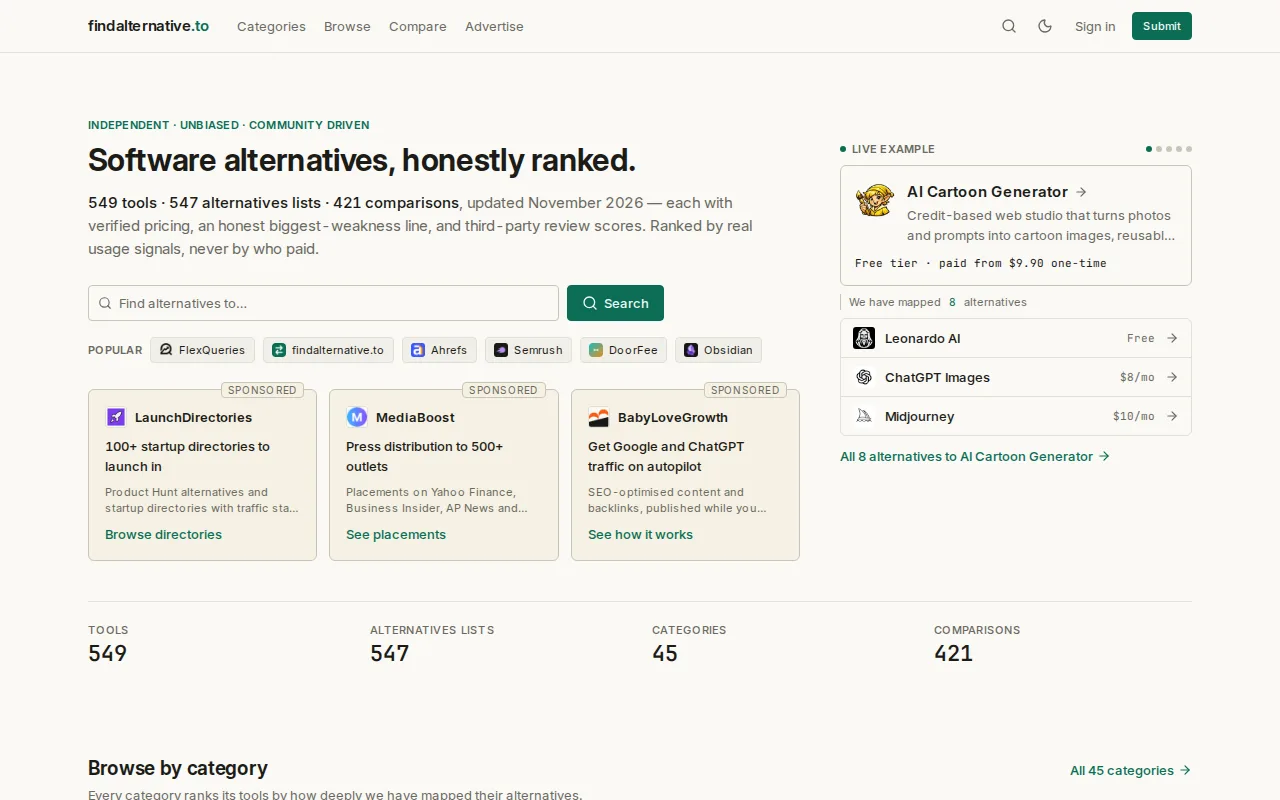
findalternative.to is this site, the directory publishing this page, and it ranks second here on fit rather than on reach. findalternative.to and SaaSHub do the same job: both build alternatives pages and head-to-head comparison pages for the products they list. findalternative.to ranks each list editorially by fit, gives every tool a mandatory biggest weakness and dates each price to the day it was read on the vendor's site. For makers, the free findalternative.to listing requires placing its badge on your own site, re-checked weekly, while a $29 one-time listing needs no badge, goes live the same day and comes with a drafted listing, up to 5 head-to-head comparison pages against competitors already listed, and its own alternatives page once at least three competitors are listed. SaaSHub, by comparison, publishes no review timeline for free submissions and sells featured placement at $99/month. Paid placement on findalternative.to is a labeled $49/month Featured card on competitors' alternatives pages, or ad slots from $10/day, and payment never changes a rank. SaaSHub is the better choice on reach and track record. SaaSHub has run since October 2014 and reports 564,000+ monthly page views and 30,600+ newsletter subscribers, while findalternative.to launched in September 2026, lists 500+ products, has no user reviews, publishes no visitor numbers because it has no honest figure, and is still building its search visibility.
Compared to SaaSHub: a $29 one-time listing that goes live the same day, where SaaSHub publishes no review timeline for free submissions; a mandatory biggest weakness and a dated price for every tool; and 500+ products, no user reviews and no published audience, against SaaSHub's 564,000+ monthly page views
Wins:A $29 one-time listing goes live the same day with no badge, a drafted listing and up to 5 comparison pages against listed competitors; SaaSHub publishes no review timeline for free submissions · Every tool carries a mandatory biggest weakness and a price dated to the day it was read on the vendor's site
Loses:Live since September 2026, against SaaSHub's October 2014 release · 500+ products, no user reviews and tiny like counts · No published visitor numbers, against SaaSHub's 564,000+ monthly page views and 30,600+ newsletter subscribers · The free listing requires keeping the findalternative.to badge on your site, where a free SaaSHub listing needs no badge
Pros
- Listing is free with a badge on your own site, verified automatically and re-checked weekly; the $29 path needs no badge, goes live the same day and includes a drafted listing, up to five head-to-head comparisons with its listed competitors, and alternatives-page copy once three of them are listed.
- Products appear in the ranked alternatives lists of the tools they compete with, the "best X" list format that an Ahrefs study found made up 43.8% of the page types ChatGPT cited.
- Built for machine readers: an
/aiguide for assistants, a Markdown version of every page,llms.txt,llms-full.txt,sitemap.md, IndexNow pings to Bing on publish, and an open MCP server with five query tools. - The editorial rules are public on
/methodology: rank follows fit, every tool gets a biggest weakness, and Featured cards and ads are labeled and never change a rank. - Owners can add alternatives from their dashboard later, and free submitters can fill in the listing by pasting JSON from their own AI agent instead of typing it.
Cons
- Small and new: 500+ products and a two-month track record, no published visitor numbers, and search visibility still being built.
- No user reviews or ratings of its own; the review scores it shows come from G2, Capterra, Trustpilot and Product Hunt.
- The free path lasts only while its badge stays on your site: the weekly re-check moves a missing badge into a grace period and then downgrades the listing.
- By its own logs the major AI crawlers do not read its llms.txt, and Markdown versions are a convenience for agents rather than a known ranking factor: Google says its Search features use neither.
Pricing: Free tier · paid from $29 one-time — Free with a badge or $29 one-time with no badge, Featured at $49/month, vs SaaSHub's free listing and verification and $99/month featured slot (verified November 9, 2026)
3G2 — best SaaSHub alternative for B2B software vendors that can keep generating customer reviews and want Grid badges, buyer-intent data and reach across G2, Capterra, GetApp and Software Advice from one account, and buyers shortlisting business software from moderated peer reviews
G2 is the best SaaSHub alternative for B2B software buyers who want verified peer reviews behind a ranking, and for vendors whose customers will keep writing them. G2 says it has more than 3 million reviews of 200,000+ products and services and more than 100 million visitors a year. Reviewers sign in with LinkedIn, a business email, or a personal email plus a product screenshot, and G2's Fall 2026 Trust & Safety Index reports 20,671 fake reviews removed out of 230,998 submitted from May to July 2026. G2 Grid reports place products by satisfaction and market presence once they have 10 reviews in a category, and since February 2026 G2 also owns Capterra, GetApp and Software Advice, so G2 Buyer Intent data spans all four sites. SaaSHub ranks from comparison articles around the web and user votes instead, which is lighter evidence but costs vendors far less. SaaSHub is the better choice for a vendor on a small budget. A SaaSHub listing links to the vendor's site, albeit with nofollow, while a free G2 profile has had no website link, CTAs or leads since August 2023, and G2's Starter plan costs $299/month in the first year (or $2,999 up front) and $599/month in year two, against SaaSHub's $99/month featured slot.
Compared to SaaSHub: 3 million+ moderated reviews by G2's count, against SaaSHub's rankings from comparison articles and user votes; Grid reports and buyer-intent data across G2, Capterra, GetApp and Software Advice; and no website link on a free profile and paid plans from $299/month, against SaaSHub's free listing and $99/month featured slot
Wins:G2 says it has 3 million+ reviews of 200,000+ products and services, each moderated, with reviewers signing in through LinkedIn, a business email or a product screenshot · Published moderation data: of 230,998 reviews submitted from May to July 2026, 70.1% were published and 20,671 were removed as fake · G2 Buyer Intent combines research activity from G2, Capterra, Software Advice and GetApp, a buyer-data product SaaSHub does not sell
Loses:A free G2 profile has had no link to the vendor's website, CTAs or leads since August 2023, where a SaaSHub listing links to the vendor's site · Starter costs $299/month or $2,999 for the first year and rises to $599/month in year two, against SaaSHub's month-to-month $99 featured slot · A product needs 10 reviews in a category to appear in a G2 Grid, and G2-run review campaigns with gift-card credits are paid features · G2's Trustpilot page scored 2.5/5 from 4,952 reviews in November 2026
Pros
- G2 reports more than 3 million reviews, 200,000+ listed products and services, 2,000+ categories and more than 100 million visitors a year, and added the Capterra, GetApp and Software Advice audiences in 2026.
- Buyers read everything for free, Grid reports require at least 10 reviews per product in a category, and incentivized and business-partner reviews carry labels.
- Moderation is documented: the Fall 2026 Trust & Safety Index reports 230,998 submissions, 70.1% published and 20,671 removed as fake between May 1 and July 31, 2026.
- G2 publishes an entry price, which most B2B review sites do not: Starter costs $299/month with no contract, or $2,999 for the first year, for companies with 1-100 employees.
- G2 Buyer Intent now combines research activity from G2, Capterra, Software Advice and GetApp, which G2 says yields up to 2x more signals at no added cost to existing Buyer Intent customers.
Cons
- Free profiles have no website link, CTAs or leads, show alternatives higher, and cannot promote Grid report or Best Software badges; only the 'Users Love Us' badge (20 reviews averaging 4.0 stars) stays free, and an independent November 2026 crawl audit (Miraqo) found that the Visit website control on G2 is a button with no href, so not a crawlable backlink.
- Review volume follows spend: G2-run campaigns with gift-card credits ($100 on Starter, $500 on Professional, $1,000 on Enterprise) are paid features, and the free plan collects reviews only from a landing page without incentives.
- Reviewer complaints are common: G2's Trustpilot page scored 2.5/5 from 4,952 reviews in November 2026, mostly about rejected reviews, suspended accounts and gift cards that never arrived.
- G2 Ads Clicks need a $500 monthly minimum, new campaigns run on all four G2-owned sites with no per-site opt-out, and click volume is not guaranteed because Paid Promotions buyers can block those ad slots.
Pricing: Free tier · paid from $299/mo — Free profile without a website link, Starter at $299/month or $2,999 for the first year, vs SaaSHub's free listing and $99/month featured slot (verified November 9, 2026)
4Capterra — best SaaSHub alternative for small and mid-sized business buyers shortlisting software by category from verified reviews, and vendors that want to buy clicks by category across Capterra, GetApp and Software Advice instead of an annual review-site subscription
Capterra is the best SaaSHub alternative for vendors who would rather pay per click than a flat monthly fee, and for small-business buyers who want verified reviews. Capterra lists products for free, says it has verified more than 2.5 million reviews with 30+ human moderators, and publishes the thresholds behind its Shortlist reports (20+ reviews in 24 months) and 'Best of' badges (10+ ratings in 12 months averaging 4.5 or higher). Sponsored placement is pay-per-click, with bids from $2 per click and a $500 minimum monthly budget, and one campaign reaches Capterra, GetApp and Software Advice. Capterra has been owned by G2 since February 5, 2026, and since November 4, 2026 a review submitted through G2's unified flow counts on all four G2-owned sites. SaaSHub is the better choice for a small vendor. SaaSHub's featured slot is a flat $99/month, cancelable in one click, and SaaSHub says a flat fee resists bot and fake clicks, while Capterra's minimum spend is $500 a month and a free Capterra listing has no link-out to the vendor's site at all, because the Visit Website button comes with paid sponsored profiles. Vendors on Capterra's Trustpilot page (3.3/5 from 1,078 reviews) cite pay-to-play rankings and sudden minimum-charge increases.
Compared to SaaSHub: pay-per-click placement from $2 per click with a $500 monthly minimum, against SaaSHub's flat $99/month featured slot; 2.5 million+ verified reviews, shared with G2, GetApp and Software Advice; and no link-out to the vendor's site on a free listing, where a SaaSHub listing links to it
Wins:Capterra says 30+ human moderators run 20+ checks on each of its 2.5 million+ verified reviews · Shortlist reports and 'Best of' badges follow published review thresholds rather than ad spend · One pay-per-click campaign reaches Capterra, GetApp and Software Advice, with bids from $2 per click
Loses:A free listing has no link-out to the vendor's website; the Visit Website button comes with paid sponsored profiles, which may sort first · Pay-per-click needs a $500 minimum monthly budget, about five times SaaSHub's $99/month featured slot · Since November 4, 2026, Capterra's ratings include reviews from G2's unified flow, so they are not independent of G2's · Vendors on Capterra's Trustpilot page (3.3/5 from 1,078 reviews, November 2026) cite pay-to-play rankings and sudden minimum-charge increases
Pros
- Free for buyers and free for vendors to list, with 2.5 million+ verified reviews shared across Capterra, GetApp and Software Advice.
- Pay-per-click pricing with no annual subscription: bids start at $2 per click, monthly spend can be capped, and one campaign covers Capterra, GetApp and Software Advice.
- Capterra says 30+ human moderators run 20+ checks on every review, including screens for fake reviewers, plagiarism and AI-generated text.
- Shortlist reports and 'Best of' badges are based on review data with published thresholds (20+ reviews in 24 months for Shortlist; 10+ ratings averaging 4.5 for Best of) rather than on ad spend.
Cons
- Sponsored profiles may appear first in category lists and carry the link-out to the vendor's site, so a free listing sends little direct traffic, and an independent November 2026 crawl audit (Miraqo) found Capterra's Visit website control is a button with no href, so even a paid profile is not a crawlable backlink.
- Pay-per-click needs a $500 minimum monthly budget, and placement goes to the highest bidder in each category.
- Under G2's unified review flow (from November 4, 2026) each new review's full text is public on only one of the four G2-owned sites, so Capterra readers must log in to read some reviews in full.
- Vendor reviews on Trustpilot (3.3/5 from 1,078 reviews, November 2026) cite pay-to-play rankings, minimum billing increases and slow support, and vendor guides report that replying to reviews now requires a paid my.G2 plan.
Pricing: Free tier · paid from $500/mo — Free listing; pay-per-click bids from $2 per click with a $500 minimum monthly budget vs SaaSHub's free listing and $99/month featured slot
5Product Hunt — best SaaSHub alternative for a team with a polished, clearly differentiated product and an engaged network that can be present for one full Pacific-time launch day, aiming for Product of the Day credibility and launch-day signups rather than an SEO backlink
Product Hunt is the SaaSHub alternative for makers who want a launch moment rather than a standing comparison listing. Launching on Product Hunt is free for any personal account with a verified email, a launch runs one Pacific-time day from 12:01 AM, and featured launches compete for Product of the Day, Week and Month in front of an audience Product Hunt describes as 1.5 million+ newsletter readers, 70% of them founders, leaders, engineers and data professionals. Product Hunt sells no paid boost for a launch and bars ads during a maker's own launch, and every launch keeps a permanent product page with reviews and alternatives. SaaSHub is the better choice for staying visible after launch week and for buyers comparing tools. A SaaSHub listing sits on its competitors' alternatives and comparison pages for as long as it is listed, and SaaSHub's $99/month featured slot puts a vendor directly on those pages, while Product Hunt's spotlight lasts one day and depends on an editorial call: Product Hunt's team hand-picks which launches reach the homepage, about 16 a day in an independent September 2024 count, down from 47 a year earlier. Product Hunt's product links also carried rel="ugc" in third-party checks in July 2026.
Compared to SaaSHub: a free one-day launch on a voted leaderboard, against SaaSHub's standing alternatives and comparison pages; newsletters that Product Hunt says reach 1.5 million+ readers, against SaaSHub's 30,600+ newsletter subscribers; and homepage featuring hand-picked by Product Hunt's team, about 16 launches a day in an independent September 2024 count
Wins:Free to launch, with no paid boost for sale and ads barred during a maker's own launch · A larger newsletter audience: 1.5 million+ readers by Product Hunt's count, against SaaSHub's 30,600+ subscribers · Product of the Day, Week and Month awards and embeddable badges give a new product launch-day credibility
Loses:The spotlight lasts one Pacific-time day, where a SaaSHub listing stays on competitors' alternatives pages · Homepage featuring is an editorial decision Product Hunt does not guarantee · Product website links carry rel="ugc" (third-party checks, July 2026), and a launch needs a network ready from 12:01 AM PT
Pros
- Launching, featuring and Product of the Day are free; Product Hunt sells no paid boost for a launch, and its ads cannot run during a maker's own launch.
- Largest audience among launch platforms: Product Hunt says its newsletters reach over 1.5 million readers and that 70% of its audience are founders, leaders, engineers and data professionals, 49% of them at startups.
- Published mechanics: launches go live at 12:01 AM Pacific, can be scheduled up to 30 days ahead or saved as drafts, and Product of the Day, Week and Month go to the most points in that period.
- Each launch stays on the product's permanent Product Page with reviews and alternatives, makers can embed Featured and Top Post badges, and a product can relaunch every two months after a major update.
- Votes are weighted by account history, so votes from brand-new accounts with no contributions count for 0 points, which blunts bought upvotes.
Cons
- Homepage featuring is an editorial decision: Product Hunt's team hand-picks featured launches, and meeting the Featuring Guidelines does not guarantee a spot.
- Exposure is concentrated in one Pacific-time day; on November 5, 2026 the #1 launch finished with 384 points and the #10 launch with 105, so a launch needs a network ready from 12:01 AM PT.
- Upvote culture invites manipulation: makers report DMs offering to sell upvotes, and Product Hunt responds by discounting votes with an undisclosed weighting, so final counts are opaque.
- Product website links carry rel="ugc" (third-party checks, July 2026) and the /r/ outbound short links are blocked in robots.txt, so the high-authority domain passes little SEO value.
Pricing: Free tier · paid from $5000 one-time — Free to launch, with display ads from $5,000 campaign budgets, vs SaaSHub's free listing and $99/month featured slot (verified November 9, 2026)
6OpenAlternative — best SaaSHub alternative for finding a self-hostable open-source replacement for a specific proprietary app, compared by GitHub stars and commit activity
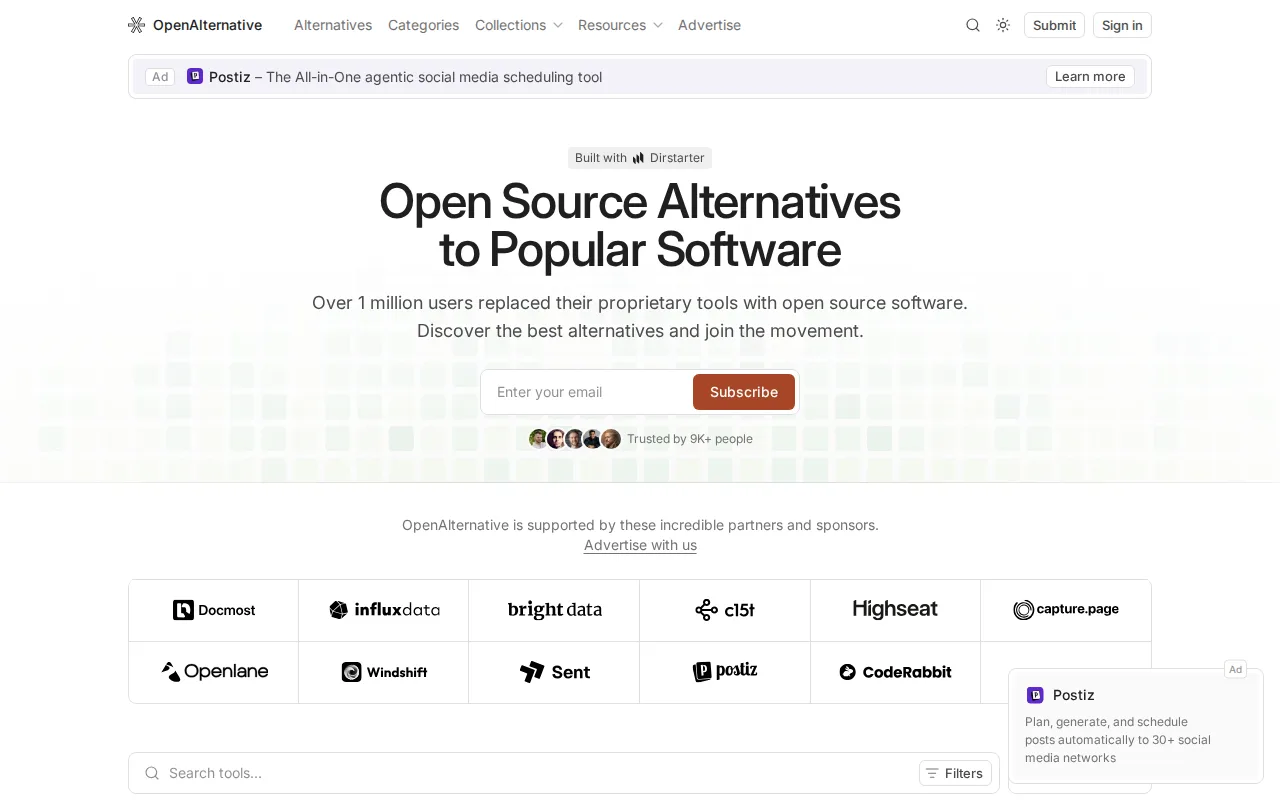
OpenAlternative is the best SaaSHub alternative only for open-source software. OpenAlternative lists full open-source applications with an OSI-approved license, each set against a named proprietary product, and ranks them by a published formula: GitHub stars and forks adjusted for project age, a penalty for inactivity and a 5% bonus for maintainer-verified listings. Every card shows stars, last commit and license, which suits buyers who want to self-host and need to know whether a project is still maintained. OpenAlternative reports 220,000 monthly visitors and 800K monthly pageviews, and its paid packages are one-time rather than monthly: Standard at $97 publishes within 48 hours and Premium at $137 within 24 hours with a do-follow link. SaaSHub is the better choice for any proprietary or commercial product and for makers with no budget. SaaSHub lists closed-source SaaS as well as open source and charges nothing to list or verify, while OpenAlternative's free queue publishes one tool per weekday and runs about five months, and its free and $97 listings link out with nofollow. OpenAlternative also rejects libraries, CLIs, SDKs, browser extensions, MCP servers and GitHub-only projects, and its catalog holds about 830 tools. It ranks last here because it serves only the open-source slice of SaaSHub's job.
Compared to SaaSHub: open-source applications only, against SaaSHub's mix of open-source and proprietary software; a published ranking formula built on GitHub stars, forks and commit activity, against SaaSHub's comparison articles and votes; and a free queue of about five months or $97 one time to publish within 48 hours, against SaaSHub's free listing and $99/month featured slot
Wins:A published ranking formula built on repository data, shown next to each project's stars, last commit and license · Paid packages are one-time: $97 to publish within 48 hours or $137 within 24 hours with a do-follow link, against SaaSHub's $99 every month for a featured slot · Hand review against written guidelines keeps out forks, waitlists, thin AI wrappers and proprietary software
Loses:Open source only, with libraries, CLIs, SDKs, browser extensions, MCP servers and GitHub-only projects rejected · The free queue publishes one tool per weekday and runs about five months · Free and $97 Standard listings link out with nofollow, and the catalog holds about 830 tools
Pros
- The ranking formula is published and based on repository data, with only a 5% bonus for maintainer verification.
- Every listing shows GitHub stars, last commit and license, with separate self-hosted, AI-native, license and tech-stack views.
- Hand review against written guidelines keeps out forks, waitlists, thin AI wrappers and proprietary software.
- Standard ($97) and Premium ($137) are one-time payments, and cancelling the Ultimate subscription keeps the Premium do-follow link.
- Audience figures are published: 220,000 monthly visitors and 800K monthly pageviews, with a live analytics dashboard linked from the advertise page.
Cons
- The free queue publishes one tool per weekday; on November 9, 2026, free tools added in July 2026 were scheduled for December 2026 and January 2027.
- Free and $97 Standard listings link out with nofollow; a do-follow link starts at the $137 Premium package.
- Only full open-source applications qualify: libraries, CLIs, SDKs, frameworks, browser extensions, plugins, MCP servers and GitHub-only projects are rejected.
- The catalog is small next to general directories: OpenAlternative's package page counted 830 listed tools.
Pricing: Free tier · paid from $97 one-time — $97 or $137 one time to skip a free queue of about five months, or $197/month for Ultimate, vs SaaSHub's free listing and $99/month featured slot (verified November 9, 2026)
Which one is right for you?
- You want to see which apps a large community recommends in place of a specific app, with votes on each suggestionAlternativeTo
- You would pay $5 to get your app reviewed in a day or two rather than wait with no stated timelineAlternativeTo
- You want a listing live the same day with comparison pages written for you, and you accept a far smaller audience (findalternative.to is this site)findalternative.to
- Your team is buying B2B software and wants moderated reviews and Grid reportsG2
- You have $500 a month or more for ads and want to pay per click for business-software buyersCapterra
- You are launching this month and want one day in front of a large tech audienceProduct Hunt
- You only use open-source software and want to check each project's GitHub activityOpenAlternative
Frequently asked questions
What is the best alternative to SaaSHub?
- AlternativeTo is the best alternative to SaaSHub for finding a replacement for a specific app: its October 2026 homepage showed 156,576 apps ranked by 2,046,354 user opinions, and listing is free. G2 is the better pick for B2B buyers who want verified reviews, and OpenAlternative for open-source software only.
Is a SaaSHub listing free?
- Yes, submitting and verifying a product on SaaSHub is free, though approval is required and products with more identified competitors are approved first. The paid option is a $99/month featured listing, month-to-month with one-click cancellation.
Are SaaSHub links dofollow?
- Mostly not: on an archived October 2026 SaaSHub alternatives page, the website links in the ranked list carried a nofollow attribute and featured products' links were marked sponsored. Only the page's own product had a plain link.
Is SaaSHub's $99 featured listing worth it?
- That depends on what a referral is worth to you: SaaSHub's own estimate is 16-30 referrals a month for a featured product (as of October 20, 2026), about $3.30 to $6.20 per referral at $99/month, with no in-house campaign stats to check it. Featured status adds a labeled Sponsored slot on competitors' alternatives pages but never moves a product up SaaSHub's ranked lists.
Can AlternativeTo replace SaaSHub?
- Yes for listing a product and for finding alternatives to a specific app, since AlternativeTo is free to list and shows 2,046,354 user opinions. No for vendors who want paid placement on competitors' pages at a published price: SaaSHub's featured slot costs $99/month, while AlternativeTo's Official Partner sponsorships are arranged by email with no public price.
What is the difference between SaaSHub and G2?
- SaaSHub ranks software from comparison articles around the web plus user votes and is free to list, while G2 ranks business software by verified, moderated user reviews and charges vendors from $299/month for a profile with a website link and CTAs. A free G2 profile has had no website link since August 2023.
Do directory listings help a product show up in AI answers?
- Possibly, but the evidence is correlational: in Ahrefs' analysis of 75,000 brands, how often a brand is mentioned across the web correlated more strongly with its visibility in Google's AI Overviews (0.664) than its number of backlinks (0.218) (Ahrefs). That is not proof that a listing causes AI mentions, and in a separate Ahrefs experiment, 43% of the AI answers that cited Ahrefs' own promotional pages never named the event those pages promoted (Ahrefs).