6 Best Alternatives to Product Hunt in 2026
By Noahlast updated pricing verified

From our data: 4 of the 6 Product Hunt alternatives listed here have a free path (Uneed's waiting line, Peerlist's Launchpad, DevHunt's nofollow listing and the badge listing on findalternative.to, this site), while BetaList and There's An AI For That charge for every self-serve submission, from $39 and $49; the cheapest paid launch among them is Uneed's $14.99 Fast-track.
 BetaList
 Uneed
 Peerlist
 DevHunt
 There's An AI For That
How we picked
- Every alternative was measured against Product Hunt's own launch rules, read in its help center in November 2026: launching is free, a launch runs for one Pacific-time day from 12:01 AM, and Product Hunt's team hand-picks which launches reach the homepage, which showed 17 featured launches on November 9, 2026.
- The ranking weighs what Product Hunt leaves to chance: whether a maker who pays or qualifies is guaranteed exposure, how long the attention lasts (one day, a week, or a permanent listing), how long a maker waits for a date, and what the launch costs.
- Link attributes come from checks of live pages: BetaList's Visit Site button is a 301 redirect with no nofollow, Uneed's product links carry rel="noopener", DevHunt's launched tools carry rel="noopener" and its free listings rel="nofollow noopener", 26 of 36 Peerlist Visit links checked on November 9, 2026 carried rel="nofollow ugc", and Product Hunt's own website links carried rel="ugc" in third-party checks in July 2026. There's An AI For That publishes no link policy, so none is claimed for it.
- Audience figures are each platform's own and unaudited: There's An AI For That claims 2.5M+ newsletter subscribers, Product Hunt 1.5 million newsletter readers, BetaList 70,000+ subscribers, DevHunt 40,000 and Uneed 30,000, while Peerlist reports 52K+ monthly active users instead. findalternative.to, the site you are reading, publishes no audience figure.
- There's An AI For That blocked direct requests, so its $49 and $437 launch prices come from archived copies of its own launch page from October 2026, not from a live read.
Paid placement never alters editorial rank — read the full methodology.
Product Hunt alternatives at a glance
| Alternative | Best for | Learning curve | Price |
|---|---|---|---|
| Product Huntreference | a team with a polished, clearly differentiated product and an engaged network that can be present for one full Pacific-time launch day, aiming for Product of the Day credibility and launch-day signups rather than an SEO backlink | Moderate | Free tier · paid from $5000 one-time |
| BetaList | a pre-launch or newly live startup with its own polished landing page that wants waitlist signups and beta testers from early adopters, and can pay $39 to $299 for a hand-edited feature with a dofollow link | Low | From $39 one-time |
| Uneed | an indie maker without a launch budget who can wait months for a free launch date, or who pays $14.99 to $39.99 for a scheduled daily launch with a dofollow link | Low | Free tier · paid from $12.99/mo |
| Peerlist | an individual developer or designer with a verified profile launching a side project, dev tool or design resource to tech peers for feedback over a full week | Low | Free tier · paid from $29 one-time |
| DevHunt | a developer tool, API, CLI or MCP server maker who wants a week-long launch in front of developers and a permanent dofollow link for $49 | Low | Free tier · paid from $49 one-time |
| There's An AI For That | finding an AI tool for one specific task, and for AI makers, buying a launch with a guaranteed newsletter feature | Low | From $49 one-time |
| findalternative.to | makers of new or niche software who want a permanent, comparison-ready listing next to the products they compete with, written so AI tools can read it, without paying for reviews or leads | Low | Free tier · paid from $29 one-time |
 Product Hunt
 findalternative.to
1BetaList — best Product Hunt alternative for a pre-launch or newly live startup with its own polished landing page that wants waitlist signups and beta testers from early adopters, and can pay $39 to $299 for a hand-edited feature with a dofollow link
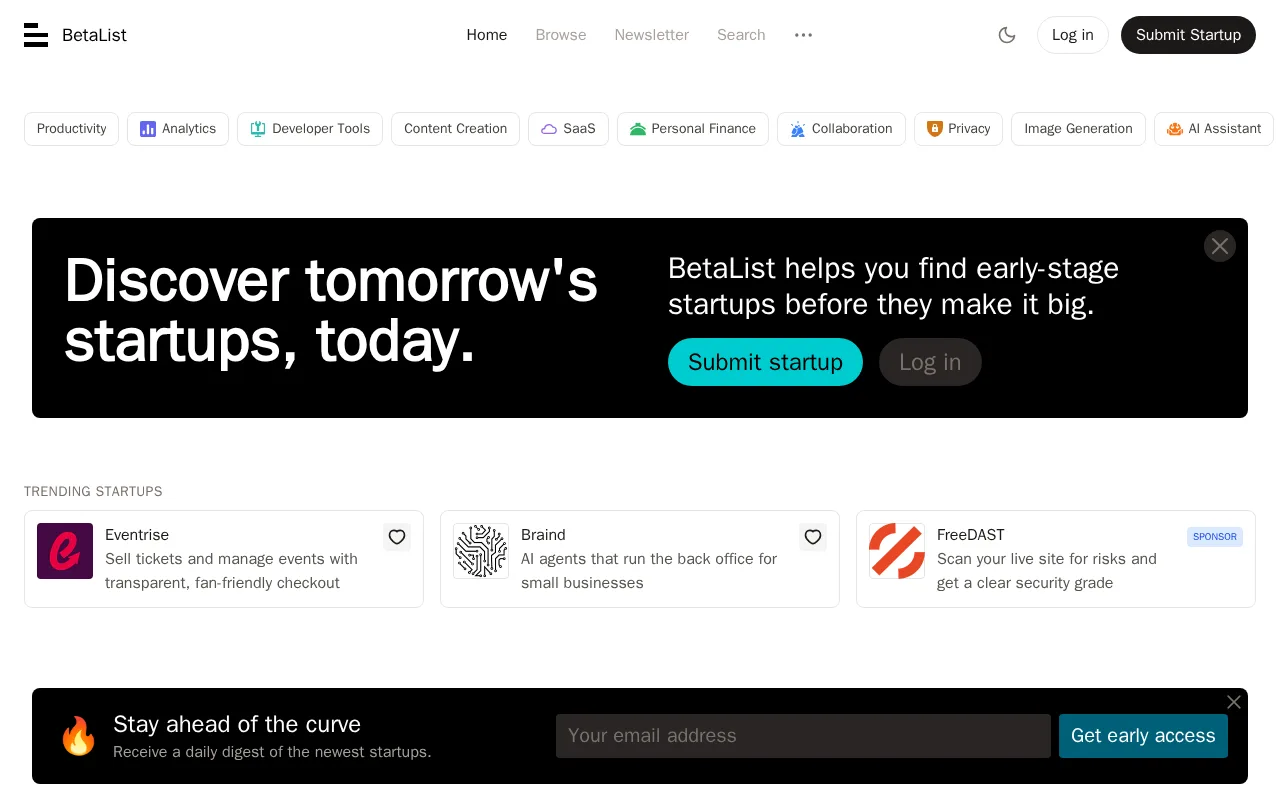
BetaList is the best Product Hunt alternative for a pre-launch or newly live startup that wants a feature it can count on. BetaList's editors review every submission, feature about 20 startups a day, and refund the payment in full if they do not select a startup, so a founder pays only for a feature that happens. Plans are priced by speed: Lite costs $39 (featured within about 14 days), Standard $99 (about 3 days) and Premium $299 (about 1 day), and Standard and Premium guarantee a spot in a newsletter BetaList says reaches 70,000+ subscribers. Every featured startup keeps a permanent listing whose Visit Site button is a dofollow link, a 301 redirect with UTM tags, where Product Hunt's website links carried rel="ugc" in third-party checks in July 2026. BetaList has no launch-day vote, so a founder does not need a network ready at 12:01 AM Pacific. Product Hunt is still the better choice for reach and price. Launching on Product Hunt is free, and Product Hunt says its newsletters reach over 1.5 million readers, about 20 times BetaList's list. BetaList also refuses agencies, courses, newsletters, online stores, templated landing pages and free subdomains with no exceptions, and it features a startup at most twice, where a Product Hunt product can relaunch after two months.
Compared to Product Hunt: a guaranteed hand-edited feature for $39 to $299 with a full refund if not selected, a dofollow link where Product Hunt's links carry rel="ugc", and a newsletter of 70,000+ subscribers against the 1.5 million readers Product Hunt claims
Wins:Every accepted startup is featured, within about 14 days on Lite ($39), 3 days on Standard ($99) or 1 day on Premium ($299), and rejected submissions are refunded automatically, where Product Hunt's homepage featuring is a hand-picked editorial call · The Visit Site button is a dofollow link (a 301 redirect with UTM tags), where Product Hunt's website links carried rel="ugc" in July 2026 third-party checks · No launch-day vote to rally: BetaList's editors select startups, while Product Hunt ranks launches by points gathered within one Pacific-time day
Loses:Every submission costs $39 to $299, where launching on Product Hunt is free · A newsletter of 70,000+ subscribers against the 1.5 million readers Product Hunt claims for its newsletters, about one-twentieth of the reach · Strict criteria with no exceptions (no agencies, courses, newsletters, online stores, templated landing pages or free subdomains) and at most two features per startup, where a Product Hunt product can relaunch after two months
Pros
- Rejected submissions are refunded in full automatically, so a founder pays only for a feature that happens.
- Featured listings are permanent and hand-edited, and the Visit Site button is a dofollow link (a 301 redirect through betalist.com with no nofollow attribute) tagged utm_source=betalist.
- Predictable timing: Lite features within about 14 days, Standard within about 3 days and Premium within about 1 day, with upgrades available from the dashboard.
- BetaList says it serves 500,000+ pageviews a month and 70,000+ newsletter subscribers, an audience of early adopters, founders and investors that suits waitlists and betas.
- A coding agent can draft the submission through BetaList's Agent API, while the founder still reviews, edits and pays.
Cons
- No free submissions: plans cost $39, $99 or $299 per feature.
- Newsletter inclusion is guaranteed only on Standard ($99) and Premium ($299); a Lite startup reaches the newsletter only if it is among the most popular.
- Strict eligibility with no exceptions: no agencies, consultancies, courses, newsletters, online stores, templated landing pages, hosted builders such as Carrd or free subdomains.
- There is no community vote, the Trending Startups section uses undisclosed engagement metrics, and a startup can be featured at most twice.
Pricing: From $39 one-time — $39 (Lite), $99 (Standard) or $299 (Premium) one-time, refunded if not selected, vs Product Hunt's free launch (verified November 9, 2026)
2Uneed — best Product Hunt alternative for an indie maker without a launch budget who can wait months for a free launch date, or who pays $14.99 to $39.99 for a scheduled daily launch with a dofollow link
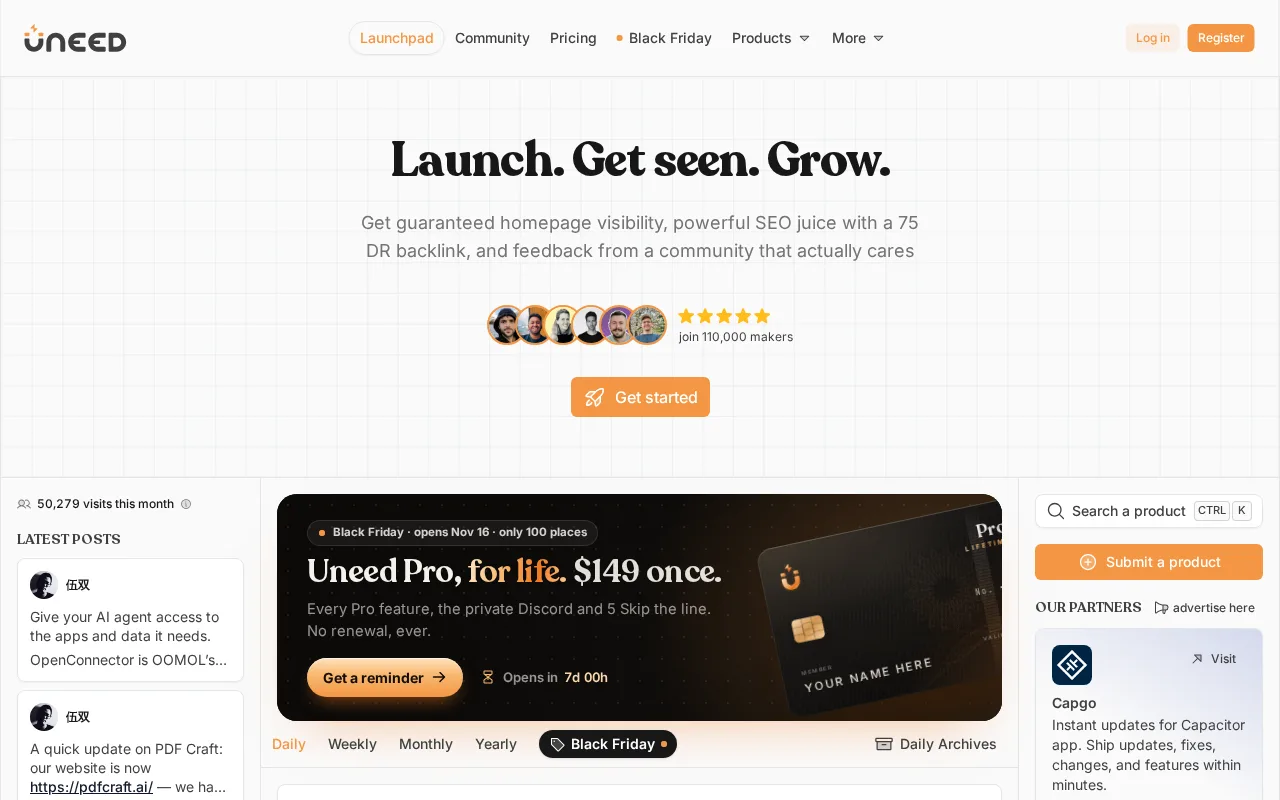
Uneed is the best Product Hunt alternative for makers who want published rules instead of an editor's call. Uneed runs the same daily-leaderboard format as Product Hunt, but every paid launch and up to 50 free launches a day go live on Uneed's homepage at 12:00 AM Pacific, where Product Hunt's team hand-picks which launches it features (17 on November 9, 2026). Uneed sells launch dates outright: Fast-track costs $14.99 for a date about 14 days out, and Skip the line costs $39.99 for the exact date a maker picks, is never declined and keeps a permanent dofollow link whatever the votes, while Product Hunt's website links carried rel="ugc" in July 2026 third-party checks. Rolling leaderboards for the last 7, 30 and 365 days and a weekly newsletter for the top 3 plus 2 editor picks keep a launch ranked after day one, and Uneed publishes its upvote thresholds and monthly launch counts. Product Hunt is still the better choice for a free launch soon and a large audience. Uneed's free waiting line gave a product joining on November 9, 2026 a date of May 12, 2027, a free launch below an upvote score of 10 is unpublished for good, and Uneed's 30,000 newsletter subscribers are about one-fiftieth of the 1.5 million readers Product Hunt claims.
Compared to Product Hunt: every launch on the homepage instead of hand-picked featuring, a chosen date and permanent dofollow link for $39.99 where Product Hunt's links carry rel="ugc", and a free waiting line that ran to May 2027 against a free Product Hunt launch within 30 days
Wins:Every paid launch and up to 50 free launches a day reach Uneed's homepage, where Product Hunt featured 17 hand-picked launches on November 9, 2026 · Skip the line ($39.99) picks the exact date and keeps a permanent dofollow link whatever the votes, and a free launch keeps one at an upvote score of 20, where Product Hunt's links carried rel="ugc" in July 2026 checks · Rolling 7-, 30- and 365-day leaderboards, published upvote thresholds and monthly launch counts under CC BY 4.0, where Product Hunt does not publish its ranking formula
Loses:The free waiting line ran to May 12, 2027 for a product joining on November 9, 2026, where a free Product Hunt launch can be scheduled from the next day up to 30 days ahead · 30,000 newsletter subscribers and 125K monthly visitors by Uneed's count, against the 1.5 million readers Product Hunt claims for its newsletters · Free launches can be declined, a free launch below an upvote score of 10 is unpublished for good, and paying Uneed Pro members' votes count with a +3 multiplier
Pros
- A free launch path exists, and its wait is visible before joining: Uneed's API reported a free launch date of May 12, 2027 on November 9, 2026.
- Cheap paid launches: Fast-track costs $14.99 and Skip the line $39.99, which guarantees a permanent dofollow link even if the launch underperforms.
- Every launch goes live on the homepage, and product links point straight to the maker's site with rel="noopener" (no nofollow) and ref and UTM tags.
- Rolling day, week, month and year leaderboards, podium badges and a weekly newsletter spot for the top 3 keep products ranked after launch day.
- Uneed removes votes from batches of new accounts or single IP addresses and bans repeat vote buyers.
Cons
- The free line is long: dates are assigned at least 50 days out and ran 184 days out in November 2026.
- A free launch needs a launch-day upvote score of 20 for a dofollow link; below 10 the product is unpublished and can never rejoin the free line.
- Votes are weighted by streak multipliers and a +3 Pro bonus, so paying members and daily voters carry more ranking weight than newcomers.
- Uneed is a one-person operation, and its audience (125K monthly visitors and 30,000 newsletter subscribers by Uneed's count) is a fraction of Product Hunt's.
Pricing: Free tier · paid from $12.99/mo — Free after a waiting line, $14.99 Fast-track or $39.99 Skip the line one-time, vs Product Hunt's free launch with no paid boost (verified November 9, 2026)
3Peerlist — best Product Hunt alternative for an individual developer or designer with a verified profile launching a side project, dev tool or design resource to tech peers for feedback over a full week
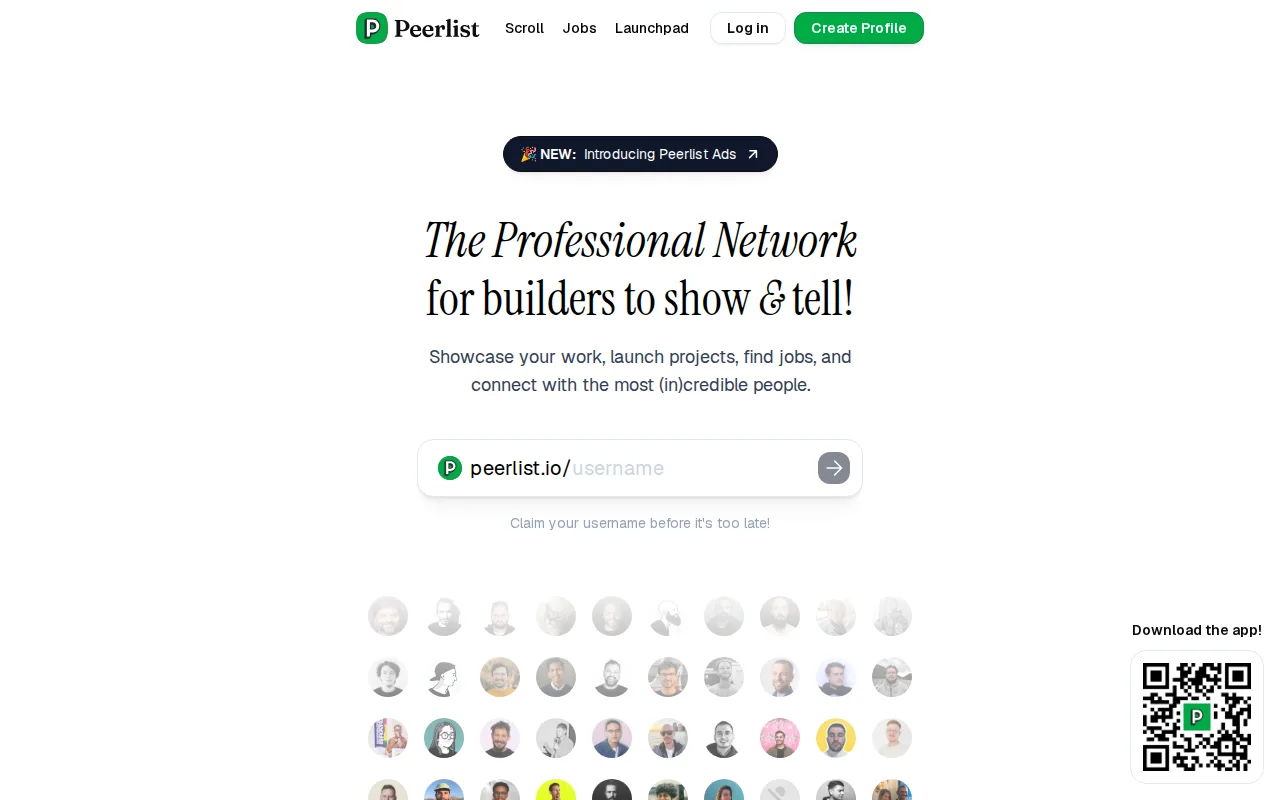
Peerlist is the best Product Hunt alternative for an individual developer or designer who wants feedback from tech peers over a full week rather than a single day. Peerlist's Launchpad opens every Monday, each launch runs for the week, and projects appear in random order on Monday and Tuesday, so the first hours do not decide who gets seen, where Product Hunt's spotlight lasts one Pacific-time day and its team hand-picks which launches reach the homepage. Launching on Peerlist is free for verified individual profiles, votes and feedback from verified profiles carry more weight, and Peerlist says 58% of its users are software engineers and 22% founders and CTOs. The week's top 3 get a badge and a feature in Peerlist's emails and social channels, and a one-day Featured Launch at the top of Peerlist's Scroll feed costs from $29. Product Hunt is still the better choice for reach and for makers who cannot verify a work email. Product Hunt says its newsletters reach over 1.5 million readers, where Peerlist reports 52K+ monthly active users, and Product Hunt needs only a verified email, where Peerlist requires a current work email or a paid one-time identity check. Peerlist also gives a backlink only to the week's top 5; 26 of 36 Visit links checked on November 9, 2026 carried rel="nofollow ugc".
Compared to Product Hunt: a full week of exposure with random ordering on the first two days, launches limited to verified individual profiles, and 52K+ monthly active users against the 1.5 million newsletter readers Product Hunt claims
Wins:A launch runs a full week from Monday, with random ordering on Monday and Tuesday, where Product Hunt's attention is concentrated in one Pacific-time day · A technical audience: Peerlist says 58% of its users are software engineers and 22% founders and CTOs, and votes from verified profiles count more · Paid reach is cheap: a one-day Featured Launch at the top of Peerlist's Scroll feed costs $29 to $59, where Product Hunt's self-serve ads start at $5,000 campaign budgets
Loses:Product Hunt claims 1.5 million newsletter readers, where Peerlist reports 52K+ monthly active users and gives no figure for the traffic a launch sends · Only verified individual profiles can launch, so makers without a current work email pay a one-time identity-verification fee, where Product Hunt needs only a verified email · Only the week's top 5 get a backlink, only the top 3 get the email feature, and Peerlist accepts a limited number of projects each week
Pros
- Launching is free, and a launch stays live for a full week, with random ordering on Monday and Tuesday.
- The audience is technical: Peerlist says 58% of its users are software engineers and 22% founders and CTOs, with 52K+ monthly active users.
- Only verified individual profiles can launch, and votes and feedback from verified profiles carry more weight in the ranking.
- Paid reach is cheap: a one-day Featured Launch at the top of Scroll starts at $29, and weekly ad slots cost $99 to $199.
- Launched projects sit on the maker's Peerlist profile next to their work history, and Peerlist has iOS and Android apps.
Cons
- Only the week's top 5 projects get a backlink; other launches' Visit links carry rel="nofollow ugc".
- Launching requires a verified individual profile: free with a current work email, otherwise a one-time identity-verification fee, and company profiles cannot launch.
- Peerlist accepts a limited number of projects each week, and a launch fails if the project page is not 100% complete on launch day.
- Peerlist gives no figure for the traffic a launch sends; its closest number is an ad estimate of about 80,000 Launchpad feed impressions a week.
Pricing: Free tier · paid from $29 one-time — Free with a verified profile (Featured Launch on Scroll from $29 a day) vs Product Hunt's free launch with no paid boost (verified November 9, 2026)
4DevHunt — best Product Hunt alternative for a developer tool, API, CLI or MCP server maker who wants a week-long launch in front of developers and a permanent dofollow link for $49
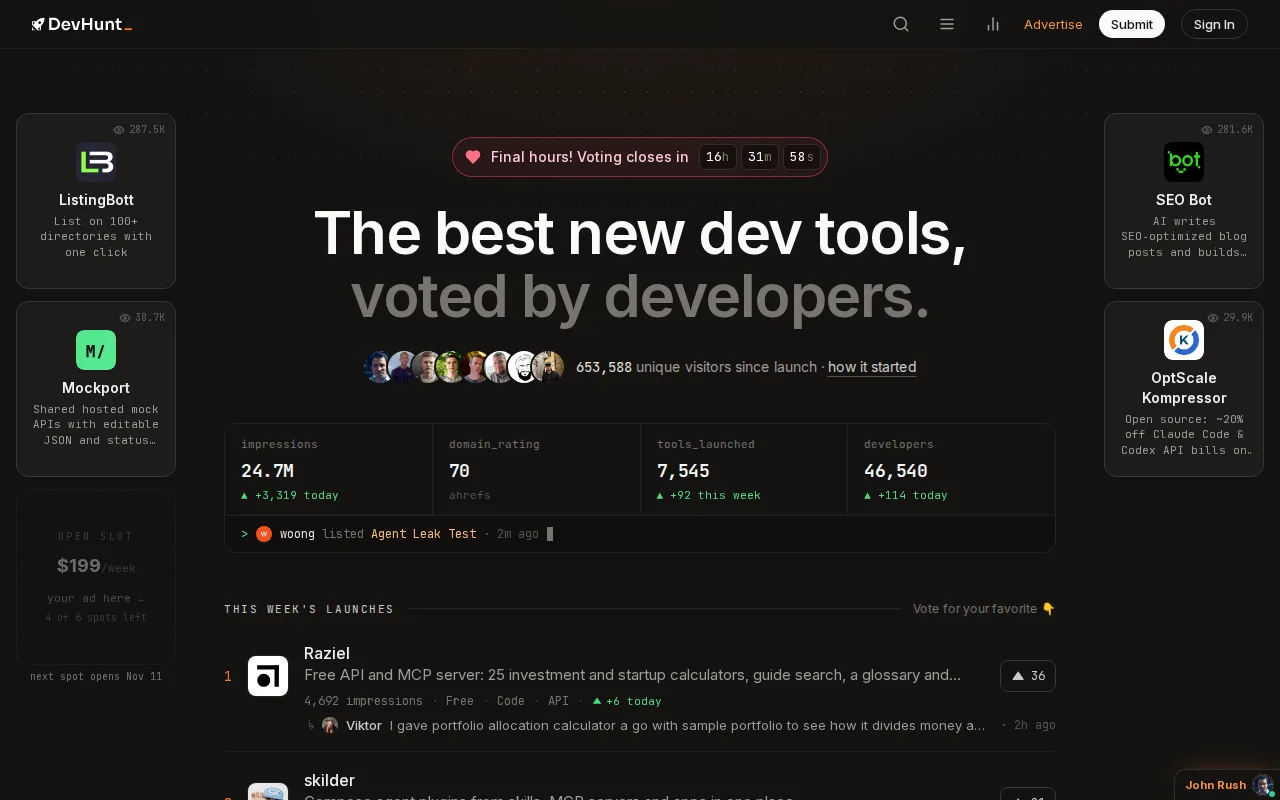
DevHunt is the best Product Hunt alternative for makers of developer tools such as APIs, SDKs, CLIs, databases and MCP servers, because only developer tools compete there. On Product Hunt, dev tools compete with every category for editorial featuring, which DevHunt's founders cite as the reason they built DevHunt. DevHunt launches go live every Tuesday and run for the week, votes and comments require a GitHub or Google sign-in, and DevHunt says it has 46,531 registered developers and 40,000 newsletter subscribers. A $49 launch picks the week and adds a newsletter spot, a post on X, a tie-break over unpaid launches and a permanent dofollow link, where Product Hunt's website links carried rel="ugc" in July 2026 third-party checks. Product Hunt is still the better choice for a free launch and for reach. DevHunt's free listing gets a nofollow link and, since a September 28, 2026 test, no launch week for new tools, while Product Hunt launches cost nothing. Product Hunt says its newsletters reach over 1.5 million readers, more than 35 times DevHunt's list. DevHunt also sells three super boosts a week ($199, $149 and $99) that lead its launch email whatever the votes, and its changelog records nine pricing changes since March 2024.
Compared to Product Hunt: a developer-tools-only launch week voted by developers signed in through GitHub or Google, a $49 launch with a newsletter spot and a permanent dofollow link, and no free launch week for new tools
Wins:Only developer tools compete, and votes require a GitHub or Google sign-in, where Product Hunt's dev tools compete with every category for featuring · A launch runs a full week from Tuesday, where a Product Hunt launch lasts one Pacific-time day · The $49 launch includes a newsletter spot, a post on X and a permanent dofollow link, where Product Hunt's website links carried rel="ugc" in July 2026 checks
Loses:A launch week costs $49, and free listings get a nofollow link and no launch week for new tools, where Product Hunt launches are free · 40,000 newsletter subscribers and 150K page views a month by DevHunt's count, against the 1.5 million newsletter readers Product Hunt claims · Three weekly super boosts ($199, $149 and $99) lead the launch email whatever the votes, and pricing has changed nine times since March 2024, where Product Hunt sells no paid boost for a launch
Pros
- A $49 launch includes the chosen week, a newsletter spot, a post on X and a permanent dofollow link (launched tools' links carry rel="noopener" with no nofollow).
- Developer-only audience and voting: votes and comments require a GitHub or Google sign-in, and tools flagged as not for developers do not compete with dev tools.
- Launches last a full week, starting every Tuesday, instead of a single day.
- DevHunt publishes open data (CC BY 4.0) and a dated changelog of its pricing and queue rules.
- Ad slots guarantee clicks (150 per newsletter edition, 50 per sidebar week, 25 per inline week) or keep running free until they deliver, and non-day ads are refundable within 24 hours minus a 5% Stripe fee.
Cons
- Free listings carry a nofollow link, and new tools have been offered only paid launch weeks since September 28, 2026.
- Pricing changes often: nine pricing entries in DevHunt's changelog since March 2024, including a $297 paywall in 2024 and several tests in October and November 2026.
- Super boosts ($99 to $199) let paying launches lead the launch email regardless of votes.
- The public GitHub code was last updated on August 28, 2026, so the open-source repository lags the live site, and DevHunt's own pages report different launch totals (7,545 on the advertise page, 14,461 on the stats page).
Pricing: Free tier · paid from $49 one-time — $49 one-time per launch week (free listing with a nofollow link) vs Product Hunt's free launch (verified November 9, 2026)
5There's An AI For That — best Product Hunt alternative for finding an AI tool for one specific task, and for AI makers, buying a launch with a guaranteed newsletter feature
There's An AI For That (TAAFT) is the best Product Hunt alternative for makers of AI tools who would rather buy a guaranteed feature than compete for Product Hunt's editorial featuring. TAAFT accepts only AI tools, MCP servers and GPTs, maps 50,000+ AI tools to 11,000+ tasks and 5,000+ job roles, and sells one-time launches: $49 for a permanent listing in its Just Released feed and $437 for a listing plus a guaranteed feature in a newsletter TAAFT says reaches 2.5M+ subscribers, more than the 1.5 million readers Product Hunt claims. Staff review submissions in 1-2 days on average, and TAAFT refunds the fee in full if a tool is not published. Product Hunt is still the better choice for most makers, AI or not. Launching on Product Hunt is free, while TAAFT's only free route is a monthly thread on X from which it picks one tool. TAAFT says over half of users who open a regular listing never click through to the maker's site unless the maker pays $99/month for Highlight, newer tools sit higher, and its Featured section is ordered by pay-per-click bids. TAAFT's own pages also disagree on its traffic (5M+ monthly visitors on one, 3,000,000 monthly unique visitors on another), and its prices here come from archived copies of its launch page from October 2026.
Compared to Product Hunt: an AI-only directory with one-time launches at $49 or $437, a guaranteed newsletter feature to 2.5M+ subscribers by TAAFT's count, and no free self-serve submission
Wins:The $437 launch guarantees a newsletter feature, where Product Hunt's homepage featuring is an editorial call it does not guarantee · TAAFT says its newsletter reaches 2.5M+ subscribers, more than the 1.5 million readers Product Hunt claims for its newsletters · A $49 listing is permanent, staff review takes 1-2 days on average, and the fee is refunded in full if a tool is not published
Loses:No free self-serve submission: the only free route is one tool picked from a monthly X thread, where Product Hunt launches are free · TAAFT says over half of users who open a regular listing never click through to the maker's site unless the maker pays $99/month for Highlight · Placement favors newer tools and pay-per-click bidders, and TAAFT's traffic claims differ between its own pages (5M+ monthly visitors against 3,000,000 monthly unique visitors)
Pros
- Fast, refundable review: TAAFT says submissions take 1-2 days on average and tools that are not published are refunded in full.
- Launch fees are one-time ($49 or $437) for a listing that does not expire.
- Task and job-role mapping helps users find tools by the work they need done, with a pricing-model label on every entry.
- Makers can claim an existing listing for free and reply to reviews; TAAFT says over 30% of listed tools are claimed.
- TAAFT cites Semrush data putting its traffic at about six times the next-largest AI tools directory (August 2026) and claims 2.5M+ newsletter subscribers.
Cons
- No free submission path except a monthly X thread from which TAAFT lists one tool.
- TAAFT says over half of users who open a regular listing never click through to the maker's site; direct links require the $99/month Highlight add-on.
- Visibility favors new and paying tools: newer tools sit higher on the page, and the Featured section is ordered by pay-per-click bids.
- Audience figures are self-reported and inconsistent: 5M+ monthly visitors on the launch page against 3,000,000 monthly unique visitors on the get-featured page.
Pricing: From $49 one-time — $49 or $437 one-time (prices from archived October 2026 pages) vs Product Hunt's free launch
6findalternative.to — best Product Hunt alternative for makers of new or niche software who want a permanent, comparison-ready listing next to the products they compete with, written so AI tools can read it, without paying for reviews or leads
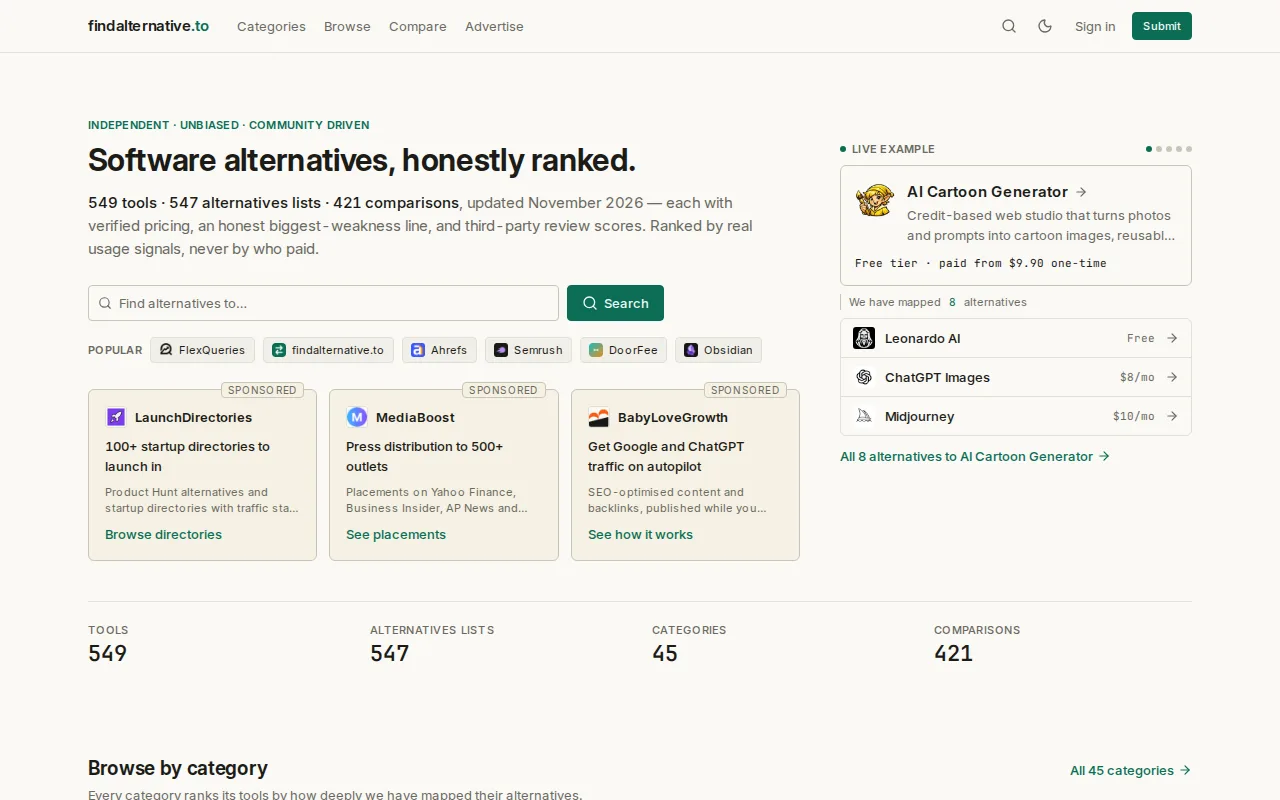
findalternative.to is the site you are reading, so weigh this entry with that in mind: it is not a launch platform and has no launch-day audience, leaderboard, votes or newsletter. What findalternative.to offers instead of Product Hunt's single Pacific-time day is a permanent listing: a profile with pricing dated to the day it was read on the vendor's site and a mandatory biggest weakness, the product's own ranked alternatives page, and a place on the alternatives pages of competitors it genuinely replaces. Listing is free with a findalternative.to badge on the maker's site, re-checked weekly, or $29 one-time with no badge, which publishes the same day and adds up to 5 head-to-head comparison pages against real competitors. Every page has a Markdown version, and an MCP server at /api/mcp lets an assistant query the directory once a user adds it. An Ahrefs study of 26,283 source URLs behind 750 ChatGPT prompts found that "best X" list articles made up 43.8% of the page types ChatGPT cited (Ahrefs); that describes page formats, not an outcome for any listing. Product Hunt is the better choice for a launch: it is free, says its newsletters reach over 1.5 million readers and carries reviews, while findalternative.to has been live only since September 2026, lists 500+ products, has no user reviews and publishes no visitor numbers.
Compared to Product Hunt: a permanent profile and alternatives page instead of a one-day launch, free with a badge on your site or $29 one-time, and no launch-day audience, votes or user reviews on this new site
Wins:A permanent profile with dated pricing and a mandatory biggest weakness, plus the product's own ranked alternatives page and placement on competitors' alternatives pages, where Product Hunt's spotlight lasts one Pacific-time day · No editorial featuring call: the $29 one-time listing needs no badge and publishes the same day, with up to 5 head-to-head comparison pages against real competitors · Every page has a Markdown version, and an MCP server with five query tools lets an AI assistant query the directory once a user adds it
Loses:No launch-day audience, leaderboard, votes or newsletter, where Product Hunt says its newsletters reach over 1.5 million readers · Live only since September 2026 with 500+ products, no published visitor numbers and search visibility still being built · No first-party user reviews, and the free listing lasts only while this site's badge stays on the maker's own site
Pros
- Listing is free with a badge on your own site, verified automatically and re-checked weekly; the $29 path needs no badge, goes live the same day and includes a drafted listing, up to five head-to-head comparisons with its listed competitors, and alternatives-page copy once three of them are listed.
- Products appear in the ranked alternatives lists of the tools they compete with, the "best X" list format that an Ahrefs study found made up 43.8% of the page types ChatGPT cited.
- Built for machine readers: an
/aiguide for assistants, a Markdown version of every page,llms.txt,llms-full.txt,sitemap.md, IndexNow pings to Bing on publish, and an open MCP server with five query tools. - The editorial rules are public on
/methodology: rank follows fit, every tool gets a biggest weakness, and Featured cards and ads are labeled and never change a rank. - Owners can add alternatives from their dashboard later, and free submitters can fill in the listing by pasting JSON from their own AI agent instead of typing it.
Cons
- Small and new: 500+ products and a two-month track record, no published visitor numbers, and search visibility still being built.
- No user reviews or ratings of its own; the review scores it shows come from G2, Capterra, Trustpilot and Product Hunt.
- The free path lasts only while its badge stays on your site: the weekly re-check moves a missing badge into a grace period and then downgrades the listing.
- By its own logs the major AI crawlers do not read its llms.txt, and Markdown versions are a convenience for agents rather than a known ranking factor: Google says its Search features use neither.
Pricing: Free tier · paid from $29 one-time — Free with a badge on the maker's site or $29 one-time vs Product Hunt's free launch (verified November 9, 2026)
Which one is right for you?
- You are pre-launch, want waitlist signups from early adopters, and want a refund if you are not selectedBetaList
- You want your launch on the homepage without an editor's call, on a fixed date, for $14.99 to $39.99Uneed
- You are an individual developer or designer who wants a free week of feedback from verified tech peersPeerlist
- You make an API, CLI or MCP server and want only developers voting on itDevHunt
- You make an AI tool and can pay $437 for a guaranteed newsletter feature, or you want to find an AI tool for one specific taskThere's An AI For That
- You are an early adopter who wants a hand-picked daily feed of new startups looking for beta testersBetaList
- Your launch day is over and you want a permanent listing on this site's alternatives and comparison pagesfindalternative.to
Frequently asked questions
Is there a free alternative to Product Hunt?
- Yes, Peerlist's Launchpad is the closest free alternative: a week-long launch from Monday, free for verified individual profiles. Uneed also has a free waiting line, which assigned May 12, 2027 to a product joining on November 9, 2026, and DevHunt's free listing gets a nofollow link and no launch week for new tools. BetaList ($39 to $299) and There's An AI For That ($49 or $437) charge for every self-serve submission.
What is the closest alternative to Product Hunt?
- Uneed is the closest match: it runs the same daily launch-leaderboard format, but every paid launch and up to 50 free launches a day reach its homepage instead of an editorial selection. Uneed's free waiting line ran to May 2027 in November 2026, so a set date costs $14.99 (Fast-track, about 14 days out) or $39.99 (Skip the line, any date).
Why wasn't my Product Hunt launch featured?
- Product Hunt's team hand-picks which launches appear on the homepage against its Featuring Guidelines (useful, novel, high craft, creative), and meeting them does not guarantee a spot. An independent Tetriz.io count found 16 featured launches a day in September 2024, down from 47 a year earlier, and an unfeatured launch is reachable only through its own link and the full daily list.
Which Product Hunt alternatives give a dofollow link?
- BetaList, Uneed and DevHunt do: BetaList's Visit Site button is dofollow for every featured startup, Uneed's Skip the line ($39.99) keeps a permanent dofollow link whatever the votes, and DevHunt's $49 launch makes the link dofollow. Peerlist gives a backlink only to the week's top 5, and There's An AI For That publishes no link policy. Product Hunt's own website links carried rel="ugc" in third-party checks in July 2026.
Can BetaList replace Product Hunt?
- BetaList can replace Product Hunt for a pre-launch startup that wants a guaranteed feature and waitlist signups, since every accepted startup is featured within about 14, 3 or 1 days and the rest are refunded. BetaList cannot match Product Hunt's reach or price: its newsletter has 70,000+ subscribers against Product Hunt's 1.5 million readers, and every submission costs $39 to $299.
Which Product Hunt alternative is best for developer tools?
- DevHunt is the best fit for developer tools: only dev tools compete, launches run a week from Tuesday, and votes require a GitHub or Google sign-in. A DevHunt launch costs $49 and includes a newsletter spot and a permanent dofollow link; Peerlist is the free option, with a week-long launch in a network where 58% of users are software engineers.
How long does a Product Hunt launch last compared with the alternatives?
- A Product Hunt launch competes for one Pacific-time day, from 12:01 AM to midnight, and then stays on the product's permanent Product Page. Uneed's launch day is followed by rolling 7-, 30- and 365-day leaderboards, Peerlist and DevHunt launches run a full week, and BetaList and There's An AI For That keep a permanent listing after the feature.