3 Best Free Alternatives to Pipedream in 2026
By Noahlast updated
Compared: free alternatives to Pipedream
| Alternative | Best for | Standout | Biggest weakness | Learning curve | Price |
|---|---|---|---|---|---|
| Pipedreamreference | developers who want code-level control (Python, Node.js, Bash, or Go) inside no-code-style workflow automation, and teams building AI agents against thousands of APIs | Any workflow step can run actual Python, Node.js, Bash, or Go code alongside no-code app connectors, and MCP servers expose 10,000+ tools directly to AI agents. | Pipedream's pricing moved to a credit-based model that's hard to estimate in advance — the public pricing page renders entirely client-side with no static content, and per-execution credit costs vary by step complexity, making exact monthly spend difficult to predict before building a workflow. | Moderate | Free |
| Zapier | non-developers and small operations teams who need to connect thousands of different apps through simple trigger-action automations, without engineering resources | The largest pre-built app-integration library in workflow automation, with thousands of supported apps, so most tools a team already uses can be connected without custom API work. | Pricing is metered by task volume, not just seats, so cost rises quickly for high-volume automations, and moving from 750 to 2,000 tasks/month on Professional roughly doubles the monthly bill; unused tasks don't roll over between billing periods. | Low | Free tier · paid from $19.99/mo |
| Make | operations, marketing, and IT teams that need visual, branching automation workflows across 3,000+ apps, beyond what simpler linear automation tools support | A canvas-style visual scenario builder with routers, filters, and branching logic that handles more complex multi-path automations than simpler linear automation tools, plus a natural-language builder (Maia) for describing automations in plain text. | Pricing is metered by operation credits rather than a flat seat price, so complex, high-volume scenarios can consume the monthly allowance quickly; the listed per-tier prices are also annual-billing rates, with monthly billing costing more, and building non-trivial branching scenarios has a real learning curve. | Moderate | Free tier · paid from $12/mo |
| n8n | technical teams that want to mix visual workflow building with custom code, either self-hosted for full control or on cloud paying per execution instead of per step | Billing by full workflow execution rather than by individual step or task, so complex multi-node automations don't multiply cost the way per-task pricing does on competitors. | Cloud pricing is listed in euros, not dollars, and jumps sharply from Pro (€50/month) to Business (€667/month), leaving a wide gap for teams that outgrow Pro's execution limits but don't need Business's SSO and compliance features. | Moderate | Free |
 Pipedream
 Zapier
 Make
Make n8n
n8n1.Zapier — best Pipedream alternative for non-developers and small operations teams who need to connect thousands of different apps through simple trigger-action automations, without engineering resources
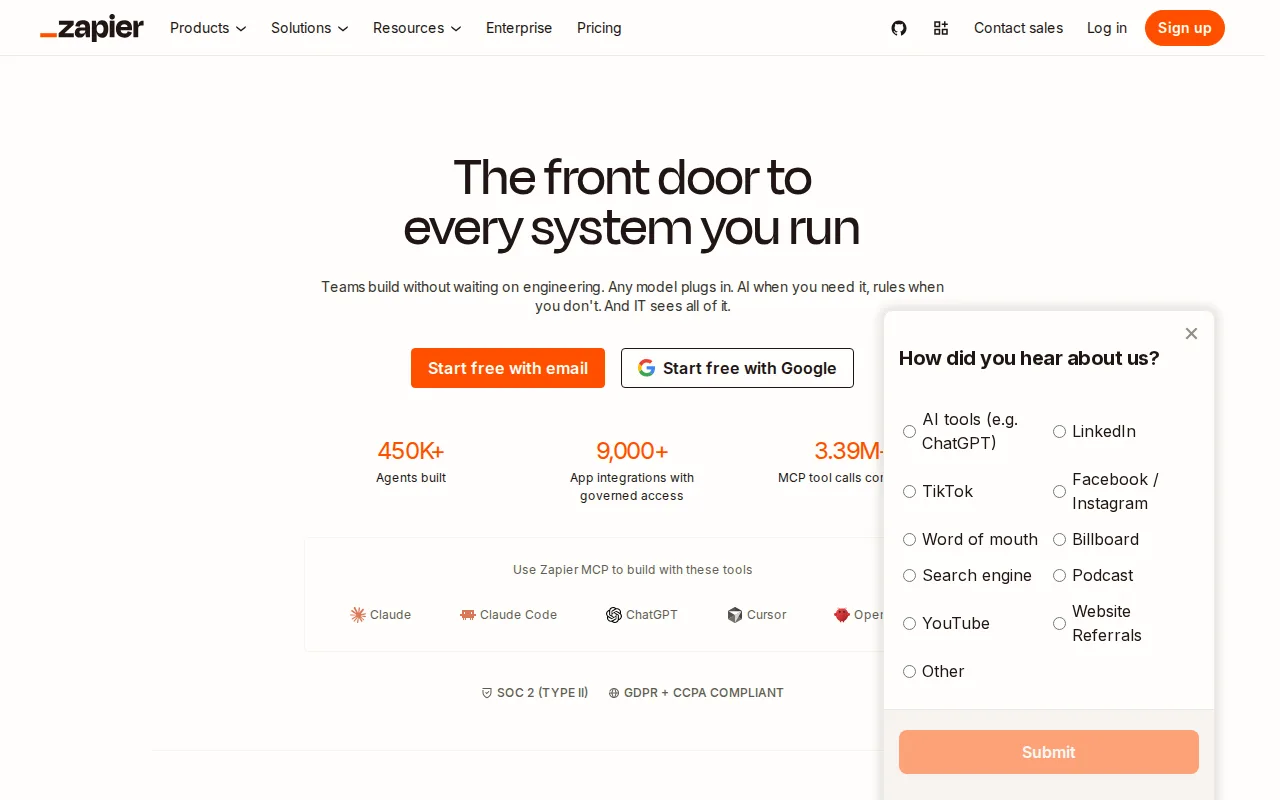
Zapier is the best Pipedream alternative for non-developers and small operations teams who need to connect thousands of apps through simple trigger-action automations without engineering resources. Zapier's Free plan supports real two-step automations at 100 tasks/month with no credit card, a clearer starting point than Pipedream's daily execution-credit cap, and Zapier holds a 4.7/5 rating from 3,069 Capterra reviews versus Pipedream's 5.0/5 from just 6 reviews, a far larger verified sample. Zapier's Professional tier starts at $19.99/month billed annually for 750 tasks/month, a published, predictable number, while Pipedream's paid tiers render pricing entirely client-side with no static content, making costs hard to estimate before building. Zapier's thousands of pre-built app connectors also mean most tools a team already uses connect without custom API work, unlike Pipedream's workflows, which often assume comfort writing Python, Node.js, Bash, or Go. Pipedream is still the better choice for developers who want code-level control inside workflow steps or teams building AI agents against MCP servers exposing 10,000+ tools: Zapier's task-based pricing scales directly with automation volume and can get expensive fast at high frequency, and its linear Zap editor is harder to debug for complex multi-branch logic than Pipedream's code-first approach.
Compared to Pipedream: 4.7/5 from 3,069 Capterra reviews vs Pipedream's 5.0/5 from only 6, published $19.99/month Professional pricing vs Pipedream's client-rendered pricing page with no static numbers, thousands of pre-built connectors requiring no custom code
Wins:4.7/5 rating from 3,069 Capterra reviews, a far larger verified sample than Pipedream's 5.0/5 from just 6 reviews · Published, predictable pricing ($19.99/month Professional for 750 tasks) versus Pipedream's client-side-only pricing page · Thousands of pre-built app connectors mean most existing tools connect without writing custom code
Loses:Task-based pricing scales directly with automation volume, and high-frequency workflows can get expensive quickly · No native support for dropping actual Python, Node.js, Bash, or Go code into a workflow step the way Pipedream allows · No MCP servers or AI-agent tool exposure comparable to Pipedream's 10,000+ tools for AI assistants
Pros
- Free plan supports real two-step automations, not just a trial, at 100 tasks/month.
- Broadest app-integration library among no-code automation tools, covering thousands of connectors.
- AI-assisted Zap building and AI fields reduce the manual setup needed for common workflows.
- Multi-step Zaps with filters, paths, and webhooks cover moderately complex logic without custom code.
Cons
- Task-based pricing means cost scales directly with automation volume, and high-frequency workflows can get expensive fast.
- Unused monthly tasks don't roll over, unlike some competitors' credit systems.
- Team and Enterprise features like SSO and shared workflows require a meaningful jump in monthly cost over Professional.
- Complex multi-branch logic can be harder to debug in Zapier's linear Zap editor than in visual-flow competitors like Make.
Pricing: Free tier · paid from $19.99/mo — $19.99/month Professional (750 tasks) vs Pipedream's unpublished credit-based paid tiers (verified undefined NaN, NaN)
2.Make — best Pipedream alternative for operations, marketing, and IT teams that need visual, branching automation workflows across 3,000+ apps, beyond what simpler linear automation tools support
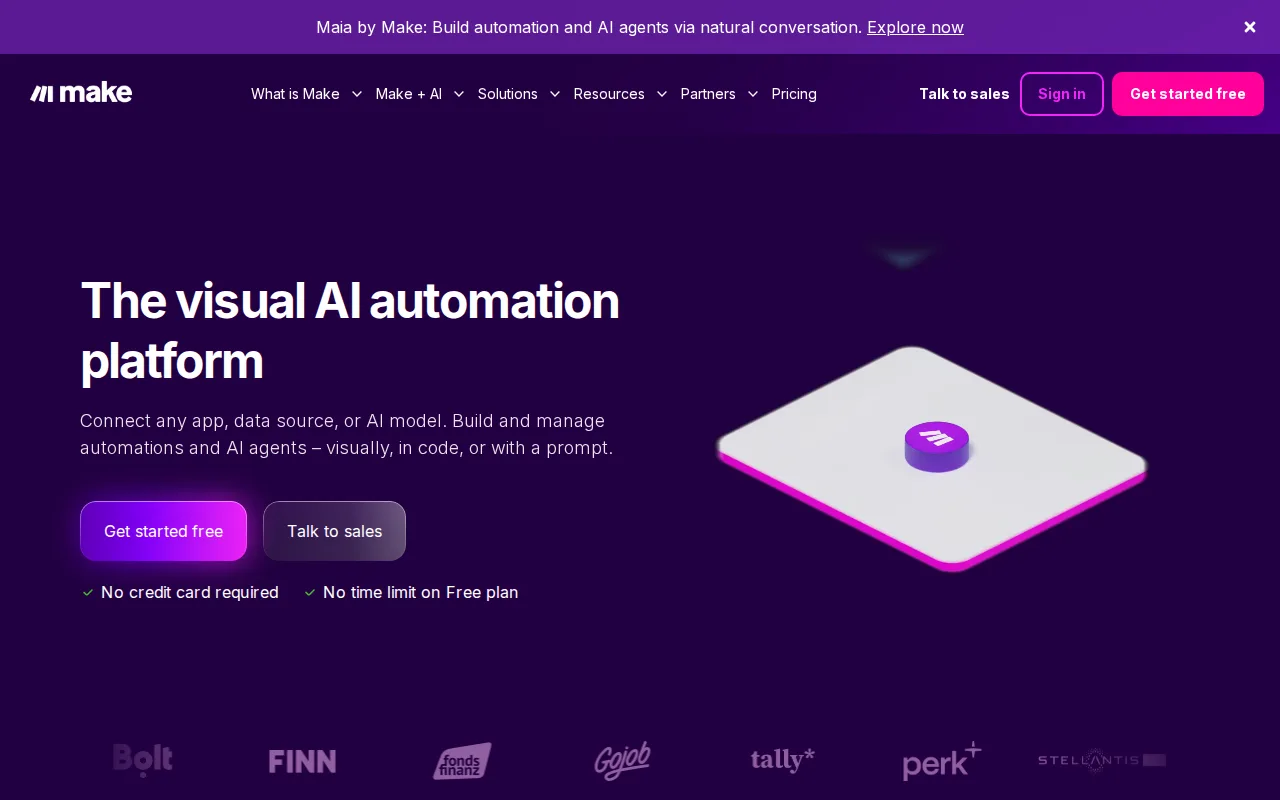
Make is the best Pipedream alternative for operations, marketing, and IT teams that need visual, branching automation workflows across thousands of apps. Make's canvas-style scenario builder with routers, filters, and branching logic handles complex multi-path automations more visibly than Pipedream's code-step approach, and Make holds a 4.8/5 rating from 408 Capterra reviews, the largest verified sample among Pipedream's alternatives. Make's Core plan starts at $12/month billed annually for 10,000 operations, a clear published number, while Pipedream's paid tiers render pricing client-side with no static fallback, leaving buyers unable to estimate cost before building. Make's Free plan also includes 1,000 operations/month, enough to build and test real automations, comparable in spirit to Pipedream's free daily execution credits but backed by a transparent operations count rather than an opaque credit system. Pipedream is still the better choice for developers who want to write actual Python, Node.js, Bash, or Go directly inside a workflow step, or teams building AI agents: Make's scenarios are configured visually rather than coded, its listed tier prices are annual-billing rates with monthly billing costing more, and non-trivial branching scenarios carry a real learning curve for non-technical users.
Compared to Pipedream: 4.8/5 from 408 Capterra reviews vs Pipedream's 5.0/5 from only 6, published $12/month Core pricing for 10,000 operations vs Pipedream's unpublished credit system, visual branching scenario builder vs Pipedream's code-step workflow model
Wins:4.8/5 rating from 408 Capterra reviews, a larger verified sample than Pipedream's 5.0/5 from just 6 reviews · Published pricing starting at $12/month for 10,000 operations, versus Pipedream's client-rendered, unconfirmed dollar figures · Canvas-style visual builder with routers and filters makes complex branching logic easier to see and debug
Loses:No native code-step option for dropping actual Python, Node.js, Bash, or Go into a workflow the way Pipedream allows · Listed tier prices are annual-billing rates; paying monthly costs more · No MCP servers or built-in AI agent tool exposure comparable to Pipedream's 10,000+ tools
Pros
- Visual scenario builder supports branching, routers, and filters for genuinely complex multi-path automations.
- 3,000+ app integrations cover most common business tools out of the box.
- Free tier (1,000 ops/month) is enough to build and test real automations before paying.
- Core plan starts at $12/month, undercutting some competitors for lower-volume users.
Cons
- Operation-credit pricing means complex or high-volume scenarios can burn through a plan's monthly allowance quickly.
- Listed tier prices are annual-billing rates; paying monthly costs more.
- Complex branching scenarios have a real learning curve for non-technical users.
- Free plan's 15-minute minimum interval between scenario runs limits near-real-time automation.
Pricing: Free tier · paid from $12/mo — $12/month Core (10,000 operations) vs Pipedream's unpublished credit-based paid tiers (verified undefined NaN, NaN)
3.n8n — best Pipedream alternative for technical teams that want to mix visual workflow building with custom code, either self-hosted for full control or on cloud paying per execution instead of per step
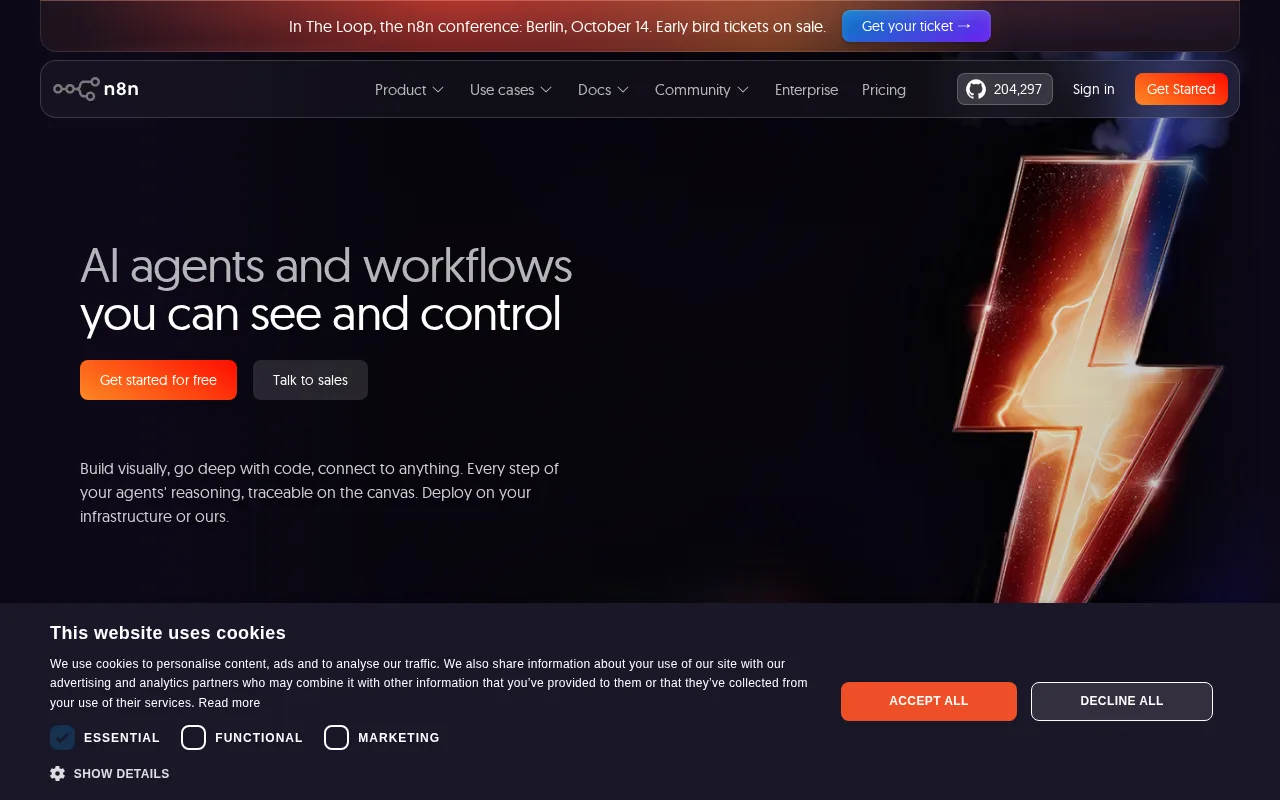
n8n is the best Pipedream alternative for technical teams that want to mix visual workflow building with custom code, either self-hosted for full control or on cloud paying per execution instead of per step. n8n's Self-hosted Community edition is free via Docker under the Sustainable Use License with the complete automation engine, a genuinely free path Pipedream doesn't offer since its free plan caps daily execution credits and active workflows. Both tools let a workflow step run custom code — n8n supports JavaScript or Python, Pipedream supports Python, Node.js, Bash, or Go — but n8n's cloud Starter tier publishes a clear €20/month price for 2,500 executions, while Pipedream's paid tiers render dollar amounts entirely client-side with no static fallback. n8n holds a 4.6/5 rating from 48 Capterra reviews, and its execution-based billing (per full workflow run, not per step) can be cheaper than credit-metered pricing for complex multi-node automations. Pipedream is still the better choice for teams that want the largest number of pre-built app integrations (1,000+) and MCP servers exposing 10,000+ tools directly to AI agents out of the box: n8n's cloud pricing jumps sharply from Pro (€50/month) to Business (€667/month) with nothing in between, and self-hosting n8n requires managing your own Docker infrastructure and updates.
Compared to Pipedream: free, fully-featured self-hosted Community edition vs Pipedream's credit-capped free plan, published €20/month Starter cloud pricing vs Pipedream's unpublished credit system, execution-based billing vs Pipedream's opaque per-execution credit costs
Wins:Free, fully self-hostable Community edition via Docker with the complete automation engine, unlike Pipedream's credit-capped free tier · Published cloud pricing starting at €20/month for 2,500 executions, versus Pipedream's client-rendered, unconfirmed pricing page · Bills by full workflow execution rather than by individual step, which can be cheaper for complex multi-node automations
Loses:Only 500+ pre-built app integrations versus Pipedream's 1,000+ · No MCP servers exposing 10,000+ tools to AI agents the way Pipedream ships out of the box · Cloud pricing jumps sharply from Pro (€50/month) to Business (€667/month), a wide gap Pipedream's model doesn't have
Pros
- Bills per full workflow execution, not per step, which can be cheaper than per-task pricing for complex automations.
- Free, fully-featured self-hosted Community edition via Docker with the complete automation engine.
- Every node can be extended or replaced with custom JavaScript or Python code.
- 500+ pre-built app integrations plus native support for building multi-agent AI workflows with human-in-the-loop steps.
Cons
- Large price jump between Pro (€50/month) and Business (€667/month) cloud tiers, with nothing in between.
- Sustainable Use License is not OSI-approved open source; enterprise features require a separate commercial license even for self-hosted use.
- Self-hosting requires managing your own Docker infrastructure, updates, and scaling, unlike a fully managed cloud automation tool.
- Visual canvas can get cluttered on large workflows with many branches and custom code nodes.
Pricing: Free — €20/month Starter cloud (2,500 executions) vs Pipedream's unpublished credit-based paid tiers (verified undefined NaN, NaN)