3 Best Free Alternatives to OnlyOffice in 2026
By Noahlast updated pricing verified
Compared: free alternatives to OnlyOffice
| Alternative | Best for | Standout | Biggest weakness | Learning curve | Price |
|---|---|---|---|---|---|
| OnlyOfficereference | organizations that need Microsoft Office-compatible editing but want the option to self-host on their own servers under an open-source license | AGPL 3.0-licensed source code that organizations can audit and self-host, combined with a DocSpace pricing model that charges only for admin seats while unlimited regular users join free. | Business Cloud pricing is per-admin rather than per-user, which can be confusing to compare against competitors, and users switching from Microsoft Office report formatting fidelity issues on complex documents with heavy macros or advanced layout. | Moderate | Free tier · paid from $20/mo |
| LibreOffice | individuals, schools, and organizations that want a full office suite without a subscription and can work without native real-time cloud co-authoring | A complete six-application office suite (including a desktop database tool in Base, which neither Microsoft nor Google offer at the consumer level) that is entirely free and open source with no feature paywall. | No native real-time multi-user co-authoring in the way Microsoft 365 or Google Workspace offer it, and complex documents with heavy Microsoft-specific formatting (advanced macros, certain chart types, some fonts) can render or convert imperfectly when round-tripped through .docx/.xlsx/.pptx. | Low | Free |
| Nextcloud | organizations that want a self-hosted, data-sovereign alternative to Google Workspace or Microsoft 365 for file sync, groupware, and video conferencing | A full collaboration suite (files, Talk conferencing, groupware, LibreOffice-based document editing, workflow automation) that self-hosts as one open-source codebase instead of stitching together separate tools. | Enterprise pricing requires a 100-user minimum to get a published rate, so smaller organizations wanting official support and SLA guarantees have to contact sales rather than see a self-serve price, and self-hosting the Community edition means the organization is responsible for its own updates, backups, and server maintenance. | Moderate | Free |
| Collabora Online | organizations that need on-premise, self-hosted document collaboration (data residency, compliance, or Nextcloud/ownCloud integration) instead of Google Workspace or Microsoft 365 SaaS | Built on LibreOffice's mature office-format engine and deployed entirely on your own infrastructure, integrating directly as the editing backend inside Nextcloud and ownCloud file-sync platforms. | Self-hosting is the whole model: even the paid Business and Enterprise tiers require running your own server infrastructure, so teams that want a zero-maintenance SaaS office suite like Google Workspace need to look elsewhere or pay for Collabora's managed support on top of hosting costs. | Moderate | Free tier · paid from $3.40/mo |
 OnlyOffice
 LibreOffice
 Nextcloud
 Collabora Online
1.LibreOffice — best OnlyOffice alternative for individuals, schools, and organizations that want a full office suite without a subscription and can work without native real-time cloud co-authoring
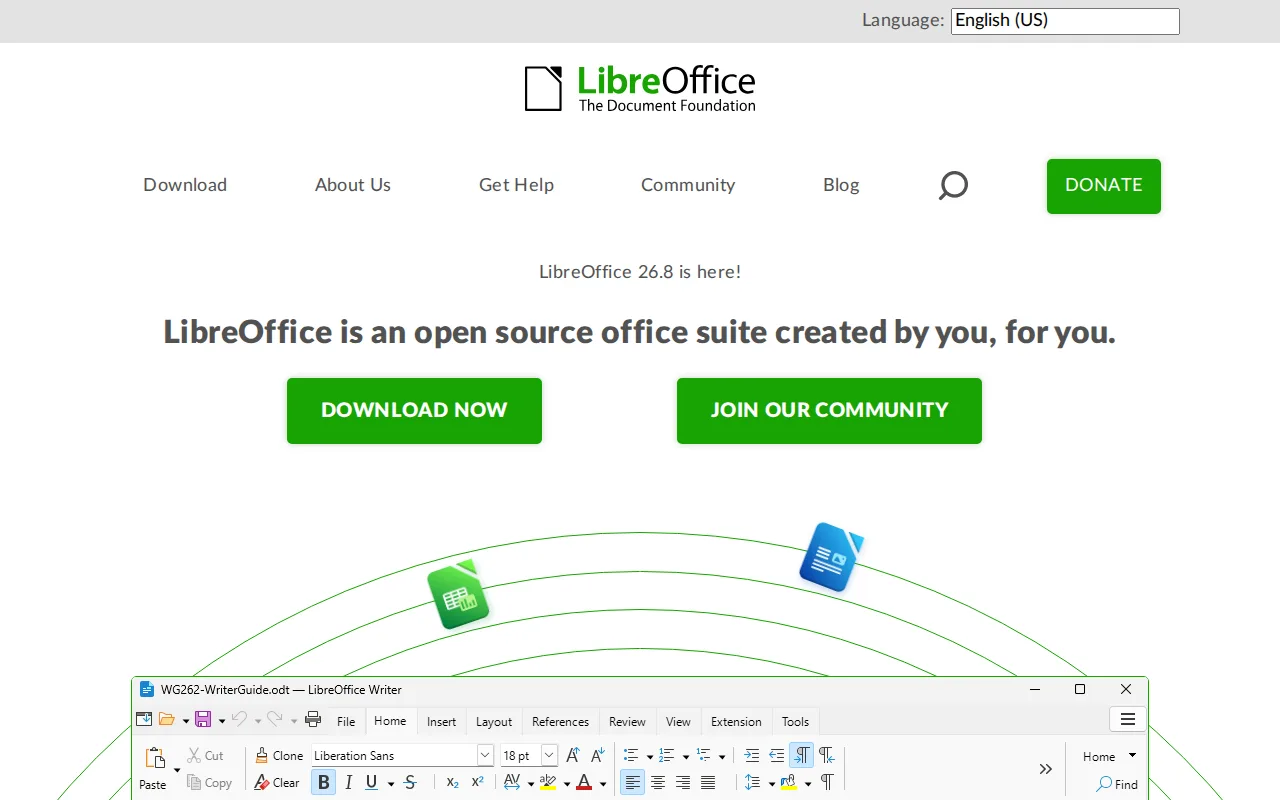
LibreOffice is the best OnlyOffice alternative for individuals and organizations that want a full office suite with absolutely no subscription, account, or license fee at any tier, going further than OnlyOffice's own free self-hosted Community Server, which still requires running and maintaining a server. LibreOffice includes six applications, Writer, Calc, Impress, Draw, Base, and Math, with Base a desktop database tool neither OnlyOffice nor most competitors offer at the consumer level. LibreOffice has no external rating on record, unlike OnlyOffice's 4.5/5 from 324 Capterra reviews. Both are open source, but LibreOffice's MPL-2.0/GPL/LGPL licensing needs no server deployment at all, just a local install on Windows, macOS, or Linux. OnlyOffice is still the better choice for teams that need real-time cloud co-editing and character-level change tracking: LibreOffice has no native real-time multi-user co-authoring the way OnlyOffice's DocSpace or Microsoft 365 and Google Workspace offer it, and complex Microsoft-format documents can lose fidelity when converted, a formatting risk OnlyOffice shares but positions closer to true Office compatibility.
Compared to OnlyOffice: zero cost at any tier with no server to run, a desktop database app (Base) neither product's core suite otherwise includes, no external rating on record vs OnlyOffice's 4.5/5 from 324 Capterra reviews
Wins:Completely free with no subscription, account, or feature paywall at any tier, and no server to deploy · Six-application suite includes Base, a desktop database tool most competitors omit · Runs fully offline as a local install with no internet dependency
Loses:No native real-time multi-user co-authoring, unlike OnlyOffice's character-level change tracking and DocSpace collaboration · No external rating on record, unlike OnlyOffice's 4.5/5 from 324 Capterra reviews · No official mobile apps for iOS/Android, unlike OnlyOffice's native mobile apps
Pros
- Completely free with no subscription, account, or feature paywall, including a desktop database app (Base) most competitors omit.
- Open source (MPL-2.0/GPL/LGPL) with an active community and frequent releases.
- Broad Microsoft Office format compatibility (.docx, .xlsx, .pptx) for opening and editing existing Office files.
- Runs on Windows, macOS, and Linux, and is the default suite on many Linux distributions.
Cons
- No native real-time cloud co-authoring like Microsoft 365 or Google Workspace, so simultaneous multi-user editing isn't built in.
- Complex Microsoft-format documents (advanced macros, some chart and font rendering) can lose fidelity when converted.
- No official mobile apps for iOS/Android under the LibreOffice brand.
- Interface and default styling feel dated compared to Microsoft Office or Google Workspace.
Pricing: Free — Free at every tier, no account or server required, vs OnlyOffice's free self-hosted Community Server or $20/admin/month DocSpace (verified undefined NaN, NaN)
2.Nextcloud — best OnlyOffice alternative for organizations that want a self-hosted, data-sovereign alternative to Google Workspace or Microsoft 365 for file sync, groupware, and video conferencing
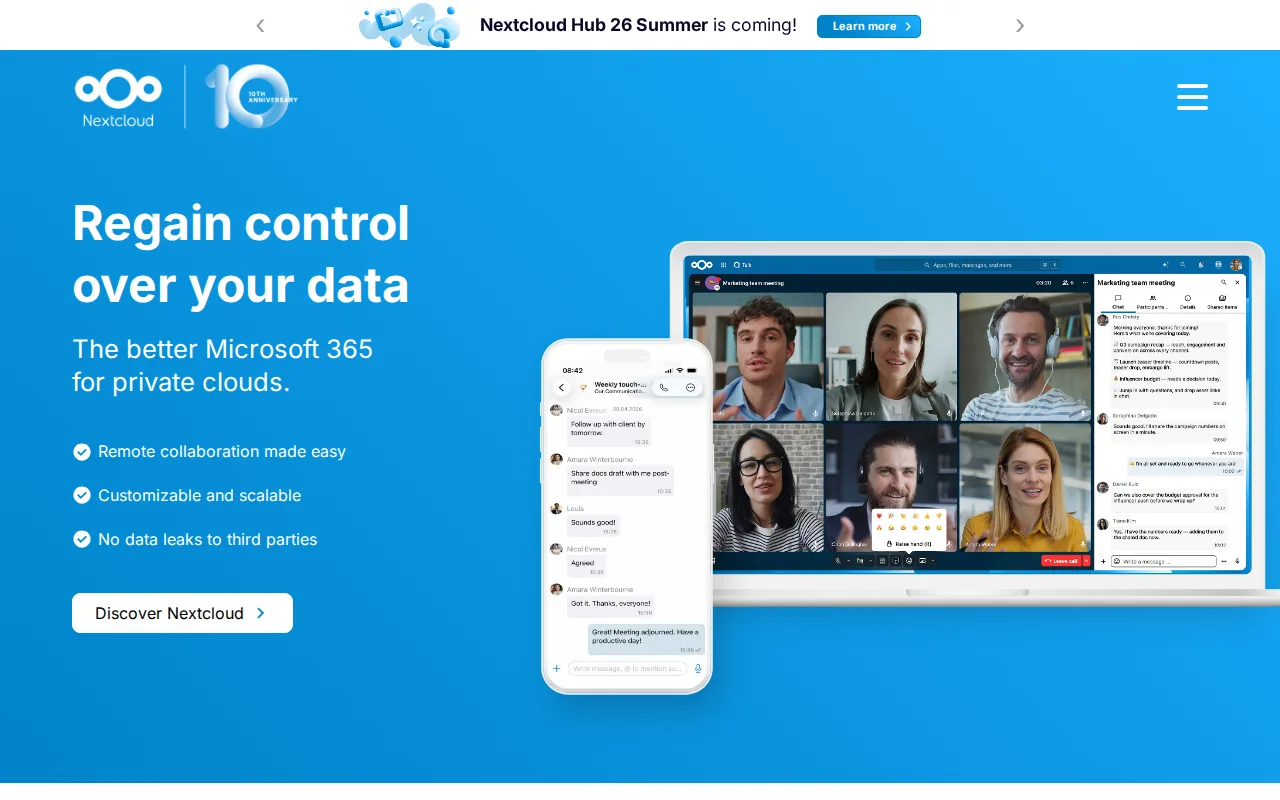
Nextcloud is the best OnlyOffice alternative for organizations that want document editing bundled inside a broader self-hosted collaboration suite, since Nextcloud's Office app is built on LibreOffice and ships alongside Talk video conferencing, groupware, and workflow automation in one codebase, going beyond OnlyOffice's narrower document-editing focus. Nextcloud's Community edition is free to self-host with no user minimum, matching OnlyOffice's own free Community Server, while Nextcloud's paid enterprise tiers start around €71.29/user/year for 100+ users, a different pricing model than OnlyOffice's per-admin DocSpace at $20/admin/month. Nextcloud holds a 4.6/5 rating from 443 Capterra reviews, more review volume than OnlyOffice's 4.5/5 from 324. Both are AGPL-licensed and self-hostable, but Nextcloud's file sync, calendar, and video conferencing apps go further than OnlyOffice's document-only focus. OnlyOffice is still the better choice for organizations that specifically need Microsoft Office-compatible document editing as the primary workload: Nextcloud's document editing depends on its bundled LibreOffice-based Office app rather than OnlyOffice's own AGPL 3.0 editors built for Office-format fidelity, and Nextcloud's enterprise pricing requires a 100-user minimum to see a published rate at all.
Compared to OnlyOffice: file sync, Talk video conferencing, and groupware bundled alongside document editing in one codebase, a 4.6/5 rating from 443 Capterra reviews vs OnlyOffice's 4.5/5 from 324, enterprise pricing from €71.29/user/year (100+ users) vs OnlyOffice's $20/admin/month DocSpace
Wins:Bundles file sync, Talk video conferencing, groupware, and workflow automation alongside document editing in one codebase · 4.6/5 rating from 443 Capterra reviews vs OnlyOffice's 4.5/5 from 324 · Scales from a single Raspberry Pi to distributed installations serving tens of millions of users
Loses:Document editing depends on a bundled LibreOffice-based Office app rather than dedicated Office-format editors like OnlyOffice's own · Enterprise pricing requires a 100-user minimum to see a published rate at all · Complex documents with heavy formatting can render less faithfully than a dedicated Office-compatible editor
Pros
- Fully open source (AGPL-3.0) and free to self-host with no user limit on the Community edition.
- Bundles file sync, video conferencing, groupware, and document editing into one connected suite.
- Scales from a single Raspberry Pi to distributed installations serving tens of millions of users.
- Native apps across web, Windows, macOS, Linux, iOS, and Android.
Cons
- Enterprise support pricing starts at a 100-user minimum, with no published self-serve rate for smaller teams.
- Self-hosting the Community edition puts the burden of updates, backups, and uptime on the organization's own IT staff.
- Performance and app ecosystem depend heavily on the hosting hardware and configuration, unlike a fully managed SaaS suite.
- The large number of optional apps can make initial setup and configuration more complex than a single-purpose file-sync tool.
Pricing: Free — Free self-hosted Community edition, then from €71.29/user/year enterprise (100+ users) vs OnlyOffice's $20/admin/month DocSpace with unlimited free users (verified undefined NaN, NaN)
3.Collabora Online — best OnlyOffice alternative for organizations that need on-premise, self-hosted document collaboration (data residency, compliance, or Nextcloud/ownCloud integration) instead of Google Workspace or Microsoft 365 SaaS
Collabora Online is the best OnlyOffice alternative for organizations that want the lowest published per-user cost for self-hosted, LibreOffice-based document collaboration, at roughly $3.40/user/month for Collabora Online for Business, well under OnlyOffice's $20/admin/month DocSpace pricing. The free Collabora Online Development Edition (CODE) is open source and self-hostable, matching OnlyOffice's own free Community Server option. Collabora Online holds a 4.7/5 rating from 102 Capterra reviews, slightly higher than OnlyOffice's 4.5/5 from 324, though from a smaller review base. Collabora Online integrates directly as the editing backend inside Nextcloud and ownCloud, a deployment pattern OnlyOffice also supports as an integration. OnlyOffice is still the better choice for organizations that want document editing and collaboration as a full standalone product rather than one built for integration into another file-sync platform: Collabora's free CODE edition explicitly isn't meant for production use, and its Business tier caps out at 99 users before requiring custom-quoted Enterprise pricing, while OnlyOffice's DocSpace charges only for admin seats with unlimited regular users at any scale.
Compared to OnlyOffice: Business tier priced at roughly $3.40/user/month vs OnlyOffice's $20/admin/month DocSpace, a 4.7/5 rating from 102 Capterra reviews vs OnlyOffice's 4.5/5 from 324, direct integration as the editing backend for Nextcloud and ownCloud
Wins:Business tier priced at roughly $3.40/user/month, well under OnlyOffice's per-admin DocSpace pricing · 4.7/5 rating from 102 Capterra reviews vs OnlyOffice's 4.5/5 from 324 · Integrates directly as the editing backend for Nextcloud and ownCloud file-sync platforms
Loses:Free CODE edition explicitly isn't meant for production use, unlike OnlyOffice's free Community Server · Business tier caps out at 99 users before requiring custom-quoted Enterprise pricing · Smaller integration and template ecosystem than OnlyOffice's broader 40+ third-party integrations
Pros
- Free, open-source core (CODE) with full LibreOffice-based document, spreadsheet, and presentation editing.
- Self-hosted deployment gives full control over data residency and compliance, unlike SaaS office suites.
- Native integration as the editing backend for Nextcloud and ownCloud file-sync platforms.
- Supports Windows, macOS, Linux, iOS, and Android, plus the browser editor, a broader native platform spread than most office suite competitors.
Cons
- Self-hosting requires running and maintaining your own server infrastructure, even on paid tiers.
- The free CODE edition explicitly isn't meant for production use; long-term support requires the paid Business tier.
- Business tier caps out at 99 users; larger organizations must move to custom-quoted Enterprise pricing.
- Smaller integration and template ecosystem than Google Workspace or Microsoft 365.
Pricing: Free tier · paid from $3.40/mo — Free CODE edition, then roughly $3.40/user/month (Business, up to 99 users) vs OnlyOffice's $20/admin/month DocSpace with unlimited free users (verified undefined NaN, NaN)