LibreOffice — A free, open-source office suite with word processing, spreadsheets, presentations, and more, maintained by The Document Foundation.

By Noahlast updated pricing verified
LibreOffice screenshots & video
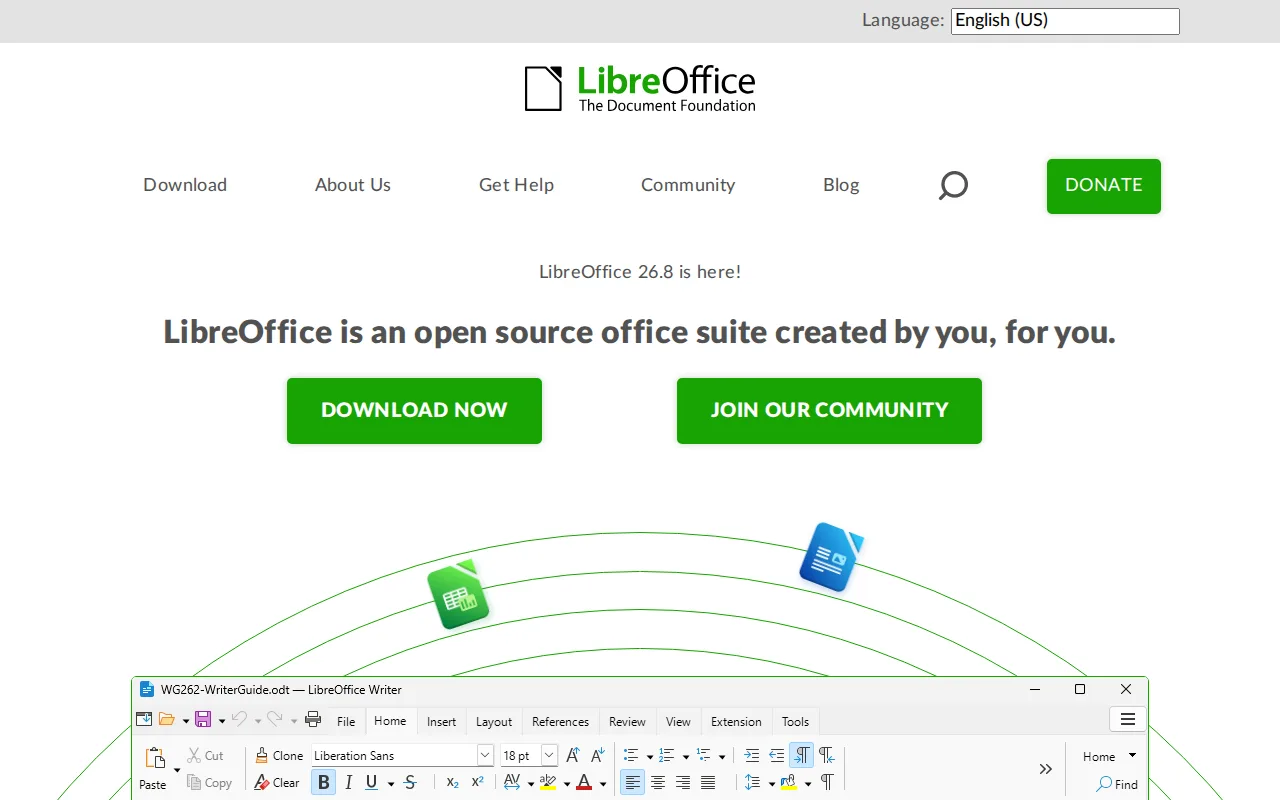
LibreOffice in 20 seconds
Best for: individuals, schools, and organizations wanting a full free office suite without a subscription
Pricing: Completely free; no paid tier or subscription.
- LibreOffice includes six applications: Writer, Calc, Impress, Draw, Base, and Math.
- It is licensed under the Mozilla Public License 2.0, with some components under GPL/LGPL.
- LibreOffice was forked from OpenOffice.org in 2010 and is maintained by The Document Foundation.
- It natively uses OpenDocument Format (ODF) and supports Microsoft Office formats (.docx, .xlsx, .pptx).
- The suite is entirely free with no paid tier, running on Windows, macOS, and Linux.
Limitations: No native real-time cloud co-authoring like Microsoft 365 or Google Workspace.; Complex Microsoft-format documents can lose fidelity on conversion.; No official mobile apps under the LibreOffice brand.
Top alternatives: Microsoft Office, Google Workspace, OnlyOffice, WPS Office, Apache OpenOffice — full list
What is LibreOffice?
LibreOffice is a full desktop office suite forked from OpenOffice.org in 2010, now maintained by the nonprofit Document Foundation with contributions from a large volunteer community and some corporate sponsors. It bundles six applications covering the core office-productivity workflow: Writer for documents, Calc for spreadsheets, Impress for presentations, Draw for vector illustration and diagramming, Base for desktop databases, and Math for typesetting mathematical formulas. The suite is licensed under the Mozilla Public License 2.0, with some components under GPL or LGPL, and its source is published on GitHub (a read-only mirror of the primary Gerrit-hosted repository at github.com/LibreOffice/core). LibreOffice natively uses the OpenDocument Format (ODF) but has broad, actively maintained compatibility with Microsoft Office file formats (.docx, .xlsx, .pptx, .doc, .xls, .ppt), which is its most common practical use case: opening and editing Office documents without an Office 365 subscription. It's distributed entirely free with no paid tier, no account requirement, and no feature gating, and is available for Windows, macOS, and Linux (it's also the default office suite on many Linux distributions). LibreOffice is used by individuals avoiding subscription software, schools and public-sector organizations standardizing on open formats, and Linux users who need a full office suite out of the box; it lacks the real-time cloud co-authoring that Microsoft 365 and Google Workspace both offer natively.
LibreOffice is a free and open-source office productivity suite made up of six applications: Writer (word processing), Calc (spreadsheets), Impress (presentations), Draw (vector graphics/diagrams), Base (databases), and Math (formula editing). It's developed by The Document Foundation and a global volunteer community, distributed under the Mozilla Public License 2.0 (with parts under GPL/LGPL), and runs on Windows, macOS, and Linux at no cost with no paid tier. It supports OpenDocument Format natively and reads/writes Microsoft Office formats (.docx, .xlsx, .pptx), making it a common no-cost alternative to Microsoft Office for individuals, schools, and organizations that don't need Office 365's cloud collaboration features.
Standout feature: A complete six-application office suite (including a desktop database tool in Base, which neither Microsoft nor Google offer at the consumer level) that is entirely free and open source with no feature paywall.
Biggest weakness: No native real-time multi-user co-authoring in the way Microsoft 365 or Google Workspace offer it, and complex documents with heavy Microsoft-specific formatting (advanced macros, certain chart types, some fonts) can render or convert imperfectly when round-tripped through .docx/.xlsx/.pptx.
Pros
- Completely free with no subscription, account, or feature paywall, including a desktop database app (Base) most competitors omit.
- Open source (MPL-2.0/GPL/LGPL) with an active community and frequent releases.
- Broad Microsoft Office format compatibility (.docx, .xlsx, .pptx) for opening and editing existing Office files.
- Runs on Windows, macOS, and Linux, and is the default suite on many Linux distributions.
Cons
- No native real-time cloud co-authoring like Microsoft 365 or Google Workspace, so simultaneous multi-user editing isn't built in.
- Complex Microsoft-format documents (advanced macros, some chart and font rendering) can lose fidelity when converted.
- No official mobile apps for iOS/Android under the LibreOffice brand.
- Interface and default styling feel dated compared to Microsoft Office or Google Workspace.
LibreOffice pricing
Free · verified from the vendor's pricing page
| Plan | Price | Notes |
|---|---|---|
| Free | Free | Full suite (Writer, Calc, Impress, Draw, Base, Math) with no feature restrictions, no account, and no subscription. |
What reviewers say
No third-party review scores on file yet.