3 Best Free Alternatives to Node-RED in 2026
By Noahlast updated pricing verified
Compared: free alternatives to Node-RED
| Alternative | Best for | Standout | Biggest weakness | Learning curve | Price |
|---|---|---|---|---|---|
| Node-REDreference | hobbyists and engineers who need a free, visual way to wire together IoT devices, APIs, and data pipelines without writing a full application from scratch | A drag-and-drop flow editor backed by an ecosystem of over 5,000 community-built nodes, covering integrations from MQTT and REST APIs to specific hardware like Raspberry Pi and Arduino. | Flows can become difficult to read, version, and debug at scale since Node-RED has no built-in first-class testing framework, and complex logic buried inside function nodes effectively becomes untracked JavaScript that's hard to review. | Moderate | Free |
| n8n | technical teams that want to mix visual workflow building with custom code, either self-hosted for full control or on cloud paying per execution instead of per step | Billing by full workflow execution rather than by individual step or task, so complex multi-node automations don't multiply cost the way per-task pricing does on competitors. | Cloud pricing is listed in euros, not dollars, and jumps sharply from Pro (€50/month) to Business (€667/month), leaving a wide gap for teams that outgrow Pro's execution limits but don't need Business's SSO and compliance features. | Moderate | Free |
| Zapier | non-developers and small operations teams who need to connect thousands of different apps through simple trigger-action automations, without engineering resources | The largest pre-built app-integration library in workflow automation, with thousands of supported apps, so most tools a team already uses can be connected without custom API work. | Pricing is metered by task volume, not just seats, so cost rises quickly for high-volume automations, and moving from 750 to 2,000 tasks/month on Professional roughly doubles the monthly bill; unused tasks don't roll over between billing periods. | Low | Free tier · paid from $19.99/mo |
| Make | operations, marketing, and IT teams that need visual, branching automation workflows across 3,000+ apps, beyond what simpler linear automation tools support | A canvas-style visual scenario builder with routers, filters, and branching logic that handles more complex multi-path automations than simpler linear automation tools, plus a natural-language builder (Maia) for describing automations in plain text. | Pricing is metered by operation credits rather than a flat seat price, so complex, high-volume scenarios can consume the monthly allowance quickly; the listed per-tier prices are also annual-billing rates, with monthly billing costing more, and building non-trivial branching scenarios has a real learning curve. | Moderate | Free tier · paid from $12/mo |
 Node-RED
 n8n
n8n Zapier
 Make
Make1.n8n — best Node-RED alternative for technical teams that want to mix visual workflow building with custom code, either self-hosted for full control or on cloud paying per execution instead of per step
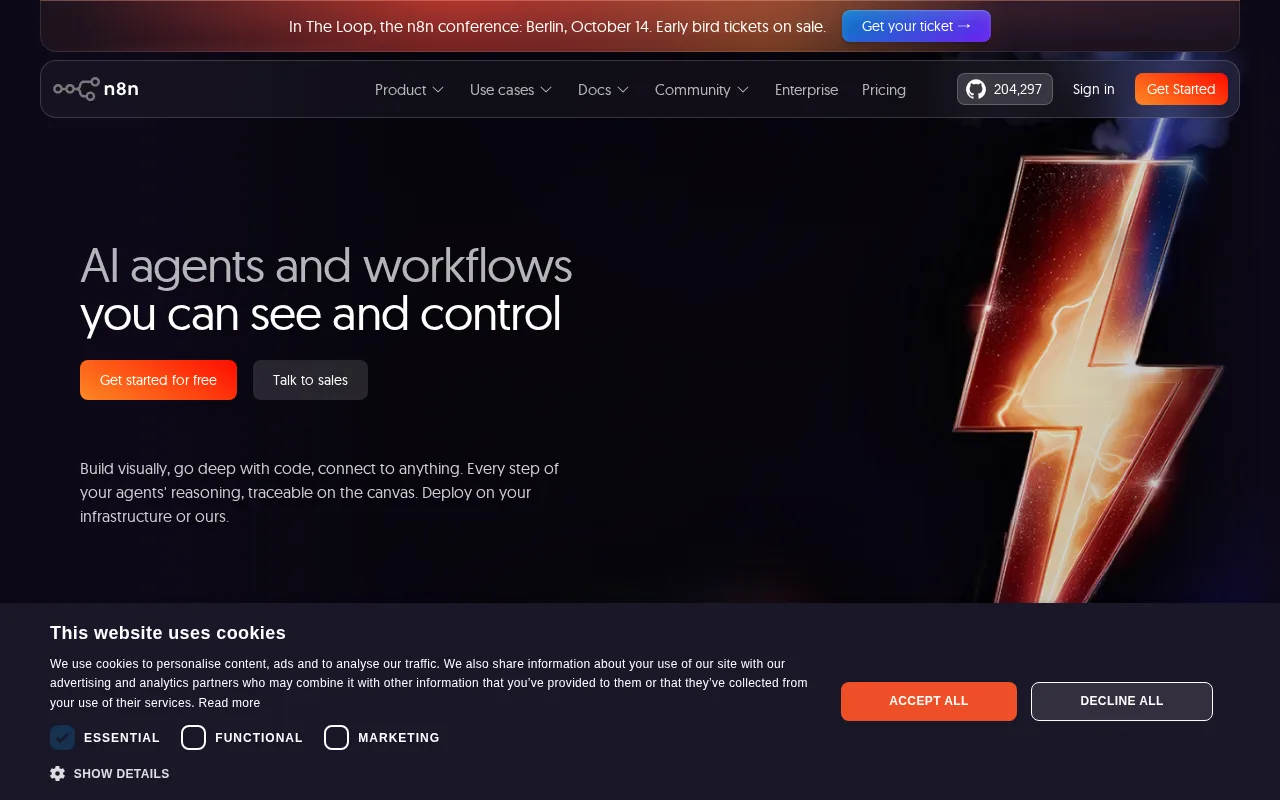
n8n is the best Node-RED alternative for technical teams that want to keep Node-RED's mix of visual building and custom code, but with 500+ pre-built app integrations and a fair-code licensing model instead of assembling function nodes from scratch. Like Node-RED, n8n can be self-hosted entirely free via Docker under its Sustainable Use License, with the same core automation engine available at no cost; n8n holds a 4.6/5 rating from 48 Capterra reviews, a review base Node-RED's single Product Hunt review doesn't match. n8n's cloud tiers start at 20 euros/month (Starter, billed annually) for 2,500 workflow executions, and every node can be swapped for custom JavaScript or Python when a pre-built integration doesn't cover a use case, directly extending Node-RED's own function-node model. Node-RED is still the better choice for hobbyist IoT and hardware projects: it deploys to Raspberry Pi, BeagleBone Black, and Arduino with an ecosystem of over 5,000 community-built nodes for specific hardware integrations, a niche n8n's app-integration-first design doesn't target the same way, and Node-RED has no licensing cost of any kind, while n8n's Sustainable Use License gates enterprise features like SSO behind a separate commercial license even for self-hosted use.
Compared to Node-RED: 500+ pre-built app integrations instead of building function nodes from scratch, bills cloud usage per full workflow execution (from 20 euros/month) rather than being entirely free like Node-RED, workflows can be version-controlled with Git on Business and Enterprise tiers
Wins:500+ pre-built app integrations reduce the need to hand-build function-node logic the way Node-RED often requires · Holds a 4.6/5 rating from 48 Capterra reviews, a review base Node-RED's single Product Hunt review doesn't approach · Bills cloud usage by full workflow execution rather than per step, which can be cheaper than per-task competitors for complex automations
Loses:Cloud tiers start at 20 euros/month for meaningful execution volume, while Node-RED itself has no licensing cost of any kind, only self-hosting infrastructure · No equivalent to Node-RED's ecosystem of over 5,000 community-built nodes for specific hardware like Raspberry Pi, BeagleBone Black, and Arduino · Sustainable Use License is not OSI-approved open source, and enterprise features require a separate commercial license even for self-hosted use, unlike Node-RED's fully open Apache 2.0 license
Pros
- Bills per full workflow execution, not per step, which can be cheaper than per-task pricing for complex automations.
- Free, fully-featured self-hosted Community edition via Docker with the complete automation engine.
- Every node can be extended or replaced with custom JavaScript or Python code.
- 500+ pre-built app integrations plus native support for building multi-agent AI workflows with human-in-the-loop steps.
Cons
- Large price jump between Pro (€50/month) and Business (€667/month) cloud tiers, with nothing in between.
- Sustainable Use License is not OSI-approved open source; enterprise features require a separate commercial license even for self-hosted use.
- Self-hosting requires managing your own Docker infrastructure, updates, and scaling, unlike a fully managed cloud automation tool.
- Visual canvas can get cluttered on large workflows with many branches and custom code nodes.
Pricing: Free — Node-RED is entirely free with no licensing cost; n8n's Self-hosted Community edition is also free, with cloud plans starting at 20 euros/month (Starter, billed annually) for 2,500 executions (verified undefined NaN, NaN)
2.Zapier — best Node-RED alternative for non-developers and small operations teams who need to connect thousands of different apps through simple trigger-action automations, without engineering resources
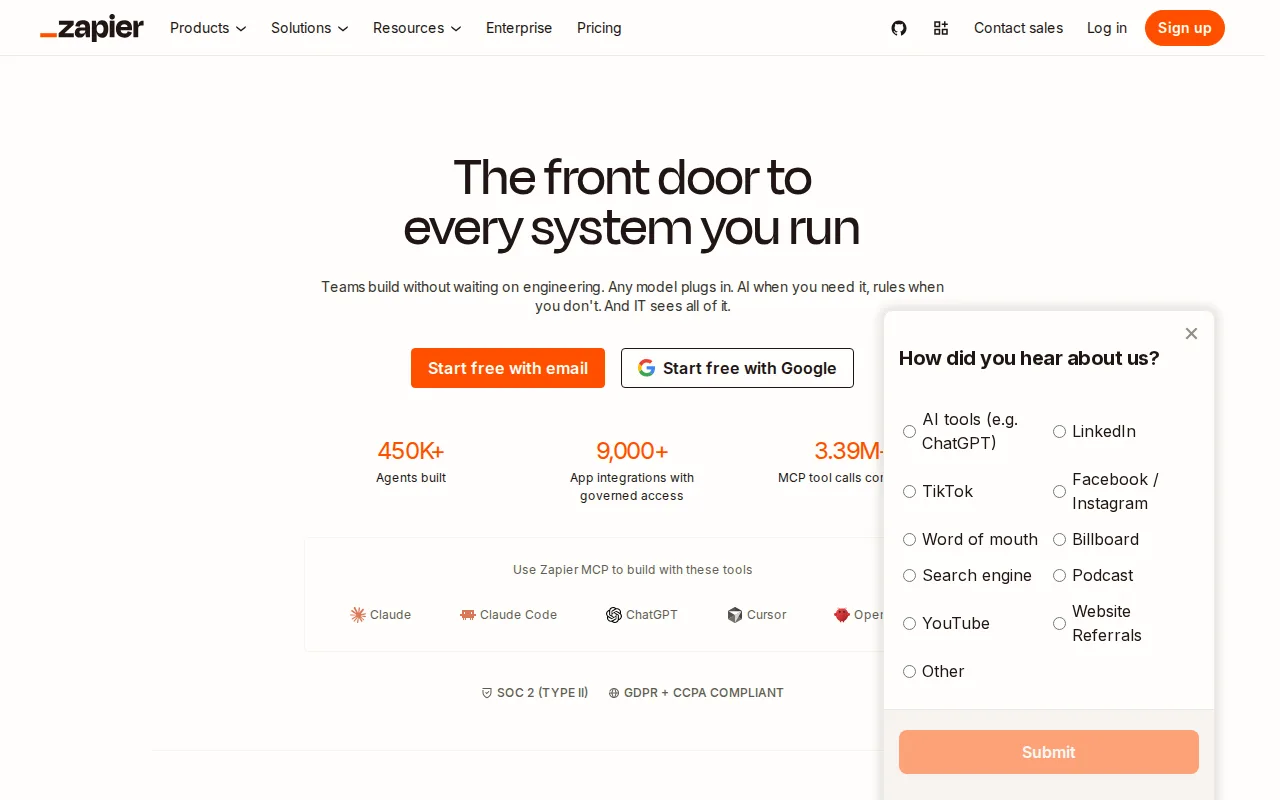
Zapier is the best Node-RED alternative for non-developers and small operations teams who need to connect apps through simple trigger-and-action automations without writing any code at all, a much lower technical bar than Node-RED's node-and-wire flow editor. Zapier's Free plan covers 100 tasks/month with two-step Zaps at no cost, and Professional starts around $19.99/month billed annually for 750 tasks/month; Zapier holds a 4.7/5 rating from 3,069 Capterra reviews, by far the largest review base of any Node-RED alternative here. Zapier connects thousands of pre-built app integrations, a breadth Node-RED's 5,000+ community nodes cover from a different, more hardware-and-protocol-focused angle. Node-RED is still the better choice for anyone who needs genuinely free, unlimited automation with no task-volume billing at all: Zapier's pricing is metered by task volume, so cost rises quickly for high-volume automations, and moving from 750 to 2,000 tasks/month roughly doubles the monthly bill, while Node-RED has no per-execution cost of any kind since it's self-hosted, open-source software maintained by the OpenJS Foundation.
Compared to Node-RED: no-code automation with thousands of pre-built app integrations rather than a visual node-and-wire flow editor, holds a 4.7/5 rating from 3,069 Capterra reviews versus Node-RED's single review, pricing is metered by task volume starting at 100 free tasks/month
Wins:No-code automation lowers the technical bar well below Node-RED's node-and-wire flow editor, which still allows embedding raw JavaScript in function nodes · Holds a 4.7/5 rating from 3,069 Capterra reviews, the largest review base of any Node-RED alternative in our listing data · Broadest pre-built app-integration library among no-code automation tools, connecting thousands of apps without custom API work
Loses:Task-based pricing means cost scales directly with automation volume, unlike Node-RED's entirely free, self-hosted model with no per-execution charge · Cloud-only with no self-hosting option, unlike Node-RED, which runs on a user's own Raspberry Pi, Docker container, or cloud VM at no licensing cost · Unused monthly tasks don't roll over between billing periods, a constraint that doesn't apply to Node-RED's unmetered self-hosted flows
Pros
- Free plan supports real two-step automations, not just a trial, at 100 tasks/month.
- Broadest app-integration library among no-code automation tools, covering thousands of connectors.
- AI-assisted Zap building and AI fields reduce the manual setup needed for common workflows.
- Multi-step Zaps with filters, paths, and webhooks cover moderately complex logic without custom code.
Cons
- Task-based pricing means cost scales directly with automation volume, and high-frequency workflows can get expensive fast.
- Unused monthly tasks don't roll over, unlike some competitors' credit systems.
- Team and Enterprise features like SSO and shared workflows require a meaningful jump in monthly cost over Professional.
- Complex multi-branch logic can be harder to debug in Zapier's linear Zap editor than in visual-flow competitors like Make.
Pricing: Free tier · paid from $19.99/mo — Node-RED has no licensing cost of any kind; Zapier's Free plan covers 100 tasks/month, with Professional starting around $19.99/month billed annually for 750 tasks/month (verified undefined NaN, NaN)
3.Make — best Node-RED alternative for operations, marketing, and IT teams that need visual, branching automation workflows across 3,000+ apps, beyond what simpler linear automation tools support
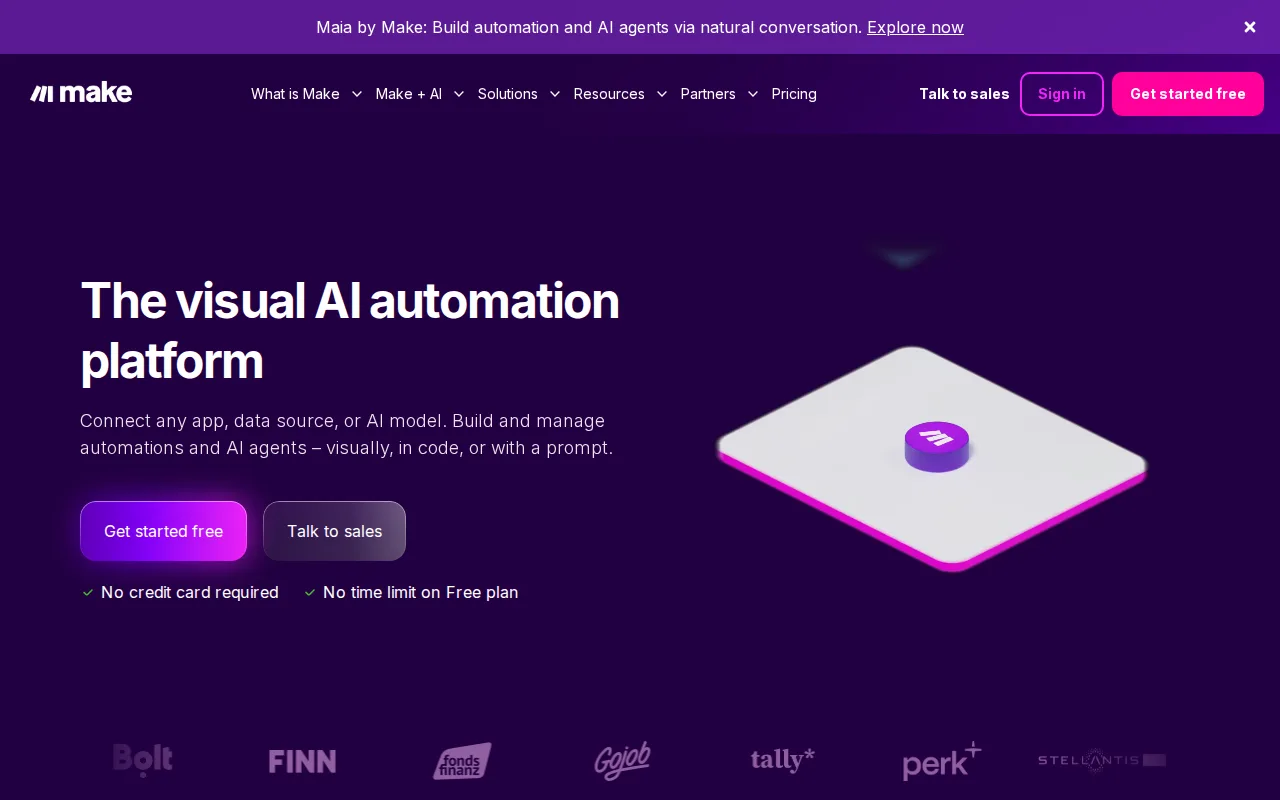
Make is the best Node-RED alternative for teams that want Node-RED's visual, canvas-style building approach but backed by 3,000+ pre-built app integrations and routers, filters, and branching logic for genuinely complex multi-path automations. Make's Free plan includes 1,000 operations/month at no cost, comparable in spirit to Node-RED's own zero-cost model, and Core starts at $12/month for 10,000 operations billed annually. Make holds a 4.8/5 rating from 408 Capterra reviews, the highest score among Node-RED's listed alternatives and a review base Node-RED's single Product Hunt review doesn't approach. Make also supports building automations through Maia, a conversational AI assistant for describing an automation in natural language, a capability Node-RED's node-and-wire model doesn't offer. Node-RED is still the better choice for anyone who wants zero ongoing cost regardless of automation volume, and for hobbyist hardware and IoT integrations specifically: Make's operation-credit pricing means complex or high-volume scenarios can burn through a plan's monthly allowance quickly, while Node-RED has no licensing cost or operation limit of any kind, and its ecosystem of over 5,000 community nodes covers specific hardware platforms that Make's business-app-focused integrations don't target.
Compared to Node-RED: routers, filters, and branching logic across 3,000+ pre-built app integrations, holds a 4.8/5 rating from 408 Capterra reviews versus Node-RED's single review, Maia natural-language assistant describes automations in plain text
Wins:Routers, filters, and branching logic across 3,000+ pre-built app integrations handle more complex multi-path automations than assembling function nodes by hand in Node-RED · Holds a 4.8/5 rating from 408 Capterra reviews, the highest score among Node-RED's listed alternatives · Maia, a natural-language assistant for describing automations in plain text, has no equivalent in Node-RED's node-and-wire editor
Loses:Operation-credit pricing means complex or high-volume scenarios can burn through a plan's monthly allowance quickly, unlike Node-RED's unmetered, self-hosted, zero-cost model · No self-hosting option at all; Make is a cloud-only product, while Node-RED deploys to a user's own Raspberry Pi, Docker container, or cloud VM for free · No equivalent to Node-RED's ecosystem of over 5,000 community-built nodes for specific hardware like Raspberry Pi, BeagleBone Black, and Arduino
Pros
- Visual scenario builder supports branching, routers, and filters for genuinely complex multi-path automations.
- 3,000+ app integrations cover most common business tools out of the box.
- Free tier (1,000 ops/month) is enough to build and test real automations before paying.
- Core plan starts at $12/month, undercutting some competitors for lower-volume users.
Cons
- Operation-credit pricing means complex or high-volume scenarios can burn through a plan's monthly allowance quickly.
- Listed tier prices are annual-billing rates; paying monthly costs more.
- Complex branching scenarios have a real learning curve for non-technical users.
- Free plan's 15-minute minimum interval between scenario runs limits near-real-time automation.
Pricing: Free tier · paid from $12/mo — Node-RED has no licensing cost of any kind; Make's Free plan covers 1,000 operations/month, with Core starting at $12/month billed annually for 10,000 operations (verified undefined NaN, NaN)