5 Best Alternatives to Microsoft Edge in 2026
By Noahlast updated pricing verified

From our data: All 5 alternatives listed here are free with no paid tier, matching Microsoft Edge's own $0 price, and 4 of the 5 (Google Chrome, Brave, Opera, and Arc) are built on the same Chromium engine as Edge, leaving Mozilla Firefox as the only one with a different rendering engine; Brave's $9.99/month Firewall + VPN is the sole paid item across the whole list.
 Google Chrome
 Brave
Brave Opera
Opera Firefox
How we picked
- Price was not a ranking factor here, because every browser on this list is free with no paid tier, exactly like Microsoft Edge; the only money in the category is Brave's optional $9.99/month Firewall + VPN add-on.
- Rendering engine was used as the main structural split, since Microsoft Edge is Chromium-based: Google Chrome, Brave, Opera, and Arc all share that engine, leaving Mozilla Firefox as the only alternative here on a different one (Gecko, Mozilla's own layout engine).
- External review evidence was used where it exists: Google Chrome carries 4.8/5 from 2,148 Capterra reviews and Opera 4.4/5 from 15 Product Hunt reviews, while Brave, Arc, and Microsoft Edge itself have no external rating on record.
- Maintenance status was checked before ranking, which is why Arc sits near the bottom: The Browser Company halted active development on Arc in May 2025 and Atlassian acquired the company in October 2025, so Arc now receives only minimal security fixes.
- Platform coverage was measured against Microsoft Edge's five (Windows, macOS, Linux, iOS, Android): Google Chrome, Brave, Opera, and Mozilla Firefox all match or exceed it, while Arc covers only macOS, Windows, and iOS.
Paid placement never alters editorial rank — read the full methodology.
Microsoft Edge alternatives at a glance
| Alternative | Best for | Standout | Biggest weakness | Learning curve | Price |
|---|---|---|---|---|---|
| Microsoft Edgereference | Windows users who want a browser tightly integrated with the OS, Microsoft 365, and Copilot AI without installing a separate browser | Deep Windows and Microsoft 365 integration combined with Copilot Vision, which can analyze on-screen content and suggest actions directly inside the browser, going beyond the AI features most competing browsers offer. | Most of Edge's distinguishing features (Copilot, cross-device sync, deep OS integration) assume a Microsoft account and are most valuable on Windows, giving non-Windows users little practical reason to choose it over Chrome, whose engine it shares; it also carries a reputation for persistent default-browser prompts and pre-installed promotional content on Windows. | Low | Free |
| Google Chrome | users who want the widest website compatibility and browser-extension ecosystem, and who are already inside the Google account/services ecosystem for sync | The largest extension ecosystem and highest web-compatibility of any browser, since Chrome's Chromium engine is also the basis most other browsers build on and test against. | Chrome consistently uses more RAM than lighter competitors when many tabs are open, which reviewers say slows down lower-spec machines and drains laptop battery faster than Firefox, Safari, or other Chromium-based browsers with more aggressive tab suspension. | Low | Free |
| Brave | privacy-conscious users who want built-in ad and tracker blocking plus an optional device-wide VPN without installing separate browser extensions | Ships with ad and tracker blocking, script blocking, and fingerprint randomization built in and on by default, with no extensions needed to match what competitors require several add-ons to replicate. | Brave Rewards' opt-in BAT-token ad program has drawn criticism from users who find its ad-serving and crypto-wallet defaults confusing to disable, and the VPN/Firewall add-on requires a separate $9.99/month subscription rather than being bundled free. | Low | Free tier · paid from $9.99/mo |
| Opera | everyday users who want built-in ad blocking, a free VPN, and an AI chat assistant bundled into the browser instead of installed as separate extensions | A free built-in VPN and ad blocker shipped inside the browser by default, with no extension installs or subscription required, plus Opera AI chat and Tab Islands for tab organization. | Opera's free built-in VPN is a basic privacy tool, not a full-featured VPN service, with fewer server locations and less consistent speed than dedicated VPN products, and the browser's extra features (AI, Flow, Tab Islands) add complexity some users don't want in a simple browser. | Low | Free |
| Arc | users who already adopted Arc's Spaces workflow and want a free, stable Chromium browser, not those looking for a browser with an active development roadmap | Spaces and Profiles, which group tabs, extensions, and favorites into separate switchable environments instead of one flat tab bar. | The Browser Company halted active development on Arc in May 2025 to focus on its new AI browser Dia, and Atlassian acquired the company in October 2025; Arc now receives only minimal security fixes, not new features, so it is effectively a discontinued product going forward. | Moderate | Free |
| Firefox | users who want a non-Chromium, open-source browser with tracker blocking on by default and no ties to Google's or Apple's advertising businesses | Runs on the independent Gecko engine rather than Chromium, giving the web a genuine rendering-engine alternative to Google's dominant Blink/Chromium base, with Enhanced Tracking Protection blocking trackers by default. | Firefox's market share has declined for years as most competing browsers (Chrome, Edge, Brave, Opera) all run on Chromium, meaning some sites and web apps get tested and optimized for Chromium first and occasionally behave inconsistently in Firefox. | Low | Free |
 Microsoft Edge
 Arc
Arc1.Google Chrome — best Microsoft Edge alternative for users who want the widest website compatibility and browser-extension ecosystem, and who are already inside the Google account/services ecosystem for sync
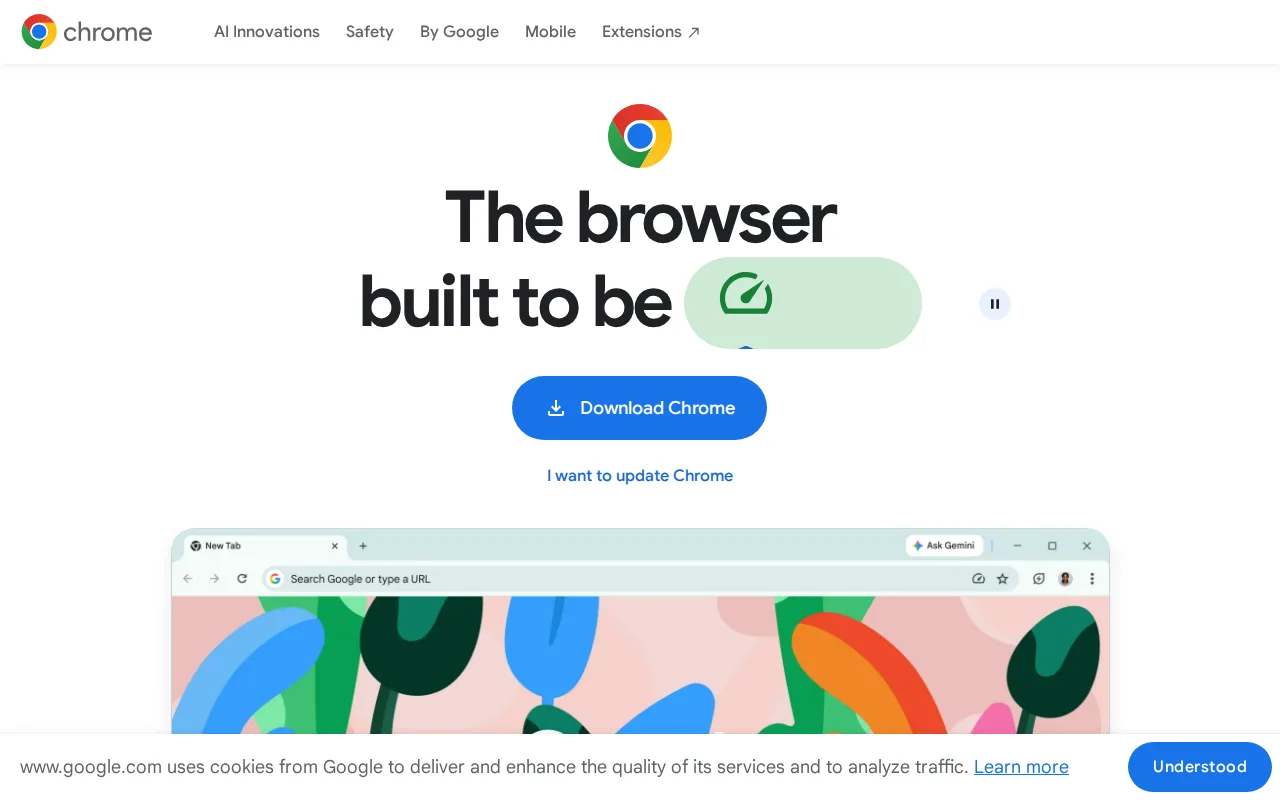
Google Chrome is the best Microsoft Edge alternative for anyone who wants the broadest extension catalog and the fewest rendering surprises. Both browsers are free and both are built on Chromium, but Chrome is the reference implementation that the rest of the Chromium family, Microsoft Edge included, builds and tests against, which is why site compatibility and extension support are its strongest cards. Google Chrome holds 4.8/5 from 2,148 Capterra reviews, where Microsoft Edge has no external rating on record. Chrome runs on Windows, macOS, Linux, iOS, Android, and the web, updates roughly every four weeks, and integrates Gemini for page summarization plus an auto-browse feature that can work through tasks such as shopping or reservations. Sync of bookmarks, passwords, and open tabs runs on a Google account rather than a Microsoft account, which matters if you are not on Windows. Microsoft Edge is still the better choice on a constrained laptop. Reviewers consistently report that Chrome uses significantly more RAM than lighter browsers once many tabs are open, slowing lower-spec machines and draining battery faster, while Microsoft Edge ships sleeping tabs, startup boost, and an energy-saver mode Microsoft says adds up to 25 minutes of battery life. Chrome's Gemini and auto-browse features also cannot be fully disabled, and its deep Google-account integration raises the same ecosystem objection Edge raises with Microsoft accounts.
Compared to Microsoft Edge: a 4.8/5 rating from 2,148 Capterra reviews where Microsoft Edge has none on record, the reference Chromium implementation other browsers test against, and sync on a Google account instead of a Microsoft account
Wins:4.8/5 from 2,148 Capterra reviews, where Microsoft Edge has no external rating on record · The broadest extension ecosystem and highest site compatibility of any browser, since Chrome is the Chromium reference implementation that Microsoft Edge, Brave, and Opera are themselves built on · Six supported platforms (web, Windows, macOS, Linux, iOS, Android) against Microsoft Edge's five, with automatic updates roughly every four weeks
Loses:Uses significantly more RAM than lighter browsers with many tabs open, where Microsoft Edge ships sleeping tabs, startup boost, and an energy-saver mode Microsoft says adds up to 25 minutes of battery life · Gemini AI and the auto-browse feature cannot be fully disabled by users who want a minimal browser · Deep Google account integration and service ties raise the same privacy and ecosystem objection Microsoft Edge raises with Microsoft accounts
Pros
- Broadest extension ecosystem and highest website compatibility of any browser.
- Free with no paid tier; all sync, password manager, and AI features are included.
- Cross-device sync of bookmarks, passwords, and tabs via a Google account.
- Frequent, low-friction automatic updates roughly every four weeks.
Cons
- Uses significantly more RAM than lighter browsers when many tabs are open, slowing lower-spec machines.
- Heavier resource use drains laptop battery faster than more battery-optimized alternatives.
- Deep integration with Google services and account-based sync raises privacy concerns for some users.
- Built-in Gemini AI features and "auto browse" cannot be fully disabled by users who prefer a minimal browser.
Pricing: Free — Free with no paid tier, the same $0 as Microsoft Edge (verified undefined NaN, NaN)
2.Brave — best Microsoft Edge alternative for privacy-conscious users who want built-in ad and tracker blocking plus an optional device-wide VPN without installing separate browser extensions
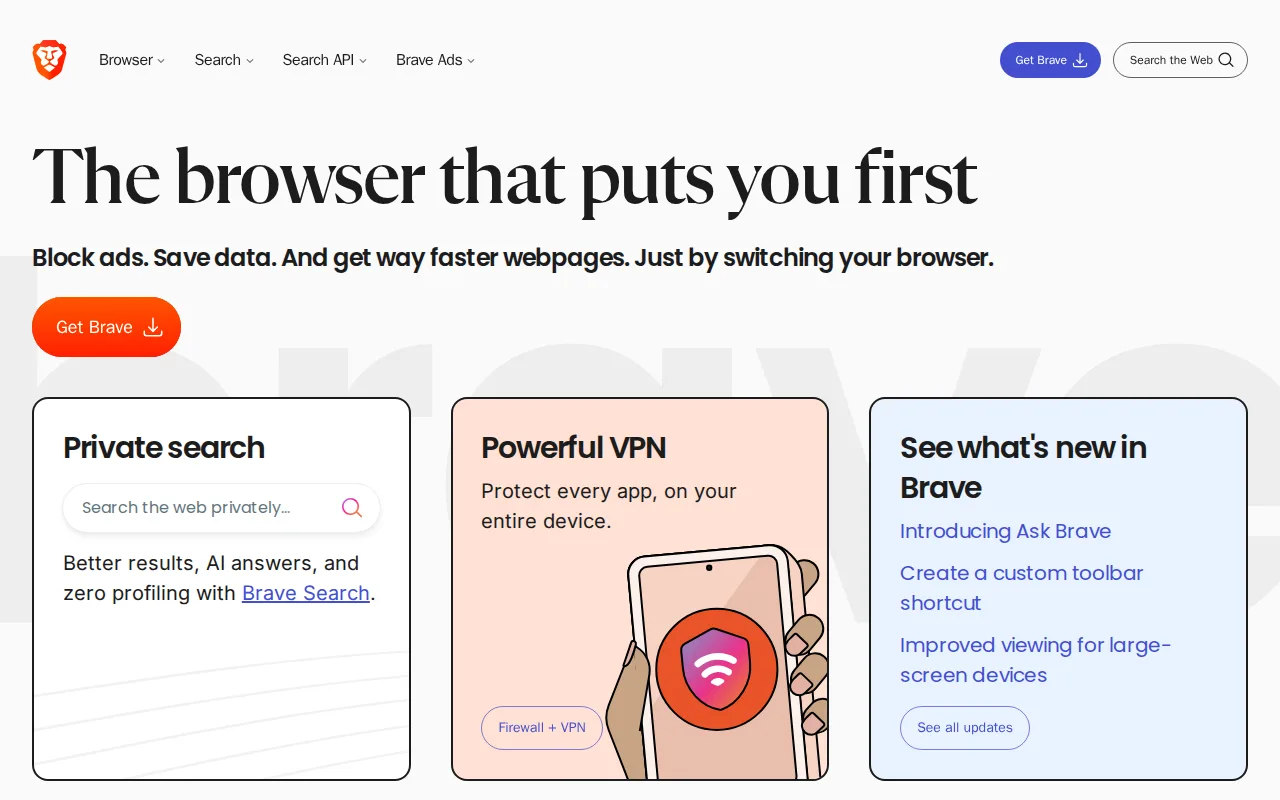
Brave is the best Microsoft Edge alternative for people who want ads, trackers, and third-party cookies blocked from the first launch without installing a single extension. Brave is free on Windows, macOS, Linux, iOS, and Android in nearly 160 languages, and its client code is published under the Mozilla Public License 2.0 so it can be audited directly, where Microsoft Edge is proprietary. Alongside blocking, Brave bundles script blocking, fingerprint randomization, a crypto wallet, and Brave Talk for video calls, and it defaults to Brave Search, which runs on an independent index rather than reselling another engine's results. That matters against Microsoft Edge specifically, because Edge is monetized indirectly by driving usage of Bing and other Microsoft services. Microsoft Edge is still the better choice for two groups. Anyone who wants AI inside the browser gets Copilot and Copilot Vision on Edge, which can analyze on-screen content and suggest actions, with no Brave equivalent. And anyone who wants everything bundled at $0 should note that Brave Firewall + VPN, which encrypts all device traffic across up to 10 devices, is a separate $9.99/month or $99.99/year subscription, where Microsoft Edge has no paid tier at all. Brave Rewards' opt-in BAT-token ad program and crypto-wallet defaults also confuse some users about what is on by default, and fingerprint randomization occasionally trips site bot detection.
Compared to Microsoft Edge: ads, trackers, and third-party cookies blocked by default with no extensions, client code open source under MPL-2.0 where Microsoft Edge is proprietary, and Brave Search on an independent index instead of driving Bing usage
Wins:Ad, tracker, and third-party cookie blocking plus script blocking and fingerprint randomization are on by default, with no extensions to install · Client code is open source under MPL-2.0 and independently auditable, where Microsoft Edge's is proprietary · Default Brave Search runs on its own independent index, where Microsoft Edge is monetized by driving Bing and other Microsoft service usage
Loses:No Copilot-style AI assistant and nothing equivalent to Microsoft Edge's Copilot Vision on-screen analysis · Brave Firewall + VPN is a separate $9.99/month ($99.99/year) subscription, where Microsoft Edge has no paid add-on at all · Brave Rewards' opt-in BAT-token ad program and crypto-wallet defaults confuse some users, and fingerprint randomization occasionally makes sites treat Brave as a bot
Pros
- Blocks ads and trackers by default with no extensions required to set up.
- Client code is open source (MPL-2.0) and independently auditable.
- Built-in Brave Search runs on an independent index rather than reselling another engine's results.
- Available on every major desktop and mobile platform with nearly 160 languages supported.
Cons
- Brave Rewards' opt-in BAT-token ad program confuses some users about what's on by default versus optional.
- Brave VPN is a separate $9.99/month subscription, not bundled free with the browser.
- Built on Chromium, so it inherits Google's engine-level decisions and roadmap even while blocking Google's tracking.
- Some sites misidentify Brave's fingerprint randomization as bot activity, occasionally breaking site functionality.
Pricing: Free tier · paid from $9.99/mo — Free browser, the same $0 as Microsoft Edge, but Brave Firewall + VPN costs $9.99/month or $99.99/year on top; Microsoft Edge has no paid tier (verified undefined NaN, NaN)
3.Opera — best Microsoft Edge alternative for everyday users who want built-in ad blocking, a free VPN, and an AI chat assistant bundled into the browser instead of installed as separate extensions
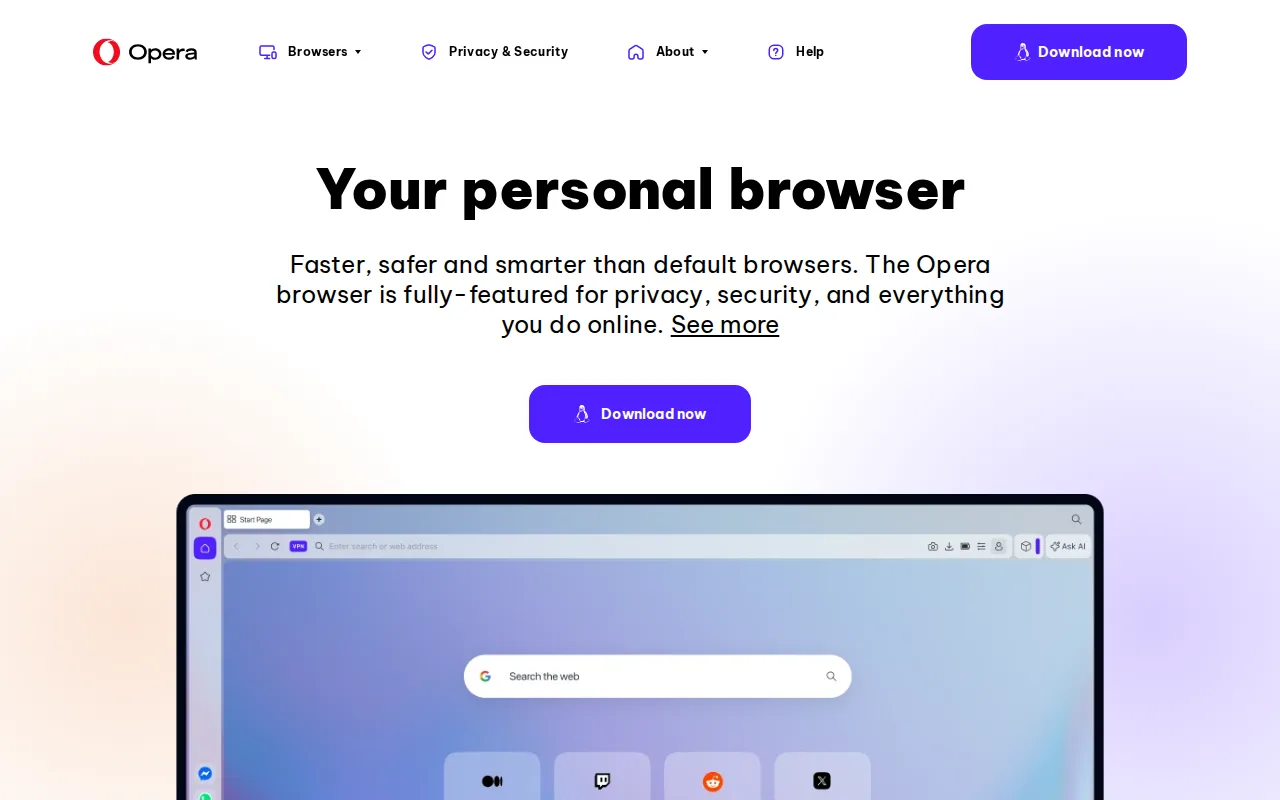
Opera is the best Microsoft Edge alternative for people who want privacy and productivity tools shipped inside the browser instead of installed as extensions. Opera is free on Windows, macOS, Linux, iOS, and Android, the same five platforms Microsoft Edge covers, and it bundles a free built-in VPN that masks IP address and location with no subscription, an ad blocker on by default, and the Opera AI chat assistant in the sidebar. Microsoft Edge's listed privacy stack is Microsoft Defender SmartScreen phishing and malware protection plus built-in password management, so Opera's default blocking and VPN cover different ground. Tab Islands group related tabs into visually separated clusters, and Flow shares files and links between desktop and mobile Opera without a Microsoft account or a third-party app. Opera also publishes Opera GX, a separate gaming build with CPU and RAM limiters, where Microsoft Edge's gaming angle is an in-game overlay that runs through the Windows Game Bar. Microsoft Edge is still the better choice for AI-first browsing and for a minimal interface. Opera has no equivalent to Copilot Vision's on-screen analysis, its bundled free VPN is a basic privacy feature with fewer server locations and less consistent speed than a dedicated VPN product, its extension ecosystem is smaller than Chrome's even though it installs most Chrome Web Store extensions, and its stack of bundled features adds interface complexity. Opera holds 4.4/5 from 15 Product Hunt reviews.
Compared to Microsoft Edge: a free built-in VPN and an ad blocker on by default with no extensions or subscription, Tab Islands and Flow for organizing and moving work between devices without a Microsoft account, and a separate gaming build (Opera GX) with CPU and RAM limiters
Wins:Free built-in VPN and default ad blocker shipped in the browser, where Microsoft Edge's listed privacy stack is Defender SmartScreen phishing protection plus password management · Tab Islands cluster related tabs visually, and Flow moves files and links between desktop and mobile without a Microsoft account or a third-party app · Opera GX ships as a separate gaming build with CPU and RAM limiters on every platform, where Microsoft Edge's in-game overlay runs through the Windows Game Bar
Loses:The bundled free VPN is a basic privacy feature with fewer server locations and less consistent speed than a dedicated VPN product · No Copilot-style AI assistant that analyzes on-screen content the way Microsoft Edge's Copilot Vision does · Smaller extension ecosystem than the Chrome catalog Microsoft Edge draws on, and the bundled AI, Flow, and sidebar messengers add interface complexity
Pros
- Free built-in VPN and ad blocker with no extension install or subscription required.
- Opera AI chat assistant is built directly into the browser sidebar.
- Tab Islands organize related tabs into visual groups for easier context switching.
- Available across Windows, macOS, Linux, iOS, and Android, plus the gaming-focused Opera GX variant.
Cons
- The bundled free VPN is a basic privacy feature, not a full VPN service, with fewer locations and less consistent performance than dedicated VPN products.
- Built on Chromium, so it inherits the same underlying engine (and market-power concerns) as Chrome and Edge rather than offering a truly independent rendering engine.
- Extra bundled features (AI, Flow, sidebar messengers) add UI complexity for users who just want a minimal browser.
- Smaller extension ecosystem than Chrome, though it can install most Chrome Web Store extensions.
Pricing: Free — Free with no paid tier, the same $0 as Microsoft Edge, with the VPN included rather than sold as an add-on (verified undefined NaN, NaN)
4.Arc — best Microsoft Edge alternative for users who already adopted Arc's Spaces workflow and want a free, stable Chromium browser, not those looking for a browser with an active development roadmap
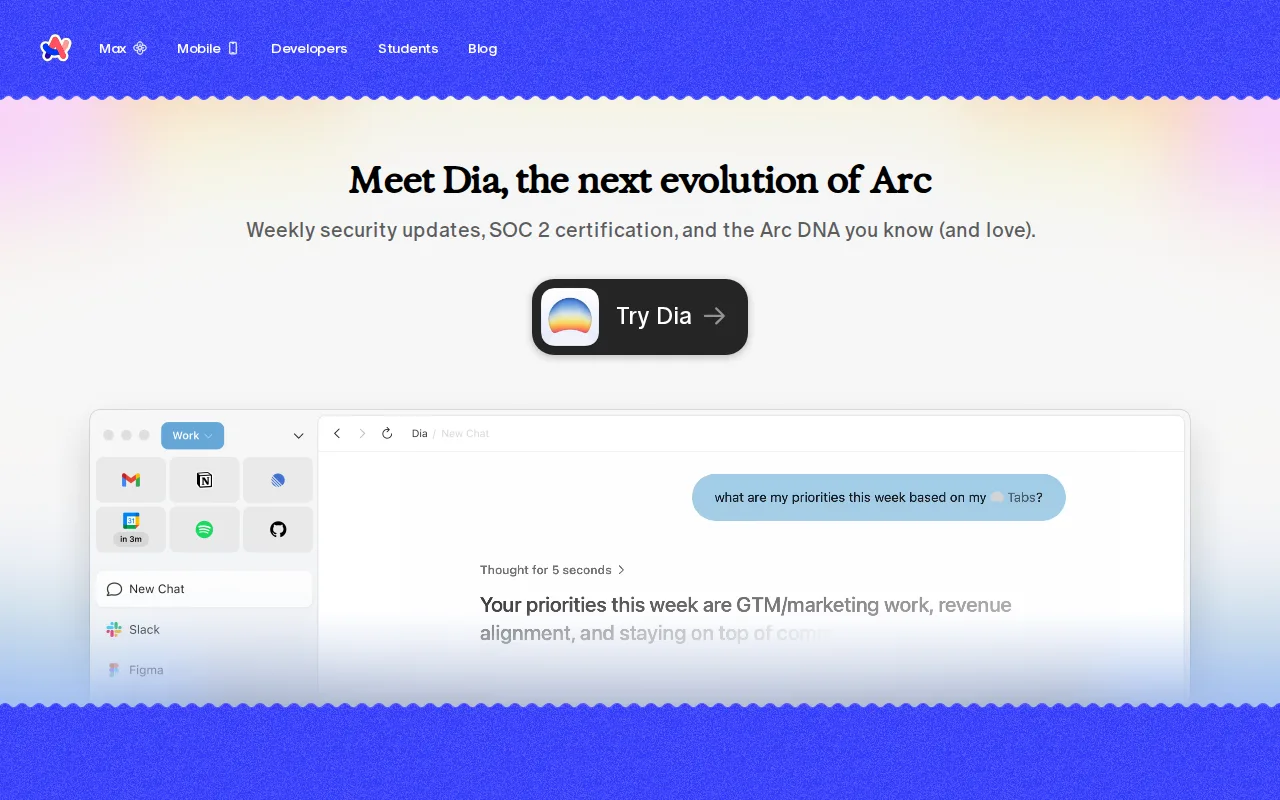
Arc is the Microsoft Edge alternative for people who already live in Arc's Spaces workflow, and it comes with a warning the other entries here do not need. Arc is free on macOS, Windows, and iOS, built on Chromium like Microsoft Edge, and it replaces the flat tab bar with Spaces, Profiles, and Split View, so work, study, and personal browsing each get their own switchable environment with their own tabs, extensions, and favorites inside one window. Because it is Chromium-based, Arc renders pages identically to Microsoft Edge and runs the same Chrome extensions, and it needs no Microsoft account and produces none of the default-browser prompting Windows does for Edge. The warning is maintenance status. The Browser Company halted active development on Arc in May 2025 to focus on its AI-native browser Dia, Atlassian acquired The Browser Company in October 2025, and Arc now receives only minimal security fixes rather than new features. Microsoft Edge is the better choice for almost everyone on that basis alone, and on three others: Edge ships continuous updates, runs on Linux and Android where Arc has no version for either, and includes Copilot and Copilot Vision, which Arc has no equivalent to. Arc also has no external review rating on record, and its Spaces interface takes a real adjustment period for anyone coming from Edge or Chrome.
Compared to Microsoft Edge: Spaces and Profiles that split tabs, extensions, and favorites into switchable environments instead of one flat tab bar, Split View for two pages side by side in a single window, and frozen development since May 2025 against Edge's continuous updates
Wins:Spaces and Profiles group tabs, extensions, and favorites into separate switchable environments, where Microsoft Edge uses a single flat tab bar · Split View shows two pages side by side in one window, and Spaces and tabs sync across devices through an Arc account · No Microsoft account required and none of the repeated default-browser prompting Windows does for Microsoft Edge
Loses:Development is frozen: The Browser Company stopped adding features in May 2025, Atlassian acquired the company in October 2025, and Arc now gets only minimal security patches, where Microsoft Edge ships continuous updates · No Linux or Android version, where Microsoft Edge runs on Windows, macOS, Linux, iOS, and Android · No Copilot-style AI assistant or on-screen analysis, no external review rating on record, and a non-traditional interface that takes real adjustment
Pros
- Free with no paid tier or subscription to manage.
- Spaces and Split View genuinely reduce tab clutter for users juggling many contexts.
- Full compatibility with Chrome extensions since it's Chromium-based.
- Polished, distinctive interface that many reviewers say replaced Chrome or Safari for them.
Cons
- Development is frozen: no new features since May 2025, only minimal security patches.
- The Browser Company (now owned by Atlassian) has redirected its engineering effort to Dia, its separate AI-native browser.
- Spaces and the non-traditional interface require a real adjustment period for users coming from Chrome or Safari.
- No Linux or Android version, unlike most competing browsers.
Pricing: Free — Free with no paid tier, the same $0 as Microsoft Edge (verified undefined NaN, NaN)
5.Firefox — best Microsoft Edge alternative for users who want a non-Chromium, open-source browser with tracker blocking on by default and no ties to Google's or Apple's advertising businesses
Mozilla Firefox is the only alternative on this list that does not share Microsoft Edge's rendering engine. Microsoft Edge has been built on Chromium since 2020, the same engine behind Google Chrome, Brave, Opera, and Arc; Mozilla Firefox runs on Gecko, the layout engine Mozilla develops itself. That is the structural reason to switch rather than a feature-by-feature one, and it is why Firefox is the only entry here whose behavior does not ultimately track Google's engine decisions. Mozilla Firefox is a free download on Windows, macOS, Linux, iOS, and Android, matching Microsoft Edge's five platforms, with over 30,000 extensions, thousands of light and dark themes, PDF editing in the browser window, tab groups, reader mode, and picture-in-picture. Trackers are blocked automatically with no setup, AI features are optional by design and can be turned off entirely, and Mozilla states it is not owned by shareholders and does not sell personal data. Bookmarks, passwords, and history sync across desktop, mobile, and tablet without a Microsoft account. Microsoft Edge is still the better choice for AI-heavy browsing and on older hardware. Firefox has no equivalent to Copilot or Copilot Vision's on-screen analysis, it does not draw on the Chrome extension catalog that Edge inherits from Chromium, and Firefox no longer supports Windows 8.1 and below or macOS 10.14 and below, pushing those machines onto the Extended Support Release.
Compared to Microsoft Edge: Mozilla's own Gecko layout engine instead of Chromium, trackers blocked automatically with AI features optional and fully disableable, and over 30,000 extensions with PDF editing built into the browser window
Wins:Runs on Gecko, Mozilla's own layout engine, making it the only alternative here that does not inherit Microsoft Edge's Chromium engine decisions · Blocks trackers automatically with no setup, keeps AI features optional by design and fully disableable, and Mozilla states it is not owned by shareholders and does not sell personal data · Over 30,000 extensions, thousands of light and dark themes, in-browser PDF editing, tab groups, reader mode, and picture-in-picture, with sync across desktop, mobile, and tablet that needs no Microsoft account
Loses:No Copilot-style AI assistant and nothing equivalent to Microsoft Edge's Copilot Vision on-screen analysis · Does not draw on the Chrome extension catalog or the Chromium compatibility baseline that Microsoft Edge inherits from sharing Chrome's engine · No longer supports Windows 8.1 and below or macOS 10.14 and below, which pushes those machines onto the Extended Support Release, while Microsoft Edge ships as the built-in Windows browser
Pros
- Free and open source, published on GitHub under the Mozilla Public License 2.0.
- Enhanced Tracking Protection blocks third-party trackers and cookies by default.
- Runs on the independent Gecko engine rather than Chromium, preserving rendering-engine diversity on the web.
- Built-in Reader Mode, picture-in-picture, and PDF editing without extra extensions.
Cons
- Market share has declined for years, so some sites are tested against Chromium first and can render inconsistently.
- Fewer and sometimes lower-quality extensions available compared to the Chrome Web Store.
- Sync and account features are less tightly integrated with a broader productivity suite than Edge (Microsoft 365) or Chrome (Google Workspace).
- Performance and memory usage can lag Chrome on some heavy, JavaScript-intensive web apps.
Pricing: Free — Free with no paid tier, the same $0 as Microsoft Edge (verified undefined NaN, NaN)
Which one is right for you?
- You want the widest site compatibility and extension catalog and already use a Google account for syncGoogle Chrome
- You want ads and trackers blocked from the first launch without installing a single extensionBrave
- You want a VPN and an ad blocker built into the browser at no extra costOpera
- You specifically want off the Chromium engine and want AI features you can switch offFirefox
- You already organize work and personal browsing with Arc's Spaces and can live without new featuresArc
- You want the browser's own client code to be open source and auditableBrave
- You want a browser on Linux as well as Windows, macOS, iOS, and AndroidGoogle Chrome
Frequently asked questions
Is there a free alternative to Microsoft Edge?
- All five alternatives here are free with no paid tier, matching Microsoft Edge's own $0 price: Google Chrome, Brave, Opera, Arc, and Mozilla Firefox. The only paid item in the group is Brave's optional Firewall + VPN add-on at $9.99/month or $99.99/year.
What is the closest alternative to Microsoft Edge?
- Google Chrome is the closest match, because Microsoft Edge has been built on Chromium, Chrome's engine, since 2020, so both render pages the same way and run the same extensions. The practical differences are the account behind sync, Google's Gemini versus Microsoft's Copilot, and Chrome's heavier RAM use.
Can Google Chrome replace Microsoft Edge?
- Yes for almost every user, since Chrome shares Edge's engine, runs the same extensions, and holds 4.8/5 from 2,148 Capterra reviews. Microsoft Edge is still worth keeping on a low-spec laptop, where its sleeping tabs, startup boost, and energy-saver mode target exactly the RAM and battery drain reviewers complain about in Chrome.
Which Microsoft Edge alternative is not based on Chromium?
- Mozilla Firefox is the only one, running on Gecko, the layout engine Mozilla develops itself. Google Chrome, Brave, Opera, and Arc are all Chromium-based, the same engine Microsoft Edge has used since 2020.
Which Microsoft Edge alternative blocks ads by default?
- Brave and Opera both block ads out of the box with no extension to install, and Mozilla Firefox blocks trackers automatically with no setup. Brave adds script blocking and fingerprint randomization on top, and Opera pairs its blocker with a free built-in VPN.
Is Arc still being updated?
- No. The Browser Company halted active development on Arc in May 2025 to focus on its AI-native browser Dia, and Atlassian acquired the company in October 2025. Arc still runs and receives minimal security patches through its Chromium base, but no new features are planned.