3 Best Open-Source Alternatives to GitHub Copilot in 2026
By Noahlast updated pricing verified
All 6 GitHub Copilot alternatives
Compared: open-source alternatives to GitHub Copilot
| Alternative | Best for | Standout | Biggest weakness | Learning curve | Price |
|---|---|---|---|---|---|
| GitHub Copilotreference | developers already working inside GitHub-integrated IDEs (VS Code, JetBrains) who want inline AI code completions plus PR review and coding-agent features without switching tools | Deep native integration across GitHub.com, VS Code, and JetBrains IDEs, including autonomous coding agents that can open pull requests directly against a repository. | Paid tiers now run on a usage-based model-credit system layered on top of the flat per-seat price, and reviewers report that heavy usage of premium models (like Opus on Pro+) can burn through included credits faster than expected, making costs less predictable than the earlier flat-rate Copilot plan. | Low | Free tier · paid from $10/mo |
| Cline | developers who want a free, open-source coding agent that works across multiple IDEs and lets them choose and pay for any AI model provider directly | Fully open-source (Apache 2.0) with 8M+ installs, letting users plug in any model provider — Claude, GPT, Gemini, or a local Ollama model — instead of being locked to one vendor's model and pricing. | No bundled AI usage is included with the free tool — every request draws down the user's own API key balance, so total cost scales unpredictably with usage and there's no flat monthly price to budget against. | Moderate | Free |
| Continue | developers who want an editor-agnostic AI coding agent they can point at any LLM, including self-hosted models, and who are comfortable adopting a project with no active company behind it | Model-agnostic architecture: developers configure any LLM provider or a self-hosted model instead of being locked into one vendor's built-in assistant, with configuration stored in version-controlled files. | The project is no longer actively developed: Continue Dev, Inc. was acquired by Cursor and the GitHub repository was archived as read-only after a final 2.0.0 release, so there is no company fixing new bugs, adding model support, or responding to issues going forward. | Moderate | Free |
| Aider | developers comfortable in a terminal who want a model-agnostic AI coding assistant without a subscription, paying only for the LLM tokens they actually use | Model-agnostic design with an automatic codebase-mapping system that lets large repositories stay within context limits, combined with automatic git commits on every accepted edit. | There is no built-in GUI or IDE-native experience: Aider lives in the terminal, which is a barrier for developers who expect an editor-integrated assistant like Cursor or GitHub Copilot, and total cost is unpredictable since it scales directly with token usage on whatever LLM is configured. | Moderate | Free |
 GitHub Copilot
 Cline
Cline Continue
 Aider
Aider1.Cline — best GitHub Copilot alternative for developers who want a free, open-source coding agent that works across multiple IDEs and lets them choose and pay for any AI model provider directly
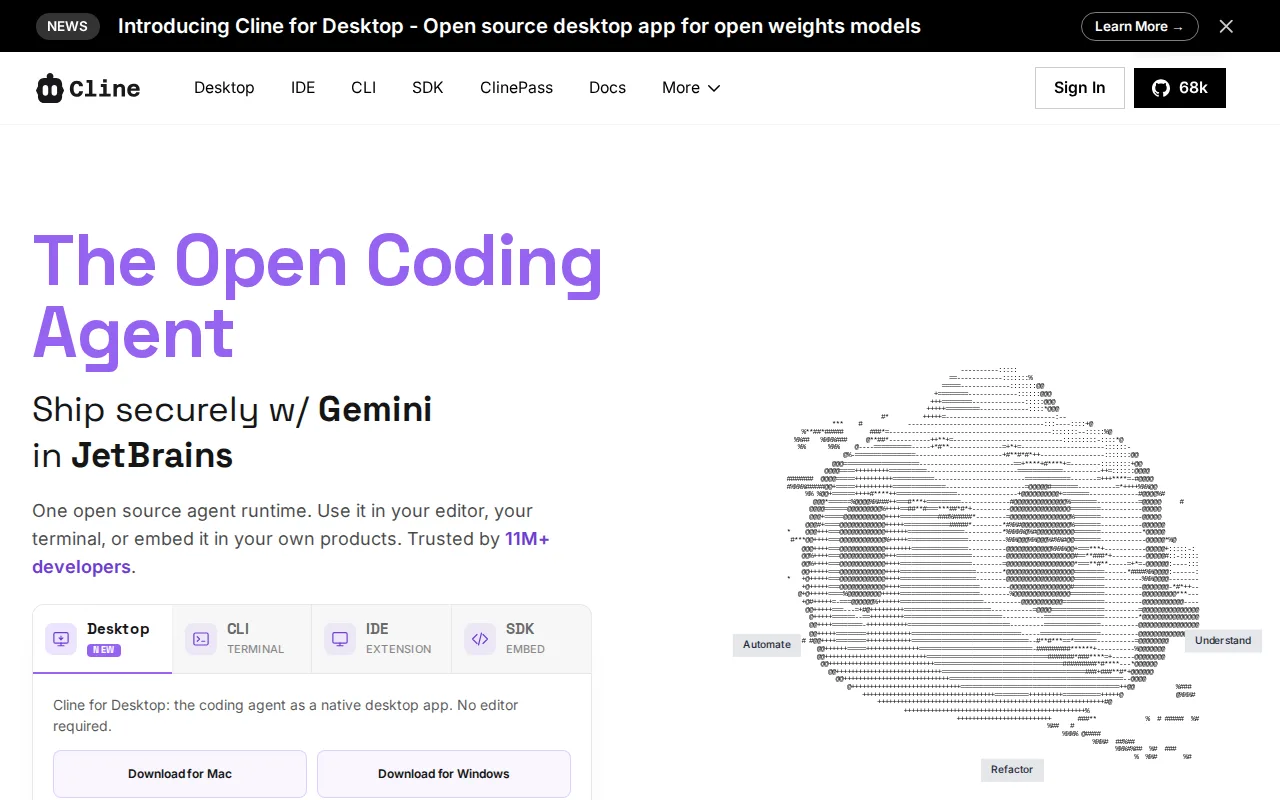
Cline and GitHub Copilot both act as AI coding assistants inside an editor, but Cline is fully open source under the Apache 2.0 license with no subscription fee of its own, unlike Copilot's paid Pro tier at $10/user/month for unlimited completions. Cline is model-agnostic: it works with Claude, GPT, Gemini, and locally run models via Ollama, letting developers bring their own API key from whichever provider they choose rather than being routed through GitHub's model selection. Cline has 8M+ installs and adoption at companies including Samsung, Amazon, and Microsoft, a scale signal that's directly comparable to Copilot's own broad usage. Where Copilot still wins: it includes a bundled free allowance of 2,000 completions and 50 chat requests a month at $0 with no separate billing setup, while Cline requires managing and securing your own API keys with providers billing usage separately, so total cost is less predictable, and Copilot's JetBrains support is more mature than Cline's, which is still in early access for JetBrains.
Compared to GitHub Copilot: fully open source (Apache 2.0) with no subscription fee for the tool itself, model-agnostic with support for Claude, GPT, Gemini, or local Ollama models, and requires managing your own API keys rather than Copilot's bundled free allowance.
Wins:Fully open-source (Apache 2.0) with no subscription fee for the tool itself · Model-agnostic: works with Claude, GPT, Gemini, and local Ollama models instead of one vendor's model · 8M+ installs with adoption at companies including Samsung, Amazon, and Microsoft
Loses:No bundled AI usage included — every request draws down the user's own API key balance, unlike Copilot's free 2,000-completions allowance · JetBrains support is still in early access, behind Copilot's more mature JetBrains integration · Enterprise features (SSO, SLA, centralized billing) require a custom sales conversation
Pros
- Fully open-source under Apache 2.0, with no subscription fee for the tool itself.
- Model-agnostic: works with Claude, GPT, Gemini, and local Ollama models via a bring-your-own-key setup.
- Available as a VS Code extension, JetBrains plugin, CLI, and embeddable SDK.
- Plan-and-Act mode separates strategy review from execution, and checkpoints allow reverting changes.
Cons
- No bundled AI usage included; costs scale directly and unpredictably with each provider's own token pricing.
- JetBrains support is still in early access, behind the more mature VS Code extension.
- Requires managing and securing your own API keys across one or more model providers.
- Enterprise features (SSO, SLA, centralized billing) require a custom sales conversation rather than transparent published pricing.
Pricing: Free — Cline itself is free; AI usage is billed directly by whichever provider you configure, vs GitHub Copilot's free tier and $10/month Pro (verified undefined NaN, NaN)
2.Continue — best GitHub Copilot alternative for developers who want an editor-agnostic AI coding agent they can point at any LLM, including self-hosted models, and who are comfortable adopting a project with no active company behind it
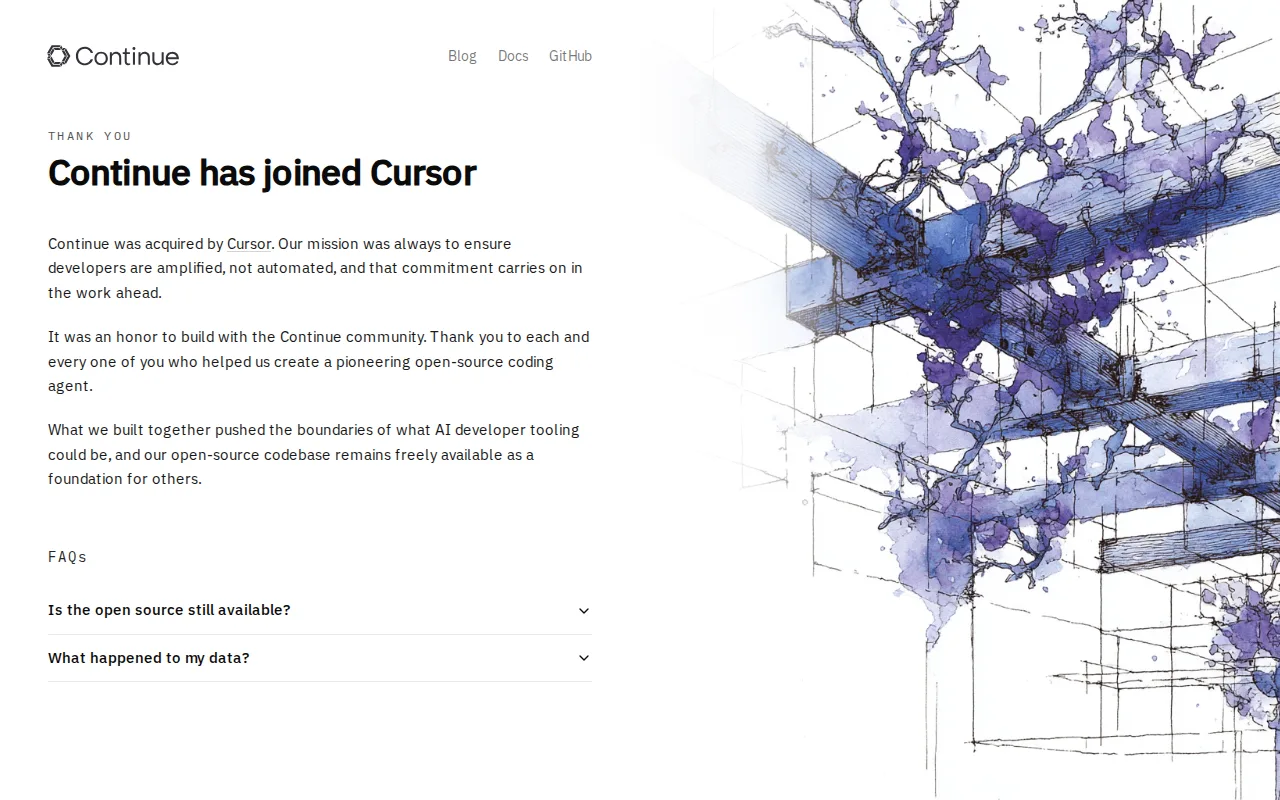
Continue and GitHub Copilot both started as AI coding assistants embedded in an editor, but Continue routed requests to any LLM a developer configured, including locally hosted models, rather than locking users into one vendor's built-in assistant the way Copilot's model selection is tied to GitHub's own offerings. Continue's codebase (35,600 GitHub stars, Apache 2.0) was free with no pricing tiers or usage limits at all, a stronger free proposition than Copilot's capped 2,000-completions tier. However, Continue Dev, Inc., the company behind it, was acquired by Cursor, and the GitHub repository shipped a final 2.0.0 release before being archived as read-only, so there is no company shipping new features or fixing new bugs going forward. Copilot wins decisively here on active development: it's maintained by GitHub with continuous updates, new model support, and enterprise features, while Continue's code remains free to fork and self-maintain but comes with no roadmap, no new model integrations, and no vendor support of any kind.
Compared to GitHub Copilot: free forever under Apache 2.0 with no pricing tiers or usage limits, editor-agnostic and model-agnostic including local models, and the project is archived as read-only with no active development going forward.
Wins:Free and open source under Apache 2.0 with no pricing tiers or usage limits at all · Works with any LLM provider, including locally hosted models, avoiding vendor lock-in · Configuration lives in version-controlled files rather than a vendor dashboard
Loses:Archived as read-only on GitHub after Cursor's acquisition — no new features or bug fixes are shipping · No active company behind it, unlike Copilot's continuous development by GitHub · Requires manually configuring an LLM provider and API key before it does anything, unlike Copilot's out-of-the-box setup
Pros
- Free and open source under Apache 2.0 with no pricing tiers or usage limits.
- Works with any LLM provider, including locally hosted models, avoiding vendor lock-in.
- Available as a VS Code extension, JetBrains plugin, and standalone CLI, covering multiple workflows.
- Configuration lives in version-controlled files rather than a vendor dashboard.
Cons
- Archived as read-only on GitHub after Cursor's acquisition, so no new features or bug fixes are shipping from the original team.
- Requires manually configuring an LLM provider and API key before it does anything, unlike bundled assistants that work out of the box.
- The JetBrains plugin is now a secondary priority; the project recommends the CLI instead.
Pricing: Free — Continue is free forever with no pricing tiers vs GitHub Copilot's free tier and $10/month Pro (verified undefined NaN, NaN)
3.Aider — best GitHub Copilot alternative for developers comfortable in a terminal who want a model-agnostic AI coding assistant without a subscription, paying only for the LLM tokens they actually use
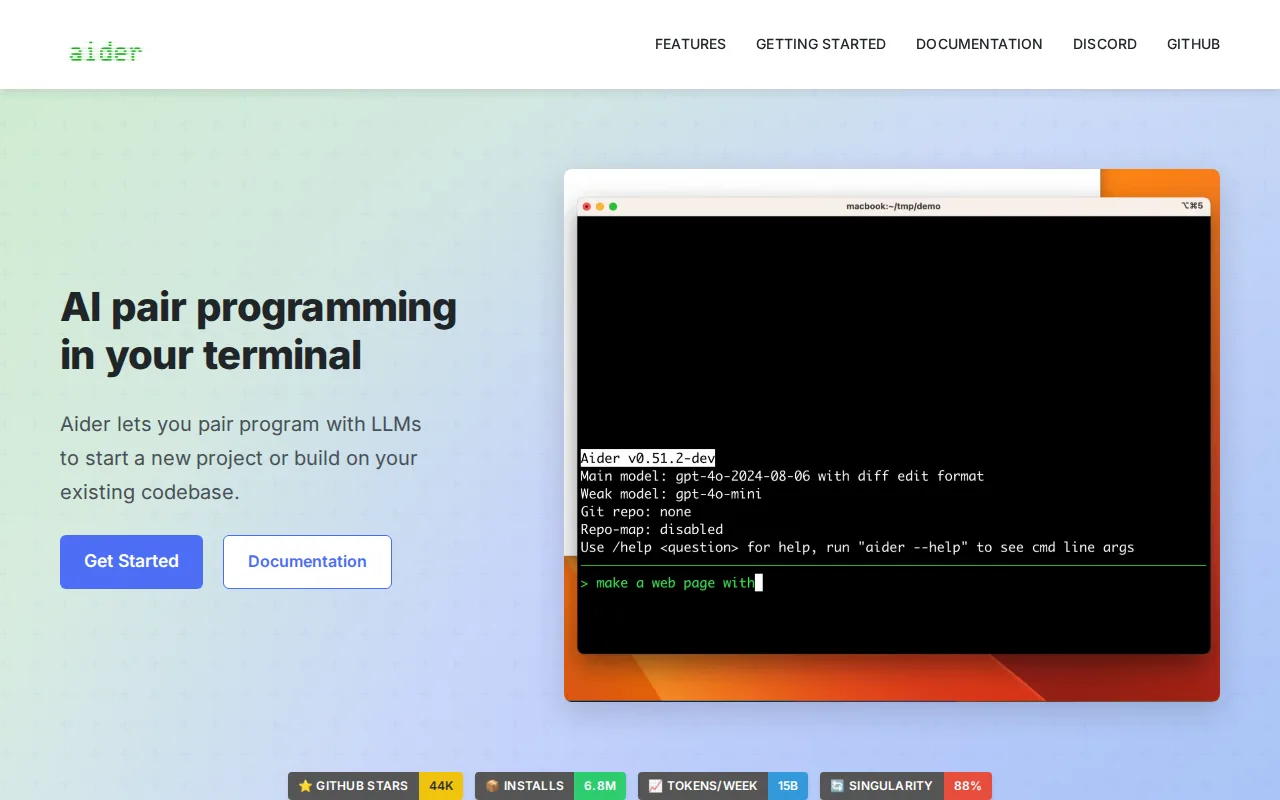
Aider and GitHub Copilot both use AI to write and edit code, but Aider runs entirely in the terminal rather than as an editor plugin, and it automatically commits every accepted edit to git, keeping changes reviewable and revertible by default, a workflow detail Copilot's inline-completion model doesn't build in. Aider is free and open source under Apache-2.0, with cost limited entirely to whichever LLM API a developer configures (Anthropic, OpenAI, DeepSeek, or local models), versus Copilot's flat $10/user/month Pro subscription. Aider's GitHub repository has 48.4k stars and the project reports 6.8 million weekly installs, a scale comparable to Copilot's own broad adoption. Aider's repository-mapping system keeps token costs down on large codebases by sending a condensed map rather than the whole project. Where Copilot still wins: it has a native GUI and IDE-integrated experience across VS Code, JetBrains, and GitHub.com, while Aider has no built-in GUI at all and lives entirely in the terminal, a real barrier for developers who expect an editor-native assistant.
Compared to GitHub Copilot: free and open source (Apache-2.0) with cost limited to whichever LLM API you configure, automatic git commits on every accepted edit, and no built-in GUI at all versus Copilot's native IDE integration.
Wins:No subscription fee; Apache-2.0 licensed and free to self-host indefinitely · Automatic git commits on every edit keep changes reviewable and revertible, unlike Copilot's completion-only model · Repository mapping lets it work effectively on large, existing codebases within context limits
Loses:No built-in GUI or IDE-native experience — Aider lives entirely in the terminal · Actual cost is variable and provider-dependent, since Aider itself doesn't charge but token usage does · Community support only, with no vendor offering paid enterprise support or SLAs
Pros
- No subscription fee; Apache-2.0 licensed and free to self-host indefinitely.
- Works with any LLM provider (Anthropic, OpenAI, DeepSeek, local models), avoiding vendor lock-in.
- Automatic git commits on every edit keep changes reviewable and revertible.
- Repository mapping lets it work effectively on large, existing codebases, not just greenfield projects.
Cons
- Terminal-only interface with no native GUI, a steeper adjustment for developers used to IDE-integrated tools.
- Actual cost is variable and provider-dependent, since Aider itself doesn't charge but token usage does.
- Requires users to separately manage and secure their own LLM API keys and billing.
- Community support only, since there is no vendor offering paid enterprise support or SLAs.
Pricing: Free — Aider is free; cost is limited to LLM API usage of your chosen provider, vs GitHub Copilot's free tier and $10/month Pro (verified undefined NaN, NaN)