4 Best Alternatives to Continue in 2026
By Noahlast updated pricing verified

From our data: All 4 of Continue's listed alternatives ship a free tier, matching Continue's own fully free, zero-pricing-tier model; only Cline and Aider match it exactly with no paid tier at all, while GitHub Copilot and Cursor layer paid plans starting at $10/month and $20/month respectively above their free entry points.
 GitHub Copilot
 Cursor
 Cline
Cline Aider
AiderHow we picked
- External review-platform ratings were compared where available: GitHub Copilot's 4.5/5 from 50 Capterra reviews is the largest sample among Continue's four listed alternatives; Cursor's 5.0/5 comes from only 4 Capterra reviews and Aider's 5.0/5 from just 1 Product Hunt review, both thin samples; Cline and Continue itself carry no external ratings on file.
- Active-development status was checked directly against Continue's own archived, read-only repository: all four alternatives ship ongoing updates, GitHub Copilot from GitHub/Microsoft, Cursor from the company that acquired Continue Dev, Inc., Cline with 8 million-plus installs, and Aider with 6.8 million weekly installs, a direct contrast to Continue's frozen 2.0.0 final release.
- Licensing and cost model were matched against Continue's own Apache 2.0, fully free, zero-pricing-tier structure: Cline and Aider are also free and open source with no subscription fee, while GitHub Copilot and Cursor are freemium products with paid tiers starting at $10/month and $20/month respectively.
- Pricing verification dates were checked against Continue's own 2026-08-21 timestamp: GitHub Copilot, Cline, and Aider all carry recorded pricing-verification dates from that date, while Cursor's pricing carries no recorded pricing-verification date.
Paid placement never alters editorial rank — read the full methodology.
Continue alternatives at a glance
| Alternative | Best for | Standout | Biggest weakness | Learning curve | Price |
|---|---|---|---|---|---|
| Continuereference | developers who want an editor-agnostic AI coding agent they can point at any LLM, including self-hosted models, and who are comfortable adopting a project with no active company behind it | Model-agnostic architecture: developers configure any LLM provider or a self-hosted model instead of being locked into one vendor's built-in assistant, with configuration stored in version-controlled files. | The project is no longer actively developed: Continue Dev, Inc. was acquired by Cursor and the GitHub repository was archived as read-only after a final 2.0.0 release, so there is no company fixing new bugs, adding model support, or responding to issues going forward. | Moderate | Free |
| GitHub Copilot | developers already working inside GitHub-integrated IDEs (VS Code, JetBrains) who want inline AI code completions plus PR review and coding-agent features without switching tools | Deep native integration across GitHub.com, VS Code, and JetBrains IDEs, including autonomous coding agents that can open pull requests directly against a repository. | Paid tiers now run on a usage-based model-credit system layered on top of the flat per-seat price, and reviewers report that heavy usage of premium models (like Opus on Pro+) can burn through included credits faster than expected, making costs less predictable than the earlier flat-rate Copilot plan. | Low | Free tier · paid from $10/mo |
| Cursor | software teams that want autonomous AI agents handling multi-file changes and PR reviews directly inside their editor and CI pipeline | Cloud agents that keep working on long-running tasks (hours or days) independent of the local machine, combined with a Slack and GitHub-integrated review workflow. | Usage-based pricing on top of the subscription (extra Agent requests, Bugbot) can make monthly costs unpredictable for heavy users, and the jump from Pro ($20/month) to Ultra ($200/month) is steep for teams that outgrow Pro's Agent limits. | Moderate | Free tier · paid from $20/mo |
| Cline | developers who want a free, open-source coding agent that works across multiple IDEs and lets them choose and pay for any AI model provider directly | Fully open-source (Apache 2.0) with 8M+ installs, letting users plug in any model provider — Claude, GPT, Gemini, or a local Ollama model — instead of being locked to one vendor's model and pricing. | No bundled AI usage is included with the free tool — every request draws down the user's own API key balance, so total cost scales unpredictably with usage and there's no flat monthly price to budget against. | Moderate | Free |
| Aider | developers comfortable in a terminal who want a model-agnostic AI coding assistant without a subscription, paying only for the LLM tokens they actually use | Model-agnostic design with an automatic codebase-mapping system that lets large repositories stay within context limits, combined with automatic git commits on every accepted edit. | There is no built-in GUI or IDE-native experience: Aider lives in the terminal, which is a barrier for developers who expect an editor-integrated assistant like Cursor or GitHub Copilot, and total cost is unpredictable since it scales directly with token usage on whatever LLM is configured. | Moderate | Free |
 Continue
1.GitHub Copilot — best Continue alternative for developers already working inside GitHub-integrated IDEs (VS Code, JetBrains) who want inline AI code completions plus PR review and coding-agent features without switching tools
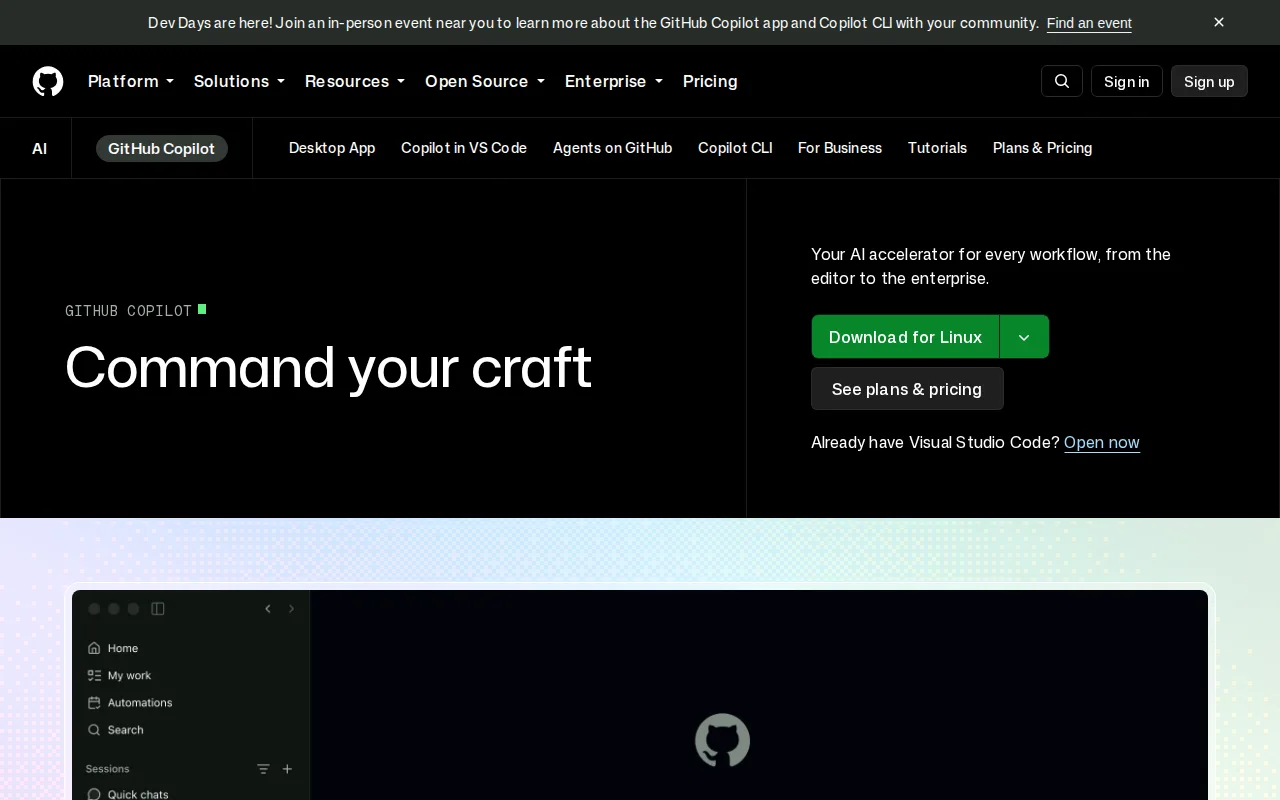
GitHub Copilot is the best Continue alternative for developers who want an actively maintained, first-party coding assistant instead of an archived project with no company behind it. Continue Dev, Inc. was acquired by Cursor and its GitHub repository was archived as read-only after a final 2.0.0 release, while GitHub Copilot ships ongoing updates from GitHub and Microsoft. Copilot's Free plan includes 2,000 completions and 50 chat requests a month with no subscription required, and it holds a 4.5/5 rating from 50 Capterra reviews, more independent review volume than Continue, which carries no external ratings on file. Copilot integrates natively across VS Code, JetBrains IDEs, and GitHub.com, including cloud coding agents that can open pull requests directly against a repository. Continue is still the better choice for developers who specifically want a fully open-source, model-agnostic agent with zero pricing tiers: Copilot's paid Pro and Pro+ tiers layer usage-based model credits on top of the flat per-seat price, which reviewers say makes heavy-usage costs less predictable than a flat rate, and Copilot doesn't offer Continue's ability to point at any self-hosted local model with configuration stored entirely in version-controlled files.
Compared to Continue: ongoing updates from GitHub and Microsoft vs Continue's now-archived repository, a free tier plus a 4.5/5 rating from 50 Capterra reviews, and native integration across VS Code, JetBrains, and GitHub.com
Wins:Actively maintained with ongoing updates from GitHub and Microsoft, unlike Continue's now-archived, read-only repository · Free tier (2,000 completions, 50 chat requests/month) plus a 4.5/5 rating from 50 Capterra reviews, more review volume than Continue, which has none on file · Native integration across VS Code, JetBrains IDEs, and GitHub.com, including cloud coding agents that open pull requests directly
Loses:Paid Pro and Pro+ tiers layer usage-based model credits on top of the flat per-seat price, making heavy-usage costs less predictable than Continue's zero-pricing-tiers model · No ability to point at a fully self-hosted local model the way Continue's model-agnostic architecture allows · Configuration lives in GitHub's platform rather than the version-controlled files Continue used
Pros
- Deep, first-party integration with GitHub.com, VS Code, and JetBrains IDEs.
- Free tier gives every GitHub user a meaningful number of completions with no subscription.
- Supports multiple AI models (including third-party models like Claude and Gemini) depending on plan.
- Coding agent and PR review features extend beyond simple autocomplete into automated code changes.
Cons
- Usage-based model credits on paid tiers make monthly costs harder to predict for heavy users.
- Not always reliable on complex logic or large codebases; generated code still needs careful review.
- Business and Enterprise pricing isn't listed directly on GitHub's public pricing page, requiring a sales conversation.
- Premium model access (like Opus on Pro+) consumes credits significantly faster than base models.
Pricing: Free tier · paid from $10/mo — Free (2,000 completions/month) vs Continue's fully free, unlimited open-source tool; Copilot Pro is $10/user/month vs Continue's $0 at every tier (verified undefined NaN, NaN)
2.Cursor — best Continue alternative for software teams that want autonomous AI agents handling multi-file changes and PR reviews directly inside their editor and CI pipeline
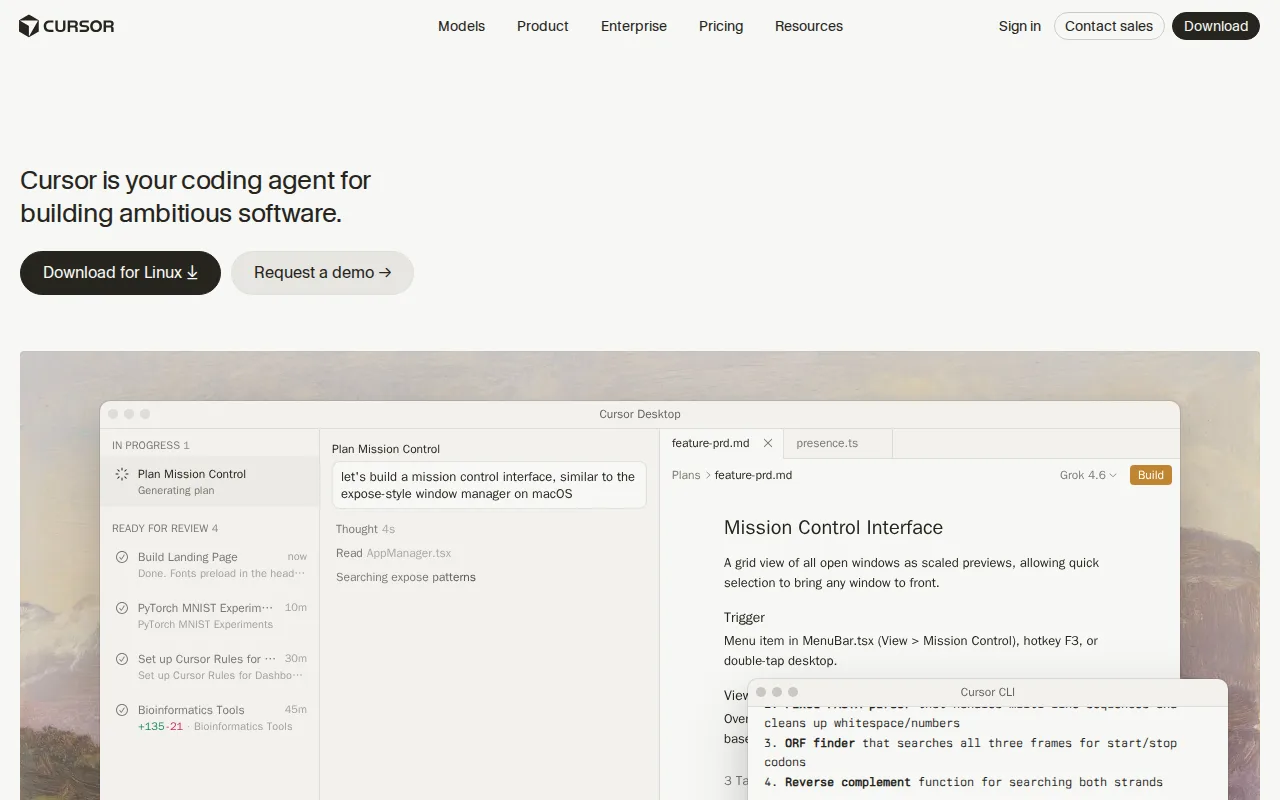
Cursor is the best Continue alternative for developers who want autonomous, multi-file coding agents built into a dedicated editor rather than an extension layered on an existing one. Cursor is in fact the company that acquired Continue Dev, Inc., and its Composer agents can read a codebase, plan a multi-file change, write the code, run tests, and open a pull request with an adjustable autonomy slider. Cursor supports multiple frontier models, Grok, Claude, and its own Composer model, plus cloud agents that keep running long tasks independent of the local machine, and its free Hobby tier requires no credit card. Cursor holds a 5.0/5 rating on Capterra, though from only 4 reviews so far, a thin sample similar to Continue's own lack of external ratings. Continue is still the better choice for developers who want to keep their existing VS Code or JetBrains setup and pay nothing at any tier: Cursor requires switching to its own forked editor rather than installing as an extension, its Pro plan starts at $20/month with a steep jump to $200/month at the Ultra tier, and usage-based charges on top of the subscription can make monthly costs unpredictable for heavy users.
Compared to Continue: autonomous Composer agents that plan, write, test, and open pull requests, multi-model support plus cloud agents for long-running tasks, and active development from the company that acquired Continue Dev, Inc.
Wins:Autonomous Composer agents that plan, write, test, and open pull requests with an adjustable autonomy slider, beyond Continue's request-response model · Multi-model support (Grok, Claude, Cursor's own Composer model) plus cloud agents that keep running long tasks independent of the local machine · Built by Cursor, the company that acquired Continue Dev, Inc., continuing active development where Continue's own repository is now archived
Loses:Requires switching to Cursor's own forked editor rather than installing as an extension inside an existing VS Code or JetBrains setup · Pro plan starts at $20/month with a steep jump to $200/month at the Ultra tier, versus Continue's $0 at every tier · 5.0/5 Capterra rating comes from only 4 reviews so far, a thin sample
Pros
- Autonomous agents can plan, write, test, and open pull requests with minimal hand-holding.
- Multi-model support (Grok, Claude, Cursor's own Composer) avoids lock-in to a single AI provider.
- Cloud agents keep running on long tasks without tying up the developer's local machine.
- Free Hobby tier requires no credit card, making it easy to evaluate before paying.
Cons
- Usage-based charges on top of the subscription make total monthly cost harder to predict than a flat fee.
- Steep price jump from Pro ($20/month) to Ultra ($200/month) for teams needing higher Agent limits.
- Requires comfort delegating multi-file changes to an agent, a real workflow shift for developers used to manual review of every diff.
- No iOS or Android app; Cursor is desktop- and CLI-only.
Pricing: Free tier · paid from $20/mo — Free Hobby tier (no credit card) vs Continue's fully free, unlimited open-source tool; Cursor Pro is $20/month, rising to $200/month at Ultra, vs Continue's $0 at every tier
3.Cline — best Continue alternative for developers who want a free, open-source coding agent that works across multiple IDEs and lets them choose and pay for any AI model provider directly
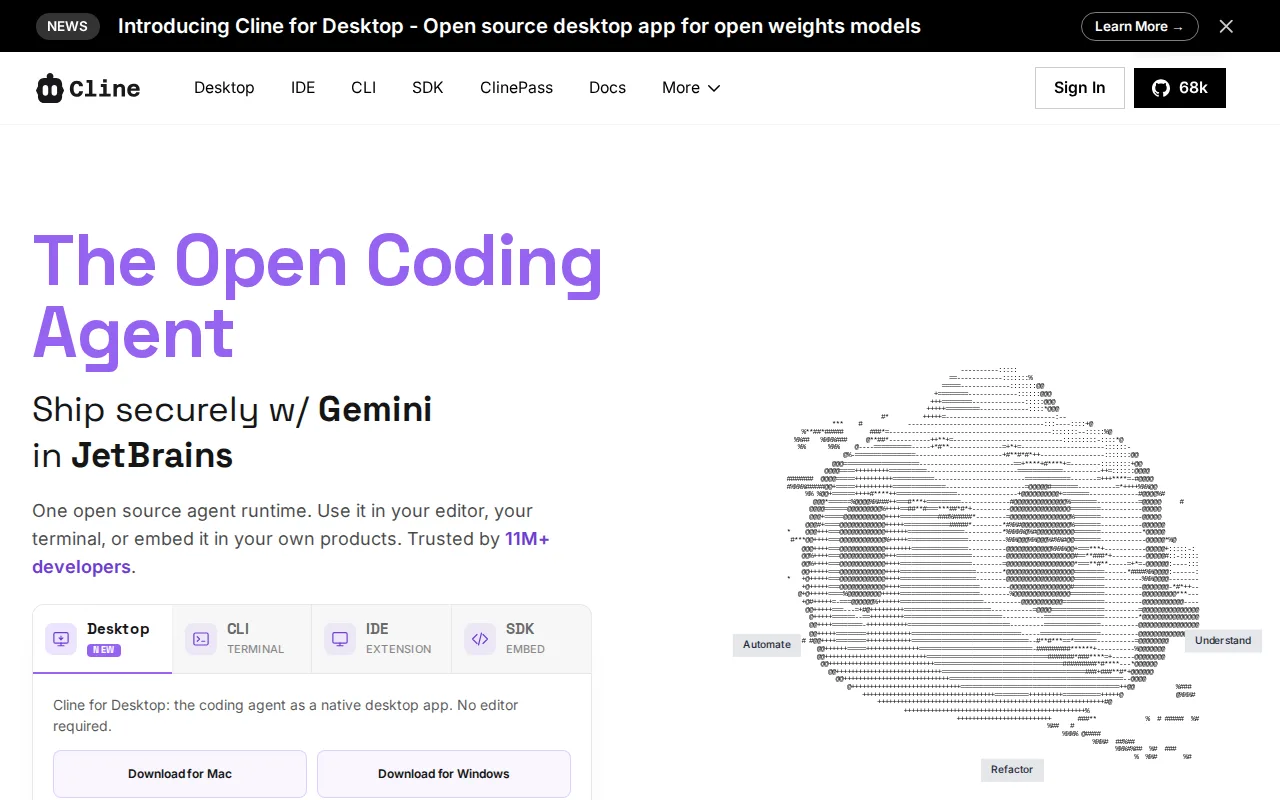
Cline is the best Continue alternative for developers who want the same free, fully open-source, model-agnostic philosophy Continue offered, but from an actively maintained project. Like Continue, Cline is licensed under Apache 2.0 with no subscription fee, and users bring their own API key to any provider, Claude, GPT, Gemini, or a local Ollama model, rather than paying a vendor for AI usage. Cline reports 8 million-plus installs and adoption at companies including Samsung, Amazon, and Microsoft, and continues shipping updates, unlike Continue's now-archived, read-only repository. It supports multi-file coordinated edits with automatic linter fixes, checkpoints for reverting changes, and a Plan-and-Act mode for reviewing strategy before execution, similar territory to what Continue offered. Continue is still arguably preferable for developers who specifically want a project with zero commercial layer at all, even an optional one: Cline's Enterprise tier adds a custom-priced path for SSO, SLAs, and centralized billing that Continue's now-frozen codebase never introduced, its JetBrains plugin remains in early access behind the more mature VS Code extension, and this listing carries no external ratings for Cline either, so review-based comparison isn't possible for either tool.
Compared to Continue: the same free, Apache 2.0, model-agnostic philosophy but from an actively maintained project, 8 million-plus installs and adoption at Samsung, Amazon, and Microsoft, and multi-file coordinated edits with checkpoints
Wins:Free, Apache 2.0, model-agnostic philosophy matching Continue's own, but from an actively maintained project rather than an archived one · 8 million-plus installs and adoption at companies including Samsung, Amazon, and Microsoft · Multi-file coordinated edits with automatic linter fixes, checkpoints for reverting changes, and a Plan-and-Act mode separating strategy from execution
Loses:Enterprise tier adds a custom-priced path for SSO, SLAs, and centralized billing, a commercial layer Continue's now-frozen codebase never introduced · JetBrains plugin remains in early access, behind the more mature VS Code extension · No external ratings on file for Cline in this listing, so review-based comparison isn't possible against Continue, which also has none
Pros
- Fully open-source under Apache 2.0, with no subscription fee for the tool itself.
- Model-agnostic: works with Claude, GPT, Gemini, and local Ollama models via a bring-your-own-key setup.
- Available as a VS Code extension, JetBrains plugin, CLI, and embeddable SDK.
- Plan-and-Act mode separates strategy review from execution, and checkpoints allow reverting changes.
Cons
- No bundled AI usage included; costs scale directly and unpredictably with each provider's own token pricing.
- JetBrains support is still in early access, behind the more mature VS Code extension.
- Requires managing and securing your own API keys across one or more model providers.
- Enterprise features (SSO, SLA, centralized billing) require a custom sales conversation rather than transparent published pricing.
Pricing: Free — Free for individual developers on both, bring-your-own API key; Cline's Enterprise tier is custom-priced vs Continue, which never introduced any paid tier at all (verified undefined NaN, NaN)
4.Aider — best Continue alternative for developers comfortable in a terminal who want a model-agnostic AI coding assistant without a subscription, paying only for the LLM tokens they actually use
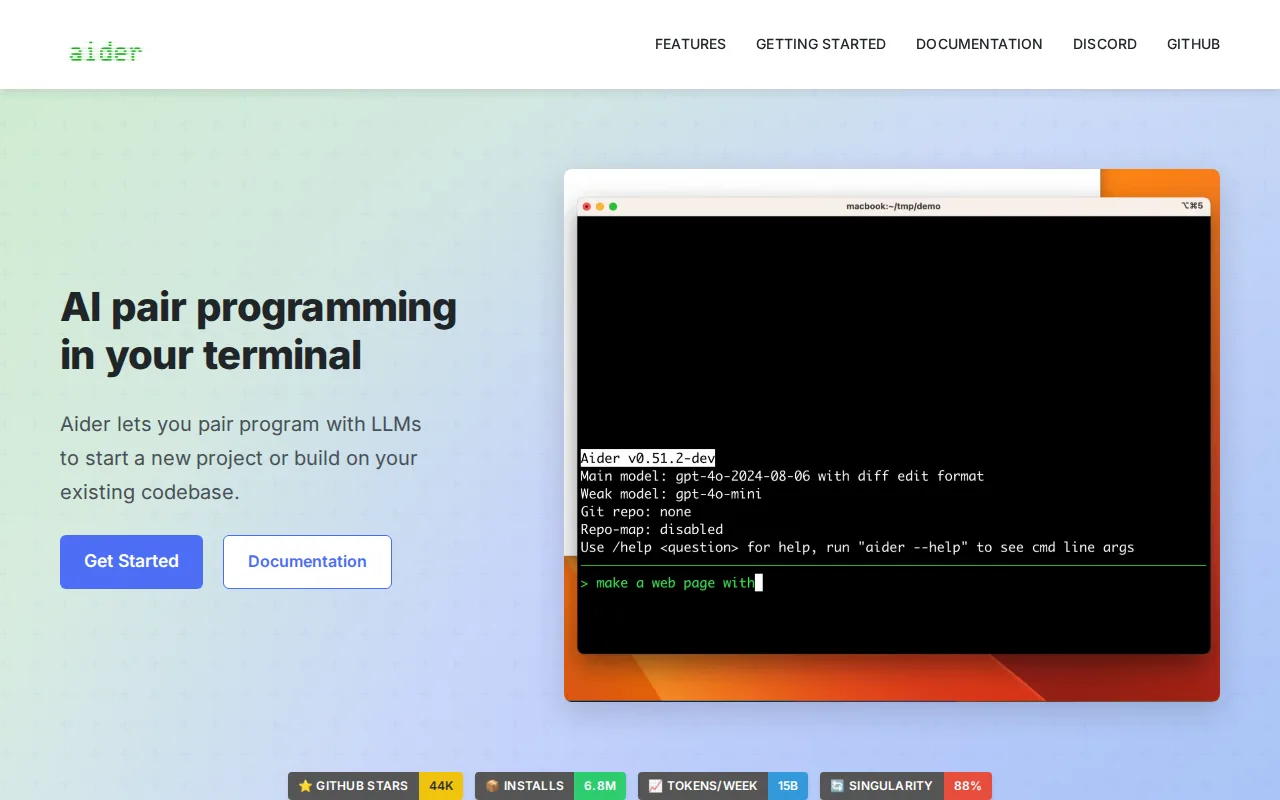
Aider is the best Continue alternative for developers comfortable in a terminal who want a model-agnostic AI pair programmer without a subscription, continuing after Continue's own project went into archived, read-only status. Aider is Apache-2.0 licensed and free like Continue, with users bringing their own API keys to Anthropic, OpenAI, DeepSeek, or local models, and its GitHub repository has 48.4k stars, more than Continue's 35,600, alongside 6.8 million weekly installs and roughly 15 billion tokens processed weekly across its user base. Aider's repository map keeps large codebases within context limits, and every accepted edit auto-commits to git, keeping changes reviewable and revertible. Aider holds a 5.0/5 rating from just 1 Product Hunt review, a thin sample. Continue is still the better fit for developers who specifically want an editor-integrated experience rather than a terminal-only workflow: Aider has no built-in GUI or IDE-native interface, a real barrier for developers used to Continue's VS Code extension and JetBrains plugin, and support is community-only since no vendor offers paid enterprise SLAs.
Compared to Continue: continued active development where Continue's repository is archived, 48.4k GitHub stars vs Continue's 35,600 plus 6.8 million weekly installs, and automatic git commits with repository-mapped context
Wins:Continued active development where Continue's own repository is now archived, read-only · 48.4k GitHub stars, more than Continue's 35,600, alongside 6.8 million weekly installs and roughly 15 billion tokens processed weekly · Automatic git commits on every accepted edit and a repository-mapping system that keeps large codebases within context limits
Loses:No built-in GUI or IDE-native interface, a real barrier for developers used to Continue's VS Code extension and JetBrains plugin · 5.0/5 rating comes from just 1 Product Hunt review, a thin sample · Support is community-only, since no vendor offers paid enterprise SLAs, matching Continue's own now-unsupported status
Pros
- No subscription fee; Apache-2.0 licensed and free to self-host indefinitely.
- Works with any LLM provider (Anthropic, OpenAI, DeepSeek, local models), avoiding vendor lock-in.
- Automatic git commits on every edit keep changes reviewable and revertible.
- Repository mapping lets it work effectively on large, existing codebases, not just greenfield projects.
Cons
- Terminal-only interface with no native GUI, a steeper adjustment for developers used to IDE-integrated tools.
- Actual cost is variable and provider-dependent, since Aider itself doesn't charge but token usage does.
- Requires users to separately manage and secure their own LLM API keys and billing.
- Community support only, since there is no vendor offering paid enterprise support or SLAs.
Pricing: Free — Free on both, bring-your-own API key for LLM usage; no subscription fee for either tool (verified undefined NaN, NaN)
Which one is right for you?
- You want an actively maintained, first-party coding assistant instead of an archived projectGitHub Copilot
- You're already working inside GitHub-integrated IDEs and want inline completions plus PR reviewGitHub Copilot
- You want autonomous agents that plan, write, test, and open pull requests in a dedicated editorCursor
- You want the same free, open-source, bring-your-own-key philosophy Continue offered, but actively maintainedCline
- You need adoption at enterprise scale (Samsung, Amazon, Microsoft) for a free open-source agentCline
- You're comfortable in a terminal and want automatic git commits on every editAider
- You need a coding agent that works effectively on large, existing codebases via repository mappingAider
Frequently asked questions
Is Continue still being developed?
- No — Continue Dev, Inc. was acquired by Cursor, and the GitHub repository shipped a final 2.0.0 release before being archived as read-only, so no company is fixing bugs or adding features going forward.
What is the closest alternative to Continue?
- Cline is the closest match philosophically: both are free, Apache 2.0-licensed, model-agnostic agents where users bring their own API key, but Cline continues shipping updates with 8 million-plus installs where Continue's repository is now archived.
Is there a free alternative to Continue?
- Yes — GitHub Copilot's Free plan (2,000 completions/month), Cursor's Hobby tier, Cline, and Aider are all free to use, though Cline and Aider match Continue's fully open-source, bring-your-own-key model most closely.
Who acquired Continue?
- Cursor acquired Continue Dev, Inc., after which Continue's GitHub repository shipped a final 2.0.0 release, removing telemetry and hosted authentication, before being archived as read-only.
Which Continue alternative is best for terminal-based workflows?
- Aider, a free, open-source, terminal-only AI pair programmer that auto-commits every edit to git and uses a repository-mapping system to work on large codebases.
Which Continue alternative is best for autonomous multi-file coding agents?
- Cursor, whose Composer agents can plan, write, test, and open pull requests with an adjustable autonomy slider, though it requires switching to Cursor's own forked editor rather than an extension.