6 Best Alternatives to Cline in 2026
By Noahlast updated pricing verified

From our data: 5 of the 6 alternatives listed here (GitHub Copilot, Cursor, Windsurf, Continue, and Aider) offer some free access; Claude Code is the only one with no free tier at all. Continue and Aider are the only two with no paid tier whatsoever, both fully free, open-source Apache 2.0 tools matching Cline's own license and price. Among the three alternatives with a disclosed non-zero starting price — GitHub Copilot at $10/month, Claude Code at $17/month, and Cursor at $20/month — the median is $17/month.
 GitHub Copilot
 Cursor
 Aider
Aider Claude Code
How we picked
- External review evidence varies widely: Claude Code holds the deepest base at 5.0/5 from 640 Product Hunt reviews, GitHub Copilot follows at 4.5/5 from 50 Capterra reviews, but Cursor's 5.0/5 rests on only 4 Capterra reviews and Windsurf's on a single 3/5 review; Continue has no external rating on file at all.
- Pricing model is the clearest split in the data: GitHub Copilot, Cursor, Windsurf, and Claude Code sell paid or freemium tiers, while Continue and Aider are entirely free, open-source (Apache 2.0) tools with no subscription of any kind, matching Cline's own free, open-source model.
- Maintenance status is treated as a real signal, not just a feature check: Continue's GitHub repository (35,600 stars) was archived as read-only after Cursor acquired the company behind it, and Windsurf's standalone product and website no longer exist independently, redirecting permanently to Cognition's devin.ai.
- Pricing verification dates were used where available: GitHub Copilot's and Claude Code's tiers were both verified on 2026-08-21, while Cursor's and Windsurf's pricing pages carried no verification timestamp in our listing data, so their numbers are treated as less current.
Paid placement never alters editorial rank — read the full methodology.
Cline alternatives at a glance
| Alternative | Best for | Standout | Biggest weakness | Learning curve | Price |
|---|---|---|---|---|---|
| Clinereference | developers who want a free, open-source coding agent that works across multiple IDEs and lets them choose and pay for any AI model provider directly | Fully open-source (Apache 2.0) with 8M+ installs, letting users plug in any model provider — Claude, GPT, Gemini, or a local Ollama model — instead of being locked to one vendor's model and pricing. | No bundled AI usage is included with the free tool — every request draws down the user's own API key balance, so total cost scales unpredictably with usage and there's no flat monthly price to budget against. | Moderate | Free |
| GitHub Copilot | developers already working inside GitHub-integrated IDEs (VS Code, JetBrains) who want inline AI code completions plus PR review and coding-agent features without switching tools | Deep native integration across GitHub.com, VS Code, and JetBrains IDEs, including autonomous coding agents that can open pull requests directly against a repository. | Paid tiers now run on a usage-based model-credit system layered on top of the flat per-seat price, and reviewers report that heavy usage of premium models (like Opus on Pro+) can burn through included credits faster than expected, making costs less predictable than the earlier flat-rate Copilot plan. | Low | Free tier · paid from $10/mo |
| Cursor | software teams that want autonomous AI agents handling multi-file changes and PR reviews directly inside their editor and CI pipeline | Cloud agents that keep working on long-running tasks (hours or days) independent of the local machine, combined with a Slack and GitHub-integrated review workflow. | Usage-based pricing on top of the subscription (extra Agent requests, Bugbot) can make monthly costs unpredictable for heavy users, and the jump from Pro ($20/month) to Ultra ($200/month) is steep for teams that outgrow Pro's Agent limits. | Moderate | Free tier · paid from $20/mo |
| Windsurf | developers who want an agentic AI coding assistant and are open to using Cognition's Devin product line, since the standalone Windsurf editor no longer exists as an independent product | Cascade-style agentic "Flows" that can plan and execute multi-step coding tasks across a codebase, inherited from the original Windsurf editor and now positioned as the IDE layer inside Cognition's Devin Desktop. | Windsurf as an independent product is effectively gone: windsurf.com now redirects permanently to devin.ai, and the editor has been absorbed into Cognition's Devin Desktop and its "Free, Pro, Max, Teams, Enterprise" pricing lineup following the 2025 acquisition, so anyone signing up for "Windsurf" today is committing to Cognition's broader (and differently priced) Devin ecosystem rather than the original standalone tool. | Moderate | Free |
| Continue | developers who want an editor-agnostic AI coding agent they can point at any LLM, including self-hosted models, and who are comfortable adopting a project with no active company behind it | Model-agnostic architecture: developers configure any LLM provider or a self-hosted model instead of being locked into one vendor's built-in assistant, with configuration stored in version-controlled files. | The project is no longer actively developed: Continue Dev, Inc. was acquired by Cursor and the GitHub repository was archived as read-only after a final 2.0.0 release, so there is no company fixing new bugs, adding model support, or responding to issues going forward. | Moderate | Free |
| Aider | developers comfortable in a terminal who want a model-agnostic AI coding assistant without a subscription, paying only for the LLM tokens they actually use | Model-agnostic design with an automatic codebase-mapping system that lets large repositories stay within context limits, combined with automatic git commits on every accepted edit. | There is no built-in GUI or IDE-native experience: Aider lives in the terminal, which is a barrier for developers who expect an editor-integrated assistant like Cursor or GitHub Copilot, and total cost is unpredictable since it scales directly with token usage on whatever LLM is configured. | Moderate | Free |
| Claude Code | developers who want an agentic coding tool that autonomously reads, edits, and runs code across a full repository from the terminal or IDE, not just single-file autocomplete | Autonomous, multi-file codebase understanding without manual context selection, able to execute shell commands and handle complete GitHub/GitLab workflows from issue to pull request directly from the terminal. | No standalone free tier — using Claude Code requires a paid Claude Pro/Max/Team subscription or a pay-as-you-go Anthropic API key, and heavy agentic usage on subscription plans can hit usage caps that push users toward the pricier Max tiers. | Moderate | From $17/mo |
 Cline
Cline Windsurf
 Continue
1.GitHub Copilot — best Cline alternative for developers already working inside GitHub-integrated IDEs (VS Code, JetBrains) who want inline AI code completions plus PR review and coding-agent features without switching tools
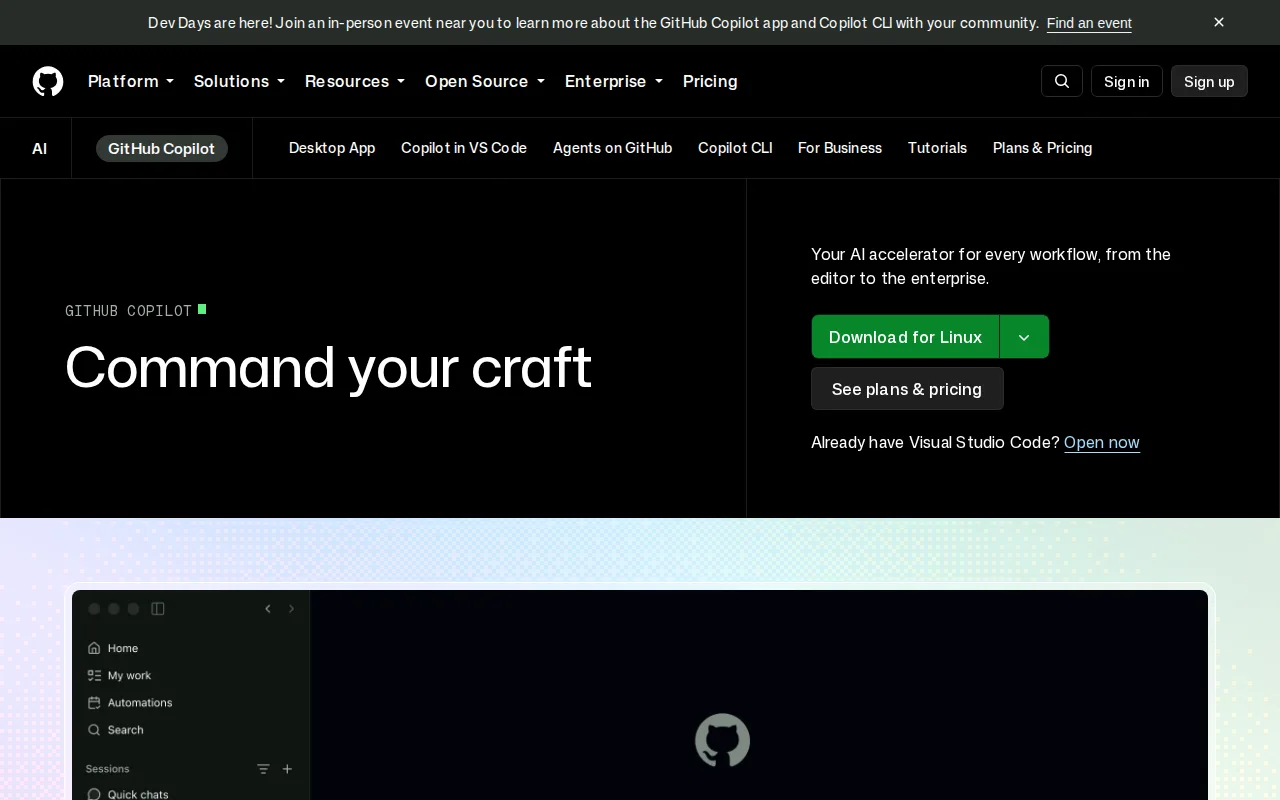
Cline and GitHub Copilot both edit code inside VS Code and JetBrains, but Copilot is built directly into GitHub.com, with autonomous coding agents that can open pull requests against a repository without configuring an external API key first. Copilot's free tier includes 2,000 completions and 50 chat requests a month at $0 with no setup step, while Cline is a bring-your-own-key tool: it costs nothing itself, but every request draws down a separately purchased Anthropic, OpenAI, or other provider API key, so there's no bundled usage at all. Copilot holds a 4.5/5 rating from 50 Capterra reviews, and its Pro tier at $10/month per user includes $15 in monthly model credits plus cloud agent access, code review, and support for third-party agents like Claude Code and Codex. The honest tradeoff is openness and cost ceiling: Copilot's paid tiers run on usage-based model credits that reviewers say can burn through quickly with premium models like Opus, and the software itself is closed-source, unlike Cline's fully open Apache 2.0 codebase with no vendor lock-in on model choice. Developers who want to freely mix Claude, GPT, Gemini, or a local Ollama model without GitHub's credit system, or who specifically want an auditable open-source tool, are better served by Cline.
Compared to Cline: native GitHub.com integration with agents that open PRs directly, a free tier with no API key setup (2,000 completions/month), but usage-based model credits on paid tiers and closed-source code versus Cline's Apache 2.0 openness.
Wins:Native integration across GitHub.com, VS Code, and JetBrains IDEs, including agents that open pull requests directly · Free tier requires no API key configuration at all — 2,000 completions and 50 chat requests per month included at $0 · 4.5/5 rating from 50 Capterra reviews, external evidence Cline doesn't have on file
Loses:Usage-based model credits on paid tiers (Pro at $10/month with $15 in credits) can be consumed quickly by premium models, unlike Cline's flat $0 tool cost · Closed-source, unlike Cline's fully open Apache 2.0 codebase that lets teams audit or fork the tool itself
Pros
- Deep, first-party integration with GitHub.com, VS Code, and JetBrains IDEs.
- Free tier gives every GitHub user a meaningful number of completions with no subscription.
- Supports multiple AI models (including third-party models like Claude and Gemini) depending on plan.
- Coding agent and PR review features extend beyond simple autocomplete into automated code changes.
Cons
- Usage-based model credits on paid tiers make monthly costs harder to predict for heavy users.
- Not always reliable on complex logic or large codebases; generated code still needs careful review.
- Business and Enterprise pricing isn't listed directly on GitHub's public pricing page, requiring a sales conversation.
- Premium model access (like Opus on Pro+) consumes credits significantly faster than base models.
Pricing: Free tier · paid from $10/mo — GitHub Copilot Pro is $10/month per user (includes $15 in model credits) vs Cline's $0 tool cost, though Cline users still pay their chosen provider directly for API usage (verified undefined NaN, NaN)
2.Cursor — best Cline alternative for software teams that want autonomous AI agents handling multi-file changes and PR reviews directly inside their editor and CI pipeline
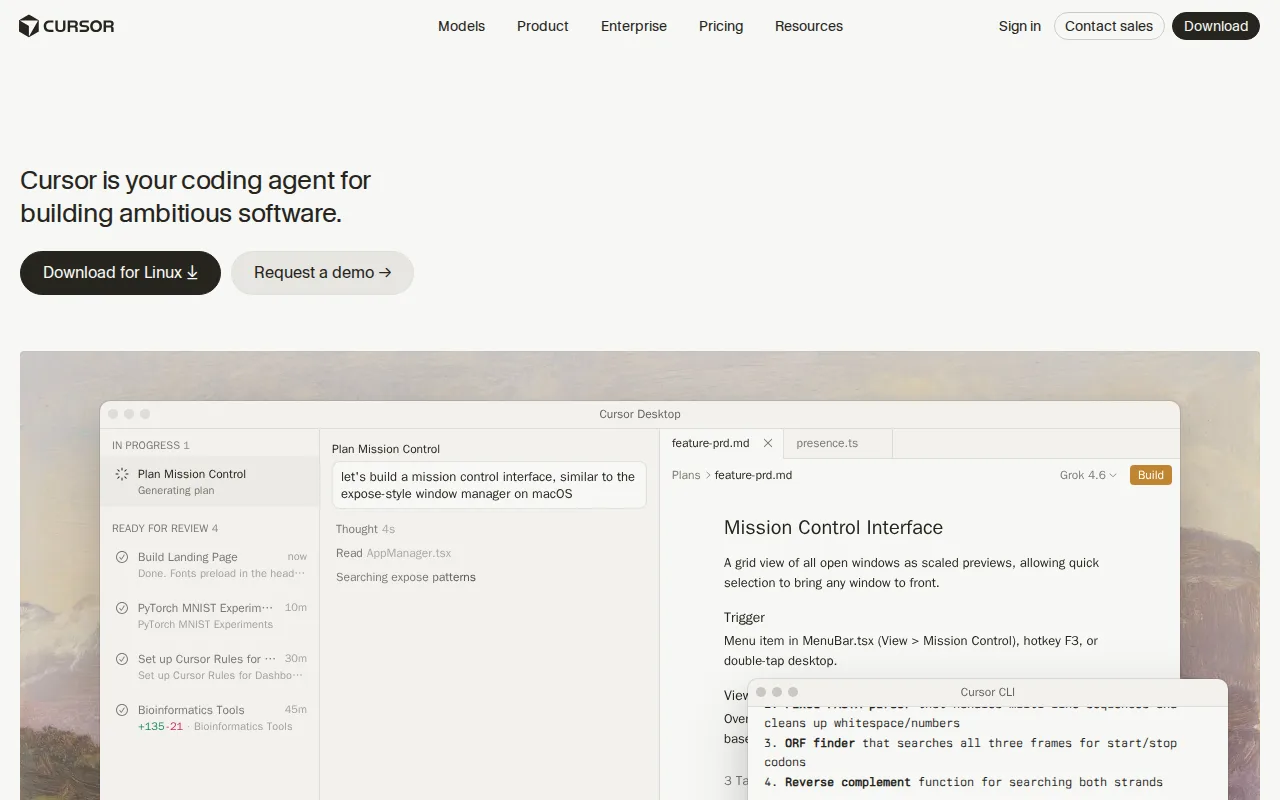
Cline and Cursor both operate as coding agents that can plan and execute multi-file changes, but Cursor is a full AI-native editor forked from VS Code rather than an extension layered on top of an existing IDE, and its cloud agents can keep working on a task for hours or days independent of the local machine, something Cline's extension model doesn't offer. Cursor's free Hobby tier requires no credit card, and Pro costs $20/month with extended agent limits and access to frontier models including Grok and Claude variants; Cline remains free for the tool itself but has no bundled model access of its own, so every request draws on a separately configured API key. Cursor holds a 5.0/5 rating on Capterra, though from only 4 reviews so far, a much thinner evidence base than its broader reputation suggests. The honest tradeoff is cost ceiling and openness: Cursor's usage-based charges stack on top of its subscription, and the jump from Pro ($20/month) to Ultra ($200/month) is steep for teams that outgrow Pro's agent limits, while Cursor itself is closed-source, unlike Cline's fully open Apache 2.0 codebase distributed as a lighter-weight VS Code and JetBrains extension. Developers who want to keep their existing editor rather than switch to a Cursor-specific fork, or who want an auditable open-source tool, are better served by Cline.
Compared to Cline: a dedicated AI-native editor with cloud agents that run for hours or days independent of the local machine, free Hobby tier with no credit card required, but usage-based charges stack on the $20/month Pro subscription and the editor itself is closed-source.
Wins:Cloud agents keep working on long tasks (hours or days) independent of the local machine, a capability Cline's extension model doesn't offer · Multi-model support (Grok, Claude, Cursor's own Composer) built into a purpose-made editor rather than an extension on an existing IDE · Free Hobby tier requires no credit card to start
Loses:Usage-based charges (extra Agent requests, Bugbot) stack on top of the $20/month Pro subscription, and the jump to Ultra ($200/month) is steep, unlike Cline's flat $0 tool cost · Closed-source, unlike Cline's fully open Apache 2.0 codebase · 5.0/5 Capterra rating is based on only 4 reviews so far, a thin evidence base
Pros
- Autonomous agents can plan, write, test, and open pull requests with minimal hand-holding.
- Multi-model support (Grok, Claude, Cursor's own Composer) avoids lock-in to a single AI provider.
- Cloud agents keep running on long tasks without tying up the developer's local machine.
- Free Hobby tier requires no credit card, making it easy to evaluate before paying.
Cons
- Usage-based charges on top of the subscription make total monthly cost harder to predict than a flat fee.
- Steep price jump from Pro ($20/month) to Ultra ($200/month) for teams needing higher Agent limits.
- Requires comfort delegating multi-file changes to an agent, a real workflow shift for developers used to manual review of every diff.
- No iOS or Android app; Cursor is desktop- and CLI-only.
Pricing: Free tier · paid from $20/mo — Cursor Pro is $20/month per user vs Cline's $0 tool cost, though Cline users pay their chosen model provider directly on top
3.Windsurf — best Cline alternative for developers who want an agentic AI coding assistant and are open to using Cognition's Devin product line, since the standalone Windsurf editor no longer exists as an independent product

Cline and Windsurf both started as free, open ways to bring AI agents into an existing coding workflow, but that comparison is now complicated: Windsurf as an independent product no longer exists. Cognition AI, maker of the autonomous agent Devin, acquired Windsurf's product, brand, and team in July 2025, and windsurf.com now redirects permanently to Cognition's devin.ai, where the editor lives on as "Devin Desktop" inside a unified Free/Pro/Max/Teams/Enterprise pricing lineup introduced in April 2026. A Free tier exists in that lineup, but exact usage limits and per-tier dollar prices for Pro, Max, and Teams could not be confirmed due to repeated rate-limiting on Cognition's own site, unlike Cline's clearly published $0 tool cost. What's inherited from the original Windsurf is Cascade-style agentic Flows that plan and execute multi-step coding tasks, now backed by Cognition's larger Devin Cloud infrastructure rather than a smaller independent team. Windsurf's only rating on file is a single Capterra review at 3/5, offering little evidence either way. Anyone who chose Windsurf specifically for its lightweight, independent positioning is now committing to a larger, differently focused Devin ecosystem; developers who want a genuinely free, transparently open-source tool with no ecosystem lock-in are better served by Cline.
Compared to Cline: Cascade-style agentic Flows inherited from the original editor, now backed by Cognition's larger Devin Cloud infrastructure, but the standalone Windsurf product no longer exists (windsurf.com redirects to devin.ai) and current per-tier pricing couldn't be confirmed.
Wins:Backed by Cognition's larger Devin Cloud infrastructure and Agent Command Center rather than a smaller independent team · A Free tier exists in Cognition's current Devin plan lineup for developers who want to try it before paying
Loses:Windsurf as an independent product no longer exists; windsurf.com redirects permanently to devin.ai, unlike Cline's actively maintained standalone tool · Current Pro, Max, and Teams pricing could not be confirmed due to rate-limiting on Cognition's site, unlike Cline's clearly published $0 cost · Only external rating on file is a single 3/5 Capterra review, thin evidence next to Cline's own track record
Pros
- Agentic Cascade/Flow-style multi-step code editing carried over from the original Windsurf editor.
- Now backed by Cognition's Devin Cloud infrastructure and Agent Command Center rather than a smaller standalone team.
- A free tier exists in the current Devin plan lineup for developers who want to try it before paying.
- VS Code-based interface keeps the editing experience familiar to developers switching from VS Code or Cursor.
Cons
- The Windsurf brand and standalone product no longer exist independently; windsurf.com redirects to devin.ai.
- Current per-tier pricing (Pro, Max, Teams) was not publicly verifiable, making cost comparison against competitors difficult without visiting devin.ai directly.
- Users who chose Windsurf specifically for its smaller, independent-company positioning are now inside a larger, differently-focused product (Devin) built around autonomous agents rather than a lightweight editor.
Pricing: Free — Windsurf/Devin Desktop's Free tier is $0 but Pro/Max/Teams dollar prices were not confirmed, vs Cline's clearly published $0 tool cost
4.Continue — best Cline alternative for developers who want an editor-agnostic AI coding agent they can point at any LLM, including self-hosted models, and who are comfortable adopting a project with no active company behind it
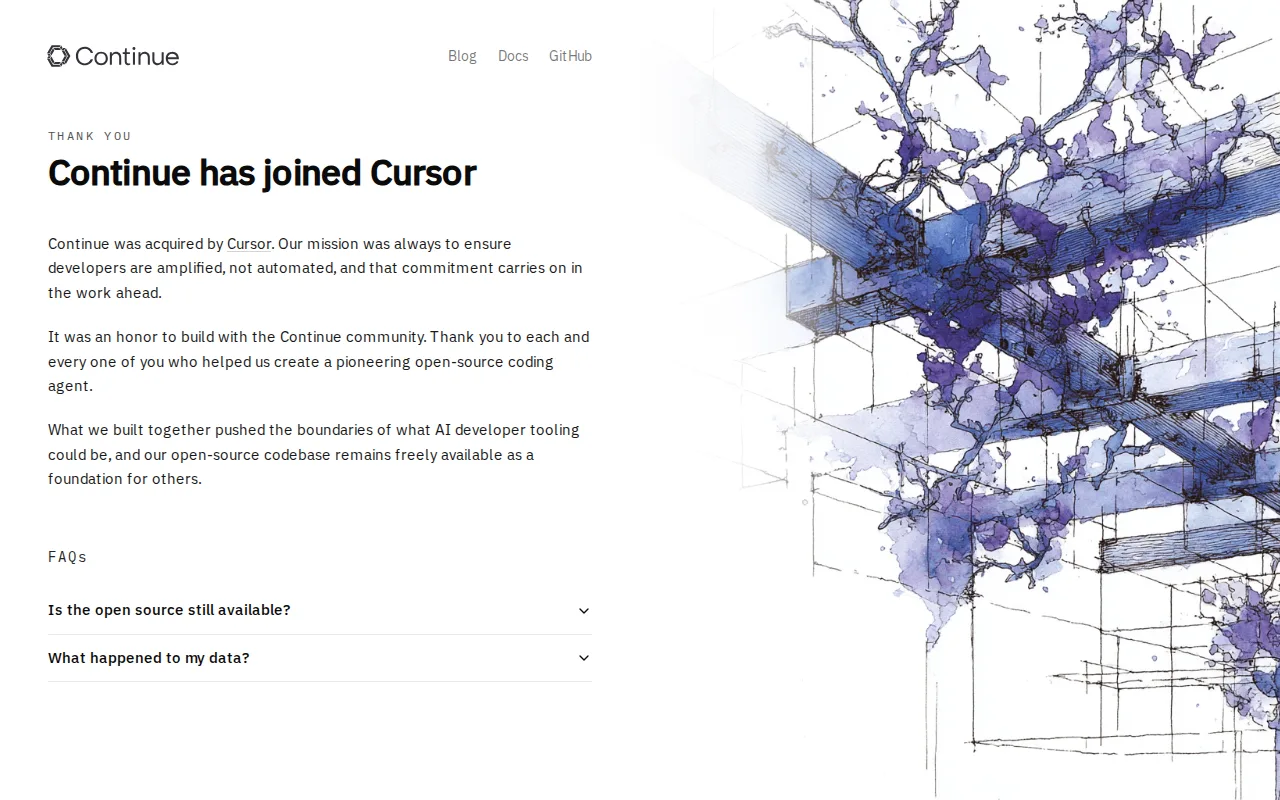
Cline and Continue are both free, open-source AI coding agents (Apache 2.0) available as VS Code extensions, JetBrains plugins, and CLIs, so the core value proposition is nearly identical: no subscription fee, and freedom to point the agent at any LLM provider including locally hosted models. Continue's GitHub repository holds 35,600 stars, and its configuration lives in version-controlled files rather than a vendor dashboard, similar to Cline's own .clinerules approach. The honest catch is maintenance: Continue Dev, Inc., the company behind the project, was acquired by Cursor, and the GitHub repository shipped a final 2.0.0 release removing telemetry and hosted authentication before being archived as read-only, so there is no company fixing new bugs, adding model support, or responding to issues going forward. Cline, by contrast, is still under active development with 8M+ installs and adoption at companies including Samsung, Amazon, and Microsoft, plus a JetBrains plugin (early access), a CLI, and an embeddable SDK, while Continue's own JetBrains support has been deprioritized in favor of its CLI. Developers who specifically need an actively maintained open-source agent with ongoing model support, or who want JetBrains parity with the VS Code experience, are better served by Cline.
Compared to Cline: nearly identical free, open-source (Apache 2.0), editor-agnostic model, but the GitHub repository was archived as read-only after Cursor's acquisition, so no new features or bug fixes are shipping, unlike Cline's actively maintained 8M+-install codebase.
Wins:35,600 GitHub stars reflect an established open-source track record · Configuration lives entirely in version-controlled files, matching Cline's own .clinerules approach to project-specific rules
Loses:Archived as read-only on GitHub after Cursor's acquisition, so no new features or bug fixes are shipping from the original team, unlike Cline's active development · JetBrains plugin support has been deprioritized in favor of the CLI, while Cline's JetBrains plugin remains in active early access · No external rating on file, unlike Cline's broader installed base of 8M+
Pros
- Free and open source under Apache 2.0 with no pricing tiers or usage limits.
- Works with any LLM provider, including locally hosted models, avoiding vendor lock-in.
- Available as a VS Code extension, JetBrains plugin, and standalone CLI, covering multiple workflows.
- Configuration lives in version-controlled files rather than a vendor dashboard.
Cons
- Archived as read-only on GitHub after Cursor's acquisition, so no new features or bug fixes are shipping from the original team.
- Requires manually configuring an LLM provider and API key before it does anything, unlike bundled assistants that work out of the box.
- The JetBrains plugin is now a secondary priority; the project recommends the CLI instead.
Pricing: Free — Both are $0 with no paid tier — Continue and Cline are both free under Apache 2.0 (verified undefined NaN, NaN)
5.Aider — best Cline alternative for developers comfortable in a terminal who want a model-agnostic AI coding assistant without a subscription, paying only for the LLM tokens they actually use
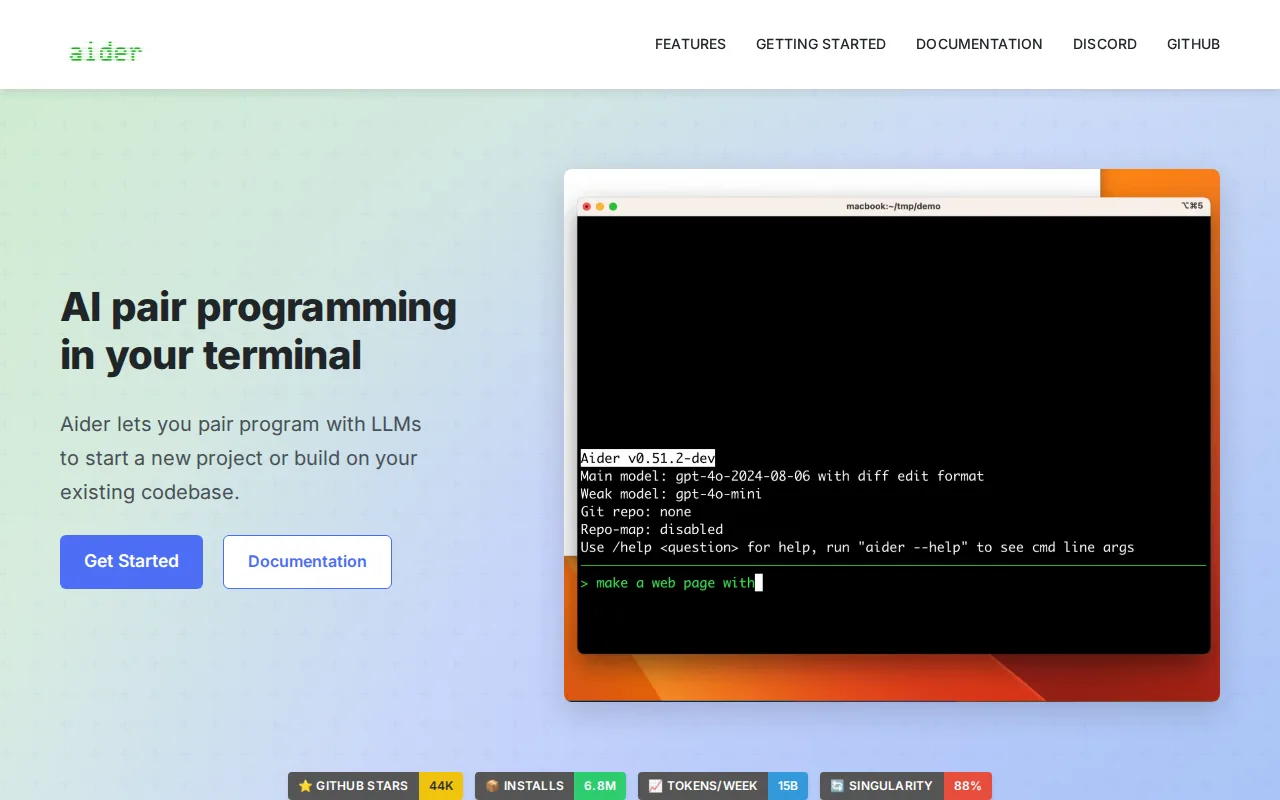
Cline and Aider are both free, open-source (Apache 2.0), bring-your-own-key coding agents with no subscription fee, but Aider lives entirely in the terminal rather than as an IDE extension, building a condensed map of the codebase so large repositories stay within a model's context window without sending the entire project on every request. Aider automatically commits every accepted edit to git, keeping changes reviewable and revertible by default, a stronger built-in safety net than Cline's checkpoint-based reverting. Aider's GitHub repository has 48.4k stars and the project reports 6.8 million weekly installs and roughly 15 billion tokens processed weekly across its user base, a larger publicly reported usage signal than Cline's 8M+ installs figure alone conveys about active weekly use. The honest tradeoff is interface: Aider has no GUI or IDE-native experience at all, a real barrier for developers who expect an editor-integrated assistant, while Cline is available directly inside VS Code and JetBrains without leaving the editor, plus a Plan-and-Act mode for reviewing strategy before execution that Aider's command-driven workflow doesn't structure the same way. Developers who want their coding agent inside the editor they already use, rather than a separate terminal tool, are better served by Cline.
Compared to Cline: terminal-native workflow with automatic codebase mapping and a git commit on every accepted edit, both free and open-source (Apache 2.0), but no GUI or IDE-native experience at all, unlike Cline's VS Code and JetBrains integration.
Wins:Automatic codebase mapping keeps large, existing repositories within a model's context window without sending the whole project · Every accepted edit auto-commits to git, keeping changes reviewable and revertible by default · 48.4k GitHub stars and a reported 6.8 million weekly installs, a larger publicly reported usage signal
Loses:No GUI or IDE-native experience at all; lives entirely in the terminal, unlike Cline's VS Code and JetBrains extensions · No Plan-and-Act-style mode separating strategy review from execution the way Cline structures it
Pros
- No subscription fee; Apache-2.0 licensed and free to self-host indefinitely.
- Works with any LLM provider (Anthropic, OpenAI, DeepSeek, local models), avoiding vendor lock-in.
- Automatic git commits on every edit keep changes reviewable and revertible.
- Repository mapping lets it work effectively on large, existing codebases, not just greenfield projects.
Cons
- Terminal-only interface with no native GUI, a steeper adjustment for developers used to IDE-integrated tools.
- Actual cost is variable and provider-dependent, since Aider itself doesn't charge but token usage does.
- Requires users to separately manage and secure their own LLM API keys and billing.
- Community support only, since there is no vendor offering paid enterprise support or SLAs.
Pricing: Free — Both are $0 with no paid tier — Aider and Cline are both free and open-source, and both bill only for the LLM API usage a user configures (verified undefined NaN, NaN)
6.Claude Code — best Cline alternative for developers who want an agentic coding tool that autonomously reads, edits, and runs code across a full repository from the terminal or IDE, not just single-file autocomplete
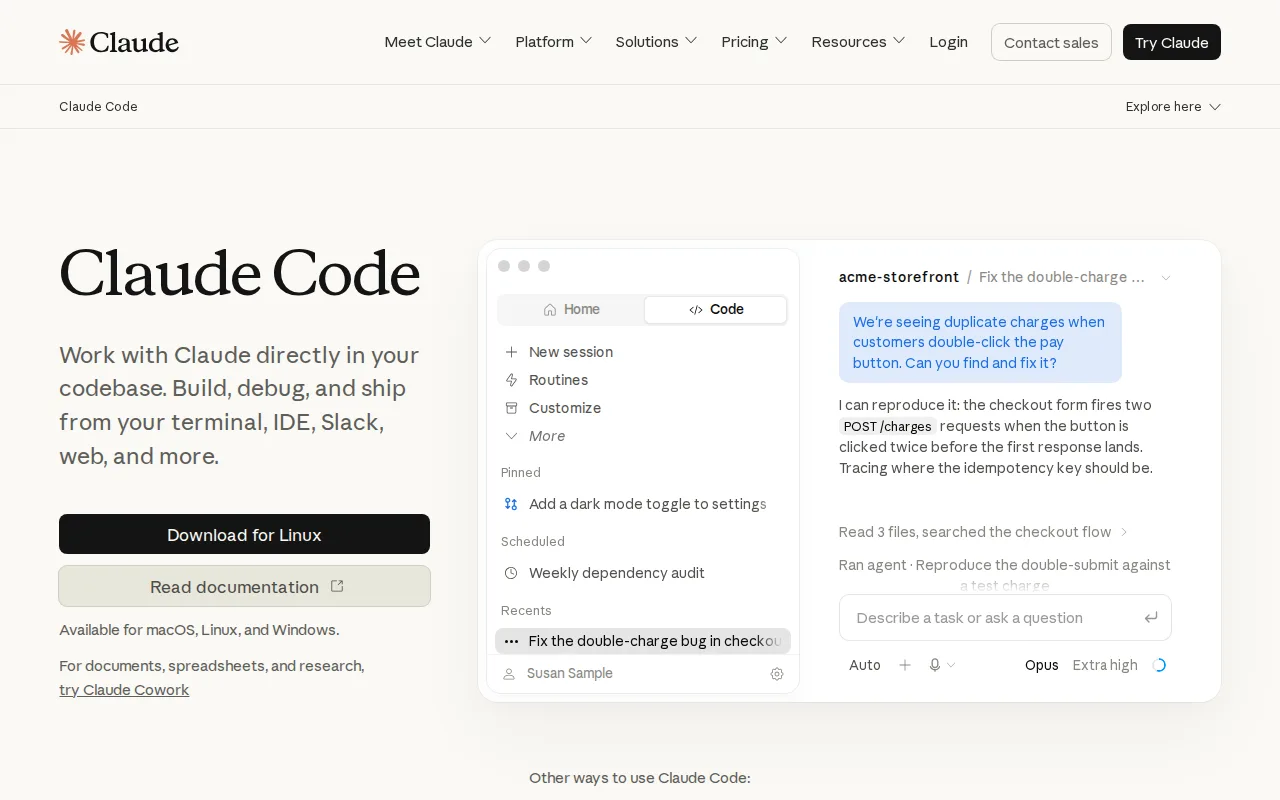
Cline and Claude Code both operate autonomously across a full codebase from the terminal, but Claude Code bundles model access into the subscription itself, so a Pro plan at $17/month (billed annually) includes standard usage limits without separately purchasing API credits, while Cline's tool is free but every request draws down a bring-your-own-key balance with no bundled usage at all. Claude Code handles complete GitHub/GitLab workflows end-to-end, from picking up an issue to opening a pull request, and holds a 5.0/5 rating from 640 Product Hunt reviews, the deepest review base of any tool in this comparison. The honest tradeoff is cost floor and openness: Claude Code has no free tier whatsoever, so trying it requires either a paid Claude subscription or pay-as-you-go API billing, unlike Cline's genuinely free tool cost, and heavy agentic sessions can hit subscription usage caps that push users toward the pricier $100-200/month Max tiers. Claude Code is also closed-source and locked to Anthropic's own models, whereas Cline is fully open Apache 2.0 and lets developers freely mix Claude, GPT, Gemini, or a local Ollama model. Developers who want to try an agent for free before committing, or who want model choice rather than a single-vendor subscription, are better served by Cline.
Compared to Cline: bundled model usage inside a flat $17/month Pro subscription and the deepest review base here (5.0/5 from 640 Product Hunt reviews), but no free tier at all and locked to Anthropic's own models, unlike Cline's free, multi-provider Apache 2.0 tool.
Wins:Bundled model usage inside the subscription itself, no separate API key purchase required to start using it · Handles complete GitHub/GitLab workflows end-to-end, from picking up an issue to opening a pull request · 5.0/5 rating from 640 Product Hunt reviews, the deepest review base of any tool compared here
Loses:No free tier at all; requires a paid Claude subscription or pay-as-you-go API billing, unlike Cline's genuinely free tool · Locked to Anthropic's own models, unlike Cline's freedom to mix Claude, GPT, Gemini, or a local Ollama model · Heavy agentic sessions can hit subscription usage caps, pushing users toward the pricier $100-200/month Max tiers
Pros
- Understands and edits across an entire codebase autonomously, without the developer manually selecting files for context.
- Handles full GitHub/GitLab workflows end-to-end, from picking up an issue to opening a pull request.
- Available from the terminal, IDE extensions (VS Code, JetBrains), and a web interface.
- Prompts for permission before executing file changes or shell commands by default.
Cons
- No free tier; access requires a paid Claude subscription or pay-as-you-go API billing.
- Subscription usage limits can be hit during heavy agentic sessions, pushing users toward the $100-200/month Max tiers.
- Pay-as-you-go API pricing can be harder to budget for than a flat subscription for unpredictable workloads.
- Team and Enterprise pricing combines a per-seat fee with usage billed at API rates, adding a variable cost on top of the base subscription.
Pricing: From $17/mo — Claude Code Pro is $17/month (billed annually) with no free tier vs Cline's $0 tool cost, though Cline users still pay their chosen provider directly for API usage (verified undefined NaN, NaN)
Which one is right for you?
- You want inline completions and PR review built directly into GitHub.com and VS Code with a no-setup free tier.GitHub Copilot
- You want a dedicated AI-native editor with cloud agents that keep working for hours after you close your laptop.Cursor
- You're already invested in Cognition's Devin ecosystem or specifically want Cascade-style agentic Flows.Windsurf
- You want a lightweight, editor-agnostic open-source agent and don't mind that active development has stopped.Continue
- You live in the terminal and want automatic codebase mapping plus a git commit on every accepted edit.Aider
- You want AI usage bundled into one flat subscription instead of managing a separate API key balance.Claude Code
- You need an agent that handles a full GitHub/GitLab workflow end-to-end, from issue to merged pull request.Claude Code
Frequently asked questions
Is there a free alternative to Cline?
- Yes — Continue and Aider are both fully free, open-source (Apache 2.0) coding agents with no subscription tier, matching Cline's own $0 tool cost. Continue's GitHub repository has been archived as read-only since Cursor's acquisition, so Aider remains the actively maintained free option.
What is the closest alternative to Cline?
- Continue is the closest match on paper — both are free, open-source (Apache 2.0), model-agnostic coding agents distributed as VS Code extensions, JetBrains plugins, and CLIs. Its GitHub repository was archived as read-only after Cursor's acquisition, though, so Aider is the closer match if active maintenance matters.
Can GitHub Copilot replace Cline?
- Yes, for developers who want a no-setup free tier — GitHub Copilot gives every GitHub user 2,000 completions and 50 chat requests a month at $0, plus a 4.5/5 rating from 50 Capterra reviews. The tradeoff is openness: Copilot is closed-source with usage-based model credits on paid tiers, while Cline is fully open Apache 2.0 with no vendor lock-in on model choice.
Is there an open-source alternative to Cline?
- Yes — Continue and Aider are both open source under Apache 2.0, the same license Cline uses. Continue's repository was archived as read-only after Cursor's 2025 acquisition of the company, while Aider (48.4k GitHub stars) remains actively developed.
Does Cursor cost more than Cline?
- Cursor's Pro tier is $20/month per user, while Cline itself costs $0. The real cost comparison depends on API usage, since Cline users still pay their chosen model provider directly, and Cursor's usage-based charges on top of Pro can also add up for heavy users.
Is Windsurf still available as a standalone product?
- No — Windsurf was acquired by Cognition AI in July 2025 and windsurf.com now redirects permanently to Cognition's devin.ai, where the editor continues as Devin Desktop inside a unified Free/Pro/Max/Teams/Enterprise pricing lineup. Anyone signing up for Windsurf today is committing to Cognition's broader Devin ecosystem rather than the original independent tool.
Which Cline alternative has no free tier at all?
- Claude Code is the only tool in this comparison with no free tier whatsoever. Using it requires a paid Claude Pro/Max/Team subscription starting at $17/month or pay-as-you-go Anthropic API billing, unlike Cline's genuinely free tool cost.