4 Best Alternatives to Fly.io in 2026
By Noahlast updated pricing verified

From our data: 3 of the 4 alternatives compared here — Render, Railway, and DigitalOcean — report a $0 starting price with a genuine free tier, while Heroku's cheapest paid Eco dyno starts at $5/month and Fly.io itself has no free tier at all.
 Render
 DigitalOcean
 Railway
 Heroku
How we picked
- Three of the four alternatives — Render, Heroku, and DigitalOcean — carry external ratings fetched 2026-08-21 (Render 4.3/5 on Capterra from 3 reviews and 5/5 on Product Hunt from 76 reviews, Heroku 4.6/5 from 305 Capterra reviews, DigitalOcean 4.6/5 from 159 Capterra reviews); Railway has none on file, so its position here rests on pricing and feature data alone.
- Pricing for all four alternatives was verified on 2026-08-21, the same day as Fly.io's own usage-based rate card, so every dollar figure compared below reflects the same pricing snapshot.
- Render, Railway, and DigitalOcean all report a $0 starting price with a free tier, while Heroku's cheapest paid Eco dyno starts at $5/month and Fly.io itself has no free tier at all, a split that shaped which alternative fits budget-constrained migrations.
- Ordering follows the balance of verified pricing depth and rating volume: Render leads on the largest combined review count (79 across two platforms) plus a working free tier, ahead of Railway's flat unlimited-seat pricing, Heroku's largest single rating base (305 Capterra reviews), and DigitalOcean's per-second VM billing.
Paid placement never alters editorial rank — read the full methodology.
Fly.io alternatives at a glance
| Alternative | Best for | Standout | Biggest weakness | Learning curve | Price |
|---|---|---|---|---|---|
| Fly.ioreference | developers deploying Dockerized apps and APIs who want multi-region placement and per-second usage billing instead of a fixed monthly plan | Fly Machines boot as Firecracker microVMs in about a second in any of Fly.io's global regions, and every resource bills per second with no predefined plan tiers. | No free tier: usage-based billing starts immediately on signup with no permanently free allowance, and predicting a monthly bill in advance is harder than on flat-rate hosts because compute, storage, IPs, and transfer all meter separately. | Moderate | From $29/mo |
| Render | developers and teams migrating off Heroku who want autoscaling web services, managed Postgres/Redis, and background workers with usage-based compute pricing | Preview environments spin up automatically for every pull request, and the instance ladder scales from a $7/month Starter web service up to a 64 CPU / 512 GB Pro Ultra instance ($450/month) without switching platforms. | Free-tier web services spin down after periods of inactivity, causing a cold-start delay on the next request, and the paid workspace/seat plan tiers above Free aren't published with specific dollar amounts on the pricing page — teams have to build out compute usage to see the real monthly total. | Low | Free tier · paid from $6/mo |
| Railway | developers and small teams who want a Heroku-style deploy experience with usage-based pricing and unlimited team seats on the $20/month Pro workspace plan | Pro is a flat $20/month per workspace with unlimited team seats rather than per-user pricing, and a built-in MCP server plus railway up -y let AI coding agents deploy and manage services directly. | Usage-based billing on top of the plan fee can surprise teams that don't watch resource limits — the Free tier is capped at just $1/month in credits and 0.5 GB RAM per service — and SLA guarantees, SSO, and dedicated support are only available on the custom-priced Enterprise tier. | Low | Free tier · paid from $5/mo |
| Heroku | small teams and startups who want git-push deployment and managed Postgres/Redis without hiring dedicated DevOps, and can accept dyno pricing above raw cloud VM cost | Git-push deployment with automatic GitHub-integrated review apps for every pull request, plus one-click rollback to a prior release or database backup. | No free tier since 2022 (the cheapest Eco dyno is $5/month and still sleeps after 30 minutes of inactivity); Standard and Performance dyno pricing scales far above the cost of an equivalent self-managed VM on AWS or DigitalOcean. | Low | From $5/mo |
| DigitalOcean | developers and small engineering teams who want predictable, usage-based cloud pricing for VMs, Kubernetes, and managed databases without navigating AWS's pricing complexity | Simple, transparent per-second billing on Droplets starting at $4/month, combined with a newer AI infrastructure stack (GPU access, a 70+ model inference engine, and managed agent orchestration) on the same account. | Fewer regions and a smaller managed-service catalog than AWS, Azure, or Google Cloud, so teams with complex compliance, networking, or enterprise-integration needs often outgrow DigitalOcean and have to migrate to a hyperscaler. | Low | Free tier · paid from $4/mo |
 Fly.io
1.Render — best Fly.io alternative for developers and teams migrating off Heroku who want autoscaling web services, managed Postgres/Redis, and background workers with usage-based compute pricing
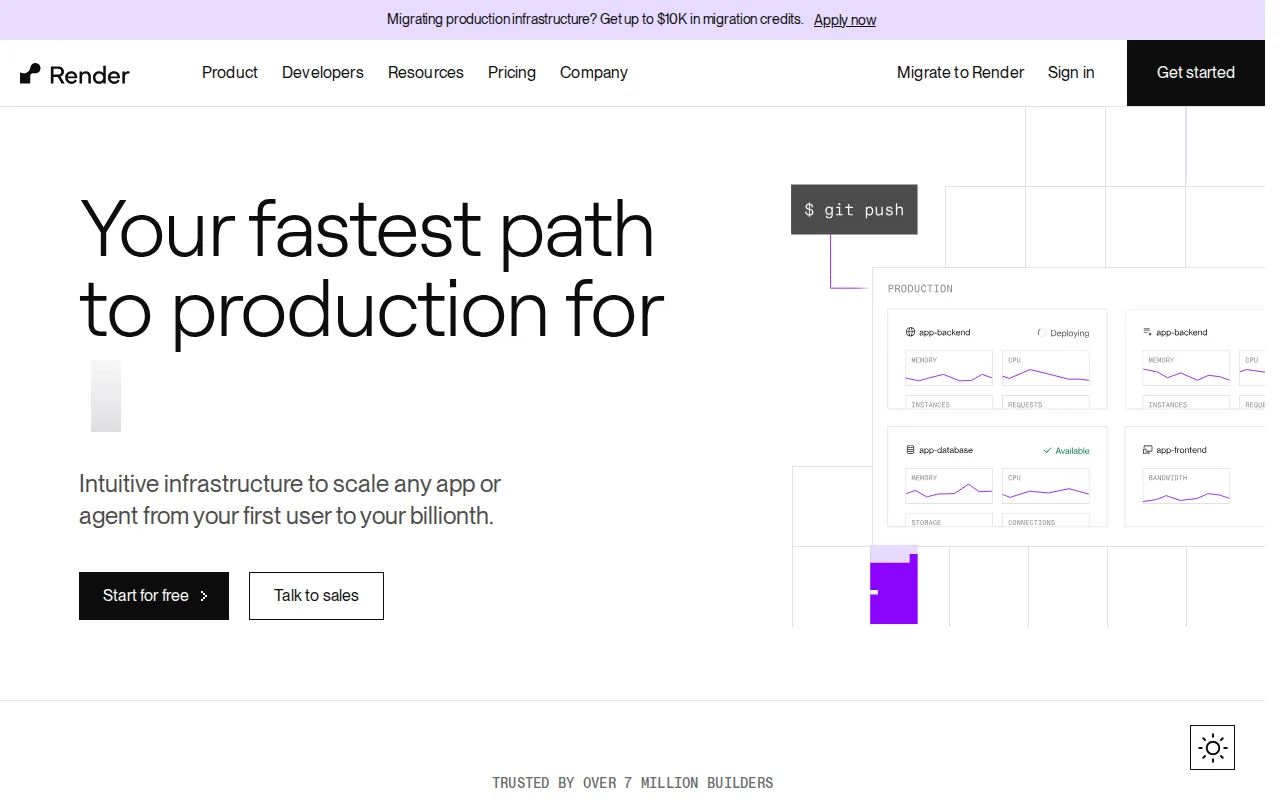
Render is the best Fly.io alternative for developers who want autoscaling web services, managed Postgres, and background workers without Fly.io's fully usage-metered billing model. Render holds a 5/5 rating across 76 Product Hunt reviews and 4.3/5 across 3 Capterra reviews, external validation Fly.io's own listing doesn't carry at all. Render's free Hobby plan gives one project with 500 build-pipeline minutes a month at $0, while Fly.io requires a credit card and starts billing from the first Machine created since it has no free tier. Paid compute on Render starts at $7/month for a Starter instance and scales through named tiers up to a 64 CPU / 512 GB Pro Ultra instance at $450/month, a predictable ladder compared to Fly.io's per-second metering across compute, storage, and IP address costs that must be added up separately. Render also bundles managed Postgres from $6/month with point-in-time recovery on paid tiers and automatic PR preview environments for every pull request. Fly.io remains the better choice for teams that specifically need Firecracker microVMs booting in about a second across dozens of global regions for latency-sensitive placement: Render's web services run in a smaller, fixed set of regions and don't offer the same per-second, pick-any-region compute model, and Render's free-tier services spin down after inactivity, adding cold-start delay Fly.io's always-billed Machines don't have.
Compared to Fly.io: 5/5 rating from 76 Product Hunt reviews vs Fly.io's none on file, genuine $0 free Hobby tier vs Fly.io's no free tier at all, predictable $7-$450/month instance ladder vs Fly.io's per-second metered compute/storage/IP billing
Wins:5/5 rating from 76 Product Hunt reviews and 4.3/5 from 3 Capterra reviews, evidence Fly.io has none of on file · Free Hobby plan with 500 build-pipeline minutes/month at $0, while Fly.io has no free tier and starts billing on signup · Named instance ladder from $7/month Starter up to $450/month Pro Ultra (64 CPU/512GB) is easier to budget than Fly.io's per-second metering across compute, storage, and IP costs
Loses:No per-second, pick-any-region Firecracker microVM placement the way Fly.io Machines offer across dozens of global regions · Free-tier web services spin down after inactivity, adding cold-start latency that Fly.io's always-billed Machines don't have · Workspace-level plan pricing beyond individual compute instance cost isn't published as static text, similar to some of Fly.io's own less-prominent Postgres and Kubernetes pricing pages
Pros
- Automatic PR preview environments and one-click rollback simplify testing changes before merge.
- Compute instance sizing scales from $7/month up to 64 CPUs / 512 GB RAM without migrating platforms.
- Managed Postgres and Redis-compatible Key Value store included, with point-in-time recovery on paid tiers.
- CLI and MCP server support AI-agent-driven deployment workflows.
Cons
- Free-tier web services spin down after inactivity, adding cold-start latency on the next request.
- Paid workspace-level plan pricing (beyond individual compute instance costs) isn't published on the pricing page.
- Managed database pricing scales steeply at larger sizes, reaching into the thousands of dollars per month.
Pricing: Free tier · paid from $6/mo — $7/month Starter instance (Render) vs Fly.io's roughly $2.02/month for a continuously run shared-cpu-1x/256MB Machine — Render's entry tier costs more but is a flat, predictable price, while Fly.io meters compute, storage, and IPs separately (verified undefined NaN, NaN)
2.Railway — best Fly.io alternative for developers and small teams who want a Heroku-style deploy experience with usage-based pricing and unlimited team seats on the $20/month Pro workspace plan
Railway is the best Fly.io alternative for small teams that want flat, predictable workspace pricing instead of Fly.io's fully itemized per-resource billing. Railway's Pro plan costs $20/month per workspace and includes unlimited team members, a flat number Fly.io can't match since every Fly.io account bills compute, storage volumes, dedicated IPv4 addresses, and data transfer separately with no team-seat concept at all. Railway's Free plan includes $1 of monthly usage credit at 0.5 vCPU/0.5GB per service, useful for testing before committing to a paid workspace, something Fly.io doesn't offer since it has no free tier and starts metering usage from the first resource created. Railway auto-detects build systems through Nixpacks or a Dockerfile, and its MCP server plus railway up -y command let AI coding agents deploy and manage services directly, a similar agent-facing angle to Fly.io's own 2026 Sprites product for persistent AI agent computers. Railway has no external ratings recorded in this comparison, unlike Fly.io's 5/5 rating from 27 Product Hunt reviews, so buyers weighing reputation evidence have less third-party signal to go on here. Fly.io remains the better choice for workloads that need Firecracker microVMs placed in specific regions worldwide for latency, and for teams already comfortable itemizing per-second compute, storage, and IP costs rather than paying a flat workspace fee with usage credits layered on top.
Compared to Fly.io: $20/month Pro workspace with unlimited seats vs Fly.io's per-resource billing with no team-seat concept, $1-$20 Free/Hobby usage credits vs Fly.io's no free tier at all, MCP server and railway up -y for agent-driven deploys similar to Fly.io's own 2026 Sprites product
Wins:Pro plan is a flat $20/month per workspace with unlimited team seats, unlike Fly.io's fully itemized per-resource billing with no seat concept · Free and Hobby tiers include $1-$5 of monthly usage credit, while Fly.io has no free tier and bills from the first resource created · MCP server and single-command railway up -y deploys support AI-agent-driven workflows without separate tooling
Loses:No external ratings recorded in our listing data, unlike Fly.io's 5/5 rating from 27 Product Hunt reviews · No per-second, pick-any-region Firecracker microVM model the way Fly.io Machines offer across dozens of global regions · SLAs, SSO, and dedicated support require the custom-priced Enterprise tier, similar to Fly.io gating direct engineering support behind its own $29/month-and-up support plans
Pros
- Pro plan is a flat $20/month per workspace with unlimited team seats, not per-user pricing.
- Auto-detects build systems via Nixpacks, or use a Dockerfile for full control.
- Managed Postgres, MySQL, Redis, MongoDB, and ClickHouse databases available out of the box.
- MCP server integration and
railway up -ysupport agent-driven, one-command deployments.
Cons
- Usage-based compute billing on top of plan fees can be hard to predict for variable workloads.
- Free tier is very limited: $1/month in usage credit and 0.5 GB RAM per service.
- SLAs, SSO, and dedicated support require the custom-priced Enterprise tier.
Pricing: Free tier · paid from $5/mo — $20/month flat per workspace (Railway Pro, unlimited seats) vs Fly.io's roughly $2.02/month per continuously run shared-cpu-1x/256MB Machine plus separate storage, IP, and transfer charges (verified undefined NaN, NaN)
3.Heroku — best Fly.io alternative for small teams and startups who want git-push deployment and managed Postgres/Redis without hiring dedicated DevOps, and can accept dyno pricing above raw cloud VM cost
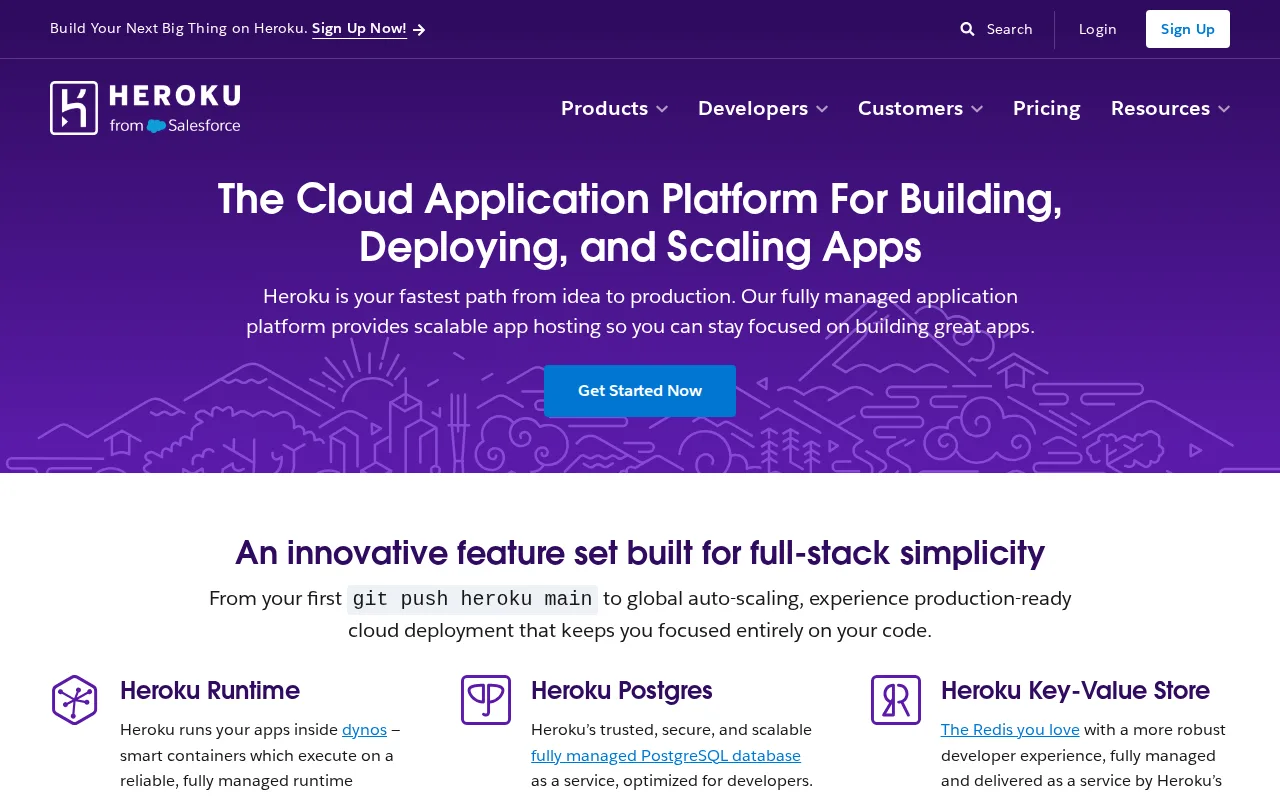
Heroku is the best Fly.io alternative for teams that want git-push deployment and managed Postgres and Redis without configuring per-second usage billing across separate resources. Heroku holds a 4.6/5 rating from 305 Capterra reviews, the largest review base in this comparison and evidence Fly.io's own listing doesn't have at all. git push heroku main builds and runs an app on a dyno automatically, using buildpacks for Node.js, Ruby, Python, Java, Go, PHP, Scala, and .NET, a simpler mental model than assembling Fly.io Machines, volumes, and IPs by hand. Heroku's GitHub-integrated review apps spin up a disposable staging environment for every pull request, and one-click rollback covers both releases and database backups. Heroku's cheapest Eco dyno costs $5/month but still sleeps after 30 minutes of inactivity and is restricted to personal projects, while Fly.io has no free tier at all and starts metering usage immediately, so neither vendor gives a genuinely free production option. Fly.io remains the better choice for cost-sensitive, low-traffic apps: a continuously run Fly.io shared-cpu-1x/256MB Machine costs roughly $2.02/month, well under Heroku's $5/month Eco dyno, and Fly.io's Firecracker Machines can be placed in dozens of regions worldwide for latency, a global-placement model Heroku's fixed dyno regions don't match.
Compared to Fly.io: 4.6/5 rating from 305 Capterra reviews vs Fly.io's none on file, git-push deployment with buildpacks vs Fly.io's Docker-image Machine model, GitHub-integrated PR review apps vs no equivalent in Fly.io's listing
Wins:4.6/5 rating from 305 Capterra reviews, the largest review base in this comparison and more than Fly.io's zero on-file ratings · Git-push deployment with buildpacks for 8 languages removes manual Docker-image and Machine configuration · GitHub-integrated review apps and one-click rollback for both releases and database backups aren't part of Fly.io's own feature listing
Loses:Eco dyno costs $5/month and still sleeps after 30 minutes of inactivity, more expensive than a continuously run Fly.io shared-cpu-1x/256MB Machine at roughly $2.02/month · No permanently free tier since 2022, the same gap as Fly.io, which also has no free tier · Standard and Performance dyno pricing (up to $500/month) climbs well above raw compute cost, and Heroku's dyno regions are fixed rather than Fly.io's pick-any-of-dozens-of-regions Firecracker placement
Pros
- Git-push deployment with zero server configuration; buildpacks auto-detect the language and framework.
- GitHub-integrated review apps spin up a disposable staging environment for every pull request.
- Managed Postgres and Redis with one-click provisioning, automated backups, and fork/rollback support.
- 380+ buildpacks cover nearly any language beyond the natively supported ones.
Cons
- No permanently free tier since 2022; the $5/month Eco dyno still sleeps after 30 minutes of inactivity.
- Standard and Performance dyno pricing runs well above equivalent raw compute on AWS, DigitalOcean, or Render.
- Add-on pricing (Postgres, Redis, Kafka) is billed separately from dyno cost, so total bills climb quickly for production apps.
- Private Spaces (network isolation, HIPAA/PCI compliance) require a much higher-priced tier, pricing out smaller regulated teams.
Pricing: From $5/mo — $5/month Eco dyno (sleeps after 30 min) vs Fly.io's roughly $2.02/month for a continuously run shared-cpu-1x/256MB Machine; neither offers a genuinely free always-on tier (verified undefined NaN, NaN)
4.DigitalOcean — best Fly.io alternative for developers and small engineering teams who want predictable, usage-based cloud pricing for VMs, Kubernetes, and managed databases without navigating AWS's pricing complexity
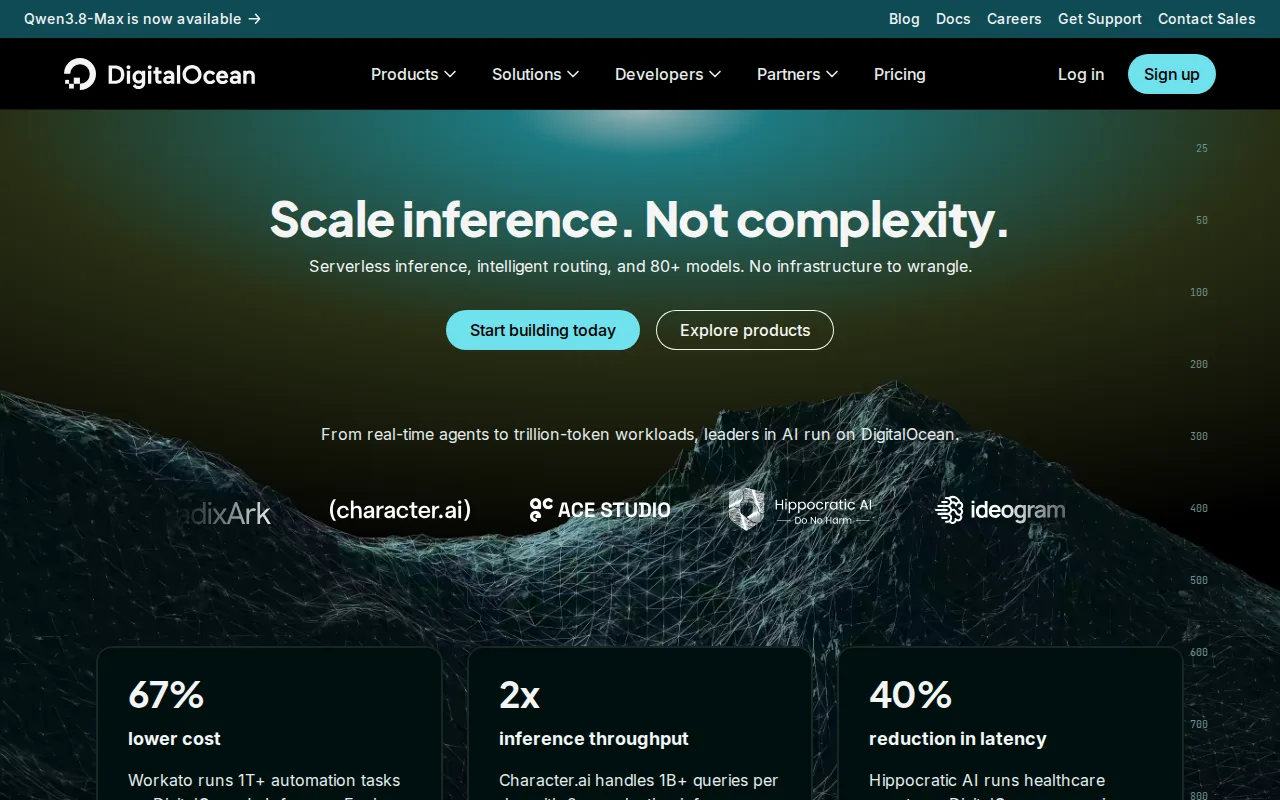
DigitalOcean is the best Fly.io alternative for developers who want per-second VM billing plus managed Kubernetes and databases on one predictable account, without Fly.io's narrower Docker-Machine-only model. DigitalOcean Droplets start at $4/month with per-second billing and a 60-second minimum, and DigitalOcean holds a 4.6/5 rating from 159 Capterra reviews that Fly.io's own listing doesn't have. DigitalOcean's App Platform includes a genuine $0/month free tier for static sites and small apps, something Fly.io doesn't offer since it has no free tier at all and bills from the first resource created. Managed Kubernetes on DigitalOcean starts at $12/month with a free control plane, a cost most competitors including Fly.io's own $75/month Fly Kubernetes charge for. DigitalOcean has also expanded into GPU access and a 70+ model inference engine across 20 data centers, a broader AI infrastructure line than Fly.io currently documents. Fly.io remains the better choice for teams that specifically need Firecracker microVMs booting in about a second in whichever of dozens of global regions they pick: DigitalOcean's Droplets run in a smaller, fixed set of regions and don't offer Fly.io's same per-second, pick-any-region global placement model, and a continuously run Fly.io shared-cpu-1x/256MB Machine at roughly $2.02/month can undercut a $4/month Droplet for the smallest always-on workloads.
Compared to Fly.io: 4.6/5 rating from 159 Capterra reviews vs Fly.io's none on file, genuine $0/month App Platform free tier vs Fly.io's no free tier at all, managed Kubernetes with a free control plane at $12/month vs Fly.io's $75/month Fly Kubernetes
Wins:4.6/5 rating from 159 Capterra reviews, evidence Fly.io has none of on file · App Platform includes a genuine $0/month free tier for static sites and small apps, unlike Fly.io which has no free tier at all · Managed Kubernetes starts at $12/month with a free control plane, versus Fly.io's own $75/month Fly Kubernetes cluster pricing
Loses:Droplets run in a smaller, fixed set of regions rather than Fly.io's pick-any-of-dozens-of-regions Firecracker Machine placement · AI infrastructure (GPU access, inference engine) is newer and less proven, and Fly.io's own 2026 Sprites product targets the same AI-agent compute niche · New-account credit is a modest $5 valid for 90 days, smaller than the flexibility of Fly.io's fully itemized pay-as-you-go model with no upfront credit needed
Pros
- Droplets start at $4/month with simple per-second billing, easier to predict than hyperscaler pricing.
- App Platform includes a genuine free tier, not just a time-limited trial.
- Managed Kubernetes includes a free control plane, a cost hyperscalers usually charge for.
- 4.6/5 rating from 159 Capterra reviews, with reviewers reporting largely positive sentiment.
Cons
- Far fewer regions and managed services than AWS, Azure, or Google Cloud, limiting fit for complex enterprise needs.
- The new-account credit is a modest $5 valid for 90 days, smaller than promotional credits some competitors offer.
- The AI infrastructure line (GPU access, inference engine) is newer and less proven than dedicated AI cloud providers.
- Support and SLA options are thinner than what enterprise customers get from the major hyperscalers.
Pricing: Free tier · paid from $4/mo — $4/month Droplets (per-second billing) vs Fly.io's roughly $2.02/month for a continuously run shared-cpu-1x/256MB Machine — DigitalOcean's entry VM price is nominally higher but bundles a genuinely free App Platform tier Fly.io doesn't have (verified undefined NaN, NaN)
Which one is right for you?
- You're migrating off Heroku and want autoscaling web services with managed Postgres and PR preview environments.Render
- You run a small team and want one flat monthly price with unlimited seats instead of paying per user.Railway
- You want to deploy with a simple git push and buildpacks instead of building and managing Docker images.Heroku
- You need managed Kubernetes with a free control plane alongside cheap, predictable per-second VM pricing.DigitalOcean
- You want an AI-agent-driven deploy workflow through an MCP server and a single deploy command.Railway
- You want the largest third-party review base to check before committing to a new host.Heroku
- You want GPU access and an open-model inference engine bundled with your core VM hosting account.DigitalOcean
Frequently asked questions
Is there a free alternative to Fly.io?
- Render and DigitalOcean both offer genuine $0/month free tiers, Render's Hobby plan and DigitalOcean's App Platform, while Fly.io itself has no free tier and bills from the first resource created. Railway also has a Free plan, though it's capped at $1 of monthly usage credit rather than a fully unmetered allowance.
What is the closest alternative to Fly.io?
- Render is the closest alternative for teams that want Fly.io's developer-first deploy experience with more predictable, tiered pricing instead of fully itemized per-second billing. Both platforms target Docker-based apps and APIs, but Render replaces Fly.io's per-resource metering with named instance sizes.
Can Render replace Fly.io?
- Yes, for most web services, APIs, and managed Postgres workloads, Render can replace Fly.io, with a free Hobby tier and a $7-$450/month compute ladder in place of Fly.io's per-second metered billing. Teams that specifically need Fly.io's pick-any-region Firecracker Machine placement across dozens of global regions will find Render's region options narrower.
Which Fly.io alternative is cheapest for a small always-on app?
- A continuously run Fly.io shared-cpu-1x/256MB Machine costs roughly $2.02/month, cheaper than DigitalOcean's $4/month Droplet or Heroku's $5/month Eco dyno, but Render's and DigitalOcean's free tiers can cost $0/month if the workload fits within free-tier limits. Railway's Free plan also works for very small apps within its $1/month usage credit.
Does any Fly.io alternative offer unlimited team seats on one price?
- Railway's Pro plan is the one alternative here with unlimited team seats included in its flat $20/month per-workspace price. Fly.io, Render, Heroku, and DigitalOcean all bill without that kind of seat-inclusive team plan in the data reviewed here.
Is DigitalOcean cheaper than Fly.io?
- Not at the smallest always-on workload: a continuously run Fly.io Machine costs about $2.02/month versus DigitalOcean's $4/month Droplet, though DigitalOcean's App Platform includes a genuine free tier Fly.io doesn't offer at all. Which is cheaper overall depends on whether a workload fits DigitalOcean's free tier or needs paid Droplet compute.