Render — A cloud platform for hosting web services, static sites, and managed databases, with a free tier and compute instances starting at $7/month.

By Noahlast updated pricing verified
Render screenshots & video
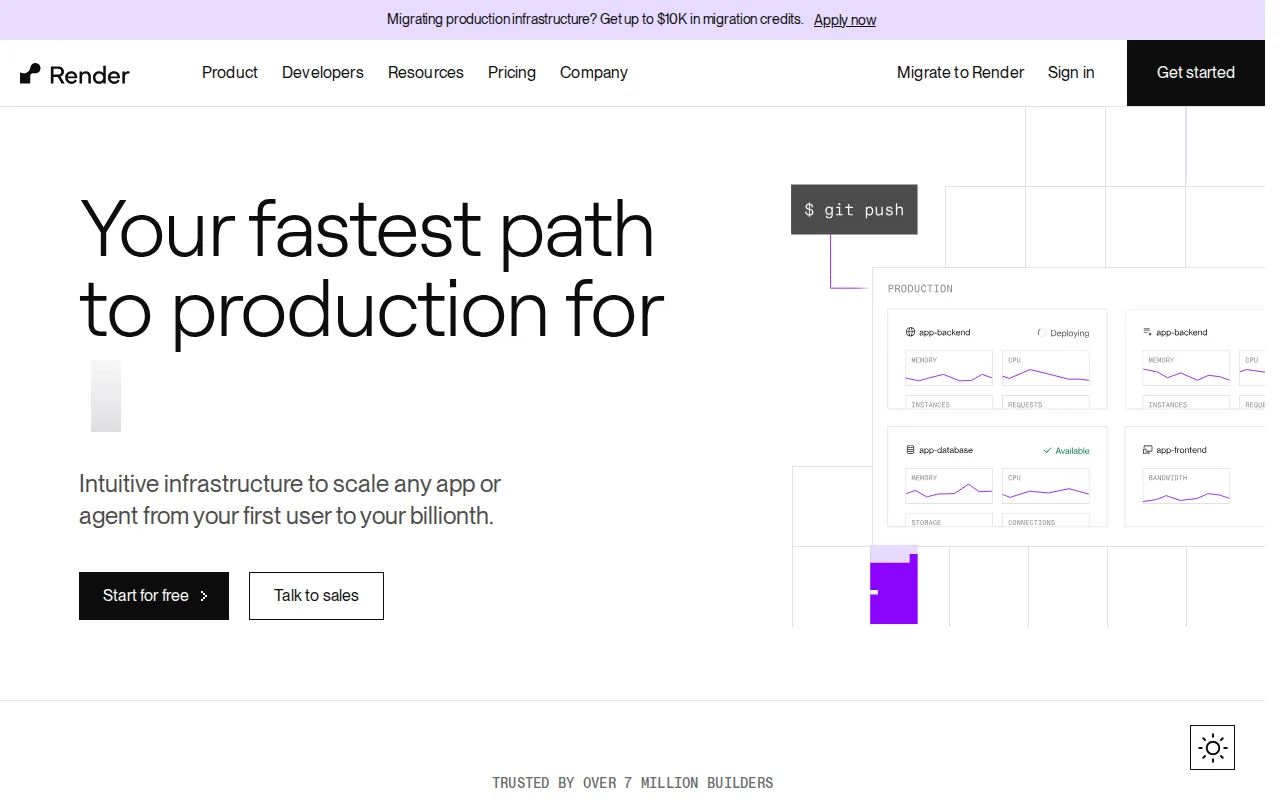
Render in 20 seconds
Best for: developers and teams migrating off Heroku who want autoscaling web services and managed databases with usage-based pricing
Pricing: Free tier available; paid compute instances start at $7/month, scaling to $450/month; managed Postgres from $6/month.
- Render's Free plan costs $0/month with 1 project, 2 environments, and 500 build minutes.
- Render's Starter compute instance costs $7/month, scaling to Pro Ultra at $450/month (64 CPU, 512 GB RAM).
- Managed Postgres on Render starts at $6/month for a 256 MB instance.
- Render offers up to $10,000 in migration credits for teams moving production infrastructure over.
- Render holds a 4.3/5 rating from 3 reviews on Capterra and a 5.0/5 rating from 76 reviews on Product Hunt.
Limitations: Free-tier services spin down after inactivity, adding cold-start delay.; Workspace/seat-level plan pricing above Free isn't published on the pricing page.; Database pricing scales into the thousands of dollars per month at larger sizes.
Top alternatives: Railway, Fly.io, Heroku, Vercel, DigitalOcean App Platform — full list
What is Render?
Render is a cloud platform for deploying web services, static sites, background workers, cron jobs, and managed databases without directly managing servers. Its free Hobby tier covers one project with two environments and 500 build-pipeline minutes a month; paid plans add unlimited team seats and scale compute through a ladder of named instance sizes, from a $7/month Starter web service up to a 64 CPU / 512 GB Pro Ultra instance at $450/month. Render also runs managed Postgres (from $6/month for a 256 MB instance) and a Redis-compatible Key Value store, both with point-in-time recovery on paid tiers. Distinguishing features include automatic preview environments for every pull request, one-click rollback, private IPv6 networking between services, Infrastructure as Code support, and a CLI/MCP server aimed at AI-agent-driven deployment workflows.
Render is a cloud platform for deploying and autoscaling web services, static sites, background workers, cron jobs, and managed Postgres or Redis-compatible Key Value databases, positioned as a modern replacement for Heroku. Its free Hobby plan covers 1 project with 2 environments, 100 GB of monthly bandwidth, and 500 build-pipeline minutes with 7-day log retention; paid compute instances scale from a $7/month Starter instance up through $25 Standard, $85 Pro, $175 Pro Plus, $225 Pro Max, to $450/month Pro Ultra (up to 64 CPUs and 512 GB RAM). Managed Postgres starts at $6/month for a 256 MB instance and scales into thousands of dollars per month for large deployments. Render targets developers and teams migrating off Heroku or Railway who want autoscaling, zero-downtime deploys, and automatic PR preview environments without managing servers directly. It also offers Infrastructure as Code support, a CLI and MCP server for AI-agent integration, private networking, persistent disks, and up to $10,000 in migration credits for teams moving production infrastructure over.
Standout feature: Preview environments spin up automatically for every pull request, and the instance ladder scales from a $7/month Starter web service up to a 64 CPU / 512 GB Pro Ultra instance ($450/month) without switching platforms.
Biggest weakness: Free-tier web services spin down after periods of inactivity, causing a cold-start delay on the next request, and the paid workspace/seat plan tiers above Free aren't published with specific dollar amounts on the pricing page — teams have to build out compute usage to see the real monthly total.
Pros
- Automatic PR preview environments and one-click rollback simplify testing changes before merge.
- Compute instance sizing scales from $7/month up to 64 CPUs / 512 GB RAM without migrating platforms.
- Managed Postgres and Redis-compatible Key Value store included, with point-in-time recovery on paid tiers.
- CLI and MCP server support AI-agent-driven deployment workflows.
Cons
- Free-tier web services spin down after inactivity, adding cold-start latency on the next request.
- Paid workspace-level plan pricing (beyond individual compute instance costs) isn't published on the pricing page.
- Managed database pricing scales steeply at larger sizes, reaching into the thousands of dollars per month.
Render pricing
Free tier · paid from $6/mo · verified from the vendor's pricing page
| Plan | Price | Notes |
|---|---|---|
| Free | Free | 1 project with 2 environments, 100 GB bandwidth/month, 500 build-pipeline minutes/month, 7-day log retention; web services spin down after inactivity. |
| Starter compute instance | $7/mo | Smallest paid web service instance; scales up through Standard ($25/mo), Pro ($85/mo), Pro Plus ($175/mo), Pro Max ($225/mo), to Pro Ultra ($450/mo) by CPU/RAM. |
| Postgres Basic-256mb | $6/mo | Entry managed Postgres instance (0.1 vCPU, 256 MB RAM, 100 connections); scales to Basic-1gb ($19/mo) and much larger instances costing thousands per month. |
| Enterprise | Custom | Custom pricing for organizations needing SSO, dedicated support, and higher usage limits. |
What reviewers say
Scores belong to their platforms; we display them with attribution and never fold them into our own ratings.