Heroku — A managed platform-as-a-service from Salesforce for deploying and scaling web apps via git push, supporting Node.js, Ruby, Python, Java, Go, and PHP, from a $5/month Eco dyno up to enterprise Private Spaces.

By Noahlast updated pricing verified
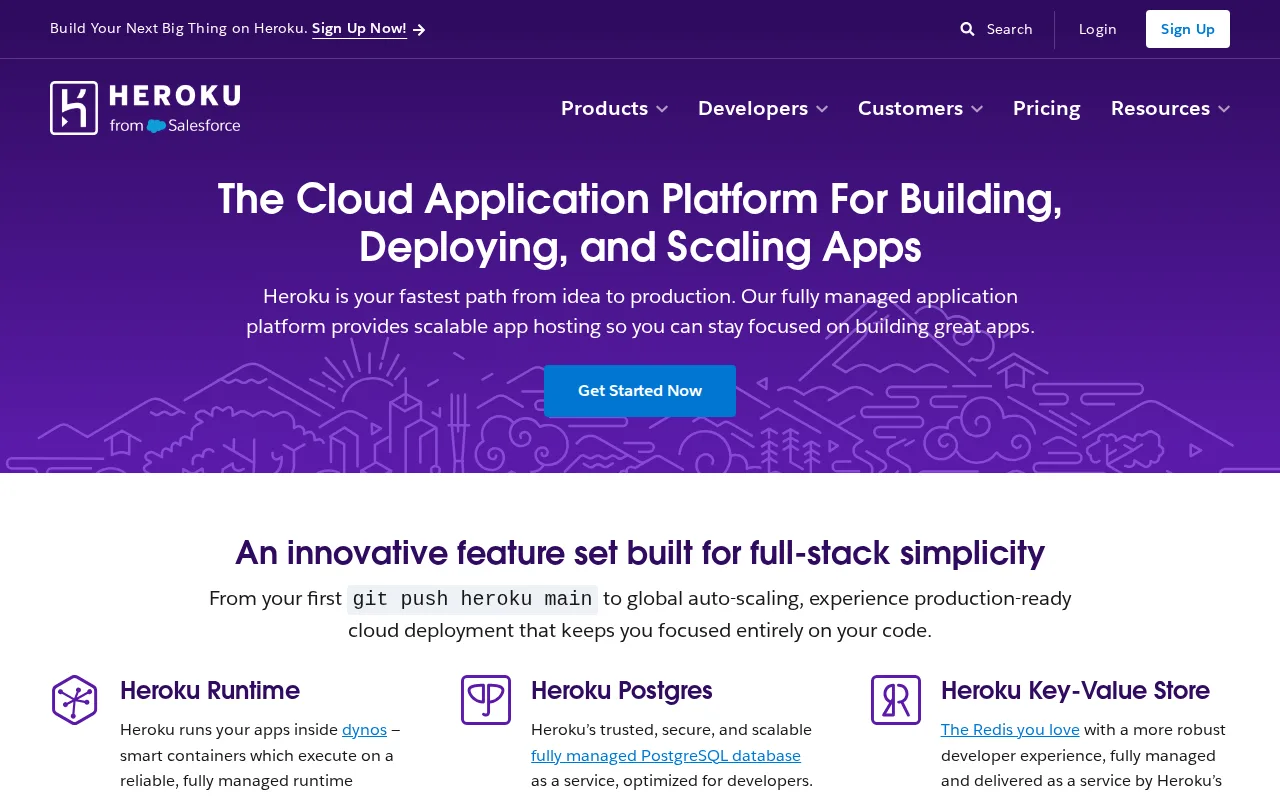
Heroku screenshots & video
Heroku in 20 seconds
Best for: Small teams wanting git-push deployment and managed databases without dedicated DevOps staff.
Pricing: Dynos from $5/month (Eco) up to $1,500/month (Performance-2XL), with Postgres and Redis add-ons billed separately.
- Heroku is owned by Salesforce and has been since 2010.
- Dyno pricing starts at $5/month (Eco, sleeps after 30 minutes) and $7/month for an always-on Basic dyno.
- Standard dynos run $25-$50/month and Performance dynos run $250-$1,500/month.
- Heroku Postgres starts at $5/month and Key-Value Store starts at $3/month, billed separately from dynos.
- Heroku holds a 4.6/5 rating from 305 reviews on Capterra.
Limitations: No permanently free tier since 2022.; Production-grade dyno pricing runs well above equivalent raw cloud compute.; Add-on costs (Postgres, Redis, Kafka) stack on top of dyno cost.
Top alternatives: Render, Railway, Fly.io, DigitalOcean App Platform — full list
What is Heroku?
Heroku is a platform-as-a-service (PaaS) that abstracts away servers: developers push code with git push heroku main, and Heroku builds, containerizes, and runs the app on 'dynos' — Heroku's term for lightweight, horizontally scalable application containers — without the team managing an operating system, load balancer, or patching schedule.
Owned by Salesforce since 2010, Heroku supports Node.js, Ruby, Python, Java, PHP, Go, Scala, Clojure, and .NET out of the box via buildpacks, with over 380 community buildpacks covering nearly any other language. Beyond compute, Heroku bundles managed Postgres databases, a managed Redis-compatible key-value store, and Apache Kafka, each billed on its own separate tier from dyno cost. Its Kubernetes-powered 'Fir' generation of dynos and newer AI tooling (Heroku Managed Inference and Agents, MCP server hosting) extend the platform toward LLM-backed applications. Heroku's core trade-off versus raw infrastructure (AWS, Google Cloud) or newer PaaS competitors (Render, Railway, Fly.io) is convenience for cost: the Eco and Basic dyno tiers are affordable for side projects, but Standard and Performance dynos for real production traffic get expensive quickly compared to a hand-configured VM, and the free tier was discontinued in 2022, replaced by the paid $5/month Eco tier that still sleeps after inactivity.
Heroku is a platform-as-a-service (PaaS) owned by Salesforce that lets developers deploy applications by pushing code to a managed git remote, without provisioning servers, load balancers, or OS patches themselves. Compute runs on 'dynos' starting at $5/month for the sleep-after-30-minutes Eco tier (personal projects only) and $7/month for an always-on Basic dyno, scaling through Standard ($25-$50/month) and Performance dynos ($250-$1,500/month) for production traffic, alongside separately billed Heroku Postgres (from $5/month) and Key-Value Store add-ons (from $3/month). It natively supports Node.js, Ruby, Python, Java, PHP, Go, Scala, and .NET via buildpacks, plus GitHub-integrated review apps and one-click rollback. Heroku holds a 4.6/5 rating from 305 reviews on Capterra, with reviewers praising deployment simplicity and citing pricing at scale and the loss of a free tier since 2022 as recurring complaints against newer PaaS competitors like Render and Railway.
Standout feature: Git-push deployment with automatic GitHub-integrated review apps for every pull request, plus one-click rollback to a prior release or database backup.
Biggest weakness: No free tier since 2022 (the cheapest Eco dyno is $5/month and still sleeps after 30 minutes of inactivity); Standard and Performance dyno pricing scales far above the cost of an equivalent self-managed VM on AWS or DigitalOcean.
Pros
- Git-push deployment with zero server configuration; buildpacks auto-detect the language and framework.
- GitHub-integrated review apps spin up a disposable staging environment for every pull request.
- Managed Postgres and Redis with one-click provisioning, automated backups, and fork/rollback support.
- 380+ buildpacks cover nearly any language beyond the natively supported ones.
Cons
- No permanently free tier since 2022; the $5/month Eco dyno still sleeps after 30 minutes of inactivity.
- Standard and Performance dyno pricing runs well above equivalent raw compute on AWS, DigitalOcean, or Render.
- Add-on pricing (Postgres, Redis, Kafka) is billed separately from dyno cost, so total bills climb quickly for production apps.
- Private Spaces (network isolation, HIPAA/PCI compliance) require a much higher-priced tier, pricing out smaller regulated teams.
Heroku pricing
From $5/mo · verified from the vendor's pricing page
| Plan | Price | Notes |
|---|---|---|
| Eco | $5/mo | 0.5GB RAM; sleeps after 30 minutes of inactivity; personal accounts only, not for production. |
| Basic | $7/mo | 0.5GB RAM; always on, free SSL, up to 10 process types. |
| Standard-1X | $25/mo | 0.5GB RAM; horizontal scalability, app metrics, zero-downtime deploys. |
| Standard-2X | $50/mo | 1GB RAM; doubled resources versus Standard-1X. |
| Performance-M | $250/mo | 2.5GB RAM, dedicated compute, autoscaling, predictable performance. |
| Performance-L | $500/mo | 14GB RAM, expanded dedicated compute for high-traffic production apps. |
What reviewers say
Scores belong to their platforms; we display them with attribution and never fold them into our own ratings.