6 Best Free Alternatives to Firebase in 2026
By Noahlast updated pricing verified
Compared: free alternatives to Firebase
| Alternative | Best for | Standout | Biggest weakness | Learning curve | Price |
|---|---|---|---|---|---|
| Firebasereference | mobile and web developers who want a fully managed backend (database, auth, hosting, functions) without provisioning or maintaining their own servers | A single integrated platform spanning database, authentication, hosting, serverless functions, crash reporting, and analytics, all provisioned and scaled automatically by Google. | Blaze-plan costs are usage-based across many separate metered services (reads/writes, bandwidth, function invocations, storage), so bills can escalate unpredictably at scale, and Firestore's proprietary NoSQL data model creates real migration lock-in compared to SQL-based backends. | Moderate | Free |
| Supabase | developers who want a Postgres-based backend (auth, storage, realtime, auto-generated APIs) they can self-host later, rather than committing to a proprietary NoSQL platform like Firebase | Auto-generated REST, GraphQL, and Realtime APIs derived straight from a project's Postgres schema, with Row Level Security enforcing per-row authorization at the database layer instead of in application code. | Pricing beyond the $25/month Pro base is usage-based and billed per project rather than per account, so teams running multiple projects or exceeding the 100,000 MAU / 250GB egress limits can see invoices climb well past the advertised starting price. | Moderate | Free tier · paid from $25/mo |
| Appwrite | developer teams building web, mobile, or Flutter apps that want a Firebase-style backend (auth, database, storage, functions) they can self-host for free instead of relying solely on a vendor's cloud | Fully self-hostable under a permissive BSD-3-Clause license, so teams can run the entire backend on their own infrastructure at no licensing cost instead of being locked into Appwrite's hosted cloud. | The free Appwrite Cloud tier pauses projects after a week of inactivity and offers only community support, and self-hosting shifts the operational burden (updates, scaling, backups) onto the team instead of a managed vendor, which is a real cost some reviewers note as a steeper setup than a pure SaaS backend. | Moderate | Free tier · paid from $25/mo |
| MongoDB Atlas | developers and teams building on a flexible document schema who want a managed, multi-cloud MongoDB deployment instead of self-hosting | Vector Search and Atlas Search run inside the same cluster as the primary document database, so AI retrieval and full-text search don't require a separate search or vector database. | Hourly, resource-based pricing across dedicated tiers, search nodes, stream processing, and data transfer makes total cost hard to predict without using the pricing calculator, and egress/backup fees stack on top of the base cluster rate once you leave the free or Flex tiers. | Moderate | Free |
| PocketBase | developers who want a single-binary backend (database, auth, storage, realtime API) for a side project or small-to-medium app without assembling separate services | The entire backend — SQLite database, authentication, file storage, and a realtime REST API — ships as one portable executable with no separate services to provision. | There is no official managed cloud hosting, so scaling, backups, and uptime are entirely the developer's responsibility, and SQLite's single-writer model makes PocketBase a weaker fit for applications with heavy concurrent write traffic than a Postgres-backed platform. | Low | Free |
| Convex | developers and small teams building AI agents or real-time web apps who want a database, functions, and search layer in one TypeScript-native system instead of assembling separate services | Reactive queries with automatic real-time sync and full ACID transactions, combined with end-to-end TypeScript type safety between the database schema and application code. | Business/Enterprise pricing starts at a $2,500/month minimum, a steep jump from the $25/developer Professional plan, and functions are written against Convex's own TypeScript API rather than standard SQL, raising migration cost if a team later needs to move off it. | Moderate | Free tier · paid from $25/mo |
| AWS Amplify | teams already building on AWS who want Git-based hosting plus managed auth, data, and storage without assembling separate services | Provisions a full backend (Cognito authentication, data APIs, storage, functions) from a single TypeScript codebase alongside CI/CD hosting on CloudFront | Pricing spans multiple separately-billed AWS services (hosting, Cognito, AppSync, DynamoDB, Lambda), so total cost isn't visible on the Amplify pricing page alone, and the platform assumes comfort with AWS's console and IAM model rather than offering a simplified single-dashboard experience like Vercel or Netlify. | Moderate | Free tier · paid from $0.01/mo |
 Firebase
 Supabase
 Appwrite
 MongoDB Atlas
 PocketBase
 Convex
 AWS Amplify
1.Supabase — best Firebase alternative for developers who want a Postgres-based backend (auth, storage, realtime, auto-generated APIs) they can self-host later, rather than committing to a proprietary NoSQL platform like Firebase
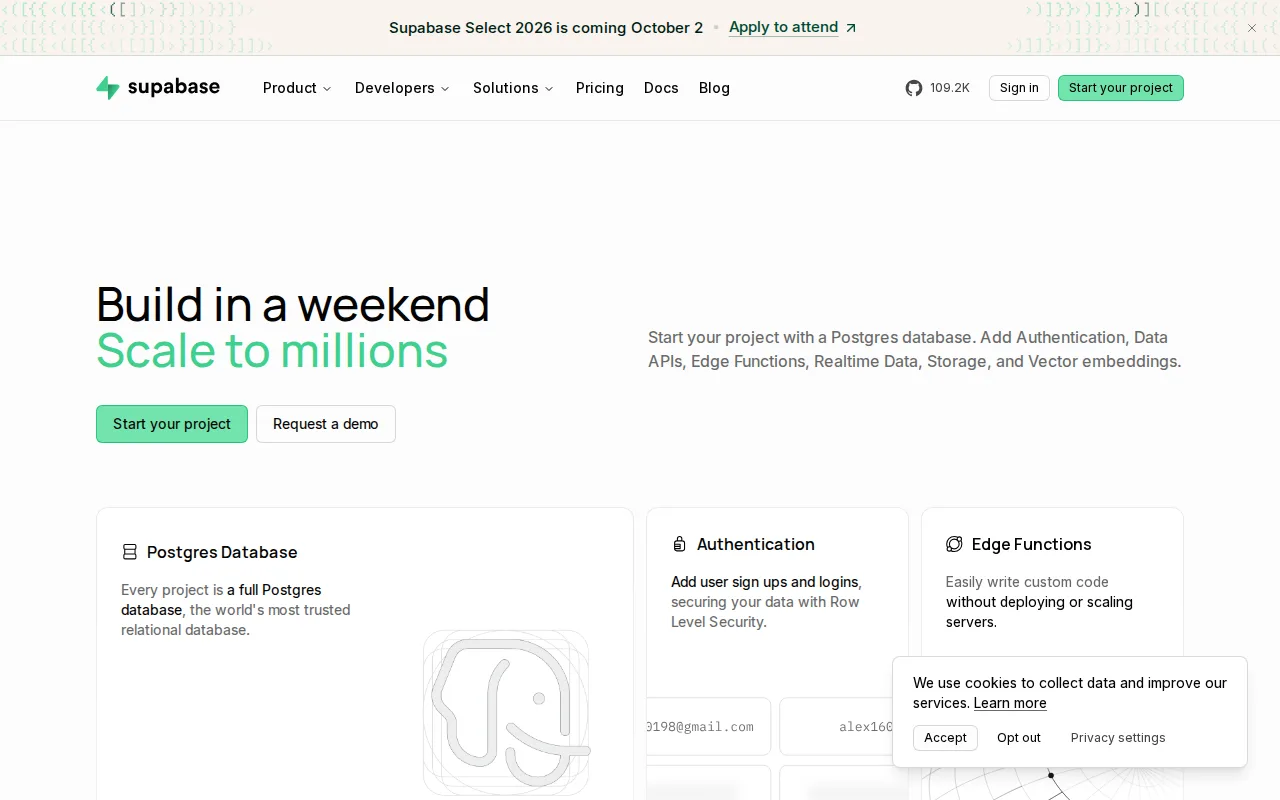
Supabase and Firebase both bundle a database, authentication, storage, and serverless functions into one backend platform, but Supabase is built on a full Postgres database rather than Firebase's proprietary Firestore NoSQL model, so existing SQL skills and extensions like pgvector carry over directly instead of requiring a new query paradigm. Supabase's core stack (Postgres, PostgREST, GoTrue auth, Realtime, Storage) is Apache-2.0 licensed and self-hostable from its GitHub repository, which has more than 108,000 stars, an openness Firebase's proprietary platform doesn't offer at all. Supabase holds a 5.0/5 rating from 861 Product Hunt reviews, ahead of Firebase's own 4.6/5 from 767 Capterra reviews. Supabase's free tier includes 50,000 monthly active users with no time limit on the account, matching Firebase Spark's free authentication allowance. Where Firebase still wins: it has a much longer track record and deeper mobile SDK coverage (iOS, Android, Flutter, Unity, C++) than Supabase's more web-focused ecosystem, and Firebase's Blaze plan's per-service metered pricing, while harder to forecast, scales further at extreme volume than Supabase's per-project compute model, so teams running many small projects on a budget should compare both carefully before switching.
Compared to Firebase: built on full Postgres rather than proprietary Firestore NoSQL, Apache-2.0-licensed core stack that's self-hostable with 108,000+ GitHub stars, and a higher Product Hunt rating (5.0/5 from 861 reviews vs Firebase's 4.6/5 from 767 Capterra reviews).
Wins:Full Postgres database instead of proprietary NoSQL, so existing SQL skills and pgvector carry over directly · Apache-2.0-licensed core stack is self-hostable, avoiding Firebase's proprietary lock-in · 5.0/5 from 861 Product Hunt reviews vs Firebase's 4.6/5 from 767 Capterra reviews
Loses:Compute is billed per project, so accounts running several projects stack charges beyond the flat $25/month Pro fee · Less mature mobile SDK coverage than Firebase's iOS, Android, Flutter, Unity, and C++ support · Free-tier projects pause automatically after 1 week of inactivity
Pros
- Full Postgres database rather than a proprietary NoSQL store, so existing SQL skills and extensions like pgvector and PostGIS carry over directly.
- Auto-generates REST, GraphQL, and Realtime APIs from the schema, with Row Level Security for per-row authorization.
- Apache-2.0-licensed core stack is self-hostable, avoiding hard vendor lock-in.
- Free tier includes unlimited API requests, 50,000 monthly active users, and a 500MB database with no time limit on the account.
Cons
- Compute is billed per project, so accounts running several projects stack recurring charges beyond the flat $25/month Pro fee.
- MAU overage ($0.00325/user past 100,000) and egress overage ($0.09/GB past 250GB) can produce unpredictable invoices at scale.
- Free-tier projects pause automatically after 1 week of inactivity.
- Row Level Security has a steeper learning curve than Firebase's simpler client-side security rules for teams new to SQL.
Pricing: Free tier · paid from $25/mo — Supabase Pro is $25/month with a $10/month compute credit vs Firebase's free Spark tier and pay-as-you-go Blaze plan (verified undefined NaN, NaN)
2.Appwrite — best Firebase alternative for developer teams building web, mobile, or Flutter apps that want a Firebase-style backend (auth, database, storage, functions) they can self-host for free instead of relying solely on a vendor's cloud
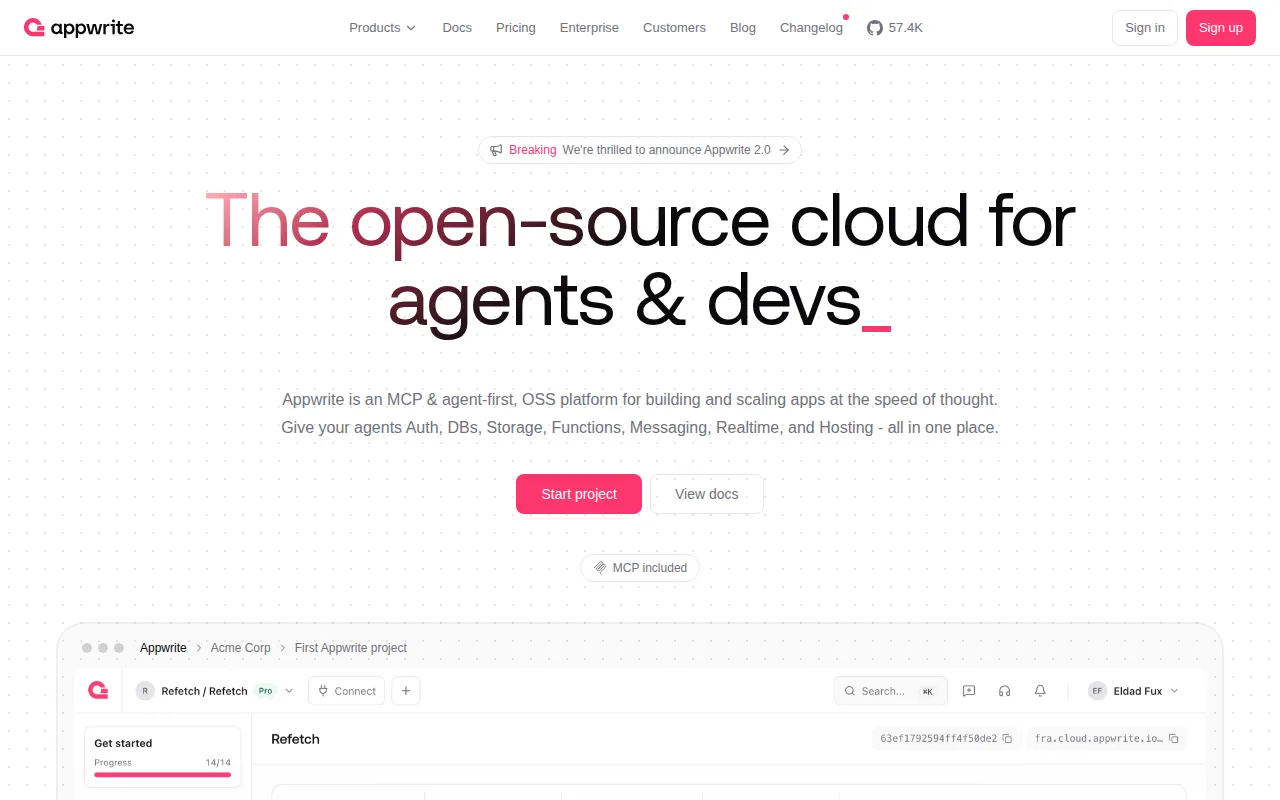
Appwrite and Firebase both bundle authentication, a database, file storage, and serverless functions behind a unified API, but Appwrite's code is BSD-3-Clause licensed and free to self-host via Docker on any server, an option Firebase's fully proprietary, Google-hosted-only platform doesn't offer at all. Appwrite has 57.1K GitHub stars, a concrete measure of open-source adoption Firebase's closed-source codebase can't be measured against. Appwrite Cloud's free tier includes 75K monthly active users and 750K monthly executions, close to Firebase Spark's 50K monthly active Authentication users and 2M Cloud Function invocations, so the free tiers are broadly comparable in scope though structured differently. Where Firebase still wins: it has a much larger, longer-established SDK ecosystem across iOS, Android, Flutter, Unity, and C++ with years more production hardening, and Appwrite Cloud's free tier pauses projects after a week of inactivity and offers only community support, while Firebase's Spark plan has no such pause and Google backs it with broader documentation and a longer track record at scale.
Compared to Firebase: BSD-3-Clause licensed code that's free to self-host via Docker, 57.1K GitHub stars as a measurable adoption signal, and free Cloud tier projects pause after 1 week of inactivity versus Firebase Spark's no-pause free tier.
Wins:Fully open source (BSD-3-Clause) and self-hostable for free, avoiding Firebase's vendor lock-in · 57.1K GitHub stars demonstrate open community adoption, unmeasurable for Firebase's closed-source codebase · Free Cloud tier includes 75K monthly active users, comparable to Firebase Spark's 50K
Loses:Free Cloud tier projects pause after 1 week of inactivity and get community-only support · Less mature, smaller SDK ecosystem than Firebase's years of iOS, Android, Flutter, Unity, and C++ coverage · Self-hosting shifts updates, scaling, and backups onto the team rather than a managed vendor like Firebase
Pros
- Fully open source (BSD-3-Clause) and self-hostable for free, avoiding vendor lock-in on a core backend.
- Single platform covers auth, database, storage, functions, and messaging instead of stitching together separate services.
- Broad SDK coverage across major frontend frameworks and mobile platforms including Flutter.
- Free Appwrite Cloud tier is usable for real projects, not just a sandbox, with 75K monthly active users included.
Cons
- Free Cloud tier projects pause after a week of inactivity and get community-only support.
- Self-hosting requires managing updates, scaling, and backups yourself, shifting operational work onto the team.
- Reviewers note initial setup can be more complex than newcomers expect for a 'quick MVP' backend.
- Enterprise features (SSO, compliance certifications, SLAs) require a custom-quote plan rather than being available at a fixed price.
Pricing: Free tier · paid from $25/mo — Appwrite Pro is $25/month vs Firebase's free Spark tier and pay-as-you-go Blaze plan (verified undefined NaN, NaN)
3.MongoDB Atlas — best Firebase alternative for developers and teams building on a flexible document schema who want a managed, multi-cloud MongoDB deployment instead of self-hosting
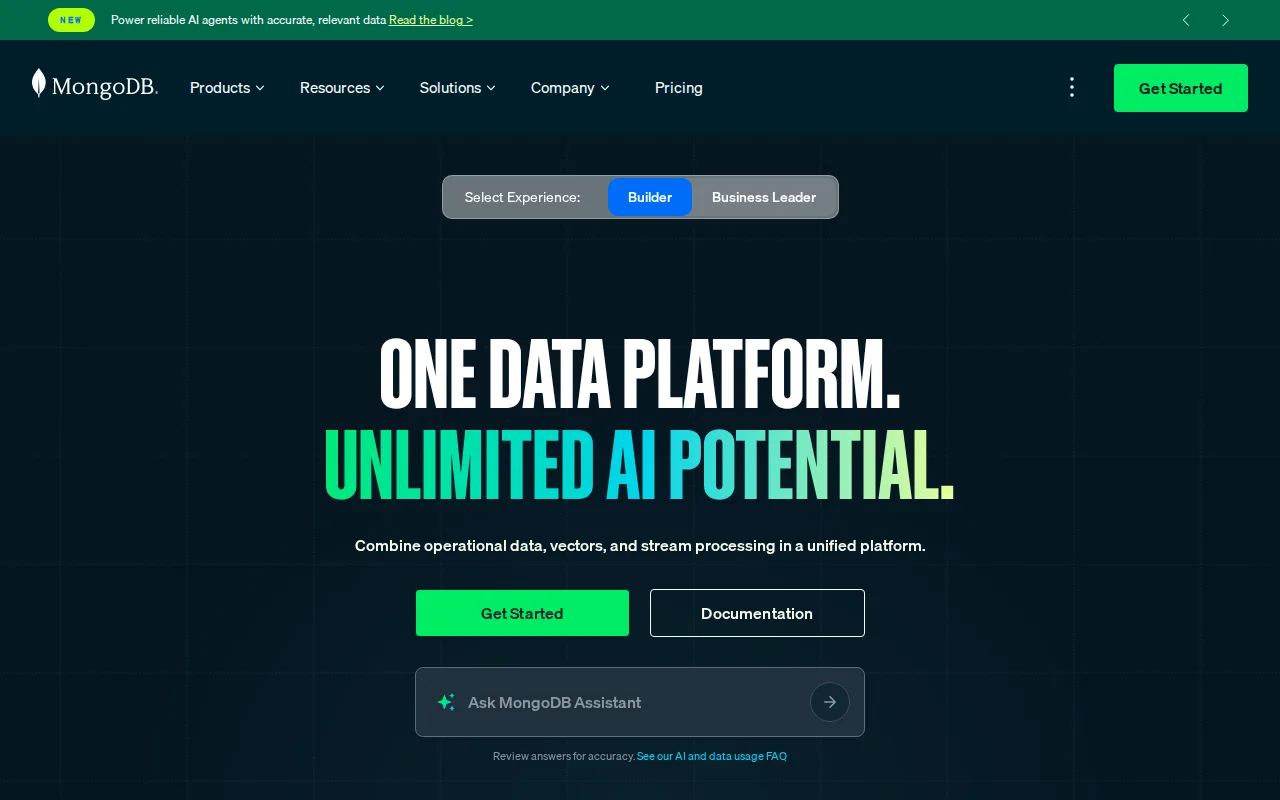
MongoDB Atlas and Firebase both offer a document-model NoSQL database as their core product, but Atlas deploys across AWS, Google Cloud, and Azure from one console, versus Firebase which runs exclusively on Google Cloud infrastructure — a real difference for teams that want multi-cloud flexibility or are already committed elsewhere. Atlas's free M0 tier is free forever with 512 MB storage, comparable in spirit to Firebase Spark's no-payment-method-required free tier, and Atlas layers in Vector Search and Atlas Search on the same cluster as the primary database, useful for AI retrieval workloads. Where Firebase still wins: it bundles authentication, hosting, and serverless functions natively in the same platform as the database, while Atlas is database-only and requires pairing with separate services (or a full framework) for auth, hosting, and functions, and Firebase's hourly-free Blaze plan billing is arguably easier to reason about for a mobile app than Atlas's cluster-hour pricing that ranges from $0.08/hour for a basic M10 dedicated cluster up to $33.26/hour for the largest M700 tier — a much wider and more complex pricing spread than Firebase's per-operation metering.
Compared to Firebase: deploys across AWS, Google Cloud, and Azure vs Firebase's Google-Cloud-only infrastructure, a free M0 tier that's free forever, and database-only scope that requires separate services for auth, hosting, and functions Firebase bundles natively.
Wins:Multi-cloud deployment across AWS, Google Cloud, and Azure from one console, unlike Firebase's Google-Cloud-only setup · Free M0 tier is genuinely free forever, not a time-limited trial · Vector Search and full-text search run on the same cluster as the primary data, avoiding separate search infrastructure
Loses:Database-only product — no bundled authentication, hosting, or serverless functions the way Firebase provides natively · Cluster-hour pricing ($0.08 to $33.26/hour across dedicated tiers) is a wider, more complex spread than Firebase's per-operation Blaze billing · Free and Flex tiers cap storage low (512 MB and 5 GB), forcing an earlier upgrade than Firebase's Spark quotas for some workloads
Pros
- Free M0 tier is genuinely free forever, not a time-limited trial.
- Multi-cloud deployment across AWS, Google Cloud, and Azure from one console.
- Vector Search and full-text search run on the same cluster as the primary data, avoiding a separate search infrastructure.
- Auto-scaling and automated backups reduce operational overhead versus self-hosted MongoDB.
Cons
- Pricing is spread across cluster hourly rates, search node rates, data transfer, and backup storage, making total monthly cost hard to estimate without the calculator.
- Free and Flex tiers cap storage low (512 MB and 5 GB respectively), forcing an early upgrade to dedicated clusters for real workloads.
- Document-model flexibility can lead to inconsistent schemas across a codebase without added application-level discipline.
- Atlas itself is a proprietary managed service; self-hosting the open-source-adjacent MongoDB server separately means losing Atlas's managed tooling.
Pricing: Free — MongoDB Atlas dedicated clusters start at $0.08/hour (M10) vs Firebase's pay-as-you-go Blaze rates on top of free Spark quotas (verified undefined NaN, NaN)
4.PocketBase — best Firebase alternative for developers who want a single-binary backend (database, auth, storage, realtime API) for a side project or small-to-medium app without assembling separate services
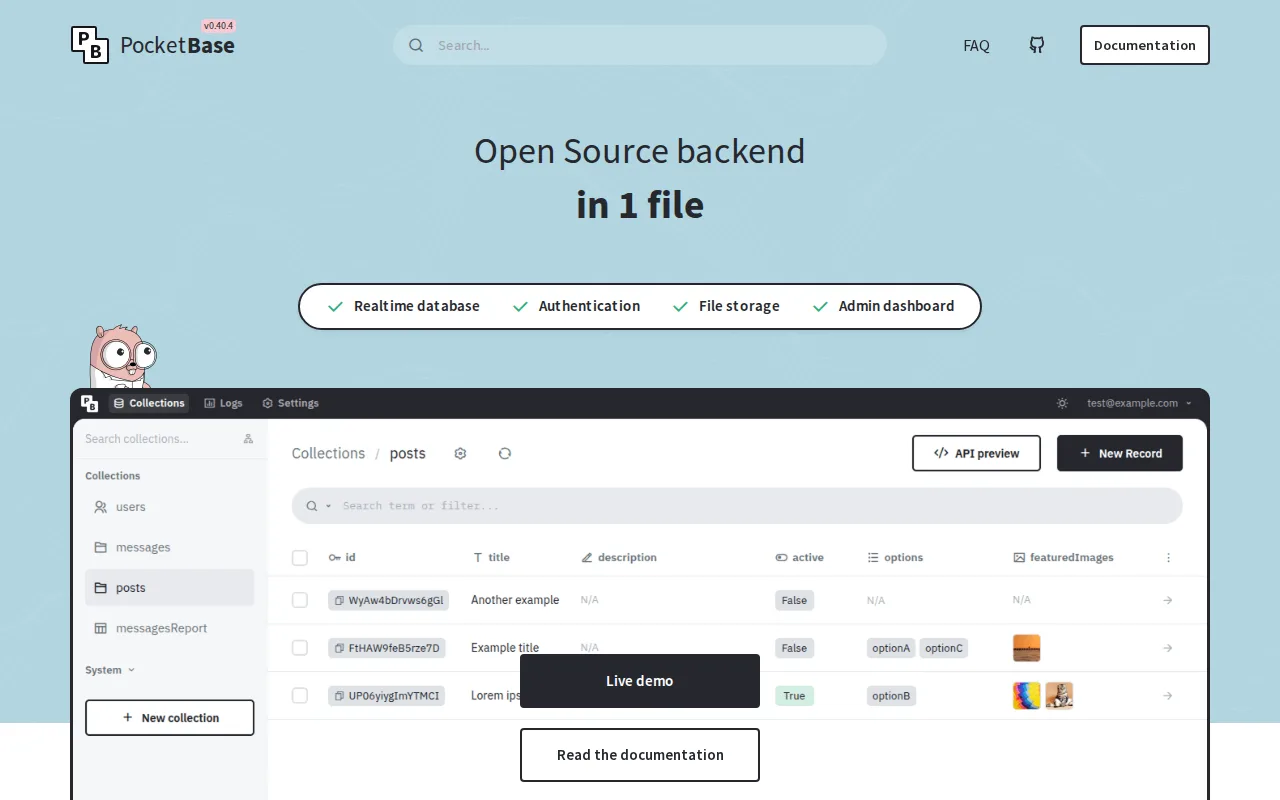
PocketBase and Firebase both bundle a database, authentication, file storage, and a realtime API, but PocketBase ships the entire backend as one portable Go executable under the MIT license, with no separate services to provision at all, versus Firebase's multi-product console spanning Firestore, Auth, Storage, and Functions as distinct pieces. PocketBase is completely free and self-hosted, with no usage-based billing of any kind, unlike Firebase's Blaze plan which bills per read, write, invocation, and GB stored once quotas are exceeded. The GitHub repository has over 60,000 stars, a concrete adoption signal PocketBase's closed-source alternative Firebase can't be measured against. Where Firebase still wins: PocketBase has no official managed cloud offering at all, so every deployment's scaling, backups, and uptime are the developer's own responsibility, unlike Firebase's fully managed infrastructure, and PocketBase's embedded SQLite database has a single-writer model that limits write concurrency compared to Firestore's ability to handle high concurrent write traffic at scale.
Compared to Firebase: ships as one portable Go executable with no separate services to provision, completely free and self-hosted with zero usage-based billing, and has no official managed cloud offering at all, unlike Firebase's fully managed infrastructure.
Wins:Single executable bundles database, auth, storage, and a realtime API with nothing separate to configure · Completely free with no usage-based billing of any kind, unlike Firebase's metered Blaze plan · MIT license with source fully available; no vendor lock-in at all
Loses:No official managed cloud offering — every deployment's scaling, backups, and uptime fall on the developer · SQLite's single-writer model limits write concurrency compared to Firestore's high-concurrency design · Smaller ecosystem of official mobile SDKs than Firebase's iOS, Android, Flutter, Unity, and C++ coverage
Pros
- Single executable bundles database, auth, storage, and a realtime API with no separate services to configure.
- MIT license with source fully available; no vendor lock-in.
- Built-in admin dashboard for managing records and users without writing code.
- JavaScript and Dart SDKs cover popular frontend frameworks including React, Vue, Svelte, and Flutter.
Cons
- No official managed cloud offering; every deployment is self-hosted and self-maintained.
- SQLite's single-writer model limits write concurrency compared to Postgres-based backends.
- Custom server-side logic requires extending PocketBase in Go or JavaScript hooks rather than a more general-purpose framework.
- Smaller ecosystem of official integrations and enterprise features than a hosted platform like Supabase or Firebase.
Pricing: Free — PocketBase is free to self-host indefinitely vs Firebase's free Spark tier plus pay-as-you-go Blaze billing (verified undefined NaN, NaN)
5.Convex — best Firebase alternative for developers and small teams building AI agents or real-time web apps who want a database, functions, and search layer in one TypeScript-native system instead of assembling separate services
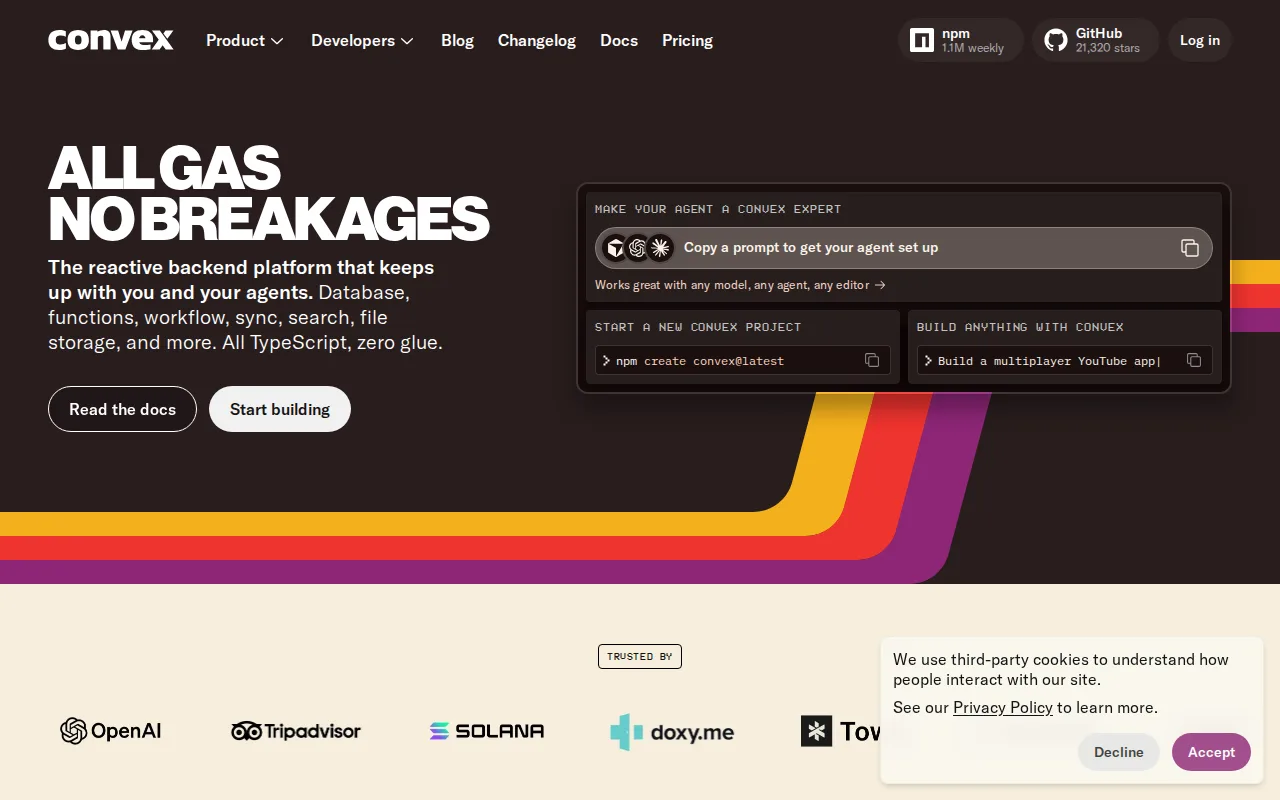
Convex and Firebase both offer a reactive backend with a database, functions, and file storage, but Convex is built end-to-end in TypeScript with automatic type safety between the database schema and application code, a stricter guarantee than Firebase's more loosely typed Firestore SDKs. Convex's Free plan costs $0/month with 0.5 GB database storage and 1 million function calls a month, and its Professional plan at $25 per developer/month raises that to 50 GB and 25 million function calls, comparable in structure to Firebase's free Spark quotas plus metered Blaze billing. Convex's backend engine is open source on GitHub (12,400 stars) and self-hostable, an option Firebase doesn't provide since its platform runs exclusively on Google's infrastructure. Where Firebase still wins: it has a far larger, more battle-tested mobile SDK ecosystem across iOS, Android, Flutter, Unity, and C++, while Convex is web-focused, and Convex's Business tier jumps to a $2,500/month minimum, a steep cliff from the $25/month Professional plan that Firebase's more gradual Blaze pay-as-you-go scaling doesn't have.
Compared to Firebase: end-to-end TypeScript type safety between the database schema and application code, an open-source, self-hostable backend engine with 12,400 GitHub stars, and Business-tier pricing that jumps to a $2,500/month minimum from the $25/month Professional plan.
Wins:End-to-end TypeScript type safety between database schema and application code catches errors before deployment · Backend engine is open source and self-hostable, unlike Firebase's Google-infrastructure-only platform · Free tier is usable for real prototypes (0.5 GB storage, 1M function calls/month), not just a trial
Loses:Far smaller, web-focused SDK ecosystem than Firebase's mature iOS, Android, Flutter, Unity, and C++ coverage · Business/Enterprise pricing starts at a steep $2,500/month minimum, a bigger jump than Firebase's gradual Blaze scaling · Functions are written against Convex's own TypeScript API rather than a more portable standard, adding migration cost
Pros
- Combines database, serverless functions, file storage, and full-text/vector search in one system with a single deployment model.
- End-to-end TypeScript type safety between database schema and application code catches errors before deployment.
- The free tier is usable for real prototypes (0.5 GB storage, 1M function calls/month), not just a trial.
- The backend engine is open source and self-hostable for teams that don't want to depend on the managed cloud.
Cons
- The jump from the $25/developer Professional plan to a $2,500/month Business minimum is steep for scaling teams.
- Functions are written against Convex's own TypeScript API rather than SQL, adding lock-in and migration cost if a team later needs to leave.
- VPC deployment for Enterprise customers is listed as coming soon rather than available today.
Pricing: Free tier · paid from $25/mo — Convex Professional is $25 per developer/month vs Firebase's free Spark tier and pay-as-you-go Blaze plan (verified undefined NaN, NaN)
6.AWS Amplify — best Firebase alternative for teams already building on AWS who want Git-based hosting plus managed auth, data, and storage without assembling separate services
AWS Amplify and Firebase both provision a full backend (authentication, data APIs, storage, functions) from a single codebase alongside hosting, but Amplify does so on top of AWS's Cognito, AppSync, DynamoDB, and Lambda services rather than Firebase's Google-Cloud-native Firestore and Cloud Functions, which matters directly for teams already standardized on AWS infrastructure. Amplify's 12-month AWS Free Tier includes 1,000 free build minutes, 5 GB of CDN storage, and 15 GB of data transfer a month at no cost, and it holds a 4.8/5 rating from 8 Capterra reviews and a 5.0/5 from 11 Product Hunt reviews, both smaller samples than Firebase's 767 Capterra reviews at 4.6/5. Amplify supports Next.js and Nuxt server-side rendering natively for web hosting, a framework-level integration Firebase's Hosting product handles differently. Where Firebase still wins: it has a much larger, more established review base (767 vs Amplify's combined 19 reviews) and Firebase's pricing, while usage-based, is consolidated in one console rather than spread across separately-billed AWS services (Cognito, AppSync, DynamoDB, Lambda) the way Amplify's total cost is, making Firebase's bill easier to reason about for teams not already deep in AWS's ecosystem.
Compared to Firebase: built on AWS's Cognito, AppSync, DynamoDB, and Lambda rather than Google Cloud's Firestore and Cloud Functions, a 12-month AWS Free Tier with 1,000 free build minutes, and a much smaller combined review base (19 vs Firebase's 767 Capterra reviews).
Wins:Fits directly into an existing AWS account and IAM setup for teams already standardized there · 12-month AWS Free Tier covers 1,000 build minutes, 5 GB storage, and 15 GB data transfer at no cost · Native Next.js and Nuxt server-side rendering support for web hosting
Loses:Much smaller combined review base (8 Capterra + 11 Product Hunt = 19) than Firebase's 767 Capterra reviews · Pricing is fragmented across multiple separately-billed AWS services, harder to predict than Firebase's single-console billing · Free tier build minutes and transfer allowances expire after 12 months, unlike Firebase Spark's ongoing free quotas
Pros
- Combines Git-based CI/CD hosting with a full backend toolkit (auth, data, storage, functions) provisioned from code.
- 12-month AWS Free Tier covers 1,000 build minutes, 5 GB storage, and 15 GB data transfer per month at no cost.
- No pay-per-seat pricing for team collaboration.
- Extends into any other AWS service as an application's needs grow.
Cons
- Backend services (Cognito, AppSync, DynamoDB, Lambda) are billed separately under their own AWS pricing, making total cost harder to estimate than flat-rate competitors.
- Learning curve is steeper for teams unfamiliar with AWS's console, IAM permissions, and service naming.
- Free tier build minutes and transfer allowances expire after 12 months.
- Fewer opinionated defaults than Vercel or Netlify, requiring more configuration for common frontend framework deployments.
Pricing: Free tier · paid from $0.01/mo — AWS Amplify's build/hosting costs are pay-as-you-go from $0.01/build-minute after a 12-month free tier vs Firebase's free Spark tier plus pay-as-you-go Blaze billing (verified undefined NaN, NaN)