3 Best Free Alternatives to Figma in 2026
By Noahlast updated pricing verified
Compared: free alternatives to Figma
| Alternative | Best for | Standout | Biggest weakness | Learning curve | Price |
|---|---|---|---|---|---|
| Figmareference | design and product teams that need real-time multiplayer editing and a shared design-to-development handoff, from solo freelancers on the free tier up to large enterprises managing design systems across many teams | True real-time multiplayer editing across design, prototyping, whiteboarding (FigJam), and dev handoff (Dev Mode), all in the same browser-based file with no manual save or merge conflicts. | Figma requires an active internet connection for full functionality, and paid tiers are priced per seat by role (full/dev/collab), which reviewers say gets expensive to manage at scale; it also lacks native CMYK color profiles and 300dpi print export, so print-focused design work still requires a separate tool. | Moderate | Free tier · paid from $16/mo |
| Penpot | small design teams (up to 8 members) wanting a free Figma-style tool, and larger organizations wanting to self-host their design infrastructure under an open-source license | Full MPL-2.0 open-source codebase that can be self-hosted with no per-seat licensing cost, while the hosted cloud plan stays free for teams up to 8 people. | The Unlimited and Enterprise cloud tiers ($7 and $25 per user/month) sit close to Figma's pricing, so the cost advantage mainly shows up for teams willing to self-host, and Penpot's plugin and font ecosystem is smaller than Figma's after years of third-party development there. | Moderate | Free tier · paid from $7/mo |
| Canva | marketers, small business owners, and social media managers who need on-brand graphics fast without hiring a designer or learning Illustrator or Photoshop | The template-first workflow combined with Magic Resize, which reformats one design across dozens of platform-specific sizes automatically. | Designs can't be exported as editable source files (no .psd or .ai export), so work started in Canva is effectively locked into Canva, and premium templates and the full content library sit behind the Pro paywall. | Low | Free tier · paid from $18/mo |
| Lunacy | designers and non-designers who want a free, native desktop vector and UI design tool with built-in AI features instead of a browser-only or per-seat subscription app | Native free desktop app for Windows, macOS, and Linux with AI tools (background removal, upscaling, art generation) and Icons8's icon and illustration libraries built directly into the editor. | Full use of the built-in AI features and Icons8's premium asset library depends on Icons8's separate paid subscription, so the 'free' core app is really a funnel into a paid ecosystem for anyone using AI tools or premium assets at real volume; it also has a smaller plugin and community ecosystem than Figma. | Low | Free |
 Figma
Figma Penpot
 Canva
Canva Lunacy
1.Penpot — best Figma alternative for small design teams (up to 8 members) wanting a free Figma-style tool, and larger organizations wanting to self-host their design infrastructure under an open-source license
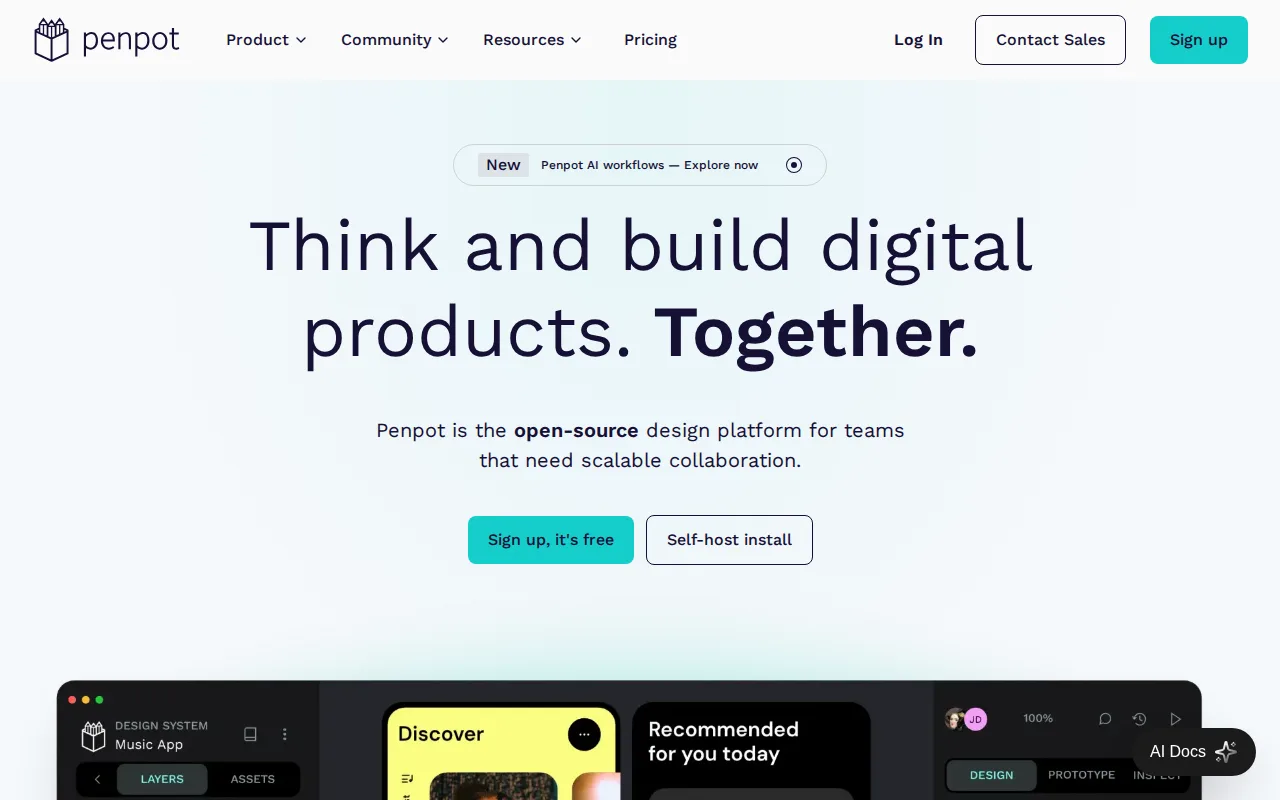
Penpot is the best Figma alternative for teams that want a Figma-style collaborative design tool they can audit or self-host, rather than trusting a closed-source vendor. Penpot's full codebase is published under the Mozilla Public License 2.0, and its hosted Professional plan is free for teams of up to 8 members with 10GB storage, comparable in spirit to Figma's free Starter tier but without Figma's 3-collaborative-file limit. Organizations that want full control can self-host Penpot entirely, avoiding per-seat fees to Kaleidos, the company behind it, an option Figma's closed-source model doesn't offer at any price. Figma is still the better choice for teams that need the largest plugin and font ecosystem: Penpot's plugin marketplace is smaller after Figma's years of third-party development, its Unlimited and Enterprise cloud tiers ($7 and $25 per user/month) sit close to Figma's own $16 and $55 tiers once seats are counted, narrowing the cost advantage for teams not self-hosting, and Penpot's real-time collaboration on very large files lags behind Figma's per user reports.
Compared to Figma: full open-source (MPL-2.0) codebase that can be self-hosted, free Professional plan for up to 8 members without a 3-file cap, but a smaller plugin ecosystem and Unlimited/Enterprise pricing close to Figma's own
Wins:Full open-source codebase (MPL-2.0) that can be self-hosted with no vendor lock-in, unlike Figma's closed-source model · Free Professional plan covers teams up to 8 members with unlimited viewers, without Figma Starter's 3-collaborative-file cap · Native CSS Grid and Flexbox-aware layout tools that export directly to standard CSS
Loses:Smaller plugin and font marketplace than Figma, which has years of third-party ecosystem lead · Cloud Unlimited and Enterprise pricing ($7-$25/user/month) is close to Figma's own $16-$55 tiers, narrowing the cost advantage for teams not self-hosting · Real-time collaboration and rendering performance on very large files lag behind Figma, per user reports
Pros
- Full open-source codebase (MPL-2.0) that can be self-hosted with no vendor lock-in.
- Free Professional plan covers teams up to 8 members with unlimited viewers.
- Native CSS Grid and Flexbox-aware layout tools that export directly to standard CSS.
- Design-to-code and code-to-design AI workflows built into the platform.
Cons
- Smaller plugin and font marketplace than Figma, which has years of third-party ecosystem lead.
- Enterprise self-hosted licensing ($50,000/year) is a significant jump from the free self-hosted community edition's DIY setup.
- Cloud Unlimited and Enterprise pricing ($7-$25/user/month) is close to Figma's own tiers, narrowing the price advantage for teams not self-hosting.
- Real-time collaboration and rendering performance on very large files lag behind Figma, per user reports.
Pricing: Free tier · paid from $7/mo — Free for up to 8 members, then $7/user/month Unlimited vs Figma's $16/month Professional seat (verified undefined NaN, NaN)
2.Canva — best Figma alternative for marketers, small business owners, and social media managers who need on-brand graphics fast without hiring a designer or learning Illustrator or Photoshop
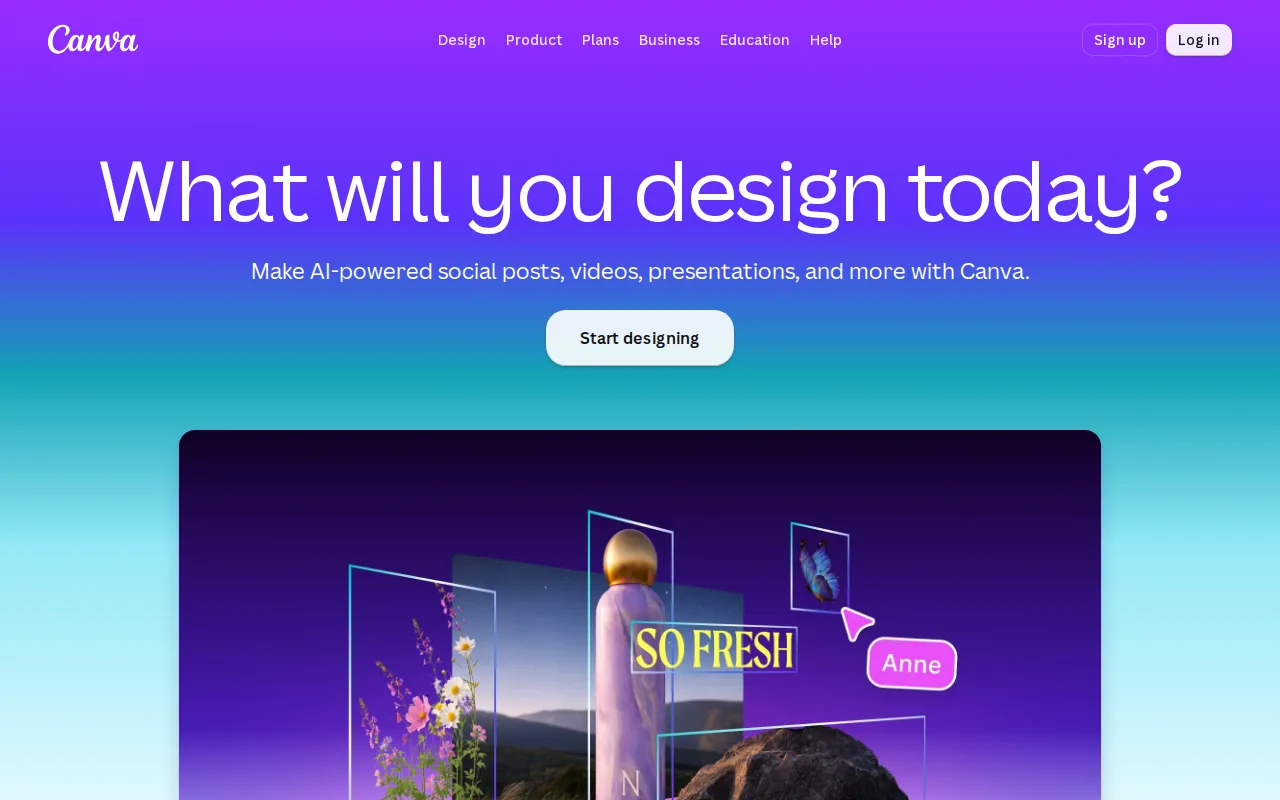
Canva is the best Figma alternative for marketers and non-designers who need on-brand graphics fast without learning Figma's vector-design tools, though it's worth naming plainly that Canva is not a like-for-like UI-design substitute. Canva's free plan includes 2M+ templates with 5GB storage, and Canva Pro costs $18/month (about $12/month billed annually), while Canva holds a 4.7/5 rating from 13,411 Capterra reviews, by far the largest evidence base among Figma's alternatives compared here. Canva's Magic Resize reformats one design across dozens of platform-specific sizes automatically, a template-first workflow Figma's blank-canvas approach doesn't replicate. Figma is still the far better choice for anyone doing actual interface design, prototyping, or developer handoff: Canva has no Dev Mode, no design-system component libraries in the Figma sense, and designs can't be exported as editable source files like .psd or .ai, so work started in Canva is effectively locked into Canva's own editor rather than portable the way Figma files are.
Compared to Figma: template-driven workflow for marketers, not UI design, 4.7/5 from 13,411 Capterra reviews (the largest evidence base here), but no Dev Mode or component libraries and no editable source-file export
Wins:4.7/5 rating from 13,411 Capterra reviews, by far the largest evidence base among Figma's compared alternatives · Template library and drag-and-drop editor let non-designers produce usable graphics in minutes · Magic Resize adapts one design to many platform-specific formats automatically, a workflow Figma doesn't offer
Loses:No Dev Mode or component-library system comparable to Figma's design-to-development handoff — a genuine category gap for UI design work · No export to editable source formats like .psd or .ai; designs are effectively locked to Canva's own editor · Not built for interface design or interactive prototyping the way Figma is
Pros
- Template library and drag-and-drop editor let non-designers produce usable graphics in minutes.
- Magic Resize adapts one design to many platform-specific formats automatically.
- Business plan's brand kits and approval workflows keep team output on-brand without a design lead reviewing everything.
- Bundles docs, presentations, and a website builder alongside design, reducing the number of separate tools a small team needs.
Cons
- No export to editable source formats like .psd or .ai; designs are effectively locked to Canva's own editor.
- Most premium templates, stock assets, and AI features require the Pro or Business paid tier.
- Mobile app is noticeably more limited than the desktop/web editor.
- Some users report confusing billing transitions between the free trial and paid subscription.
Pricing: Free tier · paid from $18/mo — $18/month Pro (about $12/month billed annually) vs Figma's $16/month Professional seat
3.Lunacy — best Figma alternative for designers and non-designers who want a free, native desktop vector and UI design tool with built-in AI features instead of a browser-only or per-seat subscription app
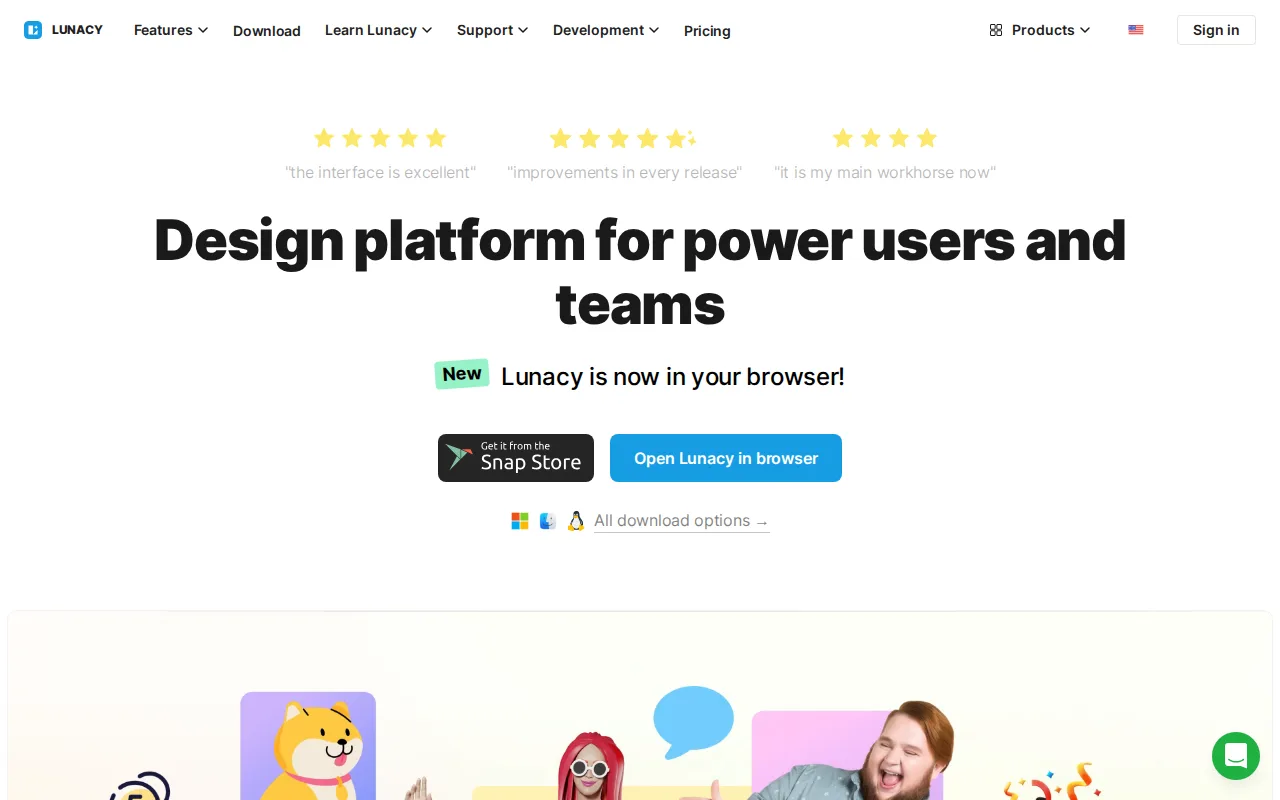
Lunacy is the best Figma alternative for designers who want a free, installable desktop app that works offline on Windows, macOS, or Linux, rather than Figma's browser-dependent model. Lunacy's core vector editing, UI design, and prototyping tools are free to download and use, with no per-seat subscription required, unlike every paid Figma tier above Starter. It bundles built-in AI features (background removal, image upscaling, avatar generation) and direct access to Icons8's icon, photo, and illustration libraries from inside the editor. Lunacy holds a 4.7/5 rating from 26 Capterra reviews. Figma is still the better choice for teams that need mature real-time multiplayer collaboration and a large plugin ecosystem: Lunacy's collaboration features are less mature than Figma's, per design-team reports, and its brand recognition and community resources are much smaller than Figma's, meaning fewer tutorials and community templates; heavy use of Lunacy's AI features or premium Icons8 assets also requires a separate Icons8 subscription not disclosed at a fixed price in our listing data.
Compared to Figma: free native desktop app for Windows, macOS, and Linux vs Figma's browser-dependent model, built-in AI tools and Icons8 libraries, but less mature real-time collaboration and a smaller ecosystem
Wins:Free native desktop app for Windows, macOS, and Linux, unlike browser-only or per-seat competitors · Built-in AI tools (background removal, upscaling, avatar/art generation) without needing separate plugins · Direct in-app access to Icons8's icon, photo, and illustration libraries
Loses:Real-time multiplayer collaboration is less mature than Figma's, a common gap noted by design teams · Smaller plugin ecosystem and third-party integration support than Figma · Heavy AI-feature or premium-asset use requires a separate Icons8 subscription, pricing not fixed in our listing data
Pros
- Free native desktop app for Windows, macOS, and Linux, unlike browser-only competitors.
- Built-in AI tools (background removal, upscaling, avatar/art generation) without needing separate plugins.
- Direct in-app access to Icons8's icon, photo, and illustration libraries.
- Low learning curve for users coming from Sketch- or Figma-style vector and UI tools.
Cons
- Heavy AI-feature or premium-asset use requires an Icons8 subscription, so the free tier has practical usage limits.
- Smaller plugin ecosystem and third-party integration support than Figma.
- Real-time multiplayer collaboration is less mature than Figma's, a common gap noted by design teams.
- Brand recognition and community resources are much smaller than for Figma or Sketch, meaning fewer tutorials and community templates.
Pricing: Free — $0 core app vs Figma's $16/month Professional seat; heavy AI/asset use on Lunacy draws on a separate, unpriced Icons8 subscription