4 Best Alternatives to Pixelmator Pro in 2026
By Noahlast updated pricing verified

From our data: Of the 4 listed Pixelmator Pro alternatives, 2 (Affinity, GIMP) are completely free, undercutting Pixelmator Pro's own one-time $49.99 price, while the other 2 (Adobe Photoshop, Luminar Neo) cost $19.99/month and $129 one-time respectively; all 4 run natively on Windows, a platform Pixelmator Pro does not support at all since it is limited to Mac and iPad.
 Adobe Photoshop
 Affinity
 Luminar Neo
 GIMP
GIMPHow we picked
- Pricing was independently verified for Pixelmator Pro, Affinity, Luminar Neo, and GIMP (all dated 2026-08-21); Adobe Photoshop's pricing was verified at the same time, from the Photoshop listing itself.
- Review volume was weighed directly: Adobe Photoshop's 2,466 Capterra reviews far exceed Pixelmator Pro's own 48 Capterra reviews, while GIMP carries no external ratings on record at all.
- Purchase model mattered given Pixelmator Pro's own one-time $49.99 price: Affinity (free) and GIMP (free) match or beat that with no ongoing cost, Luminar Neo offers a comparable one-time-purchase option from $129, and only Photoshop is subscription-only.
- Platform fit was checked against Pixelmator Pro's Mac- and iPad-only availability: Photoshop, GIMP, and Luminar Neo all reach Windows users that Pixelmator Pro's platform list excludes entirely.
Paid placement never alters editorial rank — read the full methodology.
Pixelmator Pro alternatives at a glance
| Alternative | Best for | Standout | Biggest weakness | Learning curve | Price |
|---|---|---|---|---|---|
| Pixelmator Proreference | Mac and iPad users who want professional-grade, layer-based photo editing and AI retouching without a Photoshop subscription | AI-powered Super Resolution, background removal, Auto Enhance, and Intelligent Denoise built directly into a one-time-purchase image editor. | Apple acquired the Pixelmator Team in 2024, and the app requires macOS 26 or iPadOS 26 or later, locking out older hardware; it remains Mac- and iPad-only with no Windows, Linux, or Android version, and Apple's long-term roadmap for the app as a standalone product is less publicly documented than it was as an independent company. | Moderate | From $12.99/mo |
| Adobe Photoshop | photographers and designers who need pixel-level compositing, retouching, or AI-generated image edits beyond what non-destructive editors offer | Generative Fill and Generative Expand, which use Firefly and partner AI models to add, remove, or extend image content directly from a text prompt inside the layer stack. | Subscription-only with no perpetual license, a steep learning curve for anyone new to layers and masks, and heavy enough on CPU/GPU that Capterra reviewers report performance issues even on capable machines. | Steep | Free tier · paid from $19.99/mo |
| Affinity | designers and photographers who want Photoshop/Illustrator-level editing tools without paying a subscription, and don't need AI generative features | The full Vector, Pixel, and Layout studios are free with no feature restrictions, a direct reversal from Affinity's former one-time-purchase model and from Adobe's subscription pricing. | Generative AI tools (Fill, Expand, AI image/vector generation) require a separate Canva Pro subscription rather than being included, iPad support is still listed as coming soon rather than shipped, and there is no Linux version. | Moderate | Free tier · paid from $14.99/mo |
| Luminar Neo | photography hobbyists who want AI-assisted, single-slider editing tools like sky replacement and background removal without paying an ongoing Adobe-style subscription | Sold as a one-time perpetual license rather than a pure subscription, so the desktop app itself keeps working indefinitely even if the optional annual Luminar Prime renewal is skipped. | The AI generative tools run on a 365-day license cycle and require a separate Luminar Prime renewal ($33-$59/year depending on plan) to keep working past the first year, so the 'one-time payment' framing understates the ongoing cost for anyone who wants continued access to AI features and new releases. | Low | From $129 one-time |
| GIMP | photographers, illustrators, and designers who want a full-featured, scriptable photo editor without paying a subscription or license fee | A scripting API in Python, C, C++, and Scheme lets users automate batch processing and build custom filters and plugins, backed by a large community library of scripts built up over the project's history. | No official vendor support: there is no paid support tier or SLA, so troubleshooting relies entirely on community forums and documentation, and the interface is widely considered less approachable for beginners than Photoshop or Affinity Photo. | Steep | Free |
 Pixelmator Pro
1.Adobe Photoshop — best Pixelmator Pro alternative for photographers and designers who need pixel-level compositing, retouching, or AI-generated image edits beyond what non-destructive editors offer
Adobe Photoshop is the best Pixelmator Pro alternative for anyone who needs AI-generated image content or a Windows-compatible editor, since Photoshop's Generative Fill and Generative Expand use Adobe Firefly and partner AI models to add, remove, or extend image content from a text prompt, well beyond Pixelmator Pro's own AI toolset of Super Resolution, background removal, and Intelligent Denoise. Photoshop runs on Windows, macOS, and iPad, while Pixelmator Pro is Mac- and iPad-only, requiring macOS 26 or iPadOS 26 or later since Apple's 2024 acquisition of the Pixelmator Team. Photoshop holds a 4.8/5 rating from 2,466 Capterra reviews, more than 50 times the review volume behind Pixelmator Pro's own 4.8/5 score from just 48 reviews. The Photography plan bundling Photoshop with Lightroom starts at $19.99/month billed annually, a recurring cost against Pixelmator Pro's one-time $49.99 purchase. Pixelmator Pro is still the better choice for Mac and iPad users who want to pay once instead of subscribing indefinitely: Photoshop has no perpetual license, so access ends the moment a subscription lapses, and its steep learning curve and heavy CPU/GPU demands are more than many Pixelmator Pro users need for everyday retouching.
Compared to Pixelmator Pro: Generative Fill and Generative Expand AI tools, Windows support Pixelmator Pro lacks entirely, but $19.99/month vs a one-time $49.99 purchase
Wins:Generative Fill and Generative Expand use Firefly and partner AI models for text-prompt image editing, beyond Pixelmator Pro's Super Resolution and background removal · Runs on Windows, macOS, and iPad, versus Pixelmator Pro's Mac- and iPad-only availability requiring macOS 26 or iPadOS 26 · 4.8/5 rating from 2,466 Capterra reviews, over 50 times Pixelmator Pro's 48-review sample
Loses:Photography plan costs $19.99/month billed annually with no perpetual license, versus Pixelmator Pro's one-time $49.99 purchase · Steep learning curve and heavy CPU/GPU demands are more than many everyday retouching tasks need · No native macOS/iPadOS-specific interface polish or Apple Pencil integration to the same degree as Pixelmator Pro's Mac-first design
Pros
- Layer-based, pixel-level editing that remains the industry benchmark for compositing and retouching.
- Generative Fill and Remove tool cut hours off object removal and background work.
- Deep Creative Cloud integration shares fonts, assets, and files with Illustrator and Lightroom.
- Free web-based Firefly editor lets anyone try generative editing without a subscription.
Cons
- No perpetual license; access ends when the subscription lapses.
- Steep learning curve for users unfamiliar with layers, masks, and blend modes.
- Demanding on hardware; large multi-layer files can slow even high-end machines.
- Cancelling an annual-billed-monthly plan within the first year can trigger an early termination fee.
Pricing: Free tier · paid from $19.99/mo — $19.99/month Photography plan (recurring) vs Pixelmator Pro's one-time $49.99 purchase (verified undefined NaN, NaN)
2.Affinity — best Pixelmator Pro alternative for designers and photographers who want Photoshop/Illustrator-level editing tools without paying a subscription, and don't need AI generative features
Affinity is the best Pixelmator Pro alternative for users who want vector, raster, and page-layout tools in one app without any purchase at all, since Affinity's Vector, Pixel, and Layout studios became completely free with just a Canva account in 2026, undercutting even Pixelmator Pro's one-time $49.99 price. Affinity Photo holds a 4.8/5 rating from 99 Capterra reviews, close to Pixelmator Pro's own 4.8/5 from 48 reviews, but from roughly twice the sample size. Affinity adds page-layout tools (the Layout studio) that Pixelmator Pro's image-focused toolset does not include, giving it broader scope for anyone doing print or multi-page design work. Both apps run on Windows and macOS, though Affinity currently lacks a shipped iPad app (listed as coming soon) while Pixelmator Pro's iPad version is available today. Pixelmator Pro is still the better choice for iPad users who want AI-powered Super Resolution and Intelligent Denoise built into a Mac-native app right now: Affinity's generative AI tools (Fill, Expand, AI image/vector generation) require a separate $14.99/month Canva Pro subscription, a recurring cost Pixelmator Pro's one-time purchase avoids for its own AI feature set.
Compared to Pixelmator Pro: free Vector, Pixel, and Layout studios with a Canva account, undercutting the $49.99 one-time price, but no shipped iPad app
Wins:Free Vector, Pixel, and Layout studios with a Canva account, undercutting Pixelmator Pro's one-time $49.99 price entirely · Layout studio adds page-design tools beyond Pixelmator Pro's image-focused feature set · 4.8/5 rating from 99 Capterra reviews, roughly double Pixelmator Pro's 48-review sample at the same score
Loses:No shipped iPad app yet, only listed as coming soon, while Pixelmator Pro's iPad version is available today · Generative AI tools (Fill, Expand, AI generation) require a separate $14.99/month Canva Pro subscription, a recurring cost on top of the free core app · No Apple Pencil-specific tuning to the depth Pixelmator Pro offers as a Mac/iPad-native app
Pros
- Full professional design suite (vector, raster, layout) free with no time limit or feature gate on the core tools.
- Requires only a free Canva account, no credit card, to unlock everything in the base app.
- Backed by Canva's infrastructure and update cadence rather than a small independent studio.
- Optional Canva Pro AI features integrate directly inside the same app rather than requiring a separate tool.
Cons
- Generative AI features are gated behind a paid Canva Pro subscription ($14.99/month or $119.99/year).
- No iPad app yet; it is listed as coming soon rather than available.
- No Linux support.
- The 2026 rebrand merging three separate apps into one changes workflows for users of the older per-app Affinity Designer/Photo/Publisher versions.
Pricing: Free tier · paid from $14.99/mo — Free with a Canva account vs Pixelmator Pro's one-time $49.99; Affinity's optional AI tools cost $14.99/month via Canva Pro
3.Luminar Neo — best Pixelmator Pro alternative for photography hobbyists who want AI-assisted, single-slider editing tools like sky replacement and background removal without paying an ongoing Adobe-style subscription
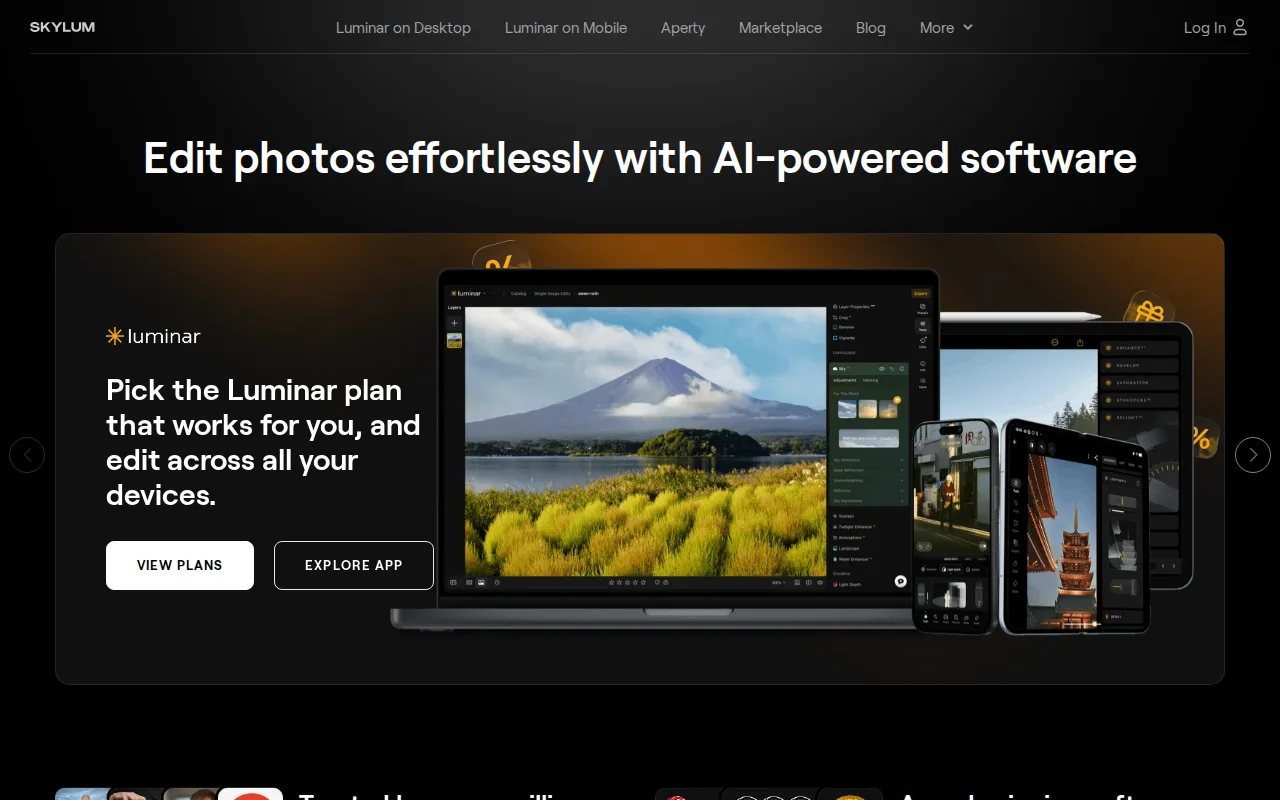
Luminar Neo is the best Pixelmator Pro alternative for photographers who want single-slider AI tools like sky replacement without a Mac-only restriction, since Luminar Neo runs on Windows, macOS, iOS, Android, and ChromeOS, while Pixelmator Pro is limited to Mac and iPad requiring macOS 26 or iPadOS 26. Both are sold as one-time purchases rather than subscriptions: Luminar Neo's Desktop Only plan starts at $129, more than double Pixelmator Pro's $49.99 price, though it includes a full year of AI tool updates. Luminar Neo's signature AI tools — Sky Replacement, automatic background removal, and NoiselessAI noise reduction — go beyond Pixelmator Pro's own Super Resolution and Intelligent Denoise with more single-slider, one-click controls aimed at hobbyists rather than layer-based editing. Pixelmator Pro is still the better choice for anyone who wants a lower upfront cost and Apple Pencil-tuned editing on iPad: Luminar Neo's AI tools run on a 365-day license cycle that requires an optional Luminar Prime renewal ($33-$59/year) to stay current after the first year, an ongoing cost Pixelmator Pro's one-time purchase does not carry, and Luminar Neo has no external ratings on record to compare against Pixelmator Pro's 4.8/5 from 48 Capterra reviews.
Compared to Pixelmator Pro: cross-platform on Windows, iOS, Android, and ChromeOS, one-click AI Sky Replacement, but $129 one-time price vs Pixelmator Pro's $49.99
Wins:Cross-platform on Windows, macOS, iOS, Android, and ChromeOS, versus Pixelmator Pro's Mac- and iPad-only availability · Single-slider AI tools (Sky Replacement, background removal, NoiselessAI) built for one-click edits beyond Pixelmator Pro's Super Resolution and Intelligent Denoise · Also sold as a one-time purchase, avoiding a subscription the way Pixelmator Pro does
Loses:Desktop Only plan starts at $129, more than double Pixelmator Pro's $49.99 one-time price · AI tools require an optional Luminar Prime renewal ($33-$59/year) to stay current after the first year, an ongoing cost Pixelmator Pro's purchase doesn't carry · No external ratings on record, versus Pixelmator Pro's 4.8/5 score from 48 Capterra reviews
Pros
- One-time perpetual license option avoids Adobe's mandatory ongoing subscription for the core desktop app.
- Single-slider AI tools (Accent AI, Sky Replacement, background removal) make complex edits accessible without a manual layers-based workflow.
- Cross-platform coverage including iOS, Android, ChromeOS, and Apple Vision Pro on higher-tier bundles.
- Includes a large library of presets, LUTs, overlays, and skies, plus bundled photography courses.
Cons
- AI tools require a 365-day license renewal through Luminar Prime ($33-$59/year) to stay current after the first year, softening the 'pay once' pitch.
- Pricing display leans on frequent 'up to 50% off' discounting from list prices, making it harder to judge the real baseline cost.
- Lacks the depth of professional-grade manual retouching and color-grading tools found in Photoshop or Capture One.
- AI-driven edits can look overprocessed on some images without careful slider tuning, a common complaint among more experienced photo editors.
Pricing: From $129 one-time — $129 one-time Desktop Only plan vs Pixelmator Pro's $49.99 one-time purchase; both avoid a recurring subscription for the core app (verified undefined NaN, NaN)
4.GIMP — best Pixelmator Pro alternative for photographers, illustrators, and designers who want a full-featured, scriptable photo editor without paying a subscription or license fee
GIMP is the best Pixelmator Pro alternative for anyone who wants a $0 image editor on any operating system, since GIMP is licensed under the GPLv3 and runs natively on Windows, macOS, and Linux, while Pixelmator Pro costs a one-time $49.99 and works only on Mac and iPad. GIMP's source code is public and auditable, and it adds a scripting API in Python, C, C++, and Scheme for batch processing, a capability Pixelmator Pro's closed-source app does not expose. Pixelmator Pro requires macOS 26 or iPadOS 26 or later, locking out older Apple hardware, while GIMP has no such version-gating restriction across its supported platforms. Pixelmator Pro is still the better choice for Mac and iPad users who want AI-powered Super Resolution, Intelligent Denoise, and a more approachable interface: GIMP has no external ratings on record to compare against Pixelmator Pro's 4.8/5 score from 48 Capterra reviews, and GIMP's interface and non-destructive editing workflow are widely considered less approachable for beginners than Pixelmator Pro's Mac-native design.
Compared to Pixelmator Pro: completely free under GPLv3 vs a one-time $49.99 purchase, native Windows and Linux support, but a steeper interface for beginners
Wins:Completely free under the GPLv3, versus Pixelmator Pro's one-time $49.99 purchase · Runs on Windows, macOS, and Linux, unlike Pixelmator Pro's Mac- and iPad-only availability requiring macOS 26 or iPadOS 26 · Scripting API in Python, C, C++, and Scheme for batch processing, a capability Pixelmator Pro's closed-source app doesn't expose
Loses:No external ratings on record, versus Pixelmator Pro's 4.8/5 score from 48 Capterra reviews · Interface and non-destructive editing workflow are widely considered less approachable for beginners than Pixelmator Pro's · No AI-powered Super Resolution or Intelligent Denoise tools built into the core app the way Pixelmator Pro has
Pros
- Completely free with no license fee, subscription, or feature paywall.
- Fully cross-platform on Linux, macOS, and Windows with the same feature set on each.
- Scriptable via Python, C, C++, and Scheme for custom filters and batch automation.
- Open-source license means the software can be audited, modified, and redistributed without restriction.
Cons
- No official vendor support or SLA; help comes only from community forums and documentation.
- Interface and non-destructive editing workflow are less approachable for beginners than Photoshop or Affinity Photo.
- Native file compatibility with Photoshop's .psd format is imperfect for complex layered files.
- Smaller plugin and brush ecosystem than commercial competitors, despite community contributions.
Pricing: Free (verified undefined NaN, NaN)
Which one is right for you?
- You need AI generative image editing and a Windows-compatible app, not just MacAdobe Photoshop
- You want a free, no-subscription suite that also handles page layout, not just photosAffinity
- You're a photography hobbyist who wants one-click sky replacement without a Mac restrictionLuminar Neo
- You want a completely free editor you can audit or script, on any operating systemGIMP
- You're on older Apple hardware that doesn't meet Pixelmator Pro's macOS 26 requirementGIMP
Frequently asked questions
Is there a free alternative to Pixelmator Pro?
- Yes, both GIMP and Affinity are completely free, undercutting Pixelmator Pro's one-time $49.99 price entirely. GIMP is free and open source under the GPLv3, while Affinity is free with just a Canva account.
What is the closest alternative to Pixelmator Pro?
- Affinity is the closest match, since it combines vector, raster, and layout tools the way Pixelmator Pro combines layer-based photo editing with vector shapes and typography, and it's also aimed at users avoiding an Adobe-style subscription. Adobe Photoshop is the closest match for AI feature depth, at a higher recurring cost.
Can Adobe Photoshop replace Pixelmator Pro?
- Yes, Adobe Photoshop can replace Pixelmator Pro for users who need AI generative editing or a Windows-compatible app. It costs $19.99/month on a recurring basis versus Pixelmator Pro's one-time $49.99 purchase, so it trades a lower upfront cost for ongoing subscription fees.
Does Pixelmator Pro work on Windows?
- No, Pixelmator Pro runs only on macOS and iPadOS, requiring macOS 26 or iPadOS 26 or later. Windows users looking for a similar one-time-purchase or free editor should consider GIMP or Luminar Neo instead.
Is Luminar Neo better than Pixelmator Pro?
- Luminar Neo adds one-click AI tools like Sky Replacement and runs on more platforms, including Windows and Android, but its $129 one-time price is more than double Pixelmator Pro's $49.99. Whether it's better depends on whether cross-platform reach or a lower price matters more.