3 Best Alternatives to Neon in 2026
By Noahlast updated pricing verified

From our data: Supabase's 861 Product Hunt reviews outnumber the combined review count of Neon (82), CockroachDB (3), and PlanetScale (1) — 86 reviews total — by more than ten times; ratings across the four range from PlanetScale's 4.0/5 up to Neon's and Supabase's shared 5.0/5, a 1.0-point spread.
 Supabase
 PlanetScale
 CockroachDB
How we picked
- External ratings favored Supabase decisively: its 5.0/5 from 861 Product Hunt reviews dwarfs Neon's own 5.0/5 from 82 reviews and CockroachDB's 4.7/5 from 3 reviews, while PlanetScale holds a thinner 4.0/5 from 1 Capterra review.
- Pricing verification dates were checked directly: Supabase (2026-08-21T06:53:19.602Z), PlanetScale (2026-08-21T10:09:18.352Z), and CockroachDB (2026-08-21T10:51:45.927Z) were all confirmed on live pricing pages, matching Neon's own verified pricing (2026-08-21T10:09:17.796Z).
- Free-tier structure was compared directly against Neon's 100 compute-hours and 0.5GB storage per project: Supabase's free tier (500MB database, 50,000 MAU) and CockroachDB's Basic tier (50 million request units, 10GiB storage) both require no credit card, while PlanetScale has had no free tier since removing its Hobby plan in April 2024.
- Open-source status was weighted since it underlies Neon's own positioning: Supabase's core stack is Apache-2.0 and self-hostable like Neon's engine, while PlanetScale is fully proprietary and CockroachDB stopped being open source as of version 24.3.
Paid placement never alters editorial rank — read the full methodology.
Neon alternatives at a glance
| Alternative | Best for | Standout | Biggest weakness | Learning curve | Price |
|---|---|---|---|---|---|
| Neonreference | developers who want instant, low-cost database branching for every pull request or preview deployment without provisioning full new Postgres instances | Instant copy-on-write database branching that forks a full production dataset in seconds, paired with scale-to-zero compute billing so idle branches cost nothing. | Paid tiers are pure usage-based billing with no flat monthly price, so cost is harder to predict up front than a fixed-price competitor, and extra branches beyond the included count cost $1.50/branch-month, which adds up for teams branching aggressively per pull request. | Low | Free |
| Supabase | developers who want a Postgres-based backend (auth, storage, realtime, auto-generated APIs) they can self-host later, rather than committing to a proprietary NoSQL platform like Firebase | Auto-generated REST, GraphQL, and Realtime APIs derived straight from a project's Postgres schema, with Row Level Security enforcing per-row authorization at the database layer instead of in application code. | Pricing beyond the $25/month Pro base is usage-based and billed per project rather than per account, so teams running multiple projects or exceeding the 100,000 MAU / 250GB egress limits can see invoices climb well past the advertised starting price. | Moderate | Free tier · paid from $25/mo |
| PlanetScale | teams needing a managed, horizontally-scalable MySQL (Vitess) or Postgres database with Git-style branching workflows, who don't need a permanent free tier | Database branching — copy-on-write schema and data branches for testing migrations — paired with non-blocking, zero-downtime schema changes on both its Postgres and Vitess (MySQL-compatible) offerings. | PlanetScale eliminated its free Hobby tier in April 2024, a widely-criticized move that pushed small and side projects onto paid plans starting at a $5/month minimum, with production-grade high-availability tiers starting significantly higher and metal tiers running into the thousands per month. | Moderate | From $5/mo |
| CockroachDB | teams running multi-region transactional workloads on PostgreSQL-compatible SQL that need automatic failover without manual sharding | Automatic 3x data replication with multi-region survivability and PostgreSQL wire compatibility, so most existing Postgres tooling connects without changes | Self-hosted CockroachDB is no longer open source as of version 24.3 — it runs under a proprietary source-available license, and clusters without a valid license (or past their trial/grace period) are throttled to five concurrent SQL transactions, a change that alienated some users who adopted it for its earlier open-source licensing. | Moderate | Free tier · paid from $0.18/mo |
 Neon
Neon1.Supabase — best Neon alternative for developers who want a Postgres-based backend (auth, storage, realtime, auto-generated APIs) they can self-host later, rather than committing to a proprietary NoSQL platform like Firebase
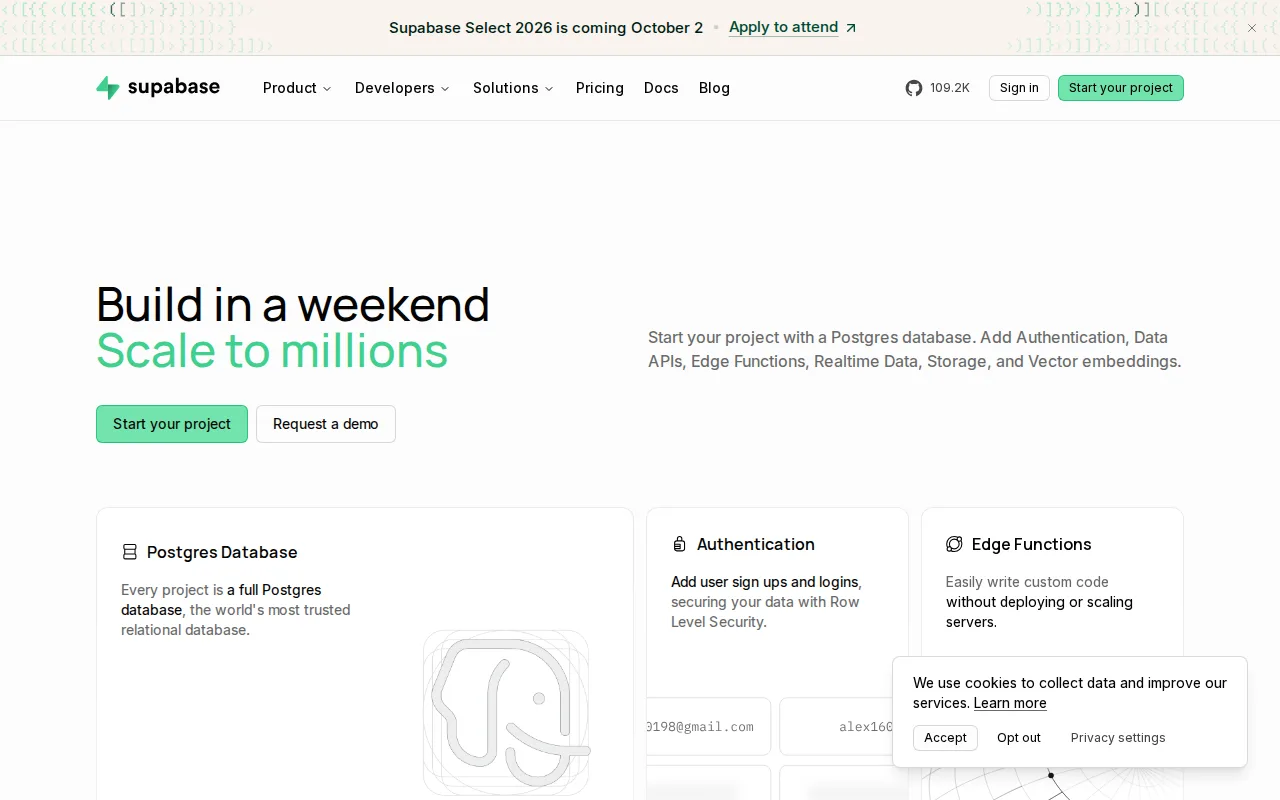
Supabase is the best Neon alternative for developers who want a Postgres-based backend bundling authentication, storage, realtime sync, and auto-generated APIs, not just the database itself that Neon provides. Supabase holds a 5.0/5 rating from 861 Product Hunt reviews, over ten times Neon's own 82 reviews, and its Free plan covers 2 projects with a 500MB database and 50,000 monthly active users at no cost, while Pro is $25/month with a $10/month compute credit included. Like Neon, Supabase's core stack (Postgres, PostgREST, GoTrue auth, Realtime, Storage) is open source and self-hostable, but Supabase adds Row Level Security for per-row authorization, S3-compatible object storage, and Deno-based edge functions that Neon's database-only product doesn't include. Neon is still the better choice for anyone who specifically wants instant, low-cost branching for every pull request: Neon's copy-on-write branching forks a full dataset in seconds with scale-to-zero compute billing, while Supabase's branching and per-project compute costs stack up faster for teams running several projects, since compute is billed per project rather than through Neon's usage-based, no-monthly-minimum model.
Compared to Neon: bundles authentication, storage, realtime sync, and auto-generated REST/GraphQL APIs, not just a database, Row Level Security enforces per-row authorization at the database layer, free tier includes 50,000 monthly active users at no cost
Wins:Bundles authentication, S3-compatible storage, realtime sync, and auto-generated REST/GraphQL/Realtime APIs alongside the database, well beyond Neon's database-only product · Row Level Security enforces per-row authorization directly in Postgres, a feature Neon's plain database layer doesn't provide · Holds a 5.0/5 rating from 861 Product Hunt reviews, over ten times Neon's own 82 reviews
Loses:Compute is billed per project rather than through Neon's usage-based, no-monthly-minimum model, so multi-project accounts stack recurring charges faster · No equivalent to Neon's instant copy-on-write branching purpose-built for per-pull-request preview databases · Free-tier projects pause automatically after 1 week of inactivity, a limit Neon's free tier doesn't impose the same way
Pros
- Full Postgres database rather than a proprietary NoSQL store, so existing SQL skills and extensions like pgvector and PostGIS carry over directly.
- Auto-generates REST, GraphQL, and Realtime APIs from the schema, with Row Level Security for per-row authorization.
- Apache-2.0-licensed core stack is self-hostable, avoiding hard vendor lock-in.
- Free tier includes unlimited API requests, 50,000 monthly active users, and a 500MB database with no time limit on the account.
Cons
- Compute is billed per project, so accounts running several projects stack recurring charges beyond the flat $25/month Pro fee.
- MAU overage ($0.00325/user past 100,000) and egress overage ($0.09/GB past 250GB) can produce unpredictable invoices at scale.
- Free-tier projects pause automatically after 1 week of inactivity.
- Row Level Security has a steeper learning curve than Firebase's simpler client-side security rules for teams new to SQL.
Pricing: Free tier · paid from $25/mo — Neon's Launch tier is pure usage-based billing ($0.106/compute-hour) with no monthly minimum; Supabase Pro is a flat $25/month with a $10/month compute credit included, then usage-based overages (verified undefined NaN, NaN)
2.PlanetScale — best Neon alternative for teams needing a managed, horizontally-scalable MySQL (Vitess) or Postgres database with Git-style branching workflows, who don't need a permanent free tier
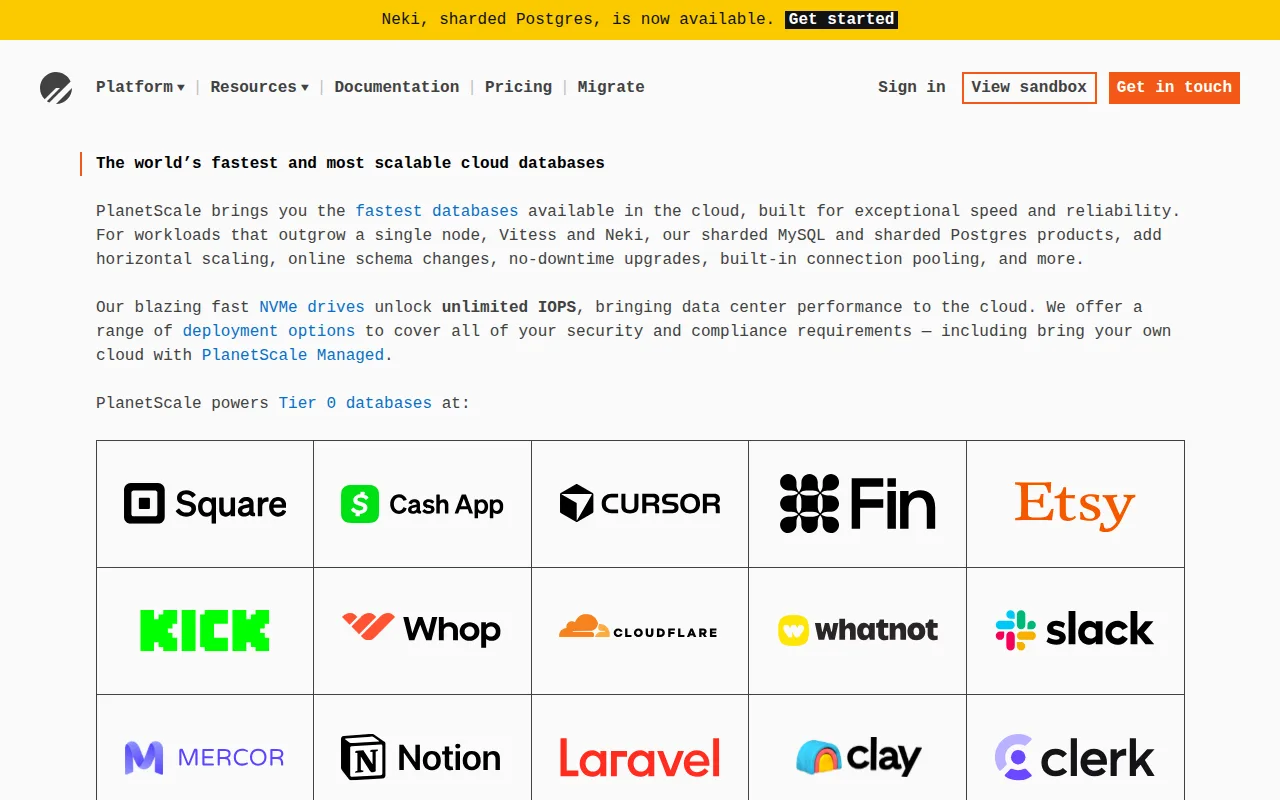
PlanetScale is the best Neon alternative for teams that need a horizontally-shardable, MySQL-compatible database (Vitess) alongside a native Postgres option, both with Git-style branching workflows similar in spirit to Neon's own branching model. PlanetScale's smallest single-node, non-HA Postgres database starts at $5/month, with a 3-node high-availability Postgres cluster at $15/month and the smallest Vitess cluster at $39/month; both product lines support copy-on-write branching and zero-downtime, non-blocking schema changes. PlanetScale holds a 4.0/5 rating from 1 Capterra review, a thin sample compared to Neon's 5.0/5 from 82 Product Hunt reviews. Neon is still the better choice for anyone who wants to start free: PlanetScale eliminated its Hobby tier in April 2024, so every PlanetScale database, including tiny side projects, costs at least $5/month, while Neon's Free plan requires no credit card and includes 100 compute-hours plus 10 branches per project at no cost. PlanetScale also offers Vitess's MySQL-compatible horizontal sharding, a workload pattern Neon's pure-Postgres product doesn't address.
Compared to Neon: offers a MySQL-compatible Vitess product line with horizontal sharding, not just Postgres, no free tier since removing Hobby in April 2024 versus Neon's no-credit-card Free plan, zero-downtime non-blocking schema changes on both Postgres and Vitess
Wins:Offers a horizontally-shardable, MySQL-compatible Vitess product line alongside Postgres, a workload pattern Neon's pure-Postgres product doesn't cover · Zero-downtime, non-blocking schema changes are supported on both its Postgres and Vitess offerings
Loses:No free tier since eliminating Hobby in April 2024, unlike Neon's no-credit-card Free plan with 100 compute-hours and 10 branches per project · Holds only a 4.0/5 rating from 1 Capterra review, a much thinner sample than Neon's 5.0/5 from 82 Product Hunt reviews · Every database costs at least $5/month minimum, with production-grade HA tiers starting significantly higher
Pros
- Database branching lets developers test schema migrations on an isolated copy before merging to production.
- Zero-downtime, non-blocking schema changes on both the Vitess and Postgres product lines.
- Offers both a MySQL-compatible (Vitess) and a native Postgres option under one platform.
- Multi-cloud support across AWS and GCP with multi-region deployment options.
Cons
- No free tier since April 2024; every database, including tiny side projects, costs at least $5/month.
- Pricing scales into thousands of dollars per month for high-availability metal tiers with meaningful storage.
- Vitess-specific concepts like sharding add operational complexity compared to a plain managed Postgres instance.
Pricing: From $5/mo — Neon's Free plan costs $0 with no credit card required; PlanetScale's cheapest database (single-node, non-HA Postgres) starts at $5/month with no free tier at all (verified undefined NaN, NaN)
3.CockroachDB — best Neon alternative for teams running multi-region transactional workloads on PostgreSQL-compatible SQL that need automatic failover without manual sharding
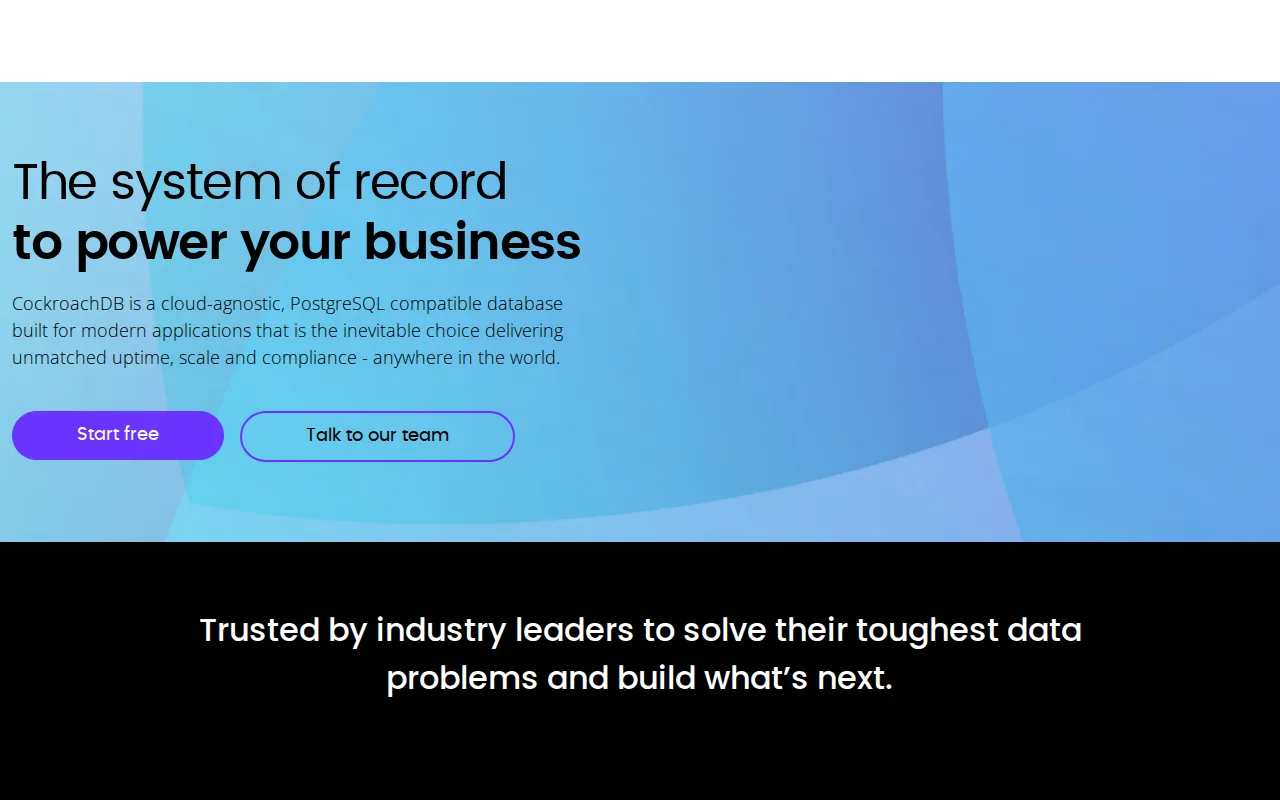
CockroachDB is the best Neon alternative for teams running multi-region transactional workloads that need automatic failover without manual sharding, a different priority than Neon's branching-first workflow. CockroachDB replicates every piece of data three times across nodes automatically to survive machine, rack, or region failures, and its Cloud Basic tier is free for workloads under 50 million request units and 10GiB of storage per month, comparable in spirit to Neon's own no-cost Free plan. CockroachDB holds a 4.7/5 rating from 3 Product Hunt reviews, a much smaller sample than Neon's 82 reviews at the same 5.0 score. Both databases speak the PostgreSQL wire protocol, so existing drivers and ORMs largely carry over. Neon is still the better choice for anyone who wants copy-on-write branching for every pull request or preview deployment: CockroachDB has no equivalent instant-branching feature, and as of version 24.3 it is no longer open source for self-hosted use, with unlicensed clusters throttled to five concurrent SQL transactions after a grace period, a licensing risk Neon's Apache-2.0 open-source engine doesn't carry.
Compared to Neon: automatic 3x data replication survives node, datacenter, and region failures, Cloud Basic tier is free up to 50 million request units and 10GiB storage, self-hosted use is no longer open source as of version 24.3
Wins:Automatic 3x data replication survives node, datacenter, and region failures without manual intervention, a resilience model Neon's single-region branching architecture doesn't target the same way · Cloud Basic tier is genuinely free up to 50 million request units and 10GiB storage per month, comparable to Neon's own free allowance
Loses:No equivalent to Neon's instant copy-on-write branching for pull requests and preview deployments · Self-hosted CockroachDB is no longer open source as of version 24.3, unlike Neon's Apache-2.0-licensed database engine; unlicensed self-hosted clusters are throttled to five concurrent SQL transactions after a grace period · Holds only a 4.7/5 rating from 3 Product Hunt reviews, a much smaller sample than Neon's 82 reviews
Pros
- Automatic 3x replication survives node, datacenter, and region failures without manual intervention.
- PostgreSQL wire-compatible, so most Postgres drivers and ORMs work without modification.
- Cloud Basic tier is genuinely free up to 50 million request units and 10 GiB storage per month.
- Deploys across AWS, GCP, and Azure, plus self-hosted or bring-your-own-cloud options.
Cons
- No longer open source as of version 24.3 — self-hosted runs under a proprietary source-available license.
- Unlicensed or expired self-hosted clusters are throttled to five concurrent SQL transactions after a grace period.
- Enterprise Free self-hosted license requires sending telemetry and cannot be used to host CockroachDB as a service for third parties.
- Cloud compute pricing is billed hourly per vCPU, which takes more effort to estimate than a flat per-seat or per-GB rate.
Pricing: Free tier · paid from $0.18/mo — Both offer a genuinely free tier: Neon's Free plan includes 100 compute-hours and 0.5GB storage per project, CockroachDB's Cloud Basic tier is free up to 50 million request units and 10GiB storage per month (verified undefined NaN, NaN)
Which one is right for you?
- You need a database plus authentication, storage, and realtime sync in one platformSupabase
- You want horizontal sharding on a MySQL-compatible database, not just PostgresPlanetScale
- You're running a multi-region transactional workload that needs automatic failoverCockroachDB
- You want to start completely free with no credit card before committingSupabase
- You need Postgres wire compatibility with automatic 3x replication across regionsCockroachDB
Frequently asked questions
Is there a free alternative to Neon?
- Yes — Supabase's Free plan covers 2 projects with a 500MB database and 50,000 monthly active users at no cost, and CockroachDB's Cloud Basic tier is free up to 50 million request units and 10GiB storage per month, both comparable to Neon's own no-credit-card Free plan.
What is the closest alternative to Neon?
- Supabase is the closest match: both are built on an open-source Postgres core with usage-based pricing beyond a free tier, though Supabase bundles authentication, storage, and realtime sync that Neon's pure-database product doesn't include.
Can Supabase replace Neon?
- Yes for teams that want a full backend, not just a database, since Supabase's Postgres core plus bundled auth and storage covers most of what Neon offers and more. Anyone who specifically needs Neon's instant per-pull-request branching should stay with Neon, since Supabase's branching model isn't the same.
Which Neon alternative supports MySQL, not just Postgres?
- PlanetScale, through its Vitess product line, a horizontally-shardable, MySQL-compatible database, alongside a separate native Postgres option starting at $5/month.
Is there a Neon alternative built for multi-region failover?
- CockroachDB, which automatically replicates data three times across nodes to survive machine, rack, or region failures, with a free Cloud Basic tier under 50 million request units and 10GiB storage per month.
Which Neon alternative has the most reviews?
- Supabase, with a 5.0/5 rating from 861 Product Hunt reviews, over ten times Neon's own 82 reviews and far more than PlanetScale's 1 review or CockroachDB's 3.