4 Best Free Alternatives to Kit in 2026
By Noahlast updated
Compared: free alternatives to Kit
| Alternative | Best for | Standout | Biggest weakness | Learning curve | Price |
|---|---|---|---|---|---|
| Kitreference | individual creators and newsletter writers who want list building, automation, and paid-newsletter monetization in one platform rather than general-purpose e-commerce email marketing software | Built-in support for selling paid newsletter subscriptions and digital products directly to subscribers, rather than treating monetization as a separate add-on outside the email platform. | Like most subscriber-count-based email pricing, cost scales up automatically as a creator's list grows, and reporting/analytics on the entry Creator tier are noticeably thinner than on Creator Pro, pushing serious growth-focused creators toward the pricier tier. | Moderate | Free tier · paid from $25/mo |
| Mailchimp | small businesses and e-commerce brands that want to run email and SMS campaigns with built-in automation and AI content tools without a separate marketing stack | A drag-and-drop email builder combined with e-commerce automation triggers (abandoned cart, order follow-up) and AI content tools, backed by 300+ third-party integrations. | Pricing scales with contact-list size and jumps sharply between tiers ($13 to $20 to $350/month), so growing lists get expensive fast, and reviewers describe the cost as disproportionate to list growth on the higher tiers; the Free plan's support is email-only and expires after 30 days. | Low | Free tier · paid from $13/mo |
| beehiiv | independent newsletter writers and small publishers who want built-in monetization (ad network, digital products) alongside a free tier up to 2,500 subscribers | A built-in Ad Network that connects publishers directly with sponsors inside the platform, letting writers monetize a free newsletter without arranging sponsorships manually. | The Ad Network, digital product sales, and email automations are all locked behind the $43/month Scale plan, and beehiiv's own branding stays on outgoing emails until the $96/month Max tier, which reviewers note as expensive for creators who haven't yet monetized their list. | Low | Free tier · paid from $43/mo |
| Substack | independent writers and journalists who want to monetize a newsletter with paid subscriptions without paying a monthly platform fee, in exchange for giving up 10% of revenue | A built-in discovery network (Notes and cross-publication recommendations) that helps new writers find their first paying subscribers without an existing email list. | Substack only supports Stripe for payment processing, which locks out writers in countries where Stripe isn't available, and the post editor lacks the formatting, HTML, and layout control of a dedicated CMS like WordPress or Ghost. | Low | Free |
| MailerLite | creators and small businesses that want an easy-to-use email marketing platform with a genuinely usable free tier before paying for more subscribers or automations | A permanently free plan for up to 250 subscribers that includes automation, landing pages, and a website builder, not just a stripped-down trial of the paid product. | Advanced deliverability and account-support features (dedicated IP, account audits, deliverability support) are reserved for the custom-quoted Enterprise tier, and the Free and Comfort plans' subscriber-based pricing means costs climb as a list grows, even for a small business that doesn't need Power's unlimited automations. | Low | Free tier · paid from $12/mo |
 Kit
Kit Mailchimp
 beehiiv
 Substack
 MailerLite
1.Mailchimp — best Kit alternative for small businesses and e-commerce brands that want to run email and SMS campaigns with built-in automation and AI content tools without a separate marketing stack
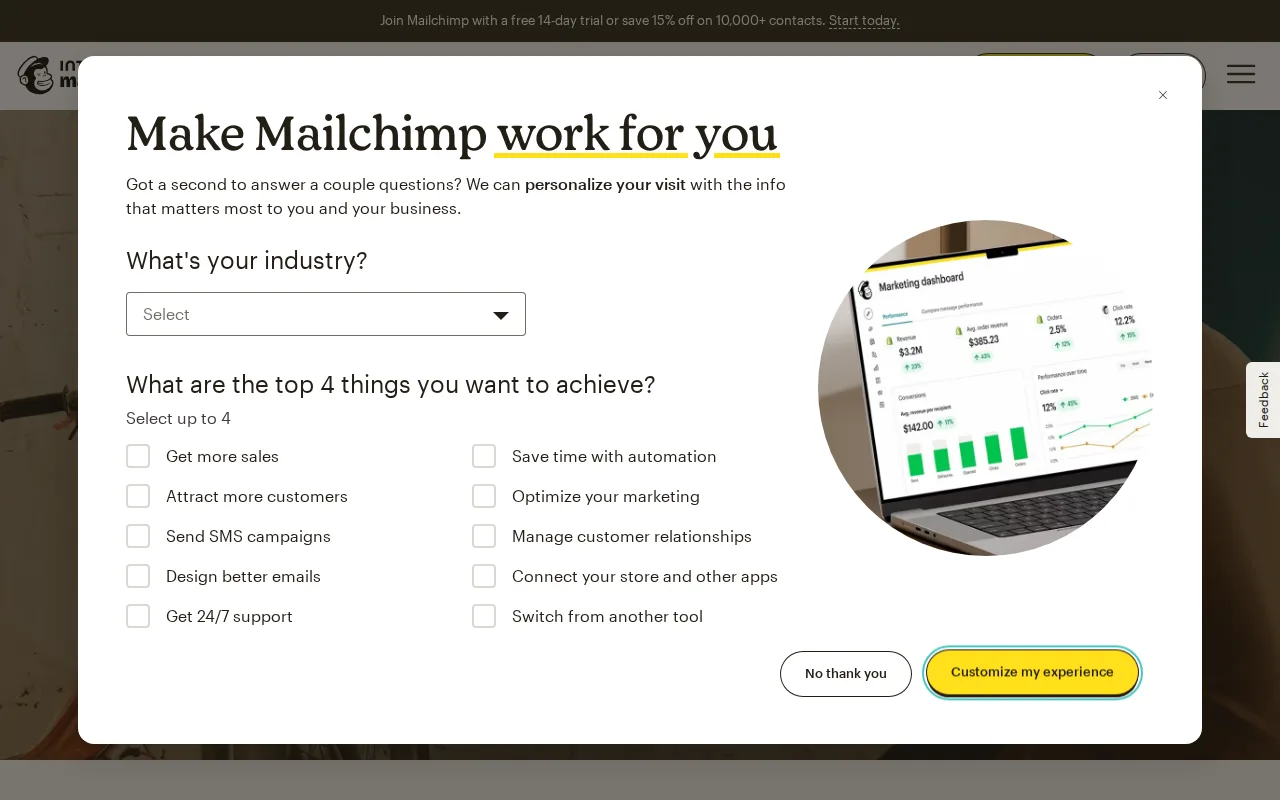
Mailchimp is the best Kit alternative for creators and small sellers who want e-commerce-grade automation and AI content tools beyond newsletter writing. Mailchimp holds a 4.5/5 rating from 17,674 Capterra reviews, while Kit carries no external rating in our listing data, and Mailchimp's Free plan covers up to 250 contacts and 500 sends a month with no credit card required. Where Kit's Creator plan starts at $25/month and scales with subscriber count, Mailchimp's Essentials tier starts lower at $13/month, though Mailchimp's own pricing then climbs steeply to $20/month Standard and $350/month Premium as automation and AI tools require higher tiers. Mailchimp's 300+ third-party integrations and e-commerce automation triggers, like abandoned-cart emails, go well beyond Kit's creator-focused feature set. Kit remains the better choice for anyone specifically monetizing a newsletter or digital products: Kit supports selling paid newsletter subscriptions and digital products natively as a core feature, while Mailchimp is built around general email and SMS campaigns rather than creator monetization, and Kit's free plan includes unlimited landing pages, forms, and broadcast emails with no send cap, unlike Mailchimp's free tier, which caps sends at 500 per month.
Compared to Kit: far larger review base (17,674 Capterra reviews vs none recorded for Kit), cheaper entry paid tier ($13/month Essentials vs Kit's $25/month Creator), 300+ third-party integrations including Shopify and WooCommerce for e-commerce automation
Wins:4.5/5 rating from 17,674 Capterra reviews, while Kit carries no external rating in our listing data · Essentials tier starts at $13/month, cheaper than Kit's $25/month starting price for Creator · 300+ third-party integrations, including deep Shopify and WooCommerce automation triggers for abandoned-cart emails
Loses:No native support for selling paid newsletter subscriptions or digital products, a core feature of Kit's Creator plans · Free plan caps sends at 500/month and 250 contacts, more restrictive than Kit's free tier, which allows unlimited landing pages, forms, and broadcast emails up to its subscriber cap · Pricing climbs steeply past the entry tier, reaching $350/month at Premium for advanced segmentation and phone support
Pros
- Free tier is genuinely usable for small lists up to 250 contacts.
- Drag-and-drop builder and template library make campaign creation fast for beginners.
- Deep e-commerce integrations (Shopify, WooCommerce) enable automated triggers like abandoned-cart emails.
- AI content and automation tools are included starting at the Standard tier.
Cons
- Pricing climbs steeply as contact count grows, with users calling the cost disproportionate at scale.
- Advanced automation flows and predictive segmentation are gated behind Standard and Premium tiers.
- Free plan email support ends after the first 30 days.
- Premium tier jumps to $350/month, a large gap from Standard's $20/month.
Pricing: Free tier · paid from $13/mo — $13/month Essentials vs Kit's $25/month starting price for Creator (verified undefined NaN, NaN)
2.beehiiv — best Kit alternative for independent newsletter writers and small publishers who want built-in monetization (ad network, digital products) alongside a free tier up to 2,500 subscribers
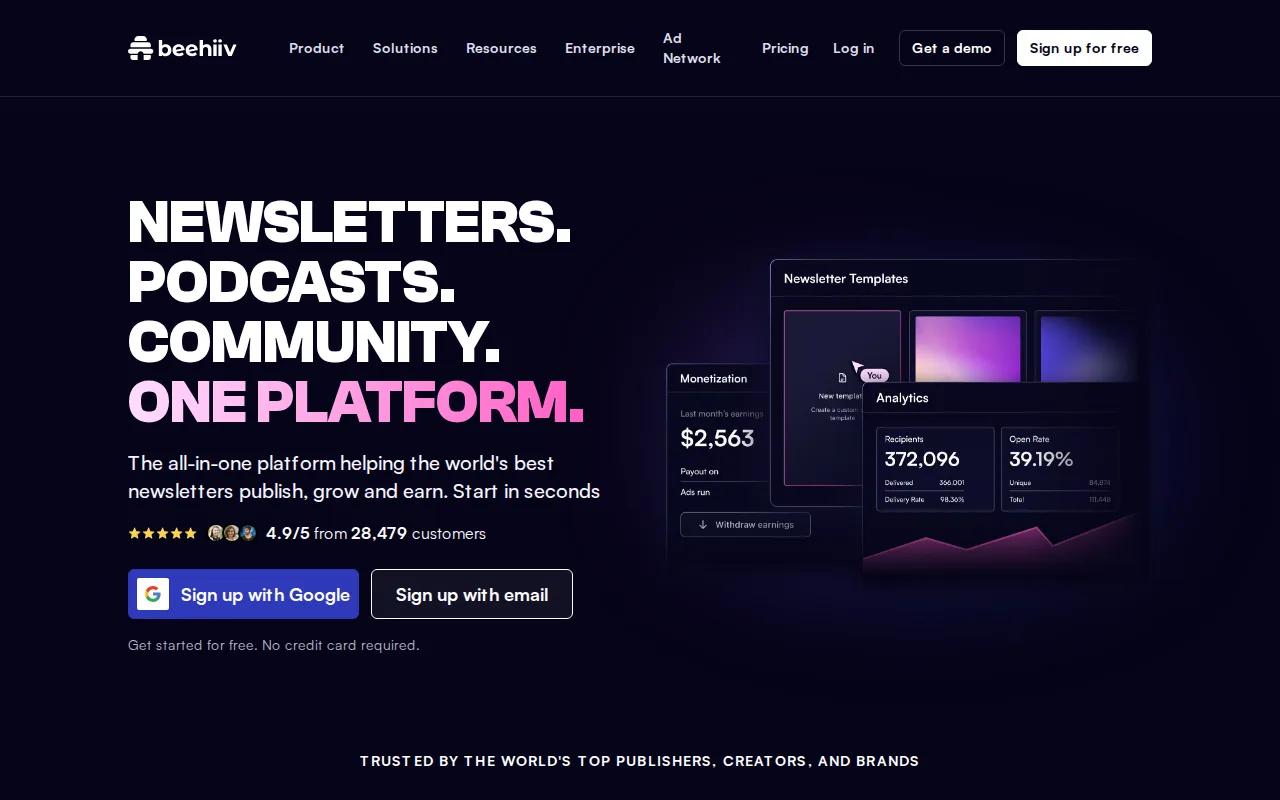
beehiiv is the best Kit alternative for independent newsletter writers who want a free tier that already includes monetization tools rather than paying from the first dollar. beehiiv's Launch plan is free for up to 2,500 subscribers with unlimited sends, a website, and podcast hosting, a larger free-tier ceiling than Kit's capped free list, and its built-in Ad Network connects publishers directly with sponsors inside the platform, a monetization path Kit doesn't offer natively. beehiiv's Scale plan then starts at $43/month for up to 100,000 subscribers, adding digital-product sales and email automations, while beehiiv holds a 4.4/5 rating from 16 Capterra reviews, a small review base worth weighing cautiously against Kit's own unrated profile in our listing data. Kit remains the better choice for creators specifically selling paid newsletter subscriptions, since beehiiv's monetization model centers on advertiser sponsorships rather than reader-paid subscriptions, and beehiiv keeps its own branding on outgoing emails until the pricier $96/month Max tier, something Kit's paid tiers don't impose.
Compared to Kit: free tier covers up to 2,500 subscribers with unlimited sends, a website, and podcast hosting, built-in Ad Network connects publishers directly with sponsors inside the platform, combines newsletter, website, podcast hosting, and digital-product sales in one tool
Wins:Free Launch plan covers up to 2,500 subscribers with unlimited sends, a website, and podcast hosting, a larger free ceiling than Kit's capped free list · Built-in Ad Network connects publishers directly with sponsors inside the platform, a monetization path Kit doesn't offer natively · Combines newsletter, website builder, podcast hosting, and digital-product sales in one tool rather than requiring separate platforms
Loses:Monetization centers on advertiser sponsorships and digital products rather than Kit's native reader-paid subscription support · Own branding stays on outgoing emails until the $96/month Max tier · Only 16 Capterra reviews at 4.4/5, a small review base to judge broad user sentiment by
Pros
- Free Launch plan supports up to 2,500 subscribers with unlimited sends and a full website, not just a stripped-down trial.
- Built-in Ad Network lets publishers monetize through sponsorships without a separate platform.
- Combines newsletter, website, podcast hosting, and digital product sales in one tool instead of several.
- Recommendation network helps new publications gain subscribers by cross-promoting with other beehiiv newsletters.
Cons
- Ad Network, digital products, and automations require the $43/month Scale plan, not available on the free tier.
- beehiiv branding remains on emails until the $96/month Max tier.
- Subscriber cap of 100,000 on Scale and Max means fast-growing publishers eventually need a custom Enterprise quote.
- Small third-party review base (16 Capterra reviews) makes it harder to gauge broad user sentiment compared to more established platforms.
Pricing: Free tier · paid from $43/mo — $43/month Scale (up to 100,000 subscribers) vs Kit's $25/month starting price for Creator (verified undefined NaN, NaN)
3.Substack — best Kit alternative for independent writers and journalists who want to monetize a newsletter with paid subscriptions without paying a monthly platform fee, in exchange for giving up 10% of revenue
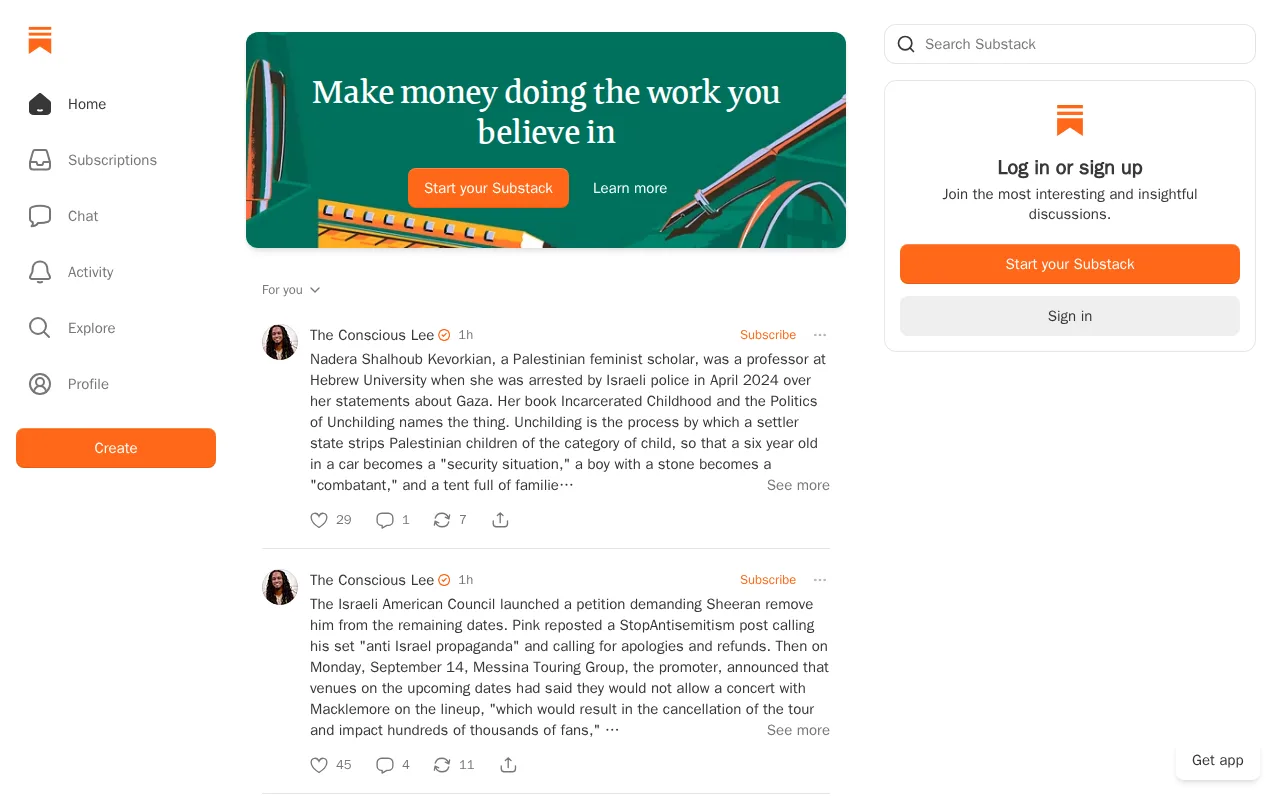
Substack is the best Kit alternative for independent writers who want to monetize a newsletter with paid subscriptions without paying any monthly platform fee. Publishing is free on Substack, and Substack only makes money by taking 10% of gross paid-subscription revenue plus Stripe's standard processing fee (about 2.9% + $0.30 per transaction), so a writer with zero paying subscribers pays nothing at all, unlike Kit's $25/month Creator plan, which is required to unlock deeper automation regardless of subscription revenue. Writers keep full ownership of their subscriber list and can export and migrate off Substack at any time. Substack's discovery layer, the Notes short-form feed and cross-publication recommendations, helps new writers find their first paying subscribers without an existing email list. Kit remains the better choice for writers running a larger list who don't want a percentage cut of every dollar earned: Substack's 10% revenue share, on top of Stripe fees, gets more expensive at scale than Kit's flat subscriber-based pricing, and Substack's post editor offers less HTML and layout control than Kit's tools, with Substack rating only 3.8/5 from 13 Product Hunt reviews, a small and lower-scoring sample than most other tools in this comparison.
Compared to Kit: no monthly platform fee — free until a writer turns on paid subscriptions, writers keep full ownership of their subscriber list and can export it anytime, built-in discovery network (Notes and cross-publication recommendations) helps new writers find first subscribers
Wins:No monthly platform fee at all; Substack only charges 10% of paid-subscription revenue once a writer earns any, unlike Kit's flat $25/month Creator plan · Writers keep full ownership of their subscriber list and can export and migrate off the platform at any time · Built-in discovery network (Notes and cross-publication recommendations) helps new writers find their first paying subscribers without an existing list
Loses:10% revenue cut plus Stripe processing fees get more expensive at scale than Kit's flat subscriber-based pricing for a writer with substantial paid revenue · Post editor has limited HTML and layout control compared to Kit's tools · 3.8/5 rating from just 13 Product Hunt reviews, a smaller and lower-scoring sample than most other tools in this comparison
Pros
- No monthly fee; Substack only makes money when a writer earns paid-subscription revenue.
- Writers keep full ownership of their subscriber list and can export it to another platform at any time.
- Built-in discovery through Notes and cross-publication recommendations helps new writers find readers.
- Free and paid tiers, live chat, and podcast hosting are included on every publication with no add-on fees.
Cons
- 10% platform fee plus Stripe processing costs eat into revenue at every price point, more expensive at scale than flat-fee platforms like Ghost.
- Payment processing is Stripe-only, excluding writers in countries where Stripe doesn't operate.
- The post editor is basic: limited layout control, no custom HTML, fewer formatting options than WordPress or Ghost.
- Established writers with large paid lists often migrate to flat-fee platforms once the percentage cut exceeds a fixed subscription cost.
Pricing: Free — Free publishing plus a 10% revenue cut on paid subscriptions vs Kit's $25/month starting price for Creator (verified undefined NaN, NaN)
4.MailerLite — best Kit alternative for creators and small businesses that want an easy-to-use email marketing platform with a genuinely usable free tier before paying for more subscribers or automations
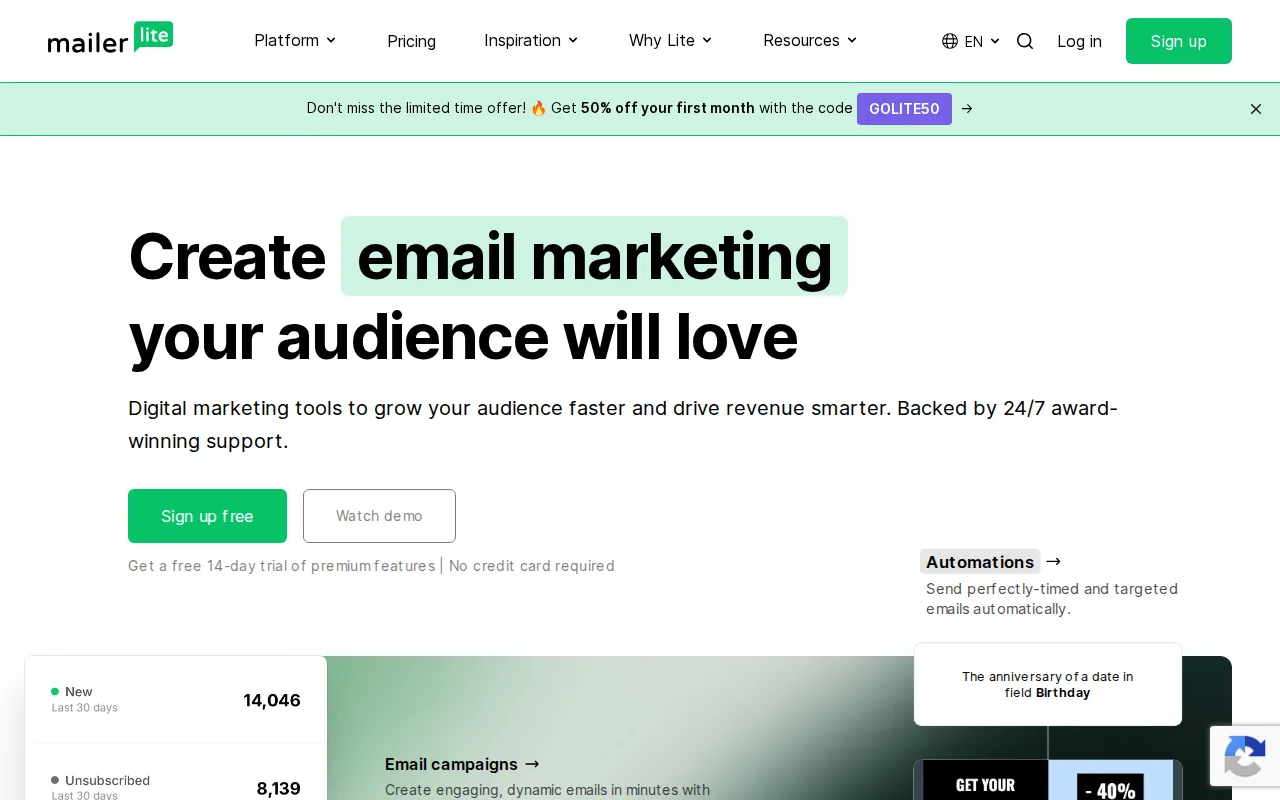
MailerLite is the best Kit alternative for creators and small businesses that want a permanently free plan bundling a website builder and digital-product sales alongside email. MailerLite's Free plan covers up to 250 subscribers and 2,500 monthly emails with 3 automations, and MailerLite holds a 4.7/5 rating from 2,322 Capterra reviews, the highest score among Kit's tracked alternatives, while Kit itself carries no external rating in our listing data. Paid tiers start at $12/month (Comfort), cheaper than Kit's $25/month starting price for Creator, and MailerLite bundles a website builder and digital-product sales directly into its plans. MailerLite is used by over 1 million businesses and creators, a scale signal not available for Kit in our listing data. Kit remains the better choice for creators specifically selling paid newsletter subscriptions: Kit supports subscription-based monetization as a core feature, while MailerLite's digital-product sales are structured around one-time purchases like ebooks rather than recurring paid-newsletter access, and MailerLite's automation and segmentation are described as less advanced than dedicated marketing-automation platforms.
Compared to Kit: highest Capterra rating among Kit's tracked alternatives (4.7/5 from 2,322 reviews), cheaper paid entry tier ($12/month Comfort vs Kit's $25/month Creator), used by over 1 million businesses and creators
Wins:4.7/5 rating from 2,322 Capterra reviews, the highest among Kit's tracked alternatives, while Kit carries no external rating in our listing data · Paid tiers start at $12/month, cheaper than Kit's $25/month starting price for Creator · Used by over 1 million businesses and creators, and bundles a website builder directly into its plans
Loses:Digital-product sales are structured around one-time purchases like ebooks rather than Kit's native recurring paid-newsletter subscriptions · Automation and segmentation are described as less advanced than dedicated marketing-automation platforms · Pricing scales with subscriber count, so costs rise as a list grows even without needing more advanced features
Pros
- Free plan supports up to 250 subscribers with real automation and landing-page features, not just a trial.
- Paid tiers start at $12/month, generally undercutting larger platforms like HubSpot or ActiveCampaign at comparable subscriber counts.
- Bundles email, landing pages, website building, and digital-product sales in one product rather than requiring separate tools.
- 100+ integrations including WordPress, Shopify, and Zapier.
Cons
- Pricing scales with subscriber count, so costs rise as a list grows even without needing more advanced features.
- Deliverability tooling like dedicated IPs and account audits is limited to the custom-quoted Enterprise tier.
- Automation and segmentation capabilities are less advanced than dedicated marketing-automation platforms like ActiveCampaign.
- 24/7 live chat support is reserved for the Power plan; lower tiers have more limited support access.
Pricing: Free tier · paid from $12/mo — $12/month Comfort vs Kit's $25/month starting price for Creator (verified undefined NaN, NaN)