Kdenlive — A free, open-source non-linear video editor from the KDE community, built on the MLT framework for Linux, Windows, and macOS.

By Noahlast updated pricing verified
Kdenlive screenshots & video
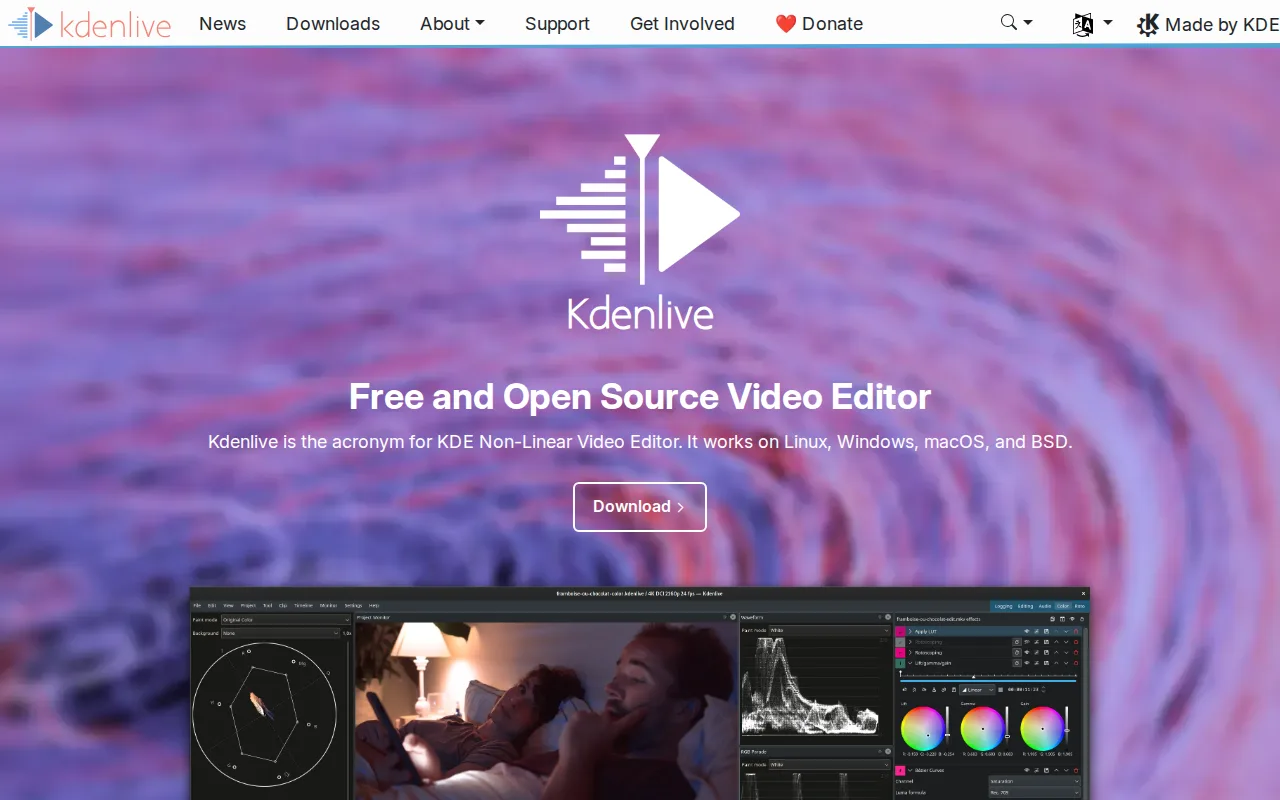
Kdenlive in 20 seconds
Best for: independent video creators who want a full-featured, free NLE without a subscription
Pricing: Completely free with no paid tier; development is funded by community donations.
- Kdenlive is free and open source under the GPL-3.0 license.
- It is maintained by the KDE community and built on the MLT Framework and KDE Frameworks 6.
- It runs on Linux, Windows, macOS, and BSD.
- The GitHub repository has roughly 5,500 stars.
Limitations: Less polished and occasionally less stable than paid NLEs on large projects.; No paid support option.; Fewer built-in stock assets and AI tools than commercial competitors.
Top alternatives: DaVinci Resolve, Shotcut, OpenShot, Adobe Premiere Pro — full list
What is Kdenlive?
Kdenlive — short for KDE Non-Linear Video Editor — is a free, open-source video editing application built by the KDE community. It provides a full non-linear editing timeline with multi-track video and audio, keyframeable effects, color correction and grading, title and text generation, proxy editing for large 4K+ footage, and audio-video sync tools, running on top of the MLT Framework for playback and rendering and KDE Frameworks 6 for its interface. Kdenlive is written primarily in C++, licensed under GPL-3.0, and hosted on GitHub as part of the wider KDE project, with roughly 5,500 GitHub stars. Because it has no commercial tier, Kdenlive's entire feature set — including things gated behind paid plans in Adobe Premiere Pro or CapCut Pro, like unlimited export resolution and no watermarks — is free from the first install. Development is community-funded through donations, and support runs through documentation, forums, and a Matrix chat rather than a paid support contract.
Kdenlive (KDE Non-Linear Video Editor) is a free, open-source video editing application maintained by the KDE community, aimed at hobbyist and independent video creators who want a full-featured NLE without a subscription. It runs on Linux, Windows, macOS, and BSD, is built in C++ on the MLT multimedia framework and KDE Frameworks 6, and is licensed under GPL-3.0 with source available on GitHub. Kdenlive has no pricing tiers, no account requirement, and no feature gating — every capability is available to every user for free, funded through community donations rather than sales. It competes with paid NLEs like Adobe Premiere Pro and free alternatives like DaVinci Resolve and Shotcut.
Standout feature: Every editing feature — multi-track timeline, keyframeable effects, color grading, proxy editing — is free and unlocked from install, with no watermarks, export limits, or paid tiers.
Biggest weakness: Interface and workflow are less polished than Adobe Premiere Pro or DaVinci Resolve, occasional stability issues with very large or complex projects are a recurring community complaint, and support runs through community forums and chat rather than paid, guaranteed-response support.
Pros
- Completely free and open source with no paid tier, watermark, or export limit.
- Cross-platform on Linux, Windows, and macOS with active KDE community development.
- Full non-linear editing feature set: multi-track timeline, keyframeable effects, color grading, proxy editing for 4K+ footage.
- Source code is public on GitHub under GPL-3.0, so the project can't disappear behind a licensing change.
Cons
- Interface and stability lag behind paid NLEs like Adobe Premiere Pro and DaVinci Resolve, especially on large or complex projects.
- No official paid support; help comes from documentation, community forums, and Matrix chat.
- Fewer built-in stock media, motion graphics templates, and AI tools than commercial competitors.
- Steeper learning curve for users coming from simplified consumer editors like CapCut.
Kdenlive pricing
Free · verified from the vendor's pricing page
| Plan | Price | Notes |
|---|---|---|
| Kdenlive | Free | Fully free and open source; no paid tier, account, or feature gating. Development is funded by donations. |
What reviewers say
No third-party review scores on file yet.