Grist — An open source spreadsheet-database hybrid with row-level access rules, Python formulas, and a free self-hosted community edition.

By Noahlast updated pricing verified
Grist screenshots & video
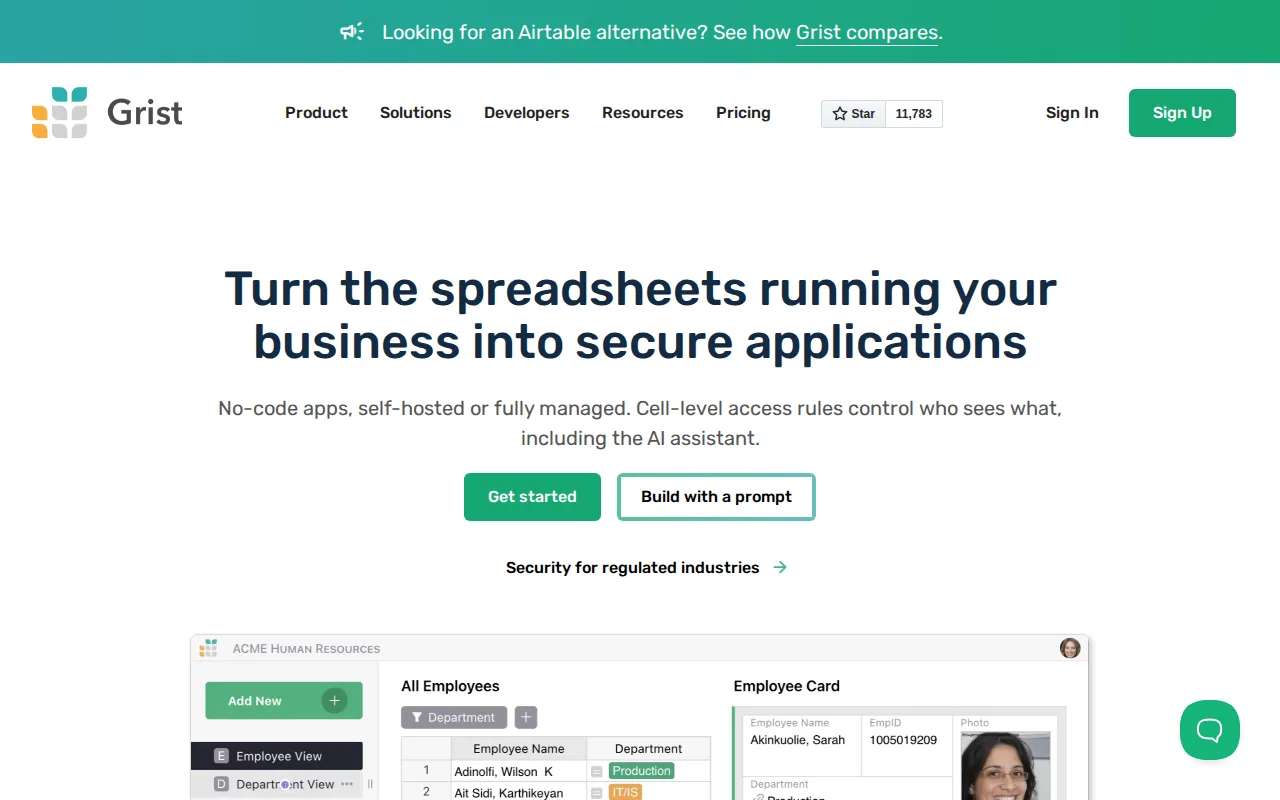
Grist in 20 seconds
Best for: teams needing spreadsheet-style data entry with database structure and granular row/column-level access control, especially security-conscious or regulated industries
Pricing: Free up to 5,000 records/document; Pro from $8/user/month (100,000 records); Business from $24/user/month (150,000 records, 5-user minimum); free unlimited if self-hosted.
- Grist's Free plan supports up to 5,000 records per document and 10 team members.
- Grist Pro costs $8/user/month billed annually ($10/month billed monthly) for up to 100,000 records per document.
- Grist Business costs $24/user/month billed annually, 5-user minimum, for up to 150,000 records per document.
- Grist is open source (github.com/gristlabs/grist-core) with a free, self-hostable Community Edition.
- Grist holds a 4.9/5 rating from 8 reviews on Capterra and 5.0/5 from 3 reviews on Product Hunt.
Limitations: Free tier's 5,000-record cap is restrictive for larger datasets.; Business and Enterprise tiers require 5- and 50-user minimums respectively.; Smaller integration ecosystem than Airtable.
Top alternatives: Airtable, Google Sheets, Microsoft Access, NocoDB, Baserow — full list
What is Grist?
Grist is a relational spreadsheet: it looks and edits like a spreadsheet but stores data with database-style structure underneath, linked records across tables, defined column types, and a Python-powered formula engine that also supports familiar Excel functions. This lets teams model relational data (projects linked to tasks linked to people) without leaving a spreadsheet-like interface. Grist's core differentiator is granular access control: row- and column-level access rules let an admin expose only certain records or fields to certain users, a level of permission control that Excel, Google Sheets, and even Airtable don't offer natively. It also ships an AI assistant for chat-based data analysis and formula generation, built-in forms for data collection, and customizable dashboards with charts and pivot tables. Grist is open source (github.com/gristlabs/grist-core) and can be self-hosted for free as the Community Edition, or run as a managed cloud service with tiered plans for larger record limits, longer snapshot history, and priority support.
Grist is a no-code spreadsheet-database hybrid built for teams in security-conscious industries (IT, manufacturing, construction), research labs, nonprofits, legal, and finance who need Excel-style flexibility with database-grade structure and access control. Cloud plans run free for up to 5,000 records per document and 10 team members, Pro at $8/user/month billed annually ($10 monthly) for up to 100,000 records, and Business at $24/user/month billed annually ($30 monthly, 5-user minimum) with automations and priority support; a fully free, open source self-hosted Community Edition is also available on GitHub (gristlabs/grist-core). Grist's standout feature is row- and column-level access rules for granular data permissions, and it holds a 4.9/5 rating from 8 reviews on Capterra.
Standout feature: Row- and column-level access rules let admins expose only specific records or fields to specific users, a permission model far more granular than Excel, Google Sheets, or Airtable offer natively.
Biggest weakness: The free tier's 5,000-record-per-document limit is restrictive for growing datasets, and moving past it means either self-hosting the open source Community Edition yourself or paying per-user for Pro, there's no mid-cost step between free and $8/user/month.
Pros
- Row- and column-level access rules give fine-grained data permissions rarely found in spreadsheet tools.
- Open source with a genuinely free, unlimited self-hosted Community Edition on GitHub.
- Python-powered formulas alongside familiar Excel functions, more powerful than Google Sheets' formula language.
- 50% nonprofit discount on the Pro plan for organizations with a Letter of Determination.
Cons
- Free tier caps at 5,000 records per document, restrictive for larger datasets without upgrading or self-hosting.
- Business tier requires a 5-user minimum, and Enterprise requires 50, pricing that penalizes small teams needing advanced features.
- Smaller third-party integration ecosystem than Airtable or Google Sheets.
- AI Assistant credits are capped and consumed even on paid tiers (100+/month on Pro), unlike unlimited AI features in some competitors.
Grist pricing
Free tier · paid from $8/mo · verified from the vendor's pricing page
| Plan | Price | Notes |
|---|---|---|
| Free | Free | Up to 5,000 records per document, 10 team members, 2 guests per document, 100 lifetime AI Assistant credits, community support. |
| Pro | $8/mo | Billed annually ($10/user/month if billed monthly). Up to 100,000 records per document, 3-year snapshot history, 100+ AI Assistant credits/month, unlimited documents and team members. |
| Business | $24/mo | Billed annually ($30/user/month if billed monthly), 5-user minimum. Up to 150,000 records per document, 5-year snapshot history, 2,000 AI Assistant credits/month, automations, priority email support. |
| Enterprise | Custom | Custom pricing, 50-user minimum. Custom record limits, dedicated server options, custom SSO/branding/domain, advanced admin controls and audit logging. |
What reviewers say
Scores belong to their platforms; we display them with attribution and never fold them into our own ratings.