4 Best Free Alternatives to Google Analytics in 2026
By Noahlast updated pricing verified
All 6 Google Analytics alternatives
Compared: free alternatives to Google Analytics
| Alternative | Best for | Standout | Biggest weakness | Learning curve | Price |
|---|---|---|---|---|---|
| Google Analyticsreference | businesses that want free, event-based web and app analytics tightly integrated with Google Ads for campaign measurement | Free, unlimited-scale analytics for most businesses, with machine-learning-driven insights and direct integration into Google Ads for measuring campaign ROI without a separate tool. | The GA4 event-based data model and reorganized interface represented a steep relearning curve for teams used to the older Universal Analytics, and standard GA4 properties still apply data sampling and shorter retention windows that only Google Analytics 360's custom, undisclosed pricing removes. | Moderate | Free |
| Mixpanel | product teams tracking funnels, retention, and feature adoption across web and mobile without writing SQL | Behavioral cohorts and multi-touch attribution built on Mixpanel's proprietary Arb query engine, fast enough for ad hoc exploration across tens of millions of monthly events. | Growth-plan pricing is not published as a flat number; it scales with event volume through a calculator, which makes budgeting harder to predict than a fixed per-seat price, and event-based pricing can get expensive fast for high-traffic products compared to flat-rate competitors. | Moderate | Free |
| PostHog | product and engineering teams who want analytics, session replay, feature flags, and error tracking in one platform instead of stitching together separate tools | One platform combining product analytics, session replay, feature flags/A-B testing, error tracking, and a data warehouse, each billed on its own usage-based rate that drops at higher volume. | Usage-based pricing across many separate products (events, replays, flags, surveys, data warehouse rows) makes total monthly cost harder to predict than a single flat per-seat price, and some enterprise features live in a separate proprietary ('ee') license rather than the fully open-source core. | Moderate | Free |
| Matomo | organizations that need GDPR-compliant web analytics with full ownership of raw visitor data, either self-hosted for free or on a paid Cloud/On-Premise support plan | A choice between a genuinely free, unlimited self-hosted Community edition and paid Cloud/On-Premise tiers that include all features (heatmaps, session recording, A/B testing) rather than gating them behind higher-priced plans. | Cloud and On-Premise pricing is published only in EUR, not USD, which complicates budgeting for US-based buyers, and self-hosting the free Community edition requires ongoing server maintenance and updates that a hosted tool like Google Analytics doesn't require. | Moderate | Free |
| Amplitude | product teams that need behavioral analytics, session replay, and lightweight experimentation in one tool, and prefer usage-based pricing tied to event volume over per-seat licensing | Bundles product analytics, session replay, and feature experimentation under one usage-based pricing model, plus native MCP connectivity so AI coding tools like Claude and Cursor can query product data directly. | Pricing above the free 2-million-event tier is usage-based and largely hidden behind "contact sales" for Growth and Enterprise, making it hard to budget for a scaling product without a sales conversation; heavy instrumentation can also drive event volume, and cost, up faster than teams expect. | Moderate | Free |
 Google Analytics
 Mixpanel
 PostHog
 Matomo
 Amplitude
1.Mixpanel — best Google Analytics alternative for product teams tracking funnels, retention, and feature adoption across web and mobile without writing SQL
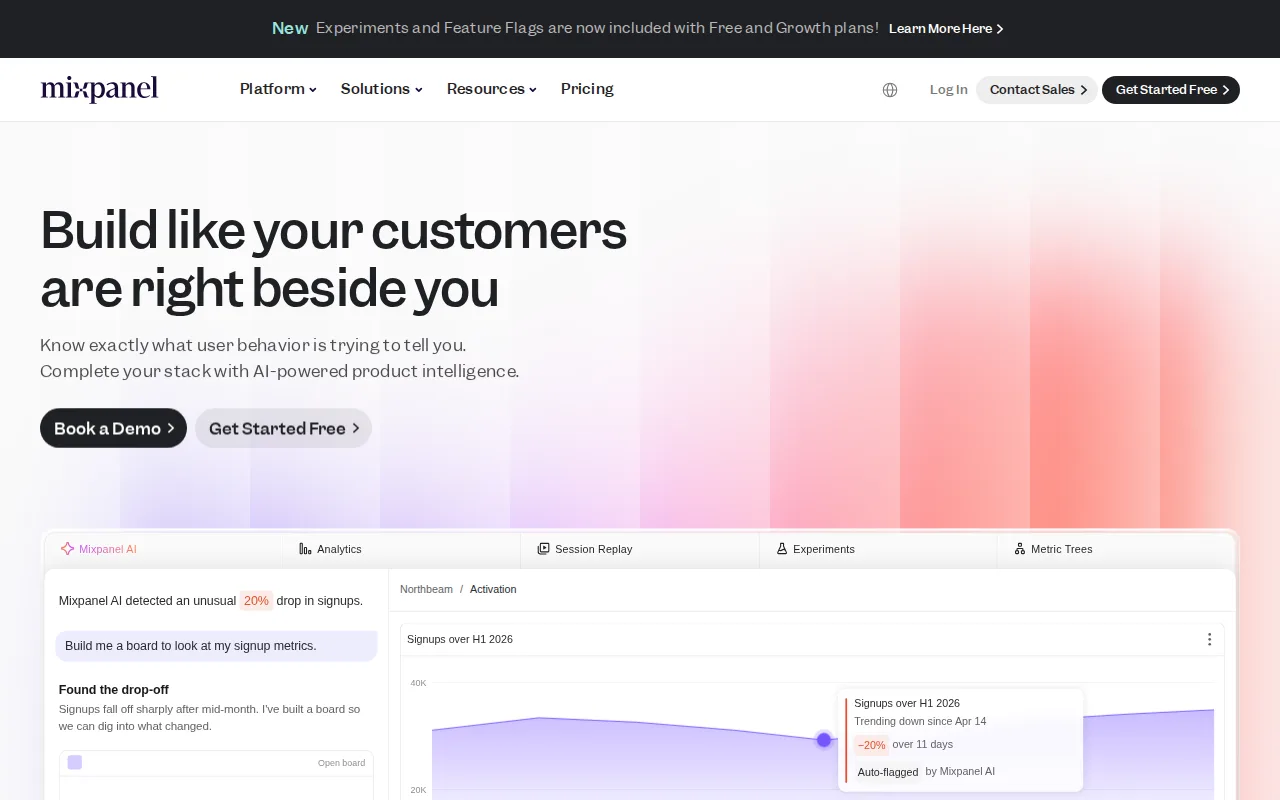
Mixpanel and Google Analytics both track user behavior, but Mixpanel is built around discrete user events (button clicks, feature usage, purchases) for product teams optimizing conversion and engagement, rather than Google Analytics' broader event-based GA4 model aimed at marketing and traffic measurement tied to Google Ads. Mixpanel's free tier covers up to 1 million events a month with 10,000 session replays at no cost, and Mixpanel holds a 4.5/5 rating from 146 Capterra reviews plus a 4.9/5 from 90 Product Hunt reviews, a smaller combined sample than Google Analytics' 8,101 Capterra reviews but a comparably strong or higher score. Mixpanel's proprietary Arb query engine supports fast ad hoc queries across large event volumes, and session replay and A/B testing are built into the same product. Where Google Analytics still wins: it's completely free for businesses of any size with no meaningful traffic cap, while Mixpanel's Growth plan pricing beyond the first 1M free events is usage-based and not shown as a flat number, making budgeting harder to forecast, and Google Analytics' native integration with Google Ads for campaign ROI measurement has no direct equivalent in Mixpanel's product-analytics focus.
Compared to Google Analytics: built around discrete user events for product teams rather than GA4's marketing-and-traffic model, session replay and A/B testing built into the same product, and Growth-plan pricing beyond 1M free events is usage-based and not shown as a flat number.
Wins:Fast ad hoc queries across large event volumes via the proprietary Arb engine, purpose-built for product analytics · Session replay and A/B testing built into the same product as the analytics · MCP integrations connect Mixpanel data directly into Slack, Claude, ChatGPT, and Cursor
Loses:Not free at scale — Growth plan pricing beyond 1M free events/month is usage-based, unlike Google Analytics' free-for-any-size model · No native integration with Google Ads for campaign ROI measurement · Requires disciplined event-tracking taxonomy up front; poorly named events make later analysis messy
Pros
- Free tier genuinely usable up to 1M events/month with core funnel and retention analysis included.
- Fast ad hoc queries across large event volumes via the proprietary Arb engine.
- Session replay and A/B testing built into the same product as the analytics.
- MCP integrations connect Mixpanel data directly into Slack, Claude, ChatGPT, and Cursor.
Cons
- Growth plan pricing is usage-based and not shown as a flat number on the pricing page, making costs harder to forecast.
- Event-based pricing can climb quickly for high-traffic consumer apps compared to flat-rate tools.
- No SQL access on lower tiers limits users who want to run custom warehouse-style queries directly.
- Requires disciplined event-tracking taxonomy up front; poorly named events make later analysis messy.
Pricing: Free — Mixpanel is free up to 1M events/month, then usage-based, vs Google Analytics' fully free GA4 tier (verified undefined NaN, NaN)
2.PostHog — best Google Analytics alternative for product and engineering teams who want analytics, session replay, feature flags, and error tracking in one platform instead of stitching together separate tools
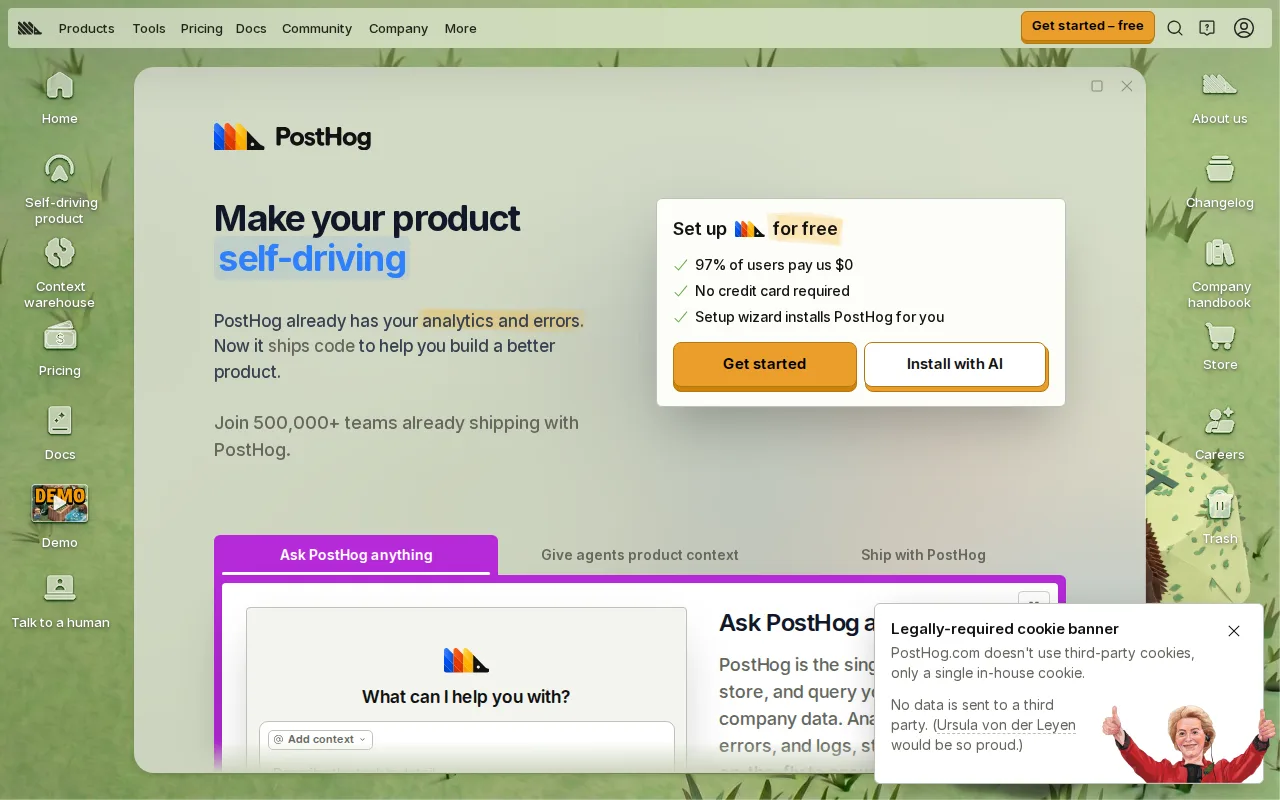
PostHog and Google Analytics both track user behavior, but PostHog bundles analytics, session replay, feature flags/A-B testing, error tracking, surveys, and a data warehouse into one product, an all-in-one scope Google Analytics' traffic-focused GA4 platform doesn't attempt to match. PostHog's core is MIT-licensed with source on GitHub, and a dedicated posthog-foss repository exists for teams wanting strictly open-source code, an option that has no counterpart in Google Analytics' fully closed platform. PostHog's free tier requires no credit card and includes 1M analytics events, 5,000 session replays, and 1M feature flag requests a month, genuinely usable for early-stage products. PostHog holds a 5.0/5 rating from 253 Product Hunt reviews, a smaller sample than Google Analytics' 8,101 Capterra reviews but a strong score in its own right. Where Google Analytics still wins: it remains completely free at any traffic volume, while PostHog's usage-based pricing spans multiple separately metered products (events, replays, flags, surveys, data warehouse rows), making total monthly cost harder to forecast than Google Analytics' zero-cost model, and some PostHog enterprise features live behind a separate proprietary ('ee') license rather than the fully open-source core.
Compared to Google Analytics: bundles analytics, session replay, feature flags, error tracking, and a data warehouse in one MIT-licensed open-source product, a generous no-credit-card-required free tier, and usage-based pricing across multiple metered products once free limits are exceeded.
Wins:Combines analytics, session replay, feature flags, error tracking, and surveys in one platform, unlike GA4's traffic-only focus · MIT-licensed core with source available on GitHub, plus a dedicated posthog-foss repository for open-source-only use · Choice of US or EU cloud region, or self-hosting entirely
Loses:Not free at scale — usage-based pricing spans multiple separately metered products, unlike Google Analytics' free-for-any-size model · Some enterprise features are gated behind a separate proprietary ('ee') license, not the fully open-source core · Wider surface area (analytics, replay, flags, surveys, warehouse) means more to learn than a single-purpose tool
Pros
- Combines analytics, session replay, feature flags, error tracking, and surveys in one platform.
- Generous free tier: 1M analytics events and 5,000 session replays per month with no credit card required.
- MIT-licensed core with source available on GitHub, plus a dedicated posthog-foss repository for strictly open-source use.
- Choice of US or EU cloud region, or self-hosting.
Cons
- Usage-based pricing spans multiple products independently, making total monthly cost harder to forecast than flat per-seat pricing.
- Some enterprise features are gated behind a separate proprietary license (the 'ee' directory), not the fully open-source core.
- Self-hosting PostHog at scale requires more operational overhead than using the managed cloud.
- The breadth of bundled tools (analytics, replay, flags, surveys, data warehouse) means new users face a wider surface area to learn than a single-purpose analytics tool.
Pricing: Free — PostHog is free up to 1M events/month, then usage-based per product, vs Google Analytics' fully free GA4 tier (verified undefined NaN, NaN)
3.Matomo — best Google Analytics alternative for organizations that need GDPR-compliant web analytics with full ownership of raw visitor data, either self-hosted for free or on a paid Cloud/On-Premise support plan
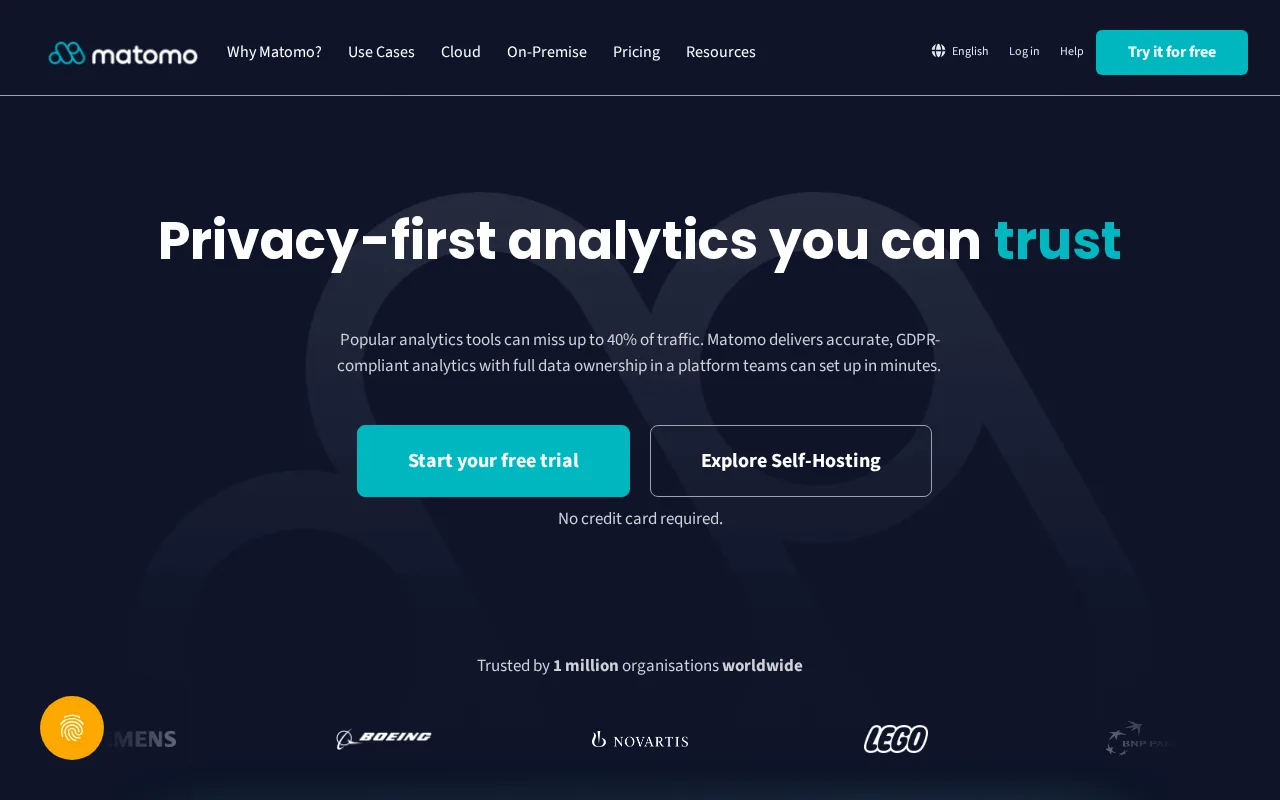
Matomo and Google Analytics both track pages, traffic sources, and conversions, but Matomo's Community edition is free forever, self-hosted, and open source under GPL-3.0-or-later with no limit on users or monthly hits, a data-ownership option Google Analytics' Google-hosted-only platform doesn't offer at all. Matomo's GitHub repository has over 21,000 stars and 31,000+ commits, and unlike some competitors, Matomo markets 'all features included' across its paid tiers — heatmaps, session recording, and A/B testing come with every Cloud or On-Premise plan rather than being gated to a higher tier. Matomo supports first-party, cookieless tracking modes for GDPR compliance, a stronger default privacy posture than Google Analytics' standard cookie-based GA4 tracking. Where Google Analytics still wins: it's completely free for businesses of any size with no self-hosting burden, while Matomo's Cloud and On-Premise pricing is published only in EUR, not USD, complicating budgeting for US buyers, and self-hosting the free Community edition requires ongoing server maintenance and updates that a fully hosted tool like Google Analytics doesn't require.
Compared to Google Analytics: Community edition is free forever, self-hosted, and open source (GPL-3.0) with no limit on users or hits, all paid tiers include heatmaps, session recording, and A/B testing rather than gating them, and self-hosting requires ongoing server maintenance Google Analytics doesn't require.
Wins:Free, self-hosted Community edition has no traffic or user caps and is open source under GPL-3.0 · All plans include the same core feature set (heatmaps, session recording, A/B testing) rather than gating advanced features · GDPR-friendly first-party and cookieless tracking modes without a separate compliance add-on
Loses:Cloud and On-Premise pricing is listed in EUR only, adding currency-conversion friction for USD-budgeting buyers · Self-hosting the free edition requires ongoing server maintenance and updates a hosted tool avoids · Community edition support is limited to community forums, unlike Google Analytics' broader documentation and support base
Pros
- Free, self-hosted Community edition has no traffic or user caps and is open source under GPL-3.0.
- All plans include the same core feature set (heatmaps, session recording, A/B testing) rather than gating advanced features behind higher tiers.
- GDPR-friendly first-party and cookieless tracking modes without requiring a separate compliance add-on.
- Raw, unsampled data access and 100+ integrations, including BigQuery data warehouse connectors.
Cons
- Cloud and On-Premise pricing is listed in EUR only, adding currency-conversion friction for USD-budgeting buyers.
- Self-hosting the free edition requires ongoing server maintenance, updates, and scaling that a fully hosted tool avoids.
- Community edition support is limited to community forums, with paid email/priority support reserved for Cloud and On-Premise plans.
- Enterprise-scale pricing (EUR3,400/month and above) is significantly higher than pure-cloud analytics competitors at similar traffic volumes.
Pricing: Free — Matomo Community edition is free to self-host vs Google Analytics' fully free GA4 tier (verified undefined NaN, NaN)
4.Amplitude — best Google Analytics alternative for product teams that need behavioral analytics, session replay, and lightweight experimentation in one tool, and prefer usage-based pricing tied to event volume over per-seat licensing
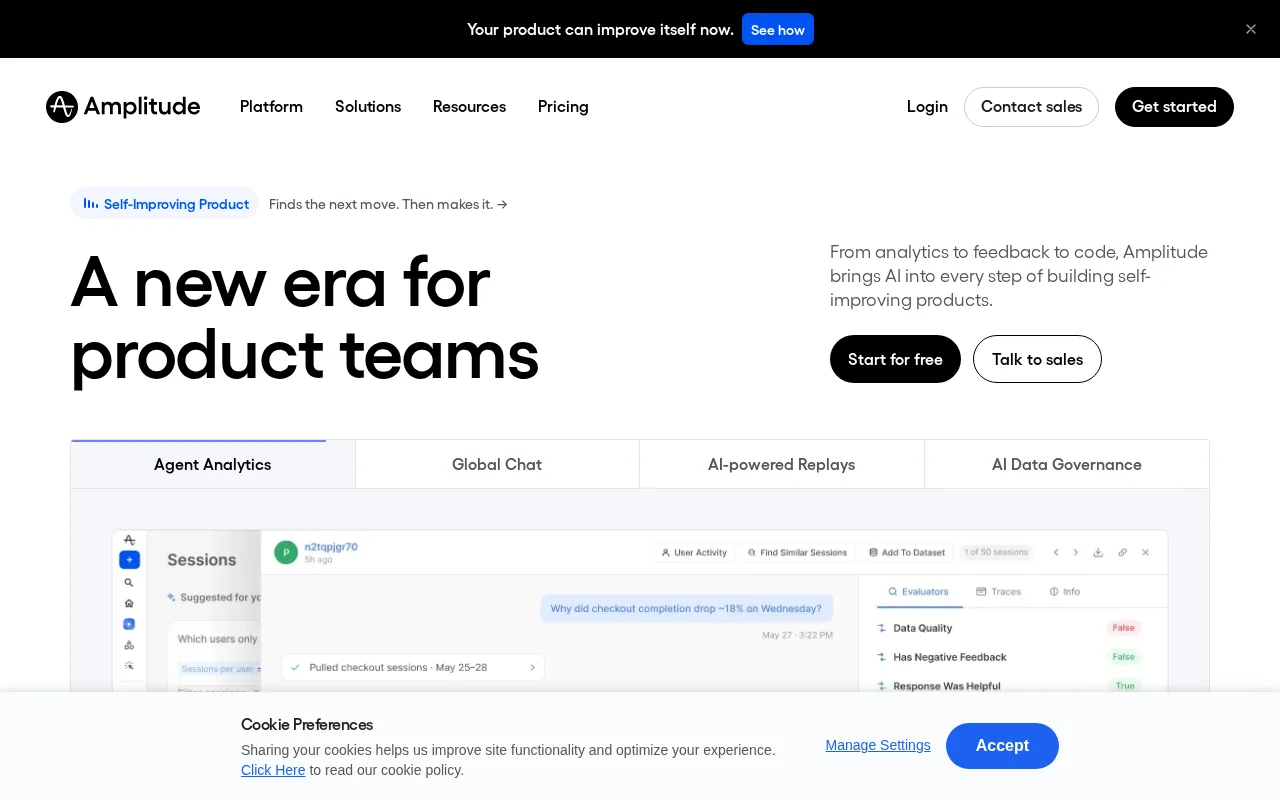
Amplitude and Google Analytics both offer machine-learning-driven insights, but Amplitude focuses specifically on product usage events (feature clicks, purchases) rather than Google Analytics' broader web/app traffic model, and it bundles session replay and feature experimentation into the same free tier. Amplitude's free plan covers up to 2 million tracked events a month with no credit card required, twice Mixpanel's comparable free allowance in this data set, and it includes native MCP connectivity so AI coding assistants like Claude and Cursor can query product data directly, a specific integration Google Analytics' data doesn't describe. Amplitude holds a 4.6/5 rating from 68 Capterra reviews, a smaller sample than Google Analytics' 8,101 but a comparable score. Where Google Analytics still wins: it's completely free at any traffic volume with no event ceiling, while Amplitude's Growth and Enterprise pricing above the free 2-million-event tier is largely hidden behind 'contact sales,' making it harder to budget for a scaling product without a sales conversation, and Google Analytics' native Google Ads integration has no equivalent in Amplitude's product-usage focus.
Compared to Google Analytics: free tier covers up to 2 million tracked events a month with session replay and experimentation included, native MCP connectivity for AI coding assistants like Claude and Cursor, and Growth/Enterprise pricing above the free tier is hidden behind contact-sales rather than published.
Wins:Free tier covers 2 million events/month with no credit card required, generous relative to comparable product-analytics tools · Session replay and feature experimentation are built in, reducing the need for separate tools · Native MCP support lets AI coding assistants query product analytics data directly
Loses:Not free at scale — Growth and Enterprise pricing is not published and requires a sales conversation, unlike Google Analytics' free-for-any-size model · No native Google Ads integration for campaign ROI, a core Google Analytics strength · Costs can rise with instrumentation depth, not just company size or seats
Pros
- Free tier covers 2 million events/month with no credit card required, generous compared to many analytics competitors.
- Session replay and feature experimentation are built in, reducing the need for separate tools.
- Native MCP support lets AI coding assistants query product analytics data directly.
- SDKs across TypeScript, Python, Go, Swift, and Kotlin cover most product stacks.
Cons
- Growth and Enterprise pricing is not published; both require a sales conversation to get a quote.
- Usage-based pricing means costs can rise with instrumentation depth, not just company size or seats.
- Advanced session replay volume (beyond the free tier's 10,000/month) requires moving to a paid plan.
- Setup and event-taxonomy design require more upfront planning than simpler analytics tools.
Pricing: Free — Amplitude is free up to 2M events/month, then contact-sales pricing, vs Google Analytics' fully free GA4 tier (verified undefined NaN, NaN)