4 Best Open-Source Alternatives to GitHub in 2026
By Noahlast updated pricing verified
Compared: open-source alternatives to GitHub
| Alternative | Best for | Standout | Biggest weakness | Learning curve | Price |
|---|---|---|---|---|---|
| GitHubreference | development teams that want Git hosting combined with integrated CI/CD, project tracking, and code review in a single platform, from individual open-source maintainers up to large enterprises requiring SSO and compliance | The largest network effect of any Git host: most open-source projects, package registries, and third-party dev tools integrate with GitHub first, making it the default home for public collaboration. | Team and Enterprise pricing shown ($4 and $21 per user/month) are promotional first-year rates, so costs increase after the first 12 months, and reviewers note that GitHub Actions configuration and navigating large repositories with many branches, workflows, and pull requests has a steeper learning curve than plain Git usage. | Moderate | Free tier · paid from $4/mo |
| GitLab | engineering teams that want source control, CI/CD, and security scanning in one application instead of assembling separate tools for each function | Security and compliance scanning (SAST, DAST, dependency and container scanning) is built into the Ultimate tier as a native part of the CI/CD pipeline, rather than a bolt-on third-party integration. | The jump from Premium to Ultimate is steep (roughly $29 to $99/user/month), pricing the deepest security features out of reach for many teams, and GitLab's dense, feature-heavy interface has a real learning curve compared to GitHub's simpler workflow. | Steep | Free tier · paid from $29/mo |
| Gitea | teams that want to self-host Git repository hosting, CI/CD, and package management with unlimited free users, upgrading to Enterprise only for SSO and compliance features | The open-source edition is genuinely free with unlimited users and repositories and no artificial seat caps, unlike many self-hosted Git platforms that gate user limits behind a paid tier. | Gitea Enterprise requires a mandatory 1-year commitment paid online rather than flexible monthly billing, and Gitea Cloud's actual subscription price is not published anywhere on the pricing page, requiring signup just to see a number. | Moderate | Free tier · paid from $9.50/mo |
| Codeberg | open-source maintainers and FOSS projects that want ad-free, non-commercial Git hosting without a corporate owner behind it | Run entirely as a non-profit association (Codeberg e.V.) rather than a company, with no ads, no third-party tracking, and terms of use that explicitly restrict LLM-generated content and cryptocurrency projects. | There is no enterprise plan, SLA, or paid support contract to buy — Codeberg runs on volunteer effort and donations, so organizations that need guaranteed uptime commitments or a support escalation path have no paid tier to purchase. | Low | Free |
| Forgejo | developers and organizations that want a GitHub-style forge on self-hosted infrastructure, governed by a community rather than a company | Runs with dramatically lower CPU and memory requirements than GitLab, making it practical to self-host on a small VPS or single-board computer while still offering pull requests, issues, and GitHub Actions-compatible CI. | Self-hosting is entirely on the user: there is no official managed cloud offering, so teams must handle their own updates, backups, and scaling, and the project deliberately has no official GitHub mirror, which can surprise developers used to finding a project's canonical repo there. | Moderate | Free |
 GitHub
 GitLab
 Gitea
Gitea Codeberg
 Forgejo
1.GitLab — best GitHub alternative for engineering teams that want source control, CI/CD, and security scanning in one application instead of assembling separate tools for each function

GitLab and GitHub both offer Git hosting, CI/CD, and code review, but GitLab bundles static and dynamic security scanning natively into its Ultimate tier's CI/CD pipeline, rather than gating Advanced Security largely behind GitHub's Enterprise pricing the way GitHub's own data describes. GitLab Community Edition is MIT-licensed and free to self-host with no user limit, an openness GitHub's fully proprietary platform doesn't offer at any tier. GitLab's Free tier costs $0/user/month on GitLab.com SaaS, and GitLab holds a 4.6/5 rating from 1,224 Capterra reviews plus a 5.0/5 from 13 Product Hunt reviews, a smaller sample than GitHub's 6,198 Capterra reviews but a comparable or higher score. Where GitHub still wins: it has the largest network effect of any Git host, meaning most open-source projects, package registries, and third-party dev tools integrate with GitHub first, and GitLab's Ultimate tier at roughly $99/user/month is a steep jump from Premium's $29/user/month, pricing the deepest security scanning out of reach for many teams that GitHub's simpler two-paid-tier structure avoids.
Compared to GitHub: Community Edition is MIT-licensed and free to self-host with no user limit, security scanning (SAST, DAST) is native to the CI/CD pipeline rather than gated behind Enterprise pricing, and the Ultimate tier's roughly $99/user/month is a steep jump from Premium's $29.
Wins:Community Edition is genuinely open source (MIT) and free to self-host with no artificial user cap · CI/CD, issue tracking, and code review are native to the platform rather than third-party add-ons · Security scanning (SAST, DAST, dependency scanning) is a native part of the Ultimate-tier pipeline
Loses:Smaller ecosystem network effect than GitHub — fewer open-source projects and third-party tools default to GitLab first · Ultimate tier costs roughly $99/user/month, a steep jump from Premium's $29/user/month · Denser, feature-heavy interface creates a steeper learning curve than GitHub for new users
Pros
- CI/CD, issue tracking, and code review are native to the platform rather than third-party add-ons.
- Community Edition is genuinely open source (MIT) and free to self-host with no artificial user cap.
- Ultimate tier includes built-in security scanning (SAST, DAST, dependency scanning) as part of the pipeline.
- Self-managed and SaaS deployment options give teams a real choice on data residency and control.
Cons
- Ultimate tier costs roughly $99/user/month, a steep jump from Premium's $29/user/month, pricing advanced security scanning out of reach for smaller teams.
- Interface density and the sheer number of features create a steeper learning curve than GitHub for new users.
- Self-managed instances can be resource-intensive to run and upgrade, especially at Ultimate-tier feature scope.
- Third-party integration marketplace is smaller than GitHub's, since GitLab favors native built-in features over an app ecosystem.
Pricing: Free tier · paid from $29/mo — GitLab Premium is $29/user/month vs GitHub Team at $4/user/month (first-year promo)
2.Gitea — best GitHub alternative for teams that want to self-host Git repository hosting, CI/CD, and package management with unlimited free users, upgrading to Enterprise only for SSO and compliance features
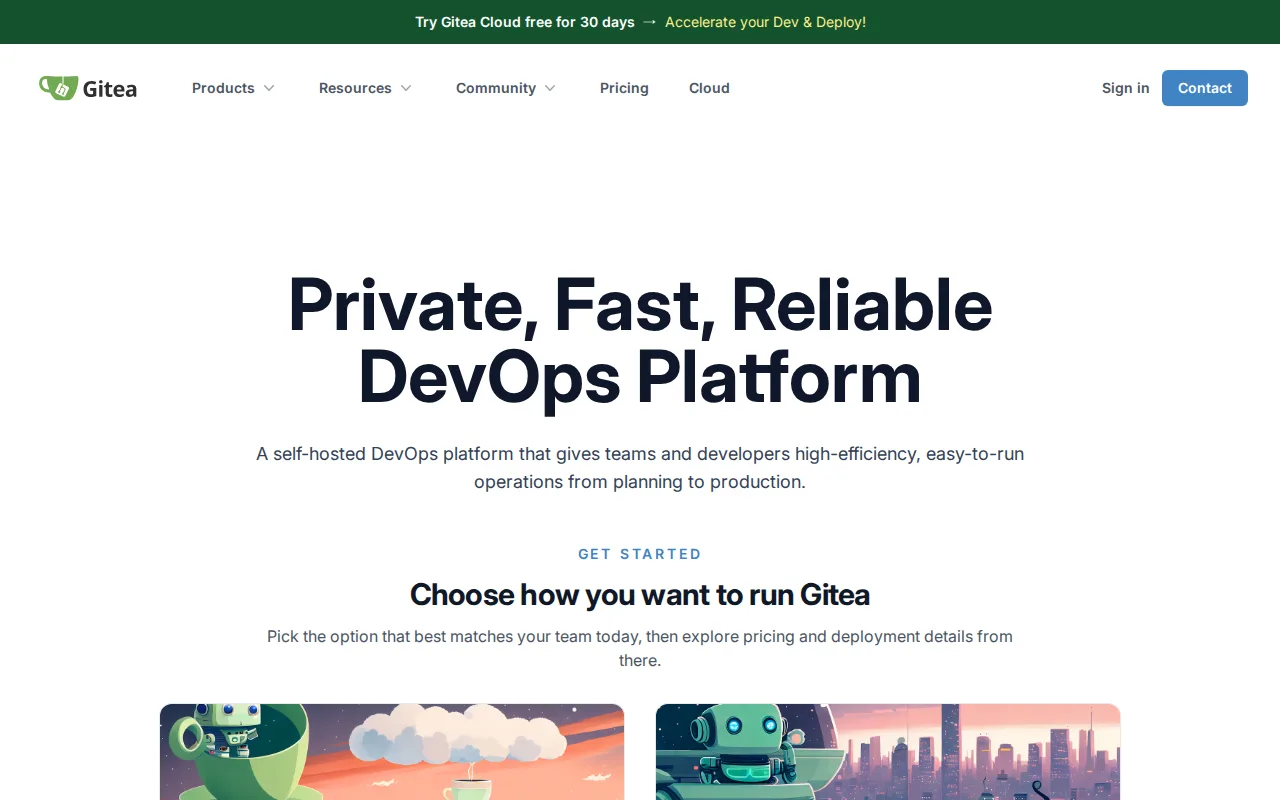
Gitea and GitHub both offer Git hosting, code review, CI/CD, and package management, but Gitea's open-source edition is MIT-licensed and free to self-host with unlimited users and repositories, no artificial seat cap the way most self-hosted alternatives to a SaaS platform impose. Gitea Actions is compatible with existing GitHub Actions workflow syntax, easing migration for teams already using GitHub's CI/CD configuration. Gitea holds a 5.0/5 rating from 9 Product Hunt reviews, a much smaller sample than GitHub's 6,198 Capterra reviews, so the evidence base is thin even at a strong score. Where GitHub still wins: it's a fully managed SaaS platform with no server to maintain, while Gitea's free self-hosted edition puts the burden of updates, backups, and uptime on the organization's own IT staff, and GitHub's third-party integration ecosystem and open-source project network effect are dramatically larger than Gitea's, which matters for teams that rely on broad tooling compatibility rather than a self-hosted, lightweight deployment.
Compared to GitHub: open-source edition is MIT-licensed and free to self-host with unlimited users and repositories, Gitea Actions is compatible with existing GitHub Actions workflow syntax, and self-hosting puts updates, backups, and uptime on your own IT staff rather than GitHub's managed SaaS.
Wins:Open-source core is free with unlimited users and repositories, no artificial caps unlike most self-hosted alternatives · Lightweight Go binary runs comfortably on small servers, unlike heavier self-hosted alternatives · Gitea Actions is compatible with existing GitHub Actions workflow syntax, easing migration
Loses:Self-hosted deployments require the team to manage updates, backups, and uptime themselves, unlike GitHub's managed SaaS · Far smaller third-party integration and marketplace ecosystem than GitHub · Gitea Enterprise requires a 1-year commitment paid online rather than GitHub's flexible monthly billing
Pros
- Open-source core is free with unlimited users and repositories, no artificial caps.
- Lightweight Go binary runs comfortably on small servers, unlike heavier self-hosted alternatives.
- Gitea Actions is compatible with existing GitHub Actions workflow syntax, easing migration.
- Supports 20+ package registry formats (npm, PyPI, Maven, Cargo, and more) built in.
Cons
- Gitea Enterprise requires a 1-year commitment with online payment rather than flexible monthly billing.
- Gitea Cloud pricing is not published on the site; the number is only revealed after starting the signup flow.
- Smaller third-party integration and marketplace ecosystem than GitHub or GitLab.
- Self-hosted deployments still require the team to manage updates, backups, and uptime themselves on the free tier.
Pricing: Free tier · paid from $9.50/mo — Gitea's open-source edition is free to self-host vs GitHub Team's $4/user/month (first-year promo) (verified undefined NaN, NaN)
3.Codeberg — best GitHub alternative for open-source maintainers and FOSS projects that want ad-free, non-commercial Git hosting without a corporate owner behind it

Codeberg and GitHub both host Git repositories for open-source projects, but Codeberg is run entirely by Codeberg e.V., a non-profit association with more than 1,700 members, funded by donations rather than a for-profit company — a fundamentally different ownership model than GitHub's Microsoft-owned platform. Codeberg has no ads and no third-party tracking of any kind, and it bundles Codeberg Pages, Woodpecker CI/CD, and Codeberg Translate (a hosted Weblate instance) at no cost with no paid tier at all, unlike GitHub's freemium structure. Codeberg carries no external star-rating data in this set to compare directly against GitHub's 6,198 Capterra reviews at 4.8/5, so buyers should treat that as an open question. Where GitHub still wins: it has by far the largest ecosystem of open-source projects, integrations, and third-party tooling of any Git host, and Codeberg has no enterprise plan, SLA, or paid support contract at any price, so organizations that need guaranteed uptime commitments have no paid tier to purchase the way GitHub's Enterprise plan provides.
Compared to GitHub: run entirely by a non-profit association (Codeberg e.V.) funded by donations rather than a for-profit company, no ads or third-party tracking of any kind, and no enterprise plan, SLA, or paid support contract available at any price.
Wins:Completely free with no paid tier, ads, or third-party tracking · Bundles CI/CD (Woodpecker), static site hosting (Pages), and localization (Weblate) alongside Git hosting · Run as a non-profit association rather than a venture-backed company, aligning incentives with FOSS projects
Loses:No enterprise plan, SLA, or paid support contract available at any price, unlike GitHub Enterprise · Far smaller ecosystem and fewer third-party integrations than GitHub · Terms of use restrict LLM-generated content and cryptocurrency projects, ruling out some use cases GitHub allows
Pros
- Completely free with no paid tier, ads, or third-party tracking.
- Bundles CI/CD (Woodpecker), static site hosting (Pages), and localization (Weblate) alongside Git hosting.
- Run as a non-profit association rather than a venture-backed company, aligning incentives with FOSS projects rather than growth targets.
- European hosting, relevant for projects with GDPR or data-residency preferences.
Cons
- No enterprise plan, SLA, or paid support contract available at any price.
- Smaller ecosystem and fewer third-party integrations than GitHub.
- Terms of use restrict LLM-generated content and cryptocurrency projects, which rules out some use cases GitHub and GitLab allow.
- As a donation-funded non-profit, infrastructure and support capacity scale with volunteer effort and donations rather than a predictable budget.
Pricing: Free — Codeberg is entirely free, funded by donations, with no paid tier at all vs GitHub Team's $4/user/month (verified undefined NaN, NaN)
4.Forgejo — best GitHub alternative for developers and organizations that want a GitHub-style forge on self-hosted infrastructure, governed by a community rather than a company
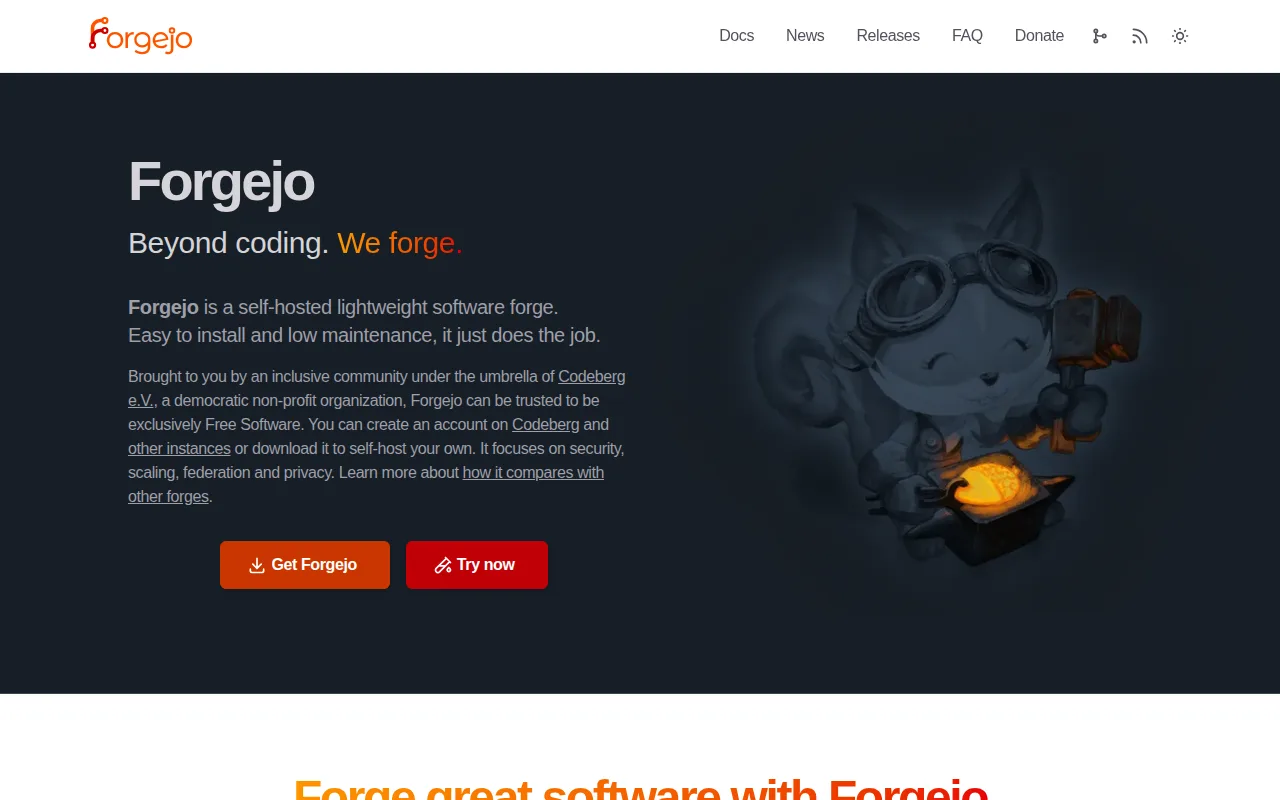
Forgejo and GitHub both provide Git hosting, issue tracking, pull requests, and CI/CD, but Forgejo is entirely free and open source with no paid tier, no hosted SaaS offering, and no corporate-controlled roadmap — it was forked from Gitea in 2022 specifically so the project could stay community-governed and never be relicensed away from free software, a governance model GitHub's Microsoft ownership doesn't offer. Forgejo Actions provides GitHub Actions-compatible CI/CD without a third-party runner, easing migration for teams already writing GitHub Actions workflows. Forgejo carries no external star-rating data in this set, so its placement rests on documented technical facts (resource efficiency, license) rather than review scores. Where GitHub still wins: it has an enormous ecosystem of open-source projects, integrations, and third-party tooling that Forgejo's smaller community can't match, and Forgejo has no official managed hosting from the project itself, so teams must self-host and maintain their own instance rather than using GitHub's fully managed SaaS.
Compared to GitHub: entirely free and open source with no paid tier or hosted SaaS offering, community governance prevents the project from ever being relicensed away from free software, and there's no official managed hosting, so every deployment must be self-hosted.
Wins:Fully free and open source with no paid tier, feature gating, or seat limits · Runs on far less CPU and memory than heavier self-hosted alternatives, practical for a small VPS · Community governance structure prevents the project from being acquired or relicensed away from free software
Loses:No official managed hosting from the Forgejo project; teams must self-host and maintain their own instance · Far smaller plugin and integration ecosystem than GitHub · No official GitHub mirror by design, which can make discovery harder for developers who default to searching GitHub
Pros
- Fully free and open source with no paid tier, feature gating, or seat limits.
- Runs on far less CPU and memory than GitLab, practical for a small VPS or home server.
- Forgejo Actions provides GitHub Actions-compatible CI/CD without a third-party runner.
- Community governance structure prevents the project from being acquired or relicensed away from free software.
Cons
- No official managed hosting from the Forgejo project; teams must self-host and maintain their own instance.
- No official GitHub mirror by design, which can make discovery harder for developers who default to searching GitHub.
- Smaller plugin and integration ecosystem than GitHub or GitLab.
- Migrating an existing GitHub or GitLab organization's issues, wikis, and CI configuration requires manual work.
Pricing: Free — Forgejo is free and open source to self-host vs GitHub Team's $4/user/month (first-year promo) (verified undefined NaN, NaN)